
For the broader learning path, visit our parent guide.
A practical way to compare reviews before spending anything
The bigger point is simple: clearer structure and clearer writing make the piece more useful. That is usually what makes the ending land better too.
The bigger point is simple: clearer structure and clearer writing make the piece more useful. That is usually what makes the ending land better too.
When your budget is tiny, a bad tool purchase is not a mild inconvenience. It is money you actually needed for something else.
That is why most “tool review” advice is weirdly unhelpful. A lot of reviews are written by people who got free access, make affiliate money if you buy, or treat a $79 monthly subscription like a casual coffee decision. Lovely for them. Less lovely for you.
How to Review Tool Reviews When You Have a Tiny Budget is really about one thing: learning how to judge the review before you judge the tool. Because if the review is shallow, biased, vague, or written for the wrong kind of buyer, it can push you into paying for features you do not need and problems you do not have.
Here’s how to read tool reviews with a little more skepticism, a little more structure, and a much better chance of keeping your money attached to your business.
Most tool reviews are answering the wrong question
The question you care about is usually not “Is this tool good?”
That question is too broad to be useful. Plenty of tools are good. They are just not good for you, right now, at your budget, for your workflow.
A better question is this: Is this tool good enough to solve my specific problem without creating three new ones?
That shift matters. It stops you from buying the most impressive option and helps you buy the most sensible one. Those are rarely the same thing.
If you want a broader framework for this, it helps to start with a solid base from the main tool reviews section and the more complete tool reviews guide for creators who care about quality. Then come back and get pickier.
Start by knowing what kind of buyer you actually are
Before reading a single review, get clear on your own situation. Otherwise every review sounds persuasive for five minutes.
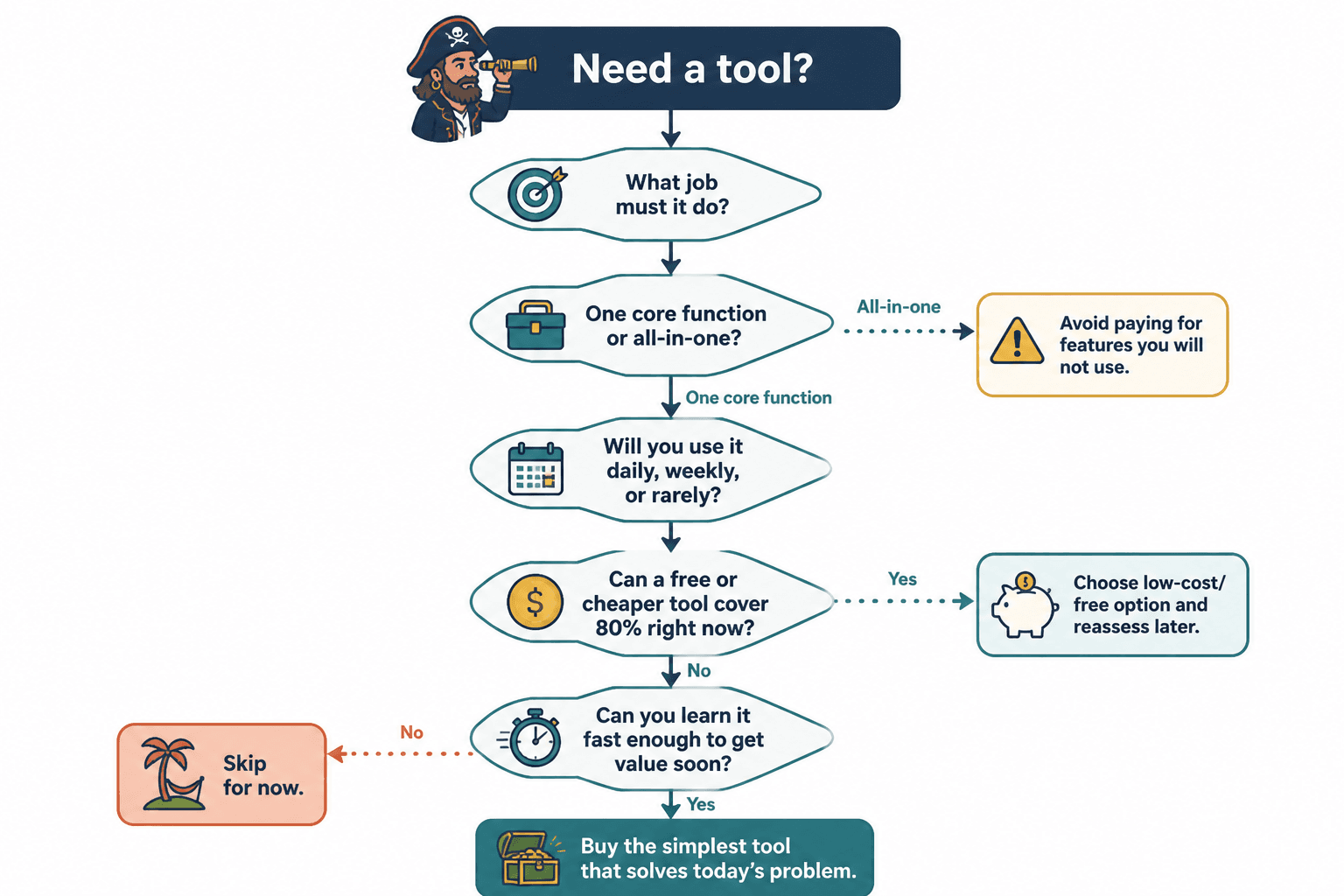
- Are you buying for speed, quality, organization, automation, or replacement of an annoying manual task?
- Do you need a tool you can learn fast, or are you willing to deal with setup pain for long-term payoff?
- Do you need one core function, or are you being seduced by an all-in-one Frankenplatform?
- Is this for daily use, weekly use, or “I think I might use it if I become a different person” use?
- Can a cheaper or free tool cover 80% of what you need right now?
That last question is boring, which is exactly why it is useful. Most overspending starts when people buy for the fantasy version of their business instead of the current one.
Check the review for budget blindness
Some reviews are not dishonest. They are just financially unserious.
If a reviewer casually compares five expensive tools and says things like “the price is reasonable” without explaining for whom, be careful. A founder running a funded team, an agency billing high-ticket clients, and a solo creator trying not to light their card on fire are not solving the same buying problem.
A useful review for tiny-budget buyers should mention things like:
- free plans and what they actually let you do
- trial limits that make testing realistic or unrealistic
- hidden costs like extra seats, usage caps, add-ons, or required integrations
- how long it takes to get value from the tool
- whether the premium version saves enough time or money to justify itself
If the review skips all of that and spends 900 words admiring the dashboard, it is not really reviewing the buying decision. It is touring the furniture.
Look for signs the reviewer actually used the tool properly
You do not need a reviewer to have used a tool for six years. You do need signs they went beyond the homepage and the pricing page.
Good signs:
- they explain what the setup was like
- they mention where the tool felt clunky or confusing
- they compare results before and after using it
- they point out who will hate it
- they note tradeoffs instead of pretending every feature is amazing
Bad signs:
- they mainly repeat the product page in different words
- every feature is described as “powerful” or “seamless”
- there are no specifics about workflow, friction, or limitations
- the review sounds polished but weirdly bloodless
- there is a giant buy button energy hanging over every paragraph
If you want help spotting this stuff faster, these pros and cons questions to ask before you buy make a very good filter.
Separate “best overall” from “best for a tight budget”
This is where people get burned.
A review may honestly conclude that Tool A is the best option overall. More features. Better support. More polished interface. Great. But if Tool B is half the price and solves your actual bottleneck, Tool B may be the smarter purchase by a mile.
When reading reviews, create two separate columns in your head:
- Performance value: How strong is the tool?
- Budget value: How much useful outcome do I get for the money?
Those are not the same. Never let a reviewer blend them into one vague “worth it.” Worth it for whom? Based on what? For what stage of business? That phrase does a lot of lazy lifting.
| Review claim | What to ask instead |
|---|---|
| “It is the best tool in its category.” | Best for power users, teams, or solo buyers on a budget? |
| “The pricing is fair.” | Fair compared to what cheaper option, and for what level of usage? |
| “It has everything you need.” | Do I need everything, or one or two functions done well? |
| “The free plan is limited.” | Limited enough to be useless, or limited in ways I can live with? |
| “It saves time.” | After setup and learning time, how much time for my use case? |
Pay attention to the use case, not just the rating
A five-star review from a 20-person agency may be completely irrelevant to a solo consultant. A three-star review from a frustrated enterprise admin may tell you nothing about how the tool works for a creator with one offer and a newsletter.
This is why rating averages are often less useful than one sharp paragraph from someone with your kind of workload.
Try to identify:
- team size
- business model
- tech confidence
- frequency of use
- main job they hired the tool to do
If the reviewer does not make that clear, the review gets weaker fast. Context is not a nice extra. It is the whole point.
Read negative reviews like a grown adult, not like a panicked squirrel
Negative reviews are useful. They are also easy to misread.
Some are warning you about real, recurring problems. Others are just someone furious that a platform did not magically understand their mess of a setup. You need to tell the difference.
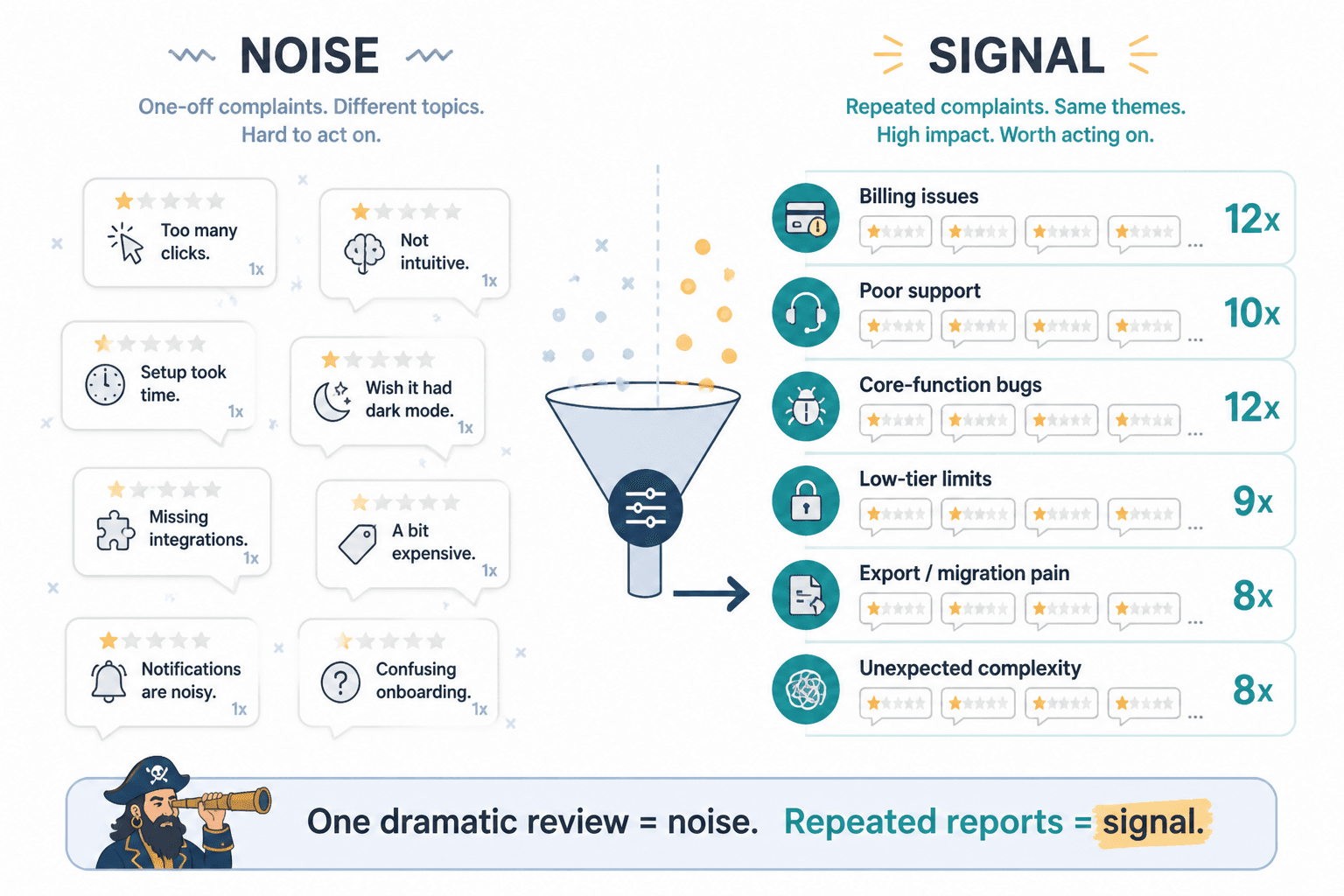
Look for patterns in negative reviews, especially around:
- billing issues
- poor support
- bugs that affect the core function
- unexpected complexity
- limits that make the tool unusable at lower tiers
- data loss, migration pain, or bad export options
One dramatic review is noise. Ten reviews mentioning the same problem is a signal.
On the flip side, do not reject a perfectly decent tool because one reviewer called it “not intuitive” after trying to set up six automations during a lunch break. Some friction is normal. The question is whether the friction matches the value.
Watch for affiliate gravity
Affiliate links do not automatically make a review useless. But they do create gravity. The review is now being pulled toward conversion.
That usually shows up in familiar ways:
- cons that are weirdly tiny compared to the supposed pros
- heavy emphasis on bonuses, discounts, or urgency
- rankings that always happen to favor the highest-commission-looking option
- vague praise with very little criticism
- reviews that compare many tools but somehow push one suspiciously hard
You do not need to become cynical about every recommendation. Just do not confuse “financial incentive exists” with “objective buyer guidance is guaranteed.” It is not.
If you want a cleaner buying process from the start, how to choose tool reviews without wasting money is a good companion read.
Use a tiny-budget review checklist before you buy
You do not need a giant spreadsheet for every tool decision. But you do need a repeatable filter, especially when reviews are trying very hard to be charming and persuasive.
Ask these questions in order
- What exact problem am I trying to solve?
Not “improve productivity.” Something concrete. - What is the cheapest workable solution?
Including free tools, manual workarounds, and simpler competitors. - Did the reviewer test the problem I actually have?
If not, the review is less useful. - What will this tool cost after the first month?
Including upgrades, limits, and add-ons. - How long until I get real value?
If setup is brutal, the low monthly price may still be expensive. - What happens if I stop paying?
Can you export your work, data, content, or contacts? - What do multiple reviewers agree on?
That is usually where the truth starts showing up. - Am I buying relief, or am I buying a fantasy?
This one stings, which is why it is useful.
That final question deserves a second to breathe. A lot of tiny-budget buyers are not just purchasing software. They are purchasing the hope that this tool will make them more consistent, more organized, more visible, more productive, or more “real” as a business. Sometimes it helps. Sometimes it just gives your chaos a prettier dashboard.
Tools can remove friction. They cannot replace discipline, positioning, clarity, or a good offer. If a review quietly implies otherwise, step back.
Prefer reviews that talk about tradeoffs, not perfection
The best tool reviews are not love letters. They are decision aids.
So when a review says things like “best for simple use cases,” “excellent if you only need X,” “not ideal for advanced reporting,” or “great value but weaker support,” that is usually a good sign. It means the reviewer understands that tools live in tradeoffs.
Perfection language is often a red flag:
- “flawless”
- “everything you need”
- “perfect for any business”
- “must-have”
- “no downsides”
No tool is perfect for any business. That sentence alone should be enough to send you back to reality.
Simple reviews are often more useful than giant roundups
Massive “27 best tools” articles look comprehensive, but they often flatten important differences. Every tool gets the same neat little format. A few features. A few pros. A few cons. A polite rating. Very tidy. Not always very helpful.
If your budget is tight, you usually need depth on a few contenders, not a buffet of mildly described options. This is exactly why simple tool reviews often beat giant roundups.
A narrower review can tell you what a broad roundup usually cannot:
- where the tool disappoints in real use
- which buyer it fits best
- what you can probably skip
- how the lower pricing tier actually feels
- what kind of person will regret buying it
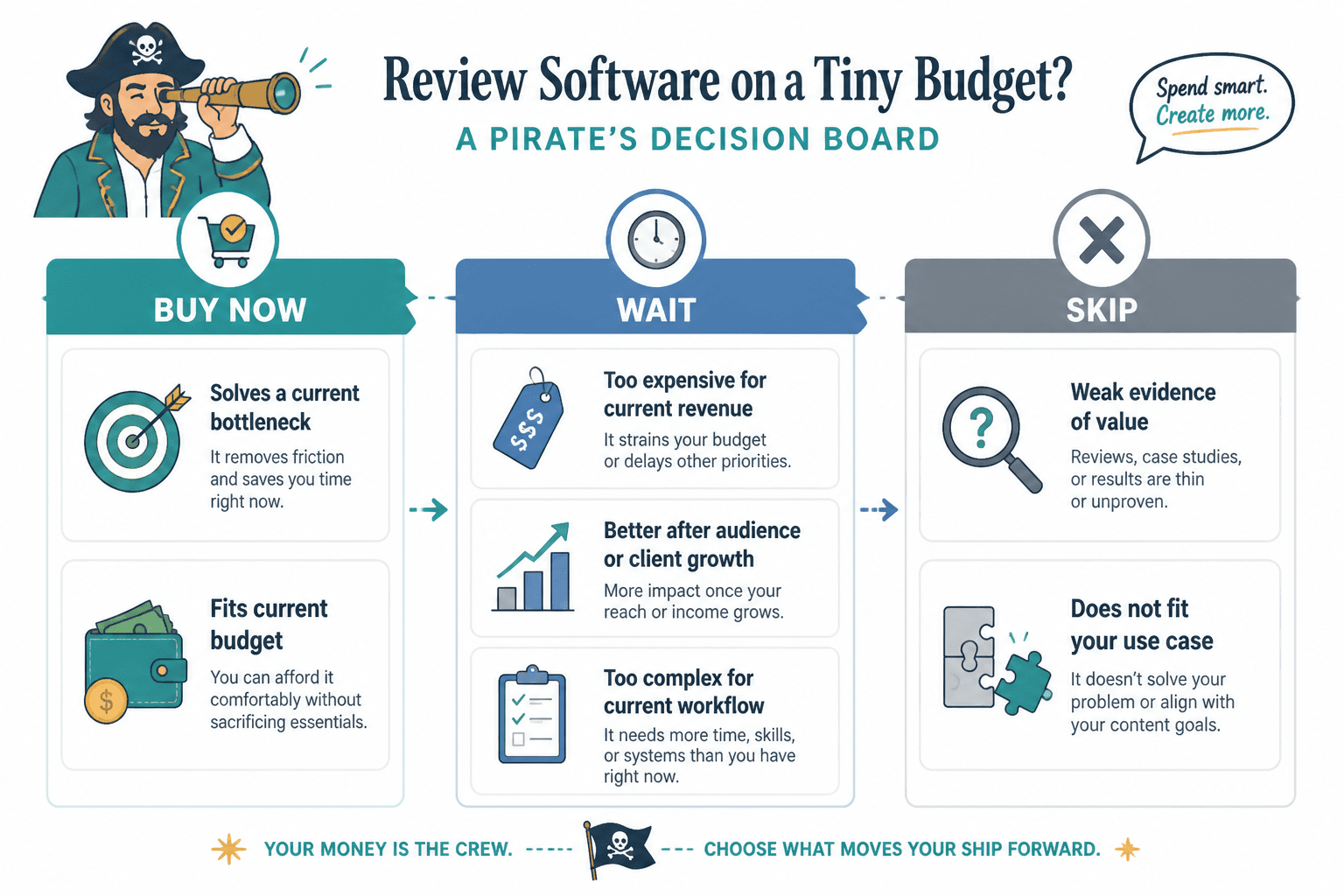
Build a “not now” list
This is one of the smartest things tiny-budget buyers can do.
Not every good tool deserves a no. Some deserve a not now. That distinction saves money without forcing you to pretend the tool is bad.
Your not-now list might include tools that are:
- clearly powerful but too expensive for current revenue
- worthwhile only after your audience or client load grows
- too complex for your present workflow
- better once another system is already in place
- promising, but not enough of a bottleneck-solver yet
This keeps you from making emotionally tidy but financially sloppy decisions. You are not rejecting the tool forever. You are refusing to buy it prematurely, which is often the more mature move.
A practical way to compare reviews before spending anything
The bigger point is simple: clearer structure and clearer writing make the piece more useful. That is usually what makes the ending land better too.
The bigger point is simple: clearer structure and clearer writing make the piece more useful. That is usually what makes the ending land better too.