Most affiliate articles fail for one simple reason: they read like a commission link wearing a fake mustache.
The creator says they are “sharing helpful resources.” The reader sees a stitched-together list of tools, vague praise, and zero reason to trust the recommendation. That is not affiliate content. That is brochure copy with tracking links.
If you want affiliate articles to work, you need better angles, better structure, and better taste. The good news is you do not need a huge audience or a giant SEO machine to make them useful. You just need to write articles that help people make a decision, avoid a mistake, or get a result faster.
This guide breaks down the best affiliate article ideas and examples for creators, plus how to shape them so they earn trust instead of polite indifference. If you write newsletters, blog posts, LinkedIn articles, resource pages, or educational content around tools and products you actually use, this is where affiliate content starts getting less awkward and more effective.
What makes an affiliate article actually worth reading
Before the ideas, the standard matters.
A good affiliate article does not just mention a product. It helps the reader answer a real question:
- Is this worth buying?
- Who is this for?
- What problem does it solve well?
- What does it do badly?
- How does it compare to alternatives?
- What should I use in my situation?
That is why the strongest affiliate content usually sits inside broader helpful content. The product is not the entire point. It is part of the solution.
In other words, stop writing “10 amazing tools I love” articles unless you have something sharper to say than “this one is great for creators.” That phrase has done enough damage.
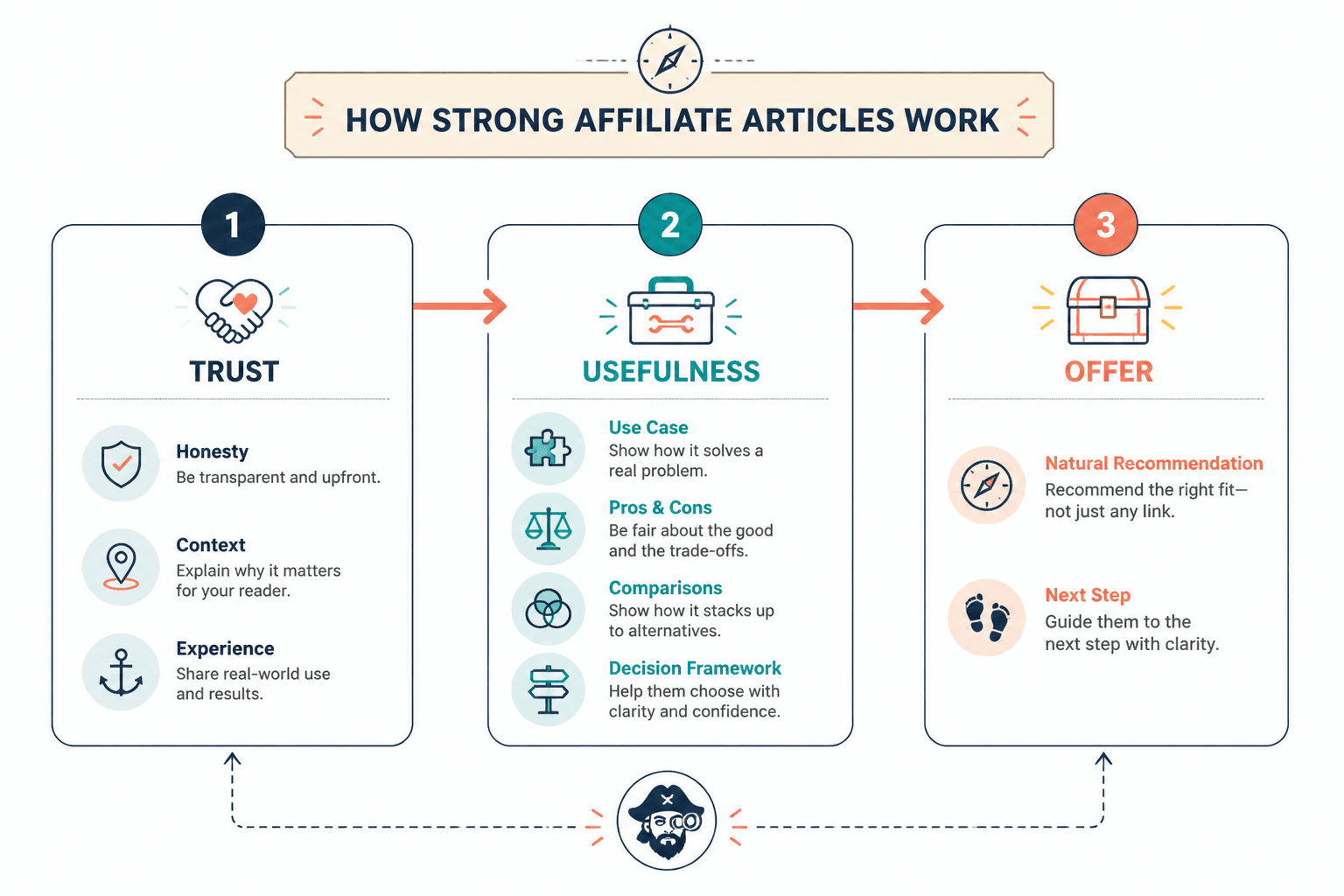
The best affiliate articles usually include some mix of:
- A clear use case
- Specific pros and cons
- Context about who the recommendation is for
- Personal or observed experience
- Comparisons or alternatives
- A decision-making framework
- A natural next step
If you want a broader foundation for this kind of monetization content, the main affiliate articles guide is worth reading alongside this one.
Best affiliate article ideas for creators
These are the article formats that tend to work because they match real reader intent. People are not usually searching for “affiliate content.” They are searching for answers, comparisons, workflows, and recommendations they can trust.
1. Best tools for a specific creator workflow
This is one of the strongest affiliate formats because it stays anchored to a real task.
Examples:
- Best email tools for solo creators selling digital products
- Best writing tools for creators publishing weekly articles
- Best link-in-bio tools for coaches with multiple offers
- Best video editing tools for short-form content creators
Why it works: the reader already has a goal. They are not casually browsing your opinions. They are trying to fix a bottleneck.
Make it stronger by organizing recommendations by use case, budget, skill level, or business model instead of dumping them into one flat list.
2. Product review with a clear angle
Not just “my review.” That is too broad and usually too lazy. Pick an angle.
Examples:
- ConvertKit review for creators who sell simple offers
- Notion review for content planning without a giant team
- Beehiiv review for newsletter-first creators
- Canva review for non-designers making sales content
A strong review article makes a claim and supports it. It does not just tour the features like a mildly impressed intern.
If you want help developing sharper review framing, read these review angles and examples creators can adapt fast.
3. Comparison articles
Comparison content works because the buyer is already closer to making a decision.
Examples:
- Kit vs Mailchimp for solo creators
- Teachable vs Podia for simple course businesses
- Notion vs Trello for content planning
- Stan Store vs a full website for beginner creators
The trap here is fake neutrality. You do not need to pretend both tools are equal if they clearly serve different people. Be fair, but make a call.
A good comparison article should answer:
- Who each option is best for
- Where each one shines
- Where each one gets annoying
- What changes as your business grows
- Which one you would pick in different scenarios
4. “What I use” stack articles
This format can work beautifully if you have credibility with a specific audience and your setup reflects real choices. It falls apart when it becomes an excuse to link 27 random tools.
Examples:
- My weekly content stack as a solo writer
- The 7 tools I use to run a one-person coaching business
- What I use to publish articles, manage leads, and book calls
The key is to explain why each tool made the cut, what you tried before, and what tradeoffs you accepted. Readers do not need your inventory. They need your judgment.
5. Problem-solution affiliate articles
This format starts with the pain point, not the product.
Examples:
- Best tools for creators who hate writing landing pages
- How to organize content ideas without drowning in tabs
- Best tools for sending freebies and lead magnets automatically
- What to use when your booking process is a mess
This is often a better move than a plain “best tools” roundup because it catches people at the exact moment they are trying to solve something annoying.
6. Beginner picks and “start here” articles
Creators shopping for tools are often overwhelmed, not under-informed. They do not need 43 options. They need a sane starting point.
Examples:
- Best first email platform for creators
- Best beginner website tools for consultants
- Simple tech stack for creators selling one offer
These articles do well when you cut complexity, explain tradeoffs, and recommend fewer things more confidently.
7. Advanced upgrade articles
Not every affiliate reader is a beginner. Some are outgrowing a basic setup and need stronger recommendations.
Examples:
- Best email tools when your creator business outgrows free plans
- When to move from basic link tools to a proper site
- Best content systems for creators publishing across multiple platforms
This kind of article works especially well if your audience is coaches, consultants, and personal brands with growing businesses. For that niche specifically, see affiliate article examples for coaches, consultants, and personal brands.
8. Alternatives articles
People search for alternatives when they are frustrated, price-sensitive, or suspicious that the default recommendation is overhyped. Sometimes they are right.
Examples:
- Best alternatives to Linktree for creators who want more control
- Email platform alternatives for creators tired of bloated pricing
- Notion alternatives for people who want less setup and more doing
These articles can convert well because the reader has intent and emotional momentum. Just make sure the alternatives are genuinely useful, not random filler to hit a number in the headline.
9. Resource page or tools page with editorial structure
A tools page can be an affiliate asset, but only if it acts like a curated guide. A dead list of logos and links is not a resource. It is clutter with branding.
Break it into categories, explain who each tool is for, and keep the page updated. Resource pages work best when paired with more specific support articles that answer the reader’s actual questions.
10. Use-case articles tied to content channels
If your audience is trying to create content more efficiently, affiliate articles around publishing channels can be strong.
Examples:
- Best tools for repurposing LinkedIn posts into articles
- Best newsletter tools for creators growing from social media
- Best scheduling tools for creators posting on X and LinkedIn
This works because the recommendation is tied to a familiar workflow. It feels less like “buy this tool” and more like “here is the setup that makes this easier.”
Examples of affiliate article angles that do not feel gross
The angle matters as much as the topic. A bland topic can work with a sharp angle. A strong topic dies fast under vague, needy writing.
Here are a few angle shifts that make affiliate articles more credible.
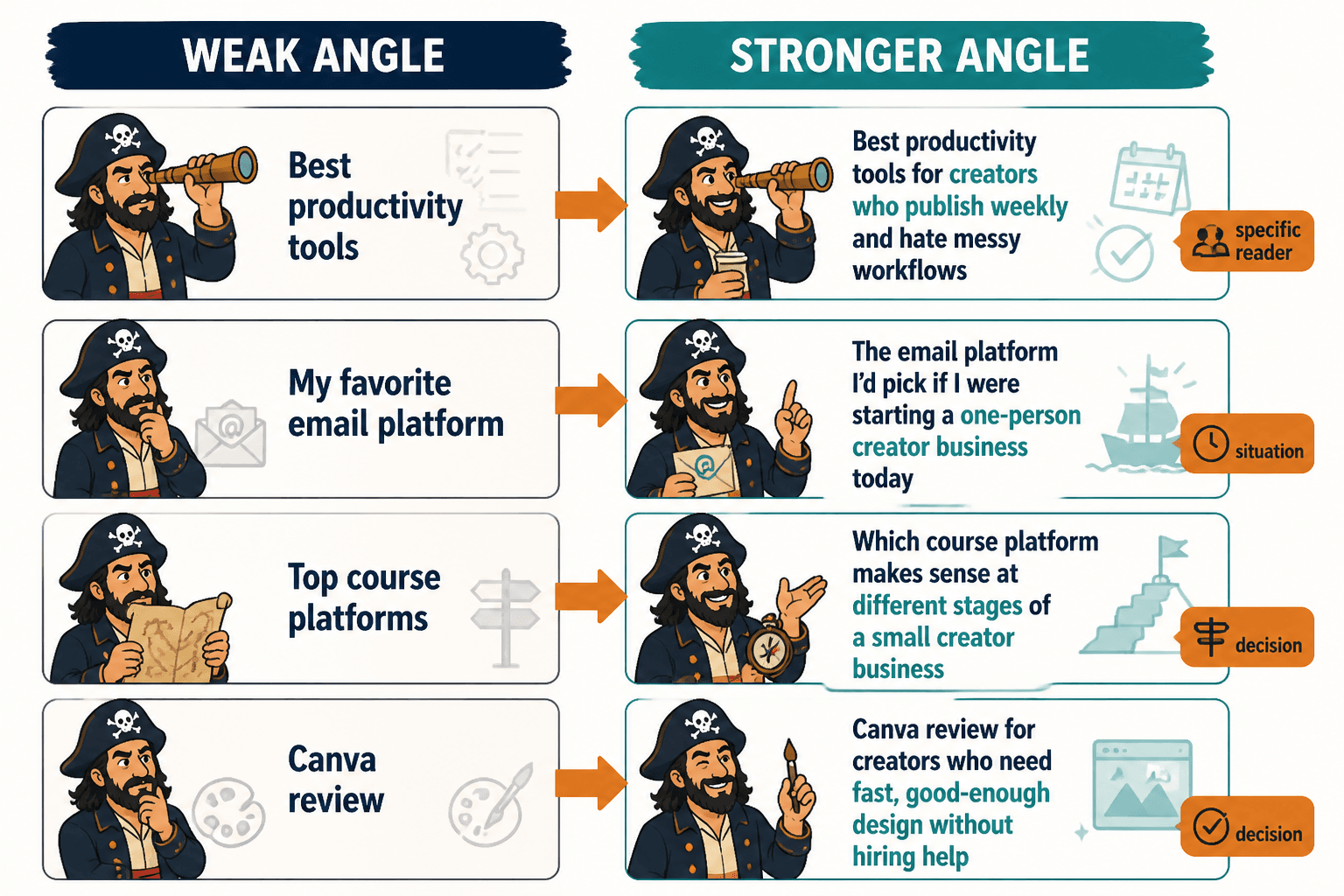
| Weak angle | Better angle |
|---|---|
| Best tools for creators | Best tools for creators who publish weekly and hate messy workflows |
| My favorite email platform | The email platform I’d pick if I were starting a one-person creator business today |
| Top course platforms | Which course platform makes sense at different stages of a small creator business |
| Canva review | Canva review for creators who need fast, good-enough design without hiring help |
| Best website builders | Best website builders for consultants who need clarity, not fancy design theater |
See the difference? The second version has a reader, a situation, and a decision in view. That gives the article shape. It also makes your recommendations easier to trust because they are tied to context, not generic praise sprayed over the internet like room freshener.
How to structure affiliate articles so people keep reading
Even strong article ideas can flop if the structure is lazy. Readers need to know quickly what the article will help them decide.
Here is a simple structure that works for most affiliate articles.
1. Start with the actual decision
Open by naming the problem behind the article.
Example:
Most creators do not need more tools. They need a smaller stack that does the boring important stuff well: capture leads, publish consistently, and not break every time they add a new offer.
That is more useful than opening with “There are many tools on the market today.” Yes. Tragically, we know.
2. Explain who the article is for
This helps the right reader self-identify and stops the article from becoming a vague “for everyone” piece.
Example:
This list is for creators, coaches, consultants, and solo business owners who need tools that are simple to run, reasonably flexible, and not built for a ten-person marketing department.
3. Show your criteria
If you are recommending tools or products, tell readers how you judged them.
- Ease of use
- Price relative to value
- Fit for solo operators
- Flexibility
- Limitations
- Support or reliability
This does two things. It makes the article more useful, and it prevents your recommendations from sounding like random affiliate drift.
4. Give each recommendation a job
Do not just describe the product. Explain its role.
Instead of:
Tool X is a powerful platform with many features for creators.
Write:
Tool X makes the most sense if you want one place to collect leads, send emails, and sell a simple product without duct-taping five separate tools together.
That is clearer, more persuasive, and much less likely to trigger the reader’s internal nonsense alarm.
5. Include downsides
If every option is “amazing,” nobody believes you. And they should not.
Useful affiliate content includes friction points like:
- Pricing gets steep later
- The setup is annoying at first
- It is too advanced for beginners
- The design flexibility is limited
- The reporting is basic
Counterintuitively, this often improves conversions because readers trust that your recommendation came from actual judgment.
6. End with a simple recommendation path
Do not make readers re-process the whole article. Give them a decision shortcut.
Example:
- Choose Tool A if you want the simplest beginner setup
- Choose Tool B if email is your main channel
- Choose Tool C if you need stronger automation later
This kind of closing guidance often matters more than another 600 words of feature description.
Affiliate article examples creators can adapt
Here are a few article concepts with stronger framing and what makes them work.
Example 1: Best email platforms for creators selling one core offer
Why it works: It is narrow, practical, and tied to a real business model. Not every creator needs advanced funnels, multiple products, and complex tagging on day one.
What to include:
- Best option for simplicity
- Best option for growth
- Best option for budget-conscious creators
- Tradeoffs for each
- Your pick by scenario
Example 2: The tools I’d use to run a one-person content business
Why it works: Stack articles feel personal and practical when they stay grounded in real workflows.
What to include:
- Writing
- Scheduling
- Payments
- Booking
- Lead capture
- One optional upgrade
Give a reason for each pick. If the article is just “here are my tools,” it is forgettable. If it becomes “here is why this stack keeps the business lean and usable,” now we have something.
Example 3: Best alternatives to bloated creator software
Why it works: Frustration is strong search intent. So is price fatigue.
What to include:
- Who should switch
- Who should stay put
- Feature differences that actually matter
- Migration annoyances
- Best low-friction alternative
Example 4: Best landing page tools for creators who are not designers
Why it works: It names the insecurity and removes some of the decision stress.
What to include:
- Fastest setup option
- Best templates
- Best option if you want more control later
- Examples of where each tool feels limiting
Example 5: The best affiliate tools for creators with small audiences
Why it works: Small creators need realistic advice, not creator-economy cosplay.
This angle can pair nicely with affiliate articles for creators with small audiences, especially if your readers are trying to monetize before they have giant traffic numbers.
What creators keep getting wrong with affiliate articles
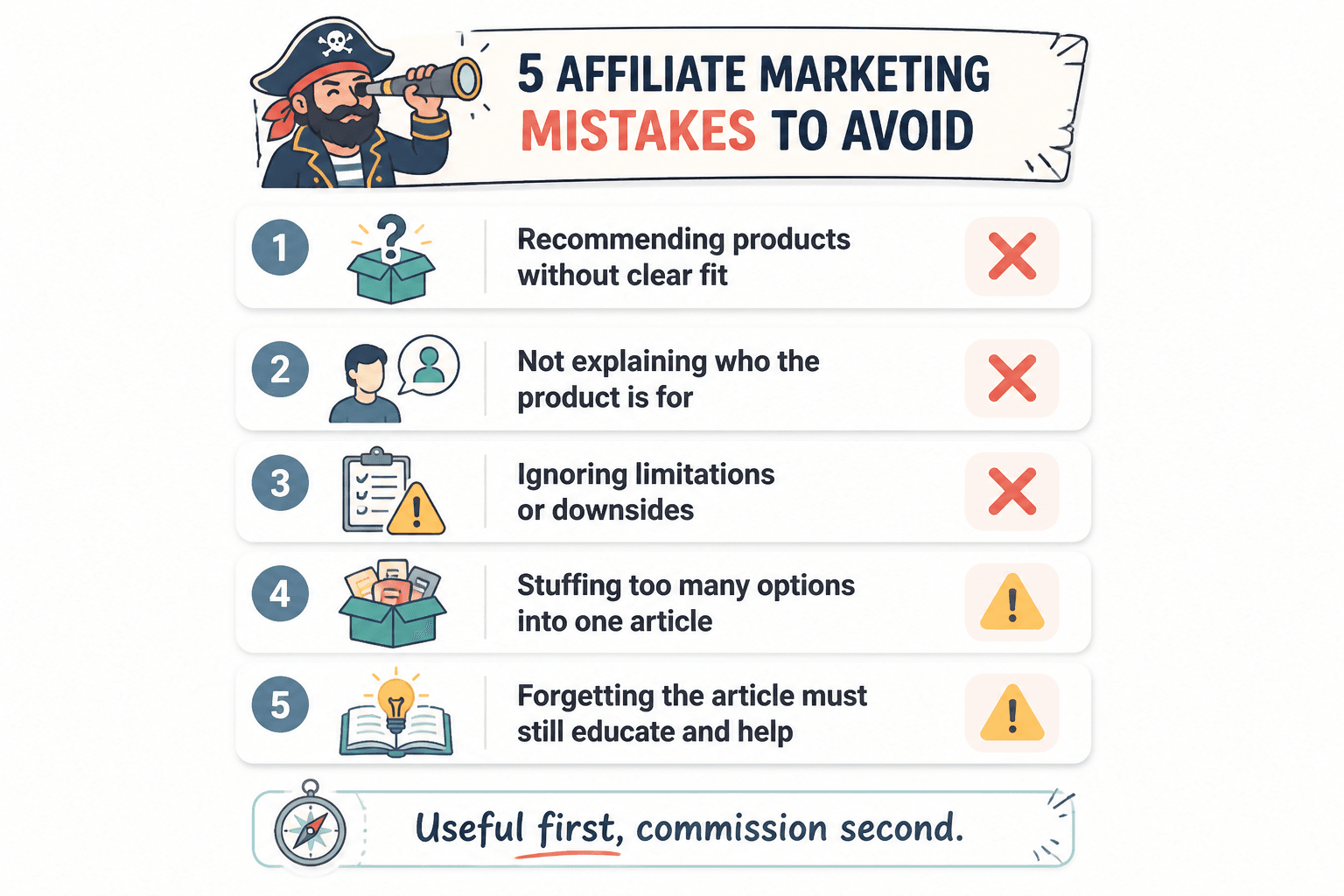
There are a few mistakes that quietly kill trust and conversions.
Writing generic listicles with no real opinion
If the article could be published by anyone with Wi-Fi and a pulse, it is too generic. You do not need hot takes for the sake of it, but you do need judgment.
Hiding the affiliate intent in weirdly cheerful language
You do not need to overexplain your affiliate relationship in every paragraph, but acting cagey makes the whole article feel slippery. Be clear, be normal, move on.
Recommending tools you do not understand
This one catches up with people fast. If you cannot explain who a product is for, what problem it solves well, and what its limitations are, you are not ready to recommend it.
Stuffing too many options into one article
More options do not always create more value. Often they create more confusion. Readers usually want a short list and a recommendation path, not a museum tour.
Forgetting the article still needs to be good content
This sounds obvious, but apparently it needs saying. Affiliate content still has to educate, guide, compare, simplify, or help. The commission is the byproduct of usefulness, not the replacement for it.
How to choose the right affiliate article idea for your audience
Do not start with the product. Start with the audience problem, buying stage, and content channel.
Ask:
- What are they trying to do right now?
- Are they beginners, switchers, or upgraders?
- What kind of decision are they struggling with?
- Do they need a tutorial, comparison, review, stack, or shortlist?
- What would make them trust this recommendation from me?
If your readers already know you for practical advice, stack articles and workflow recommendations can work well. If your traffic is more search-driven, comparisons and alternatives often match stronger intent. If you are building authority, review articles with a clear angle tend to do better than generic roundups.
And if you are building out a fuller content ecosystem, it helps to think in clusters instead of one-offs. A review can link to a comparison. A comparison can link to a broader guide. A broader guide can link to a tools page. That structure makes your affiliate content more useful and gives readers multiple points of entry.
For a broader path through that ecosystem, you can also point readers toward the main monetization and affiliate article hub and the more detailed guide for creators who want better results.
A simple affiliate article template creators can use
If you want a repeatable format, use this:
- Name the decision or problem
- Say who the article is for
- Explain how you judged the options
- Present 3 to 7 recommendations max
- For each one, cover best for, strengths, downsides, and fit
- Include comparisons where useful
- End with a “pick this if…” summary
- Add a clear but low-pressure next step
That next step might be reading a related guide, saving a comparison for later, or checking a next-step resource that fits their stage better.
The strongest affiliate article ideas do not just create clicks. They create clearer decisions, and that is usually what makes the monetization feel earned instead of forced.