
Most creators with small audiences mess up affiliate content in one of two ways.
They either act like they need huge traffic before affiliate articles can work, or they publish limp “top tools I use” posts that nobody asked for and nobody trusts. Both approaches are bad. One is defeatist. The other is lazy wearing a recommendations badge.
Affiliate Articles for Creators With Small Audiences can work surprisingly well, but only if you stop thinking like a media company chasing volume and start thinking like a useful guide for a specific kind of reader. Small audiences do not need more noise. They need tighter intent, better positioning, and more trust per pageview.
That is the good news here. You do not need 100,000 monthly visitors to make affiliate articles worth publishing. You need the right readers, the right article angles, and recommendations that actually help someone make a decision instead of wandering around your blog like a badly dressed popup.
This article will show you how to write affiliate articles that fit a smaller creator brand, earn trust, and have a real shot at generating clicks, leads, and sales without turning your content into a sad little coupon rack.
To see how this fits into the wider strategy, open the parent guide.
Why small creators can actually do affiliate articles well
Big publishers often win on scale. They publish endless comparison posts, chase search terms, update pages constantly, and have domain authority doing half the work for them.
You probably do not have that. Fine. You have something else that can matter more in affiliate content: relevance, specificity, and a real voice.
A small creator can write from closer experience. You know what your audience is trying to do, where they get stuck, what they waste money on, and what kind of tool or product actually fits their stage. That gives you an edge, especially when the buyer does not want a giant “50 best” list written by someone who clearly tested nothing except their ability to paraphrase pricing pages.
Small audiences also tend to be warmer. If someone already reads your posts, follows your newsletter, or trusts your advice, they do not need a Broadway production to click an affiliate link. They need a clear reason, believable context, and confidence that you are not recommending junk for a commission.
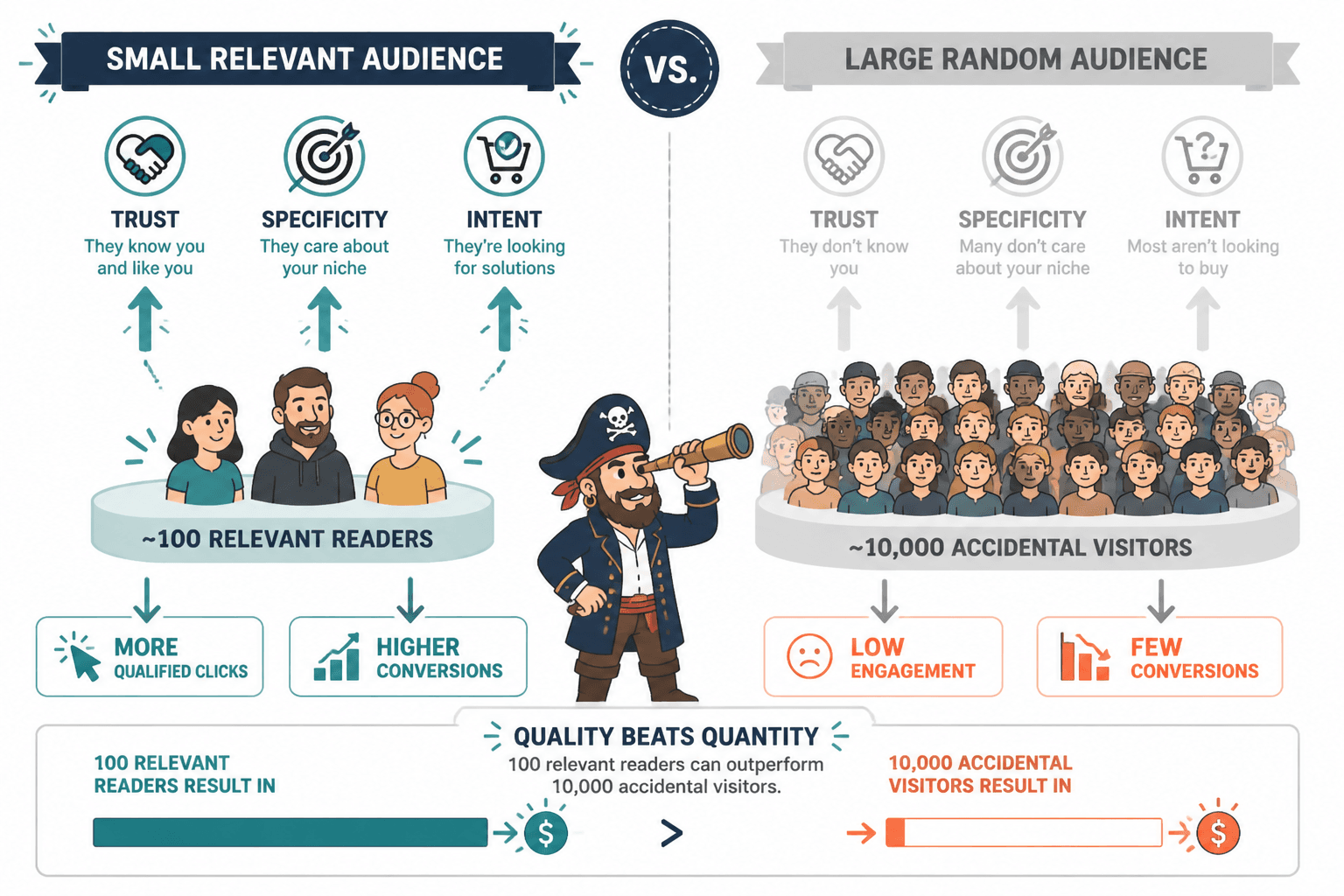
That is why a small audience of the right people often beats a broad audience of random passersby. One hundred relevant readers with a real need can outperform ten thousand bored ones who landed there by accident and left three seconds later.
What makes affiliate articles fail for small audiences
Before getting into what works, it helps to kill off the usual mistakes.
- Writing for volume instead of fit. If your audience is small, broad generic topics are usually a waste. “Best email marketing tools” is crowded. “Best email tools for coaches selling one flagship offer” is much stronger.
- Recommending too many things. Small creators often think more options looks more helpful. Usually it just makes you sound uncertain and dilutes clicks.
- No actual opinion. If every tool is “great for different needs,” congratulations, you have written nothing.
- Publishing buyer content before building context. If your whole site is random and then suddenly there is a “best software” article, people can smell the commission from space.
- No proof, no use case, no trust signal. Readers want to know why this recommendation makes sense coming from you.
- Trying to sound neutral when you should sound useful. You are not Consumer Reports. You are a creator helping a certain type of person make a better decision.
If your affiliate articles are getting polite silence, it is usually not because affiliate content is dead. It is because the article does not match a real buying situation closely enough.
Pick affiliate article topics with buyer intent, not just affiliate potential
This is where most small creators need to get more disciplined.
A good affiliate article topic lives at the overlap of three things:
- What your audience is already trying to solve
- What product or tool genuinely helps with that problem
- What kind of article format helps them make a decision
That overlap matters more than search volume alone. If you are writing for a smaller audience, intent is the whole game.
Strong affiliate article formats for small creators
- Best for specific use case
Example: “Best Scheduling Tools for Consultants Who Sell by DM” - X vs Y
Example: “ConvertKit vs Beehiiv for Small Personal Brands” - What I use and why
Works best when you already have credibility and can explain tradeoffs honestly - Tool stack breakdown
Example: “My Simple Content Workflow Stack for Writing, Scheduling, and Lead Capture” - Alternatives articles
Example: “Best Kajabi Alternatives for Coaches Who Want Simpler Funnels” - Problem-first recommendation posts
Example: “If Your Booking Funnel Is Leaking Leads, Start With These 3 Fixes and Tools”
If you want more structure on article selection, this guide on affiliate articles for creators who want better results pairs well with what you are reading now.
And if you want formats that naturally fit buying intent, these buyer-intent sections and templates will save you from inventing your structure from scratch every time.
How to choose products to recommend without looking like a commission goblin
You do not need to recommend everything with an affiliate program. In fact, please do not.
For small creators, fewer and better recommendations usually convert more cleanly. Why? Because your credibility is part of the sales mechanism. If readers trust your judgment, they are more likely to click. If your content feels stuffed with monetization furniture, that trust disappears fast.
Choose products using these filters:
- Audience fit: Does this product solve a problem your audience already has?
- Stage fit: Is it right for beginners, intermediate users, or advanced operators? Be honest about that.
- Offer fit: Does it match the kind of business model your readers are running?
- Proof fit: Can you explain why you recommend it based on use, results, comparisons, or clear reasoning?
- Trust fit: Would you still mention it if there were no commission attached?
That last question is annoyingly useful. If the answer is no, leave it out.
A simple way to narrow your recommendations
Instead of listing 10 tools in a category, try this:
- Pick 1 best overall option for your audience
- Pick 1 better budget option if needed
- Pick 1 better advanced option if the category really needs it
That structure is easier to write, easier to trust, and easier to act on. Too many affiliate articles collapse because they replace guidance with endless options. Readers did not come for a menu. They came for help deciding.
Structure affiliate articles so small audiences actually read and click
A solid affiliate article does not just name products. It helps a reader move from confusion to decision.
That means your structure matters a lot. Especially when you do not have massive traffic, you cannot afford articles that meander for 900 words before saying anything useful.
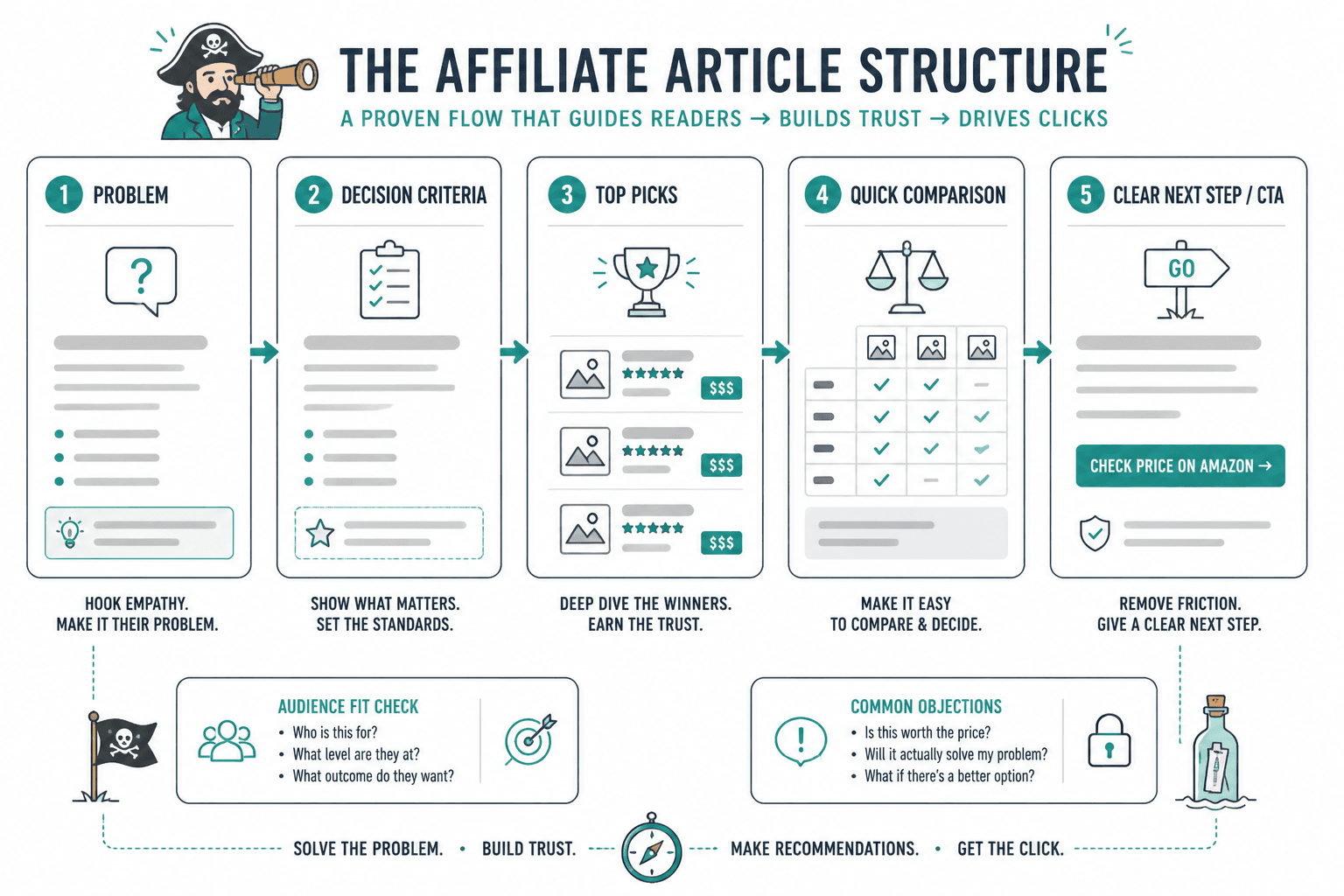
A practical article structure that works
- Open with the problem clearly.
Example: “Most creators do not need an all-in-one platform. They need one tool that does the one thing their current setup keeps failing at.” - Explain who the article is for.
This improves relevance fast. Name the audience and stage. - Set the decision criteria.
What should matter here: price, ease of use, automation, integrations, speed, design, support? - Give your top picks with honest reasoning.
Not feature vomit. Explain who each option is best for and where it falls short. - Add a quick comparison section if helpful.
- Handle common objections.
Cost, complexity, migration pain, setup time, or “do I even need this yet?” - End with a clear next step.
Tell the reader what to choose based on their situation.
This is also where internal linking helps. If someone is not ready to buy but is clearly interested, move them deeper into your ecosystem. Link to broader category pages like affiliate articles or a related monetization cluster such as monetization funnels and money content resources.
Write like a trusted recommender, not a comparison site clone
The voice of affiliate content matters more than people think.
If your article sounds like a stitched-together summary of product landing pages, readers will treat it like wallpaper. Nice enough. Forgettable. Slightly suspicious.
What works better is a useful, opinionated, transparent tone. You do not need to be dramatic. You do need to sound like a person with judgment.
Weak vs stronger affiliate writing
| Weak | Stronger |
|---|---|
| “Tool X offers a robust suite of features for creators.” | “Tool X is a good fit if you want fewer moving parts and do not need fancy automation yet.” |
| “Tool Y is great for businesses of all sizes.” | “Tool Y makes more sense once your list is growing and you actually plan to segment, test, and automate.” |
| “Both platforms have pros and cons.” | “If simplicity matters most, choose A. If customization matters more and you can tolerate setup friction, choose B.” |
See the difference? The stronger version helps someone decide. The weaker version just fills space with polished nothing.
Readers do not need you to pretend every option is wonderful. They need you to reduce friction. That includes saying things like “this is overkill for most solo creators” or “this tool is solid, but the learning curve is annoying if you just need basic scheduling.” That kind of specificity builds trust.
Use small-audience advantages inside the article
Here is where smaller creators can quietly outperform larger ones: context.
You may not have massive test labs or giant traffic numbers, but you can make your article feel much more relevant to a certain reader. That often matters more than scale when someone is deciding what to buy.
Ways to make the article feel more credible and useful
- Name the audience clearly. “For coaches selling a small group program” is better than “for entrepreneurs.”
- Name the use case. “Best tools for sending a weekly newsletter” is better than “best email software.”
- Include tradeoffs. If a tool is strong but annoying, say that.
- Use scenario-based guidance. “Choose this if you care more about easy setup than deep reporting.”
- Keep the stack realistic. Small creators do not need enterprise complexity just because some YouTuber with a team of eleven uses it.
This does two things. It improves conversion because the recommendation feels tailored, and it protects trust because your article sounds grounded rather than performative.
Make the click feel natural, not shoved in from the side
A lot of affiliate articles sabotage themselves with awkward calls to action. The recommendation is fine, then suddenly the copy turns into “Click here now to transform your business,” and the whole thing develops late-stage webinar energy.
Keep your CTA simple and matched to the article.
Better affiliate CTA styles
- “If you want the simplest option for a small creator setup, check out Tool X.”
- “If your main goal is better automation without rebuilding everything, Tool Y is the better fit.”
- “If you are comparing based on price first, start with Tool Z.”
- “If you want the one I would recommend to most solo consultants, it is this.”
That tone works because it continues the guidance instead of interrupting it.
Also, think beyond the click. Some affiliate articles should send readers to a related resource first, especially if the product decision is more complex. That is where a smart content path helps. If you are building a fuller system, this guide on turning affiliate articles into more leads or sales is worth reading next.
Affiliate article ideas that fit small audiences better
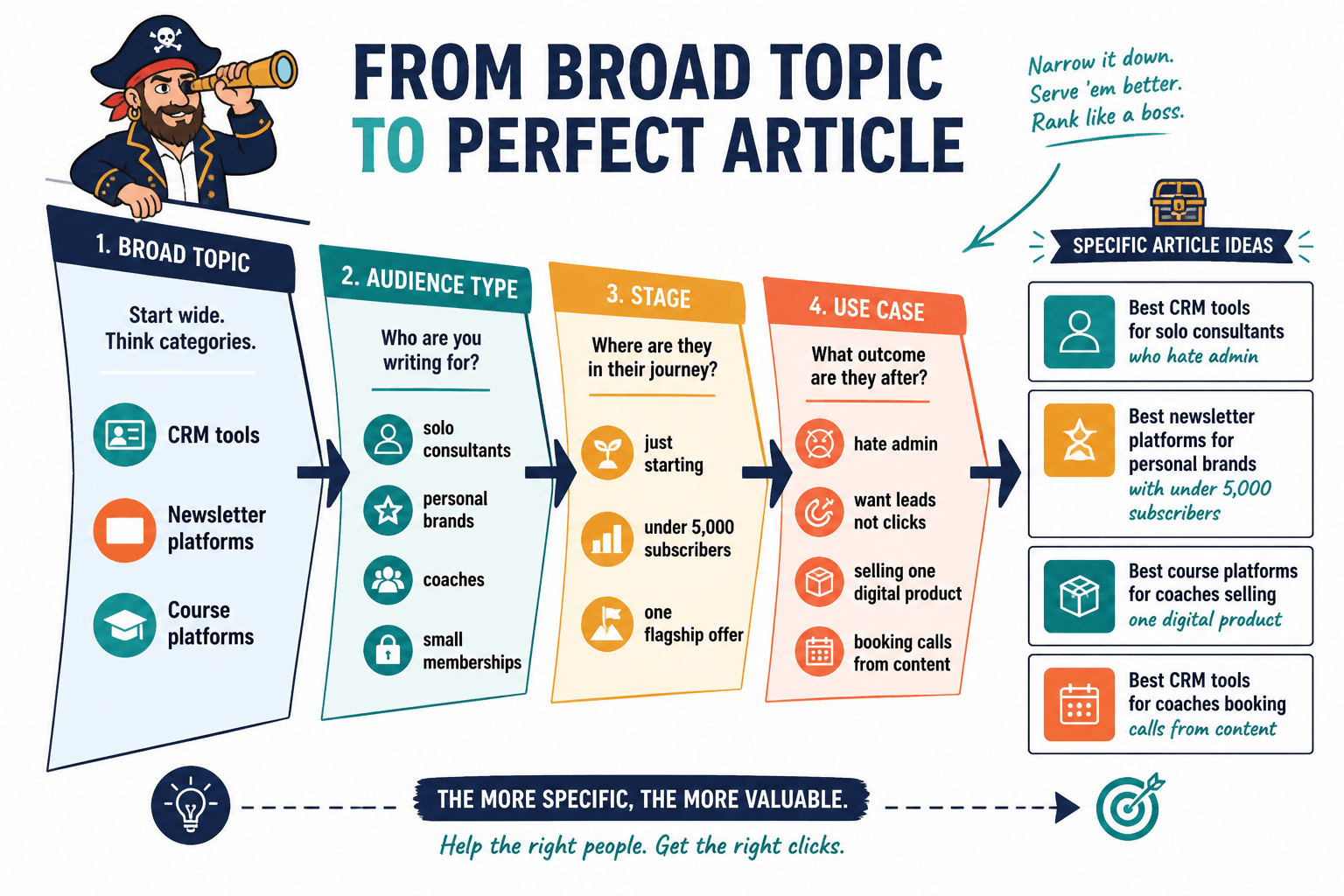
If your audience is small, the safest move is usually to go narrower, not broader.
- Best CRM tools for solo consultants who hate admin
- Best landing page tools for creators selling one digital product
- Best newsletter platforms for personal brands with under 5,000 subscribers
- Best scheduling tools for coaches booking calls from content
- Best community platforms for small paid memberships
- Best Canva alternatives for creators who need faster content graphics
- Best course platforms for experts with one flagship offer
- Best link-in-bio tools for creators who want leads, not just clicks
Need more angles? These affiliate article ideas and examples for creators will give you plenty to work with without drifting into generic review sludge.
What to measure if your audience is still small
If you do not have much traffic yet, obsessing over raw clicks can make you stupid fast.
Look at signals that tell you whether the article is aligned before you decide it failed.
- Are the right readers landing on the article?
- Are they spending time with it?
- Are they clicking the recommendation links?
- Are they moving to related pages or your email list?
- Are certain article angles outperforming others?
Small audiences usually need accumulation, not instant fireworks. A solid affiliate article can quietly compound over time if it targets a real need, stays relevant, and fits your broader content ecosystem.
One article may not make you rich. Good. That expectation was nonsense anyway. But a handful of focused, useful affiliate articles can become a meaningful revenue layer, especially when they connect to the rest of your content and offers.
Quick FAQ
Do affiliate articles work with a very small audience?
Yes, if the audience is relevant and the article targets a real buying decision. Small and right beats larger and random.
How many products should I include in one affiliate article?
Usually fewer than you think. One to three strong recommendations is often enough.
Should I only recommend products I personally use?
Not always, but you should have a credible basis for recommending them. Direct use helps. Clear research and audience fit can also work if you are transparent.
That matters even more with a small audience. Trust grows faster when your recommendations feel selective, honest, and rooted in real judgment.