
The bad assumption is that a better X post just needs more wit. It does not. Wit without shape is how perfectly capable ideas wander off and die in public. Better X posts are usually sharper, more specific, and easier to stop for in the first place. That is less glamorous than “be brilliant,” but far more useful.
On X, the post has to earn attention quickly. That means one clear idea, a useful angle, and language that sounds like a human thought instead of a conference badge. If you want the broader system behind that, start with the X posts parent guide. This page is the practical version: how to make the actual post better.
What X posts are actually trying to do
A good X post is not a tiny essay. It is not a miniature brand manifesto, either. It is a compact unit of attention that should do one of a few jobs:
- make a point people want to read to the end
- signal a useful perspective quickly
- earn replies, reposts, or profile taps
- set up a thread, offer, or deeper piece of content
The point is not to cram everything in. The point is to make one thing land.
X itself has long treated the post as a tight format with limits and constraints, which is exactly why clarity matters. Their help docs on posts and media are worth a glance if you want the platform’s basic shape from the source: X Help Center. For broader posting guidance, the platform’s own business advice on content and engagement is also a stable reference point: X for Business.
The core rule: one post, one clean idea
Weak X posts usually fail because they try to do three things at once: explain, impress, and sell. That produces a post that feels busy but lands softly. Better posts make one clear move and commit to it.
If the post is an opinion, give the opinion. If it is a useful observation, state the observation. If it is a sales post, make the offer obvious without disguising it as philosophy in a blazer.
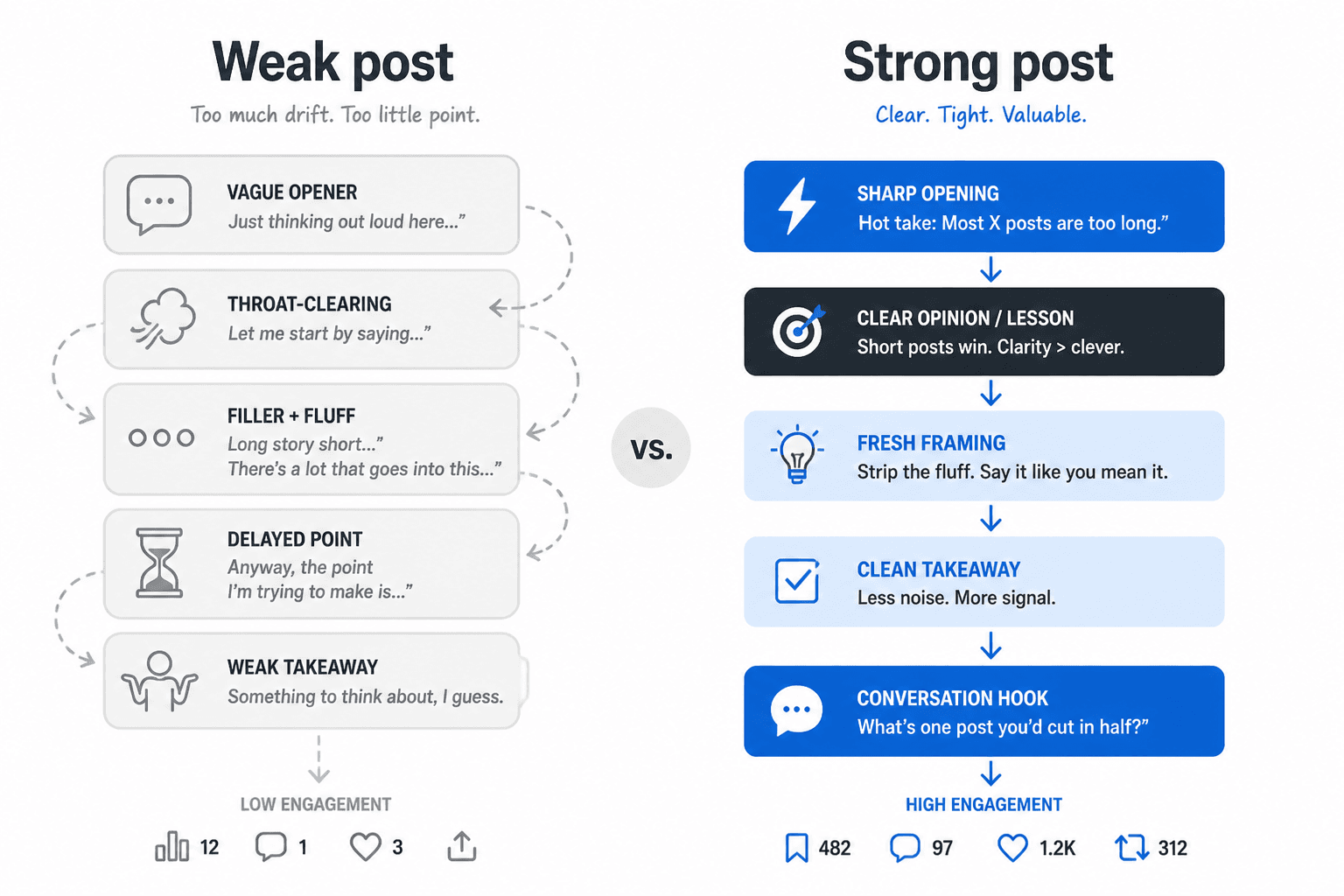
Why most weak X posts underperform
- They start with setup instead of the point. The useful part arrives too late.
- They are vague. “Do better” is not a post. It is a fog machine.
- They sound borrowed. The voice reads like content software trying on a necktie.
- They pile on extra ideas. Every extra point lowers the odds that any point lands cleanly.
- They ask for attention they did not earn. The closing line wants engagement before the post has done the work.
The fix is not “write harder.” The fix is to tighten the idea until it has edges.
How to write better X posts
1. Start with the sharpest part, not the warm-up
When a post begins with throat-clearing, it burns the reader’s patience before it has offered anything in return. Start where the tension is. Start where the opinion is. Start where the useful observation actually lives.
Instead of:
I was thinking about content strategy today and there are a few things that matter when you want to get more engagement on X…
Try:
Most X posts fail because they try to sound insightful before they become clear.
That version gives the reader a reason to keep going.
2. Make the idea specific enough to matter
Specificity is not decoration. It is the difference between a line people nod at and a line people remember. Abstract advice floats. Concrete detail sticks.
Weak:
Post with confidence and be authentic.
Stronger:
Say one thing plainly, then stop adding sentences that only exist to make you sound prepared.
That is more useful because it describes an action, not a mood.
3. Remove the robotic phrasing
Robotic posts often do not sound robotic because they use AI. They sound robotic because they are overmanaged. Too much polish, too much abstraction, too much “thought leadership,” not enough actual thought.
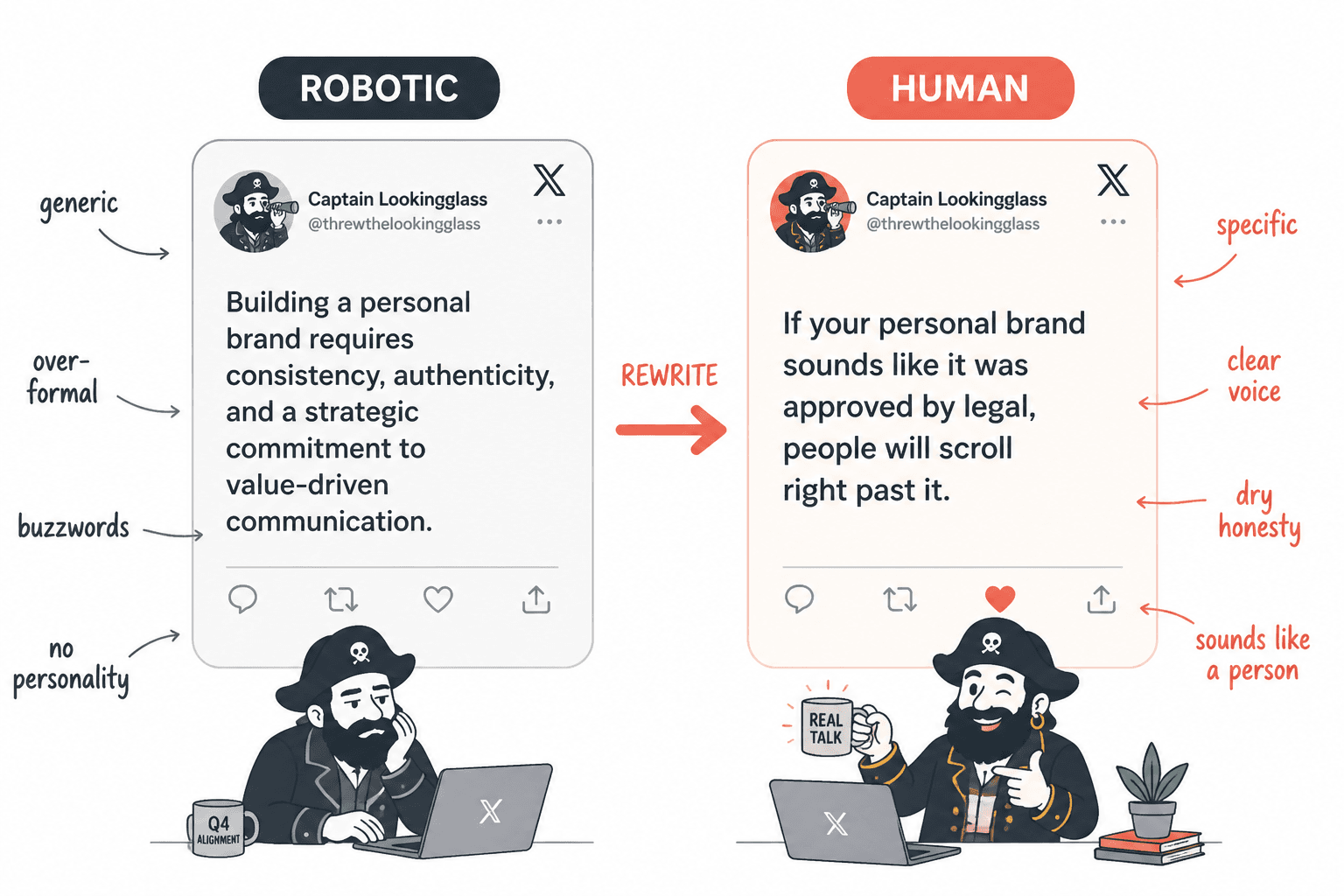
Cut phrases that nobody says out loud unless they are being paid by the slide deck:
- “in today’s fast-moving landscape”
- “unlock your potential”
- “game-changing”
- “leverage synergies”
If the sentence sounds like it was ironed, loosen it. A little friction is fine. It reads as alive.
4. Match the structure to the job
Not every post needs the same shape. A sharp opinion post, a practical tip, a contrarian take, and a sales post each need different handling. The mistake is using one generic template for everything and pretending that is strategy.
- Opinion post: lead with the stance.
- Practical post: lead with the problem and the fix.
- Contrarian post: name the false belief first.
- Sales post: make the offer clear without hiding it under a pile of praise for the reader’s intelligence.
If you want to connect the post to a broader content system, the parent guide gives the higher-level framing. If you are working through adjacent topics like stronger openings or better endings, those sibling pages are the next logical stop once they are live.
Before-and-after: a simple rewrite pattern
Here is a generic example of the kind of rewrite that usually helps.
Weak version:
Creating content consistently is important if you want to build an audience and grow your brand over time.
Stronger version:
Consistency matters less than having a point people actually want to hear twice.
The stronger version works because it says something specific, slightly surprising, and easy to understand.
Another one:
Weak version:
There are many ways to improve your X strategy, but the best approach is to focus on quality and relevance.
Stronger version:
A post people ignore is not “underoptimized.” It is unclear, late, or trying too hard to sound smart.
That second version has teeth. Teeth help.
A practical workflow for better X posts
When the writing feels muddy, it helps to stop treating the post like a one-shot performance. Draft it in a simple sequence instead.
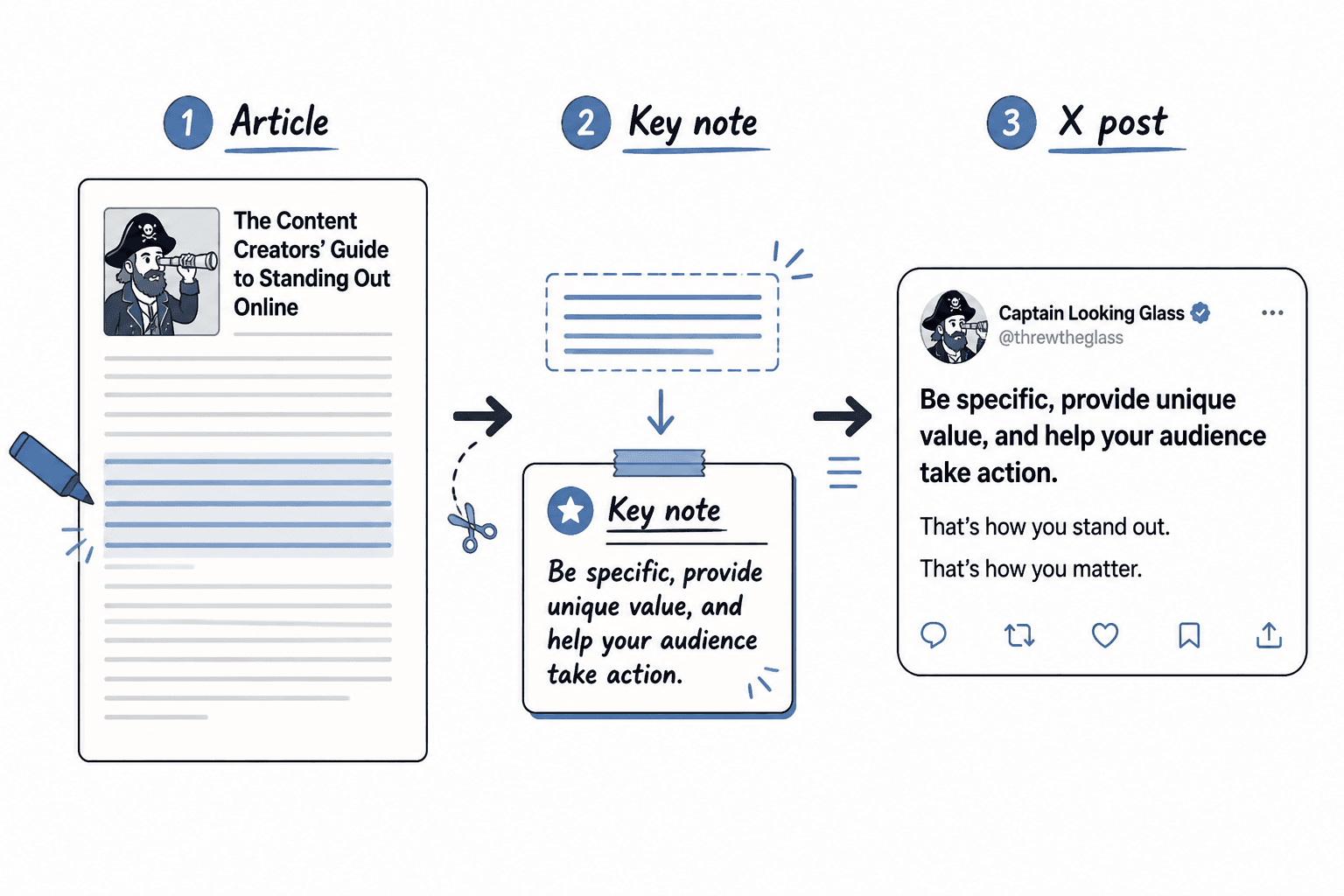
- Capture the raw idea. Write the thought before you try to make it sound good.
- Find the point. What is actually worth saying here?
- Cut the setup. Keep only the part that helps the reader move faster toward the idea.
- Choose the format. Opinion, tip, observation, contrast, list, or short story.
- Trim vague language. Delete anything that could apply to 500 other posts.
- Read it out loud. If it sounds like a memo, revise again.
This is also the point where a rough draft often improves fast if you compare it to the actual job the post is supposed to do. A reply magnet should feel different from a direct-response post. A quick insight post should not carry the weight of a mini-essay.
Common mistakes to avoid
- Starting with context nobody asked for. Context is useful only when it earns the next sentence.
- Trying to sound smarter than necessary. Smart is good. Dense is not a personality.
- Writing for approval instead of clarity. The post becomes cautious, and cautious posts rarely travel far.
- Using a question because you need a close. A weak question is just a tired hand raised in the back row.
- Padding a good idea until it loses shape. Some posts need one sentence. Some need six. Many need fewer than the draft thinks.
How long should an X post be?
The honest answer is that length should follow the idea, not the other way around. Short posts work when the point is already sharp. Longer posts work when the argument genuinely needs room.
As a rule of thumb:
- Use short posts when the idea is clean and punchy on its own.
- Use medium-length posts when you need one extra beat for proof or nuance.
- Use longer posts when you are teaching, contrasting, or building toward a useful conclusion.
What usually fails is not length itself. It is length without reason.
A quick checklist before you publish
- Does the first line earn the second?
- Is there only one main idea?
- Does any sentence sound fake, inflated, or borrowed?
- Is the post specific enough to feel real?
- Would a reader know why they should care within a few seconds?
If the answer to any of those is no, revise before posting. The platform is crowded enough without handing people a reason to keep scrolling.
Wrap-up
Better X posts are not mysterious. They are tighter, clearer, and less desperate to be impressive. Lead with the point, sharpen the language, strip the filler, and make the structure match the job. That is how a post starts earning its keep.
For the broader structure around this topic, return to the X posts parent guide. Once the related sibling guides are live, they belong naturally alongside this one: openings, punchy lines, quote posts, endings, length, and rewrite patterns are all part of the same system.