
Most Facebook long-form posts do not fail in the middle. They fail at the end.
The setup is decent. The story has some tension. The opinion is clear enough. Then the writer lands the plane by crashing it into one of three things: a limp “what do you think?”, a weird sales pitch, or a motivational line that sounds like it came free with a ring light.
If you want better Facebook long-form and rants strong endings for personal brands, the fix is not “be more inspiring.” It’s to end with purpose. A strong ending should complete the emotional arc, sharpen the point, and give the reader one obvious place to go next, even if that next step is just leaving a real comment.
This is where a lot of good posts quietly lose their power. They spend 500 words earning attention, then hand the final impression over to a generic closing line. Bit of a waste, honestly.
For the main guide behind this topic, visit the parent guide.
What a strong Facebook post ending actually needs to do
A strong ending is not just “the last sentence.” It is the payoff.
On Facebook, especially with long-form posts and rants, readers are not just scanning for information. They are following an emotional and conversational rhythm. They want to know: what was the point of that, why does it matter, and what am I meant to do with it?
Your ending should usually do at least two of these three things:
- Clarify the takeaway so the reader does not have to interpret your meaning through fog
- Create a reaction point so people know what kind of response fits
- Direct the next step without turning the post into a needy funnel monologue
That means the ending is not decorative. It is structural. It tells the reader how to hold the whole post in their head.
A good ending does not tack on energy. It concentrates the energy you already built.
Why weak endings hurt personal brands more than they hurt casual posters
If you are building a personal brand, your posts are not random content objects floating through the feed. They are signals.
Each post teaches people something about your judgment, clarity, conviction, and usefulness. So when your ending gets vague, apologetic, overly broad, or clumsy, it weakens the impression people are forming about you. Not because they are harsh. Because they are busy.
A strong ending makes you sound like someone who can think clearly and finish a point. A weak ending makes you sound like someone who almost had something to say.
That matters for coaches, consultants, creators, and service providers in particular. People are often deciding if you are worth listening to before they ever click your profile, read your offer, or reply to your post. If the ending feels off, trust drops a little. Not dramatically. Just enough to cost you momentum.
If you want the broader structure behind this, the main Facebook long-form and rants hub and this guide for creators who want better results will help.
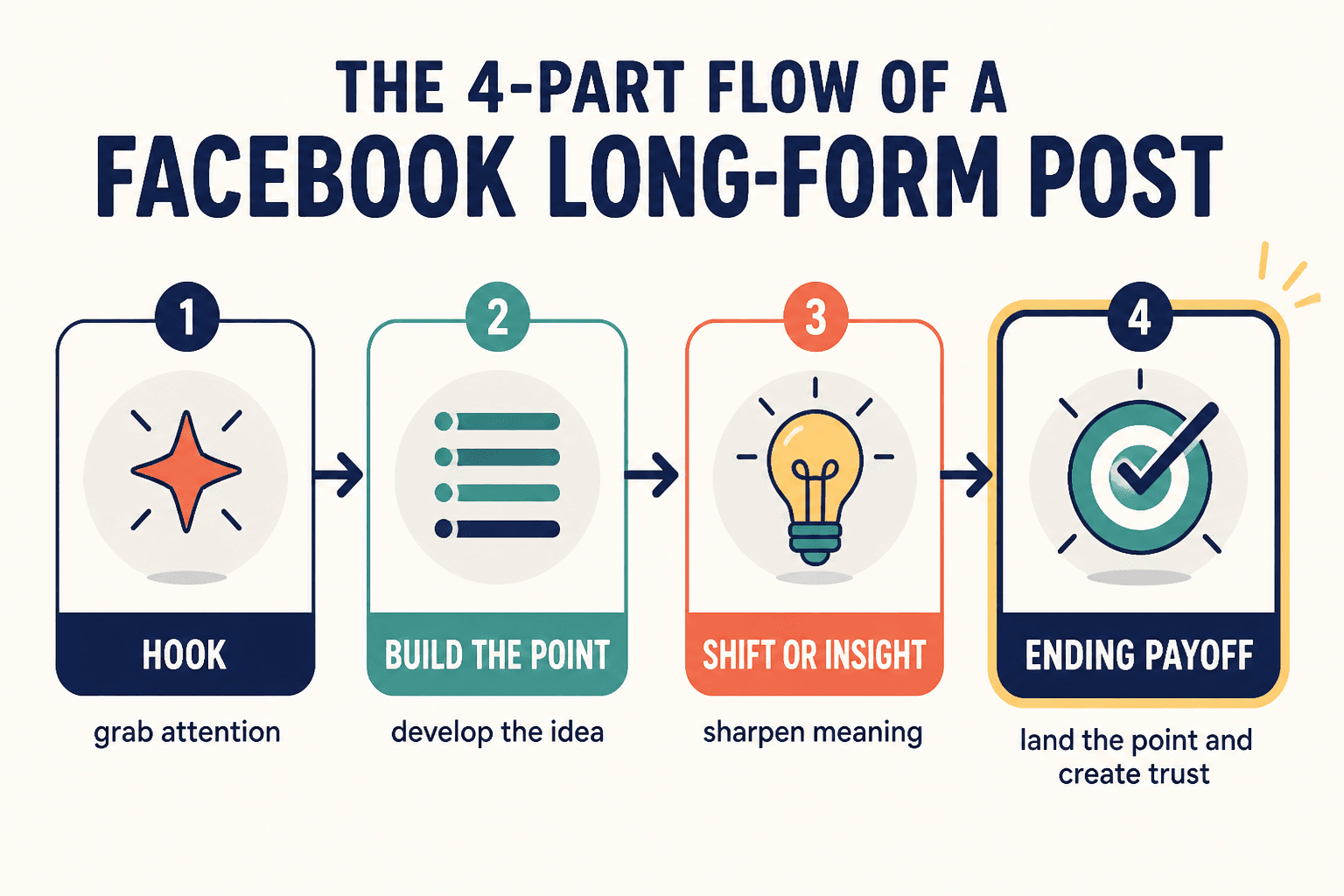
The 5 ending jobs your post might need
Not every Facebook rant should end the same way. That is part of the problem. People copy one formula and paste it onto everything from opinion posts to story posts to mini-manifestos.
Instead, match the ending to the job of the post.
1. The point-landing ending
Use this when the post builds toward a clear lesson, insight, or argument.
Example: “That’s why ‘just post consistently’ is bad advice for most small personal brands. Consistency without a sharper point just means repeating yourself on schedule.”
This style works because it names the conclusion plainly. No mist. No drama. Just the point.
2. The conversation-opening ending
Use this when comments are part of the post’s value, especially on Facebook where discussion often matters more than polished authority.
Example: “I’m curious where you land on this: do you trust blunt posts more, or do they start feeling performative after a while?”
Notice this is not “Thoughts?” or “Can anyone relate?” It gives people something specific to react to.
3. The challenge ending
Use this when the post is meant to change behavior.
Example: “Before you post another 900-word rant this week, cut the last four lines and ask yourself if the ending actually says anything.”
This works well for tactical or educational posts because it creates immediate action without sounding like a lecture.
4. The soft CTA ending
Use this when the post naturally leads to an offer, resource, guide, or next step.
Example: “If your Facebook posts keep turning into long, shapeless monologues, I put together a cleaner breakdown here: how to write better Facebook long-form and rants.”
The key word here is naturally. If the CTA feels stapled on, people can tell.
5. The mic-drop ending
Use this sparingly. Very sparingly.
Example: “Some people do not need a better content strategy. They need a point.”
Good mic-drop endings are sharp because they are earned. Bad ones sound like somebody trying to go viral in a blazer.
The endings that quietly ruin otherwise good posts
If you want better Facebook long-form and rants strong endings for personal brands, you also need to know what to stop doing.
The vague engagement beg
“What do you think?”
Sometimes it works. Usually it is lazy. It asks for effort while giving the reader nothing specific to respond to.
Better: “Have you noticed this too, or is this just a consultant-side effect of seeing too many careful-but-forgettable posts?”
The TED Talk ending
“So keep going. Keep believing. Keep showing up.”
Unless the whole post genuinely built toward a motivational close, this usually sounds borrowed. It drains specificity out of everything that came before it.
Better: End on the actual insight the post earned.
The surprise pitch
You spent 700 words ranting about bad marketing, then suddenly: “DM me ‘SCALE’ if you want to 10x your authority.”
No.
If the post was not shaped to lead there, the pitch feels like a trap door. Trust drops fast.
The overexplained closing
Some writers make the point, then explain the point, then explain why they explained the point.
This is especially common in rants. You get to the sharp sentence, and instead of stopping, you add three softer lines that dilute it.
Often the stronger move is to cut the final paragraph entirely.
How to write a strong ending without making it feel forced
Here is the simple process.
- Ask what the post is really about. Not the topic. The point.
- Choose the ending job. Do you want takeaway, discussion, action, or transition?
- Pull language from the body. Reuse the core tension or phrase so the ending feels connected.
- Cut any line that sounds borrowed. If it could end 5,000 other posts, it is probably weak.
- Read the final two paragraphs out loud. If the energy drops, trim harder.
This matters because endings should feel inevitable, not attached. The reader should get to the end and think, “Yes, that’s where this was going,” not, “Oh, now we’re doing comments” or “Right, here comes the funnel.”
Before-and-after ending rewrites
Let’s make this more useful than a pile of theory.
Example 1: Rant about fake authenticity
Weak ending: “Anyway, just be yourself and people will connect with you. Thoughts?”
Stronger ending: “People do not connect with ‘authenticity’ in the abstract. They connect with clear opinion, real stakes, and a voice that does not sound outsourced.”
Why it works: It sharpens the argument and ends with conviction instead of a shrug.
Example 2: Story post about content burnout
Weak ending: “So if this resonates, drop a heart in the comments.”
Stronger ending: “If your content feels heavy right now, it may not be a discipline problem. It may be a format problem. You might be trying to sound polished when the stronger move is sounding clear.”
Why it works: It gives the reader a clean reframe they can use immediately.
Example 3: Educational post leading to a resource
Weak ending: “I help people with this stuff, so message me if you need help.”
Stronger ending: “If your long posts tend to ramble before they land, start with these simple story pacing templates. They make the ending easier because the post stops wandering in the middle.”
Why it works: The CTA is useful, specific, and connected to the exact problem in the post.
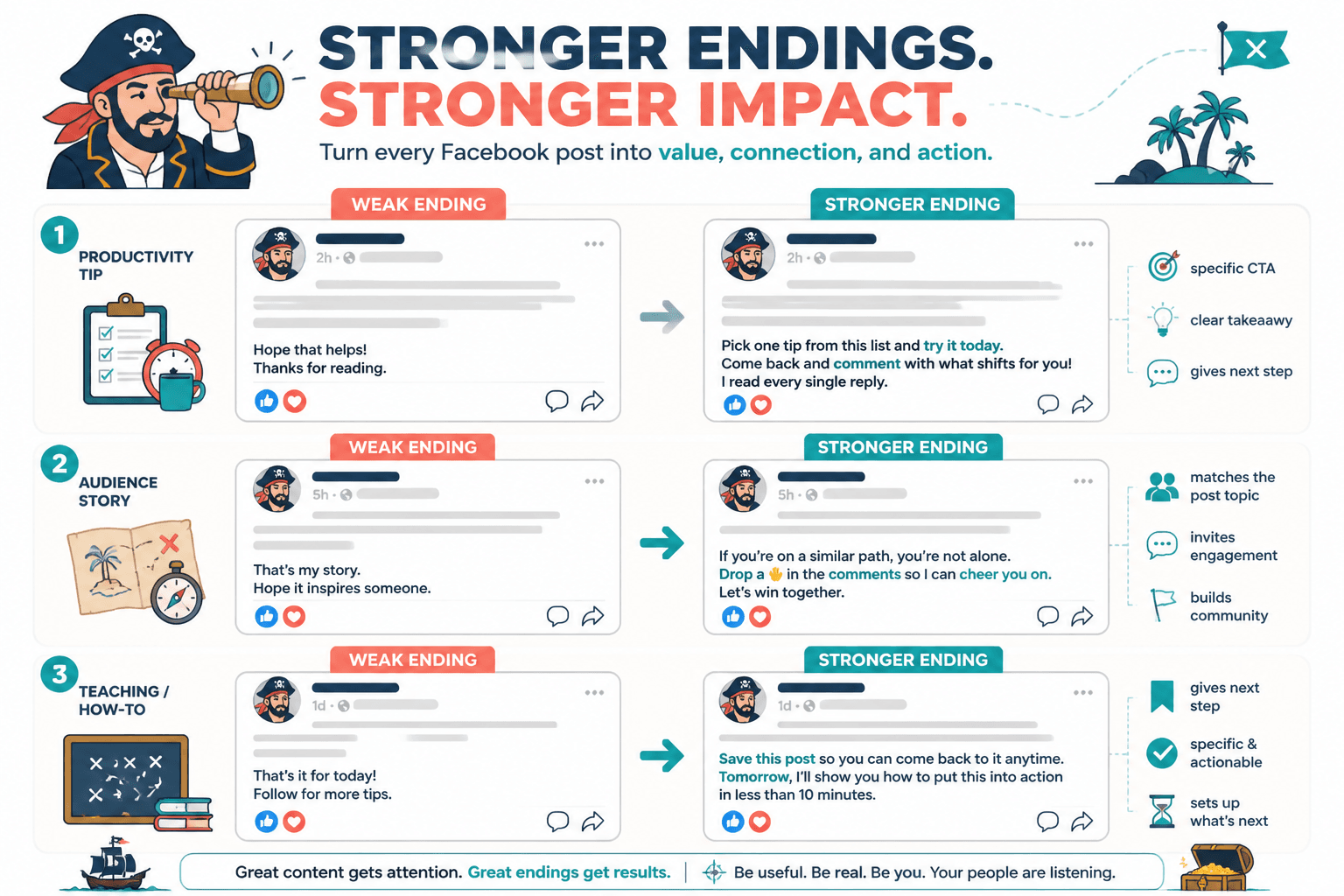
Strong ending formulas you can actually use
Templates are helpful right up until they make everyone sound the same. So use these as structures, not scripts.
Formula 1: The clear takeaway
Structure: “The real problem is not [surface issue]. It is [deeper issue].”
Example: “The real problem is not that your Facebook posts are too long. It is that they take too long to say something worth staying for.”
Formula 2: The comment prompt with a spine
Structure: “I’m curious about one part of this: [specific tension]. Where do you land?”
Example: “I’m curious about one part of this: do you think blunt content builds more trust now, or are people getting tired of forced bluntness too?”
Formula 3: The behavior challenge
Structure: “Before you [common action], try [better action].”
Example: “Before you end your next Facebook rant with a generic question, try writing one sentence that states the actual point with your full chest.”
Formula 4: The soft resource bridge
Structure: “If you want help with [specific issue], start here: [resource].”
Example: “If you want help shaping stronger posts from the start, this roundup on Facebook long-form and rants examples for coaches, consultants, and personal brands gives you better models than most of the vague advice floating around.”
How different types of personal brands should end Facebook rants
Same platform, different trust dynamics.
The bigger point is simple: clearer structure and clearer writing make the piece more useful. That is usually what makes the ending land better too.