
Facebook posts that get likes but not leads are expensive in a very dull way: they burn time, nibble away at trust, and leave sales looking like a separate job you have to do later. That usually turns into more busywork, not more revenue. The better move is to make each post do one clear job in the path from attention to action.
That does not mean every post has to sell. It means the post should make the next step obvious enough that a decent reader does not need a rescue mission. Facebook is still a place where people notice tone, context, and fit before they notice your cleverness. The useful question is not “How do I squeeze money out of this post?” It is “What action makes sense after this post, and how do I make that action feel natural?”
If you want the writing side of that to hold up, start with how to write better Facebook posts. If you want broader example patterns, the Facebook posts ideas and examples guide is a useful companion. For the full parent topic, see the Facebook posts guide.
What a post has to do before it can convert
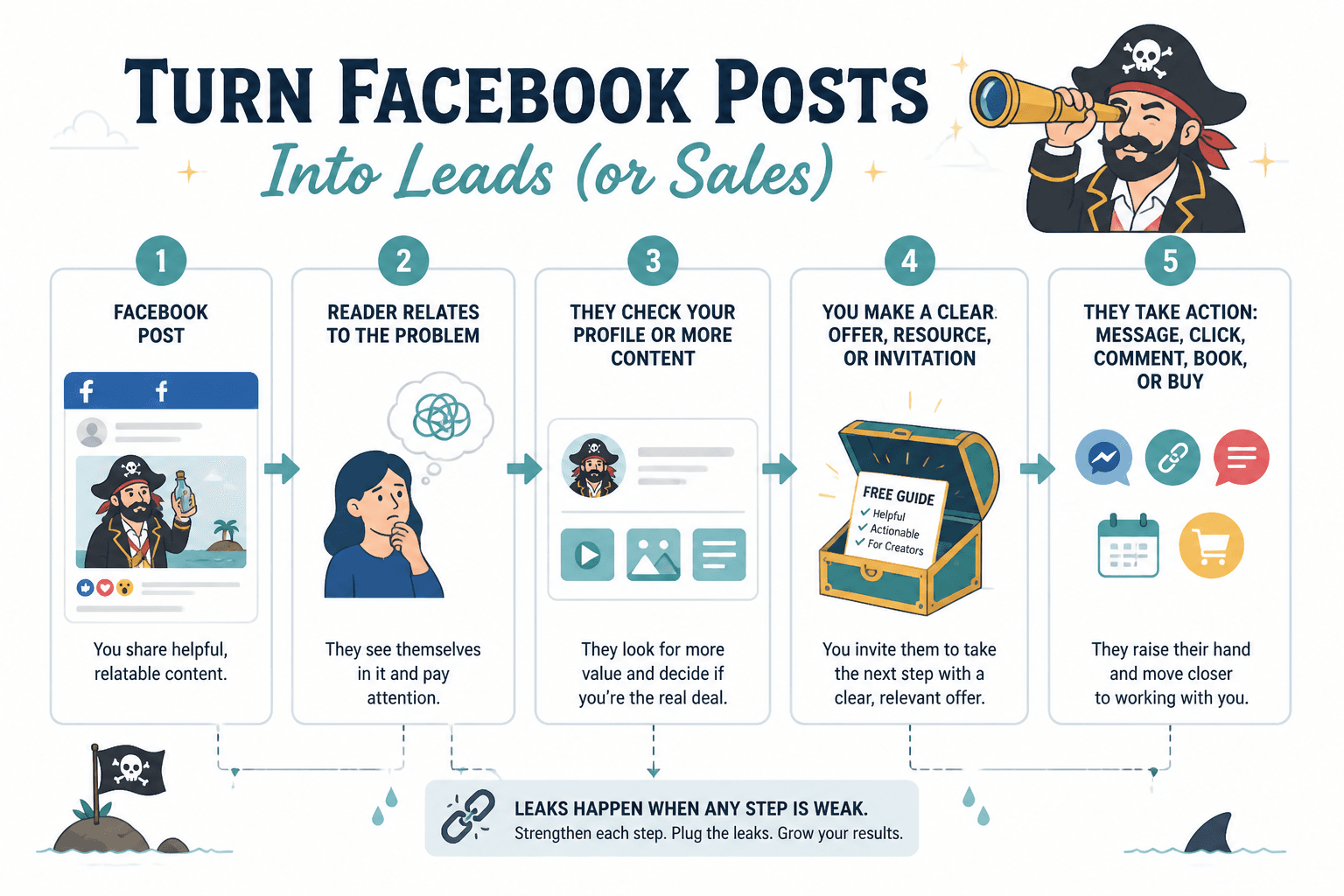
A Facebook post rarely converts because it shouts harder. It converts because it earns enough attention to make the next step feel safe. That means the post has to do three things well:
- Signal relevance – the reader should know quickly that this is for them.
- Reduce uncertainty – the reader should understand what they get if they click, reply, or visit your profile.
- Create a clean next step – the post should point to one obvious action, not four competing ones.
This is the basic logic behind any solid conversion path. Google’s GA4 measurement model is built around understanding the steps people take before a conversion, and the same idea applies here: the post is not the finish line, it is part of the route.
The conversion path that works best on Facebook
The best Facebook conversion path is usually short and emotionally consistent. That means the tone of the post, the promise on the next page, and the action you ask for should all feel like they belong to the same conversation.
A mismatch is where things go sideways. A useful post that leads to a hard sell feels abrupt. A strong opinion post that leads to a vague homepage feels like the floor dropped out. The handoff matters because people do not separate content and offer as neatly as marketers do.
1. Post → profile → lead magnet
This works well when the post builds curiosity or authority, but the buy is not ready yet. The profile acts like a small trust bridge. Keep the profile bio and pinned content aligned with the post, then point to a clear lead magnet or starter resource.
This route is especially useful when the post is educational and the next step needs to be lower pressure than a direct pitch. If you want more funnel structure around this approach, see best funnel ideas to pair with Facebook posts.
2. Post → comments or DMs → offer
This is useful when the post is specific, timely, or interactive. A comment trigger or DM prompt can work well if the offer is closely tied to the post’s topic. The key is to keep the transition simple. The reader should not feel like they are entering a maze just to ask for the thing you mentioned.
Use this path when the audience already has enough context to understand the offer without a long explanation. The post should qualify interest, not perform a full sales call in public.
3. Post → booking page
This is the most direct path, and it is usually the least forgiving. It works best when the post already contains enough proof, specificity, and relevance that the reader is ready to act. If the post is still doing heavy trust-building, a booking page can feel too sharp a turn.
Think of it as a narrow lane, not a default setting. The clearer the fit, the better this route performs.
The post types that monetize best
Not every Facebook post is built to sell, and that is fine. The ones that convert best usually do one of four jobs well.
1. The useful insight post
This post teaches something practical that solves a specific pain point. It works because usefulness builds credibility. The offer can follow naturally if the topic overlaps with what you sell.
Example pattern: “Here is the mistake, here is why it happens, here is the fix, and here is where to go if you want help applying it.” Clean. No fireworks needed.
2. The story-with-a-point post
Stories work when they have a clear lesson and that lesson connects to a product, service, or next step. The story should not wander around waiting for applause. It should arrive at a point that matters to the buyer.
Use this post type when you want to lower resistance and show context without sounding promotional too early.
3. The opinion post that filters the right people in
A strong opinion can help people self-select. It should be specific enough to attract the right readers and repel the wrong ones without turning into a shouty little performance.
These posts often convert well because they clarify fit. A buyer who agrees with your framing is more likely to trust the offer that follows.
4. The soft offer post
This post names the offer with enough clarity that a reader can act without extra decoding. It is not a hard pitch. It is a direct, low-drama invitation.
Soft offers work best when the benefit is concrete, the action is simple, and the reader can tell why the offer exists in the first place.
How to make the CTA feel natural instead of needy
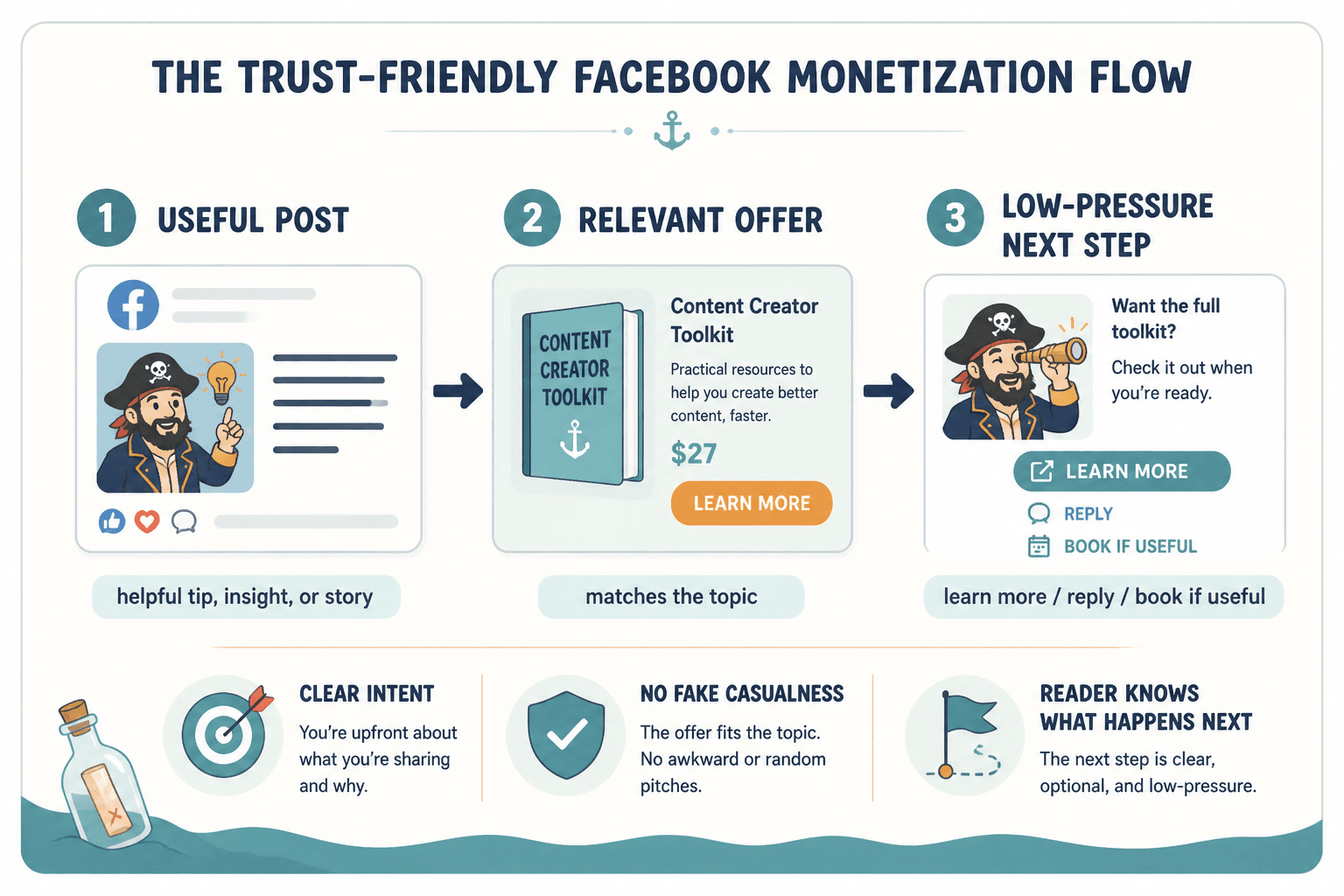
A weak CTA usually sounds like it was stapled onto the end after the actual thinking was done. A good CTA feels like the next logical move in the conversation.
Three things help:
- Match the ask to the post – do not ask for a booking when the post only earned mild curiosity.
- Keep the payoff obvious – the reader should know what happens after the click, comment, or message.
- Use one action – more choices usually means more hesitation.
A CTA can be direct without sounding desperate. “Reply with X,” “Grab the guide,” or “Book a consult” are all fine if the post has actually earned that step.
What usually kills conversion
Facebook posts tend to fail at monetization in the same few boring ways. Boring is annoying, but it is also fixable.
- The offer appears too early. The post has not earned enough trust yet.
- The transition is too abrupt. The post and the next step feel like different conversations.
- The ask is too vague. Readers do not know what to do or why.
- The post tries to do everything. Teach, inspire, entertain, and sell all at once, and it usually does none of them well.
- The profile does not support the post. A good post can be kneecapped by a bio, pinned post, or link that sends people into fog.
That last one matters more than people admit. If the post is the invitation, the profile is the front door. A messy front door makes the invitation look less serious.
How to balance trust-building and sales posts
The easiest way to wreck results is to make every post a pitch. The other easy mistake is to make every post noble and useful and then wonder why revenue still needs a calendar reminder.
A healthier mix usually includes:
- trust-building posts that teach or clarify
- proof or story posts that show experience and judgment
- opinion posts that sharpen positioning
- offer posts that point to a next step
The exact ratio depends on the audience and the offer, but the principle stays the same: trust and conversion are not enemies. They are roommates with poor boundaries. You need both, but they should not be speaking over each other all day.
A simple way to think about the funnel
If you want a practical shorthand, use this:
- Warm readers can move from post to offer faster.
- Colder readers usually need a bridge like a profile visit or lead magnet first.
- High-fit readers can often go straight to booking, checkout, or DM.
This is why the best funnel ideas for Facebook posts are not about force. They are about fit. The more the next step matches the post’s trust level, the better the conversion path tends to work.
A practical weekly structure
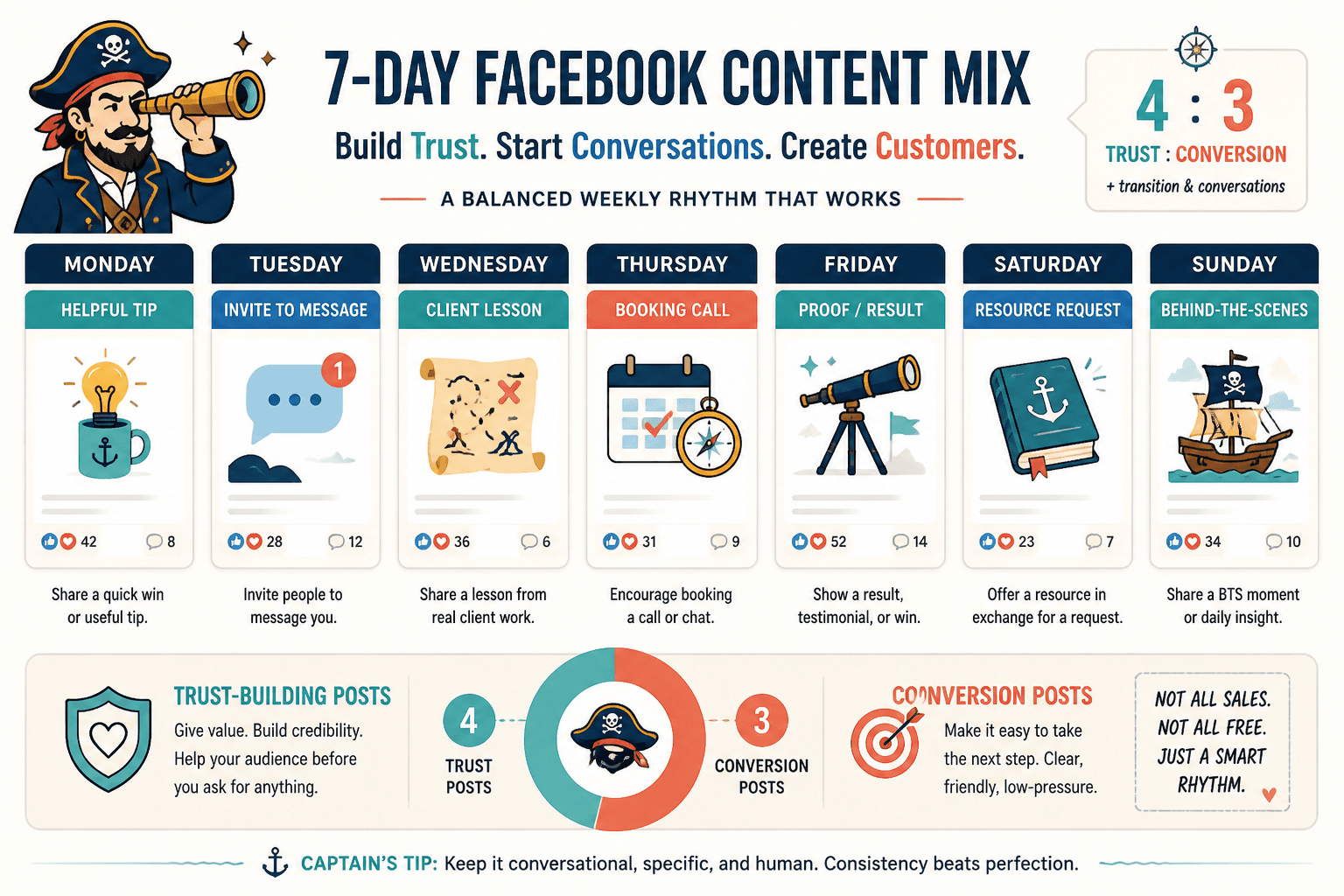
One workable rhythm is to rotate the job of the post instead of trying to make every post carry the same weight:
- One post that teaches something useful
- One post that shares a point of view or sharp observation
- One post that shows proof through a result, process, or example
- One post that makes a clear offer or next step
That mix gives you coverage without making the feed feel like a sales trench. It also gives readers different reasons to trust you, which is usually the part that actually moves the sale.
Final takeaway
Facebook posts turn into leads or sales when they do more than attract attention. They need to create enough trust, clarity, and fit that the next step feels obvious. That next step can be a profile visit, a lead magnet, a DM, or a booking page. What matters is that the path is intentional.
Write the post for the reader’s current level of trust, make the handoff obvious, and keep the offer aligned with what the post already promised. That is the difference between content that merely gets seen and content that quietly pays rent.
If you want to keep building the system around this, revisit the Facebook posts parent guide and the companion page on how to monetize Facebook posts without wrecking trust.