
Most LinkedIn article CTAs are either weirdly timid or painfully overeager.
They end with something like “What do you think?” after 1,800 words of serious advice, or they lurch into “Book a call with me today” like the article was just a long hallway leading to a sales ambush.
That’s the problem with a lot of advice about Better LinkedIn Article CTAs for Personal Brands. It treats the CTA like a decorative closing line, or worse, a conversion trap. In reality, your CTA is the bridge between attention and next action. If that bridge is vague, needy, or mismatched, people leave.
Here’s how to write LinkedIn article CTAs that actually fit the piece, respect the reader, and move the right people one step closer to trusting you, following you, joining your list, or working with you.
For the main guide behind this topic, visit the parent guide.
What a LinkedIn article CTA is actually supposed to do
A CTA in a LinkedIn article is not just a closing sentence. It is the article’s next-step logic.
If your article teaches something useful, challenges a bad assumption, or shows your expertise clearly, the CTA should help the reader continue in the most natural direction. Not the most aggressive one. The most natural one.
For personal brands, that usually means one of five things:
- Start a conversation
- Prompt profile visits
- Lead to a related resource
- Grow an email list
- Create soft commercial intent
That’s it. You do not need a closing paragraph that sounds like it escaped from a webinar funnel.
LinkedIn articles are not short posts. They ask for more time from the reader, so the CTA should feel proportionate to the value delivered. If the piece is thoughtful and genuinely useful, a sharp, relevant CTA feels earned. If the article is thin and the CTA is heavy, people notice. They may not tell you, but they notice.
Why most LinkedIn article CTAs underperform
The usual failures are not mysterious. They are mostly bad fit.
1. The CTA is too generic
“What are your thoughts?” is not always terrible, but it is often lazy. It asks for effort without giving the reader a useful angle. After a specific article, a generic question feels like you ran out of road.
2. The CTA asks for too much too soon
If someone just met you through one article, jumping straight to “Book a strategy session” can be a bit much. Especially if the article was educational rather than deeply proof-driven.
3. The CTA does not match the article’s intent
A practical how-to article usually deserves a practical next step. A credibility-building opinion piece may work better with a conversation CTA. A case-study-style article can support a stronger business CTA. Same platform, different job.
4. The CTA sounds fake-professional
This is the classic personal-brand mistake: trying to sound polished instead of useful. Readers do not need “I would be delighted to connect and explore synergies.” They need a clear reason to do the next thing.
A weak CTA does not fail because it is short. It fails because it gives the reader no obvious reason to move.
Start with the goal, not the sentence
Before you write the last line of your LinkedIn article, decide what the article is trying to produce.
Not in a vague “build my brand” way. In a real way.
- Do you want comments from the right people?
- Do you want readers to click to a related article?
- Do you want them to visit your profile and understand what you do?
- Do you want email subscribers?
- Do you want qualified leads to quietly raise their hand?
Your article CTA should support one primary next action. One. Not four. When you stack “comment below, follow me, subscribe to my newsletter, and book a call” at the end, you are not giving options. You are creating friction.
People tend to treat article endings like a dumping ground for every possible conversion point. That usually weakens all of them. A cleaner ending feels more confident and gets better results because the reader can see the path.
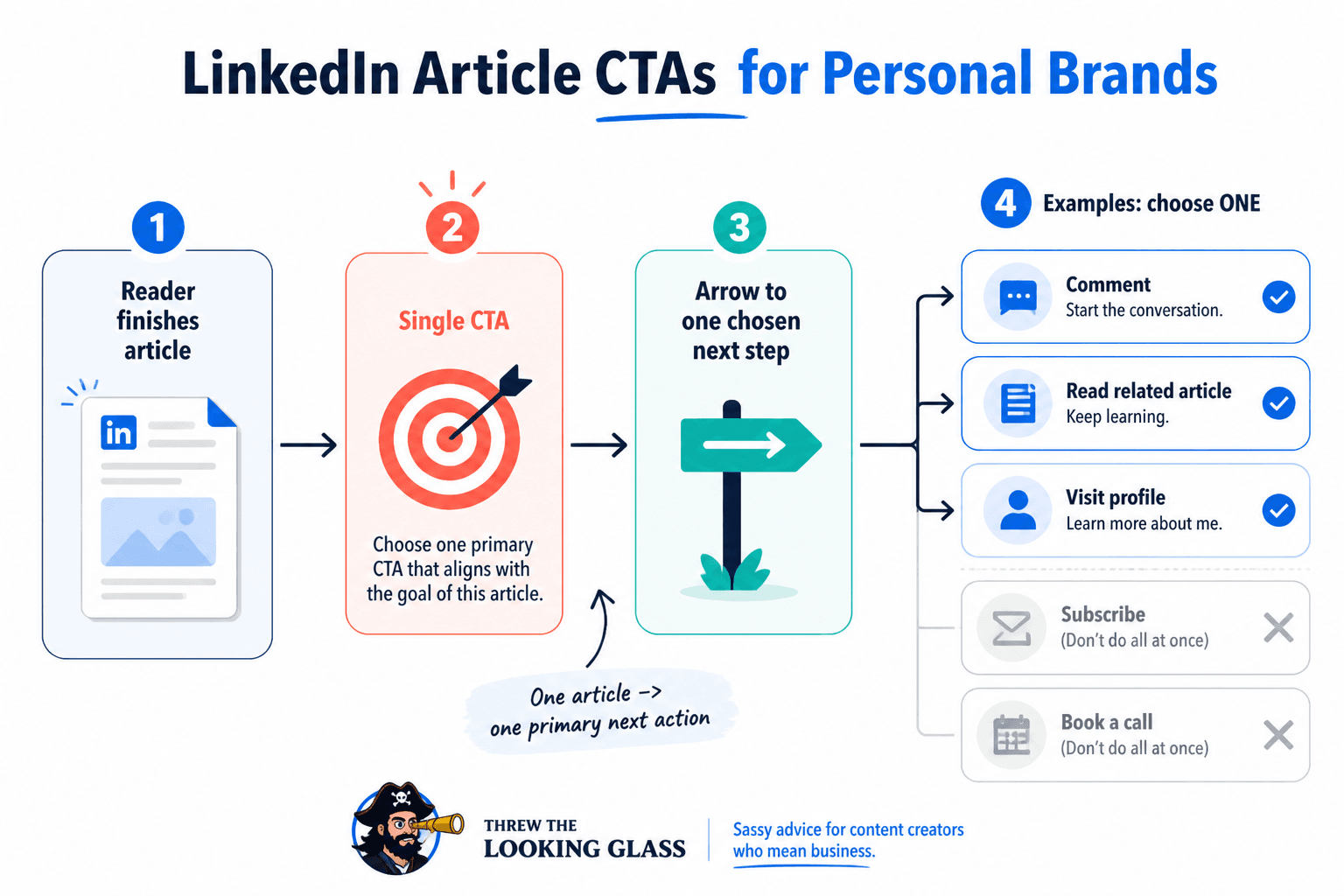
The 5 best CTA types for LinkedIn articles
These are the CTA types that tend to work best for personal brands because they fit how LinkedIn articles are actually consumed: as trust-building, authority-building, evergreen content.
1. The conversation CTA
Use this when the article presents an opinion, framework, trend, or debatable idea.
Good example: “If you’re writing LinkedIn articles for leads, what’s been harder for you: getting the click, keeping attention, or knowing what to ask for at the end?”
Why it works:
- Specific question
- Tied to the article topic
- Easy to answer
- Brings in relevant readers, not random drive-by comments
Weak version: “What do you think?”
That’s not a conversation starter. That’s a shrug.
2. The profile CTA
Use this when the article is meant to build authority and make readers curious about your work.
Good example: “If this helped, my profile has more LinkedIn writing breakdowns for creators and consultants who want sharper content without the usual fluff.”
This works best when your profile is ready for the visit. If your profile headline, about section, and featured section are a mess, fix that first. Do not send people into a house with no furniture.
3. The related-resource CTA
Use this when the topic has a natural next layer.
For example, if your article is about CTAs, the next step might be intros, structure, or examples. This is where internal linking quietly does a lot of work.
Good example: “If your CTA is fine but readers drop off earlier, fix the opening first. This guide on how to improve LinkedIn article intros without sounding generic will help.”
This kind of CTA is useful because it keeps the reader in motion without making the article feel like a sales page.
4. The email-list CTA
Use this when your article is educational and your offer needs more trust before a sale.
Good example: “If you want more content strategy like this in a less algorithm-dependent format, join my newsletter. That’s where I share the sharper stuff.”
Notice what makes that better than “Subscribe for updates.” It gives a reason. It frames the value. It sounds human.
5. The soft-offer CTA
Use this when the article clearly demonstrates expertise and naturally connects to a service.
Good example: “If your team is publishing LinkedIn articles that sound polished but don’t convert, that’s the kind of messaging problem I help fix.”
This works because it does not yell. It names a specific problem, hints at the service, and lets qualified readers self-select.
How to match the CTA to the kind of article you wrote
| Article type | Best CTA style | Why it fits |
|---|---|---|
| How-to article | Related resource or email-list CTA | Reader is in learning mode |
| Opinion article | Conversation CTA | Reader may want to respond or challenge |
| Case study | Soft-offer CTA | Proof supports commercial intent |
| Beginner guide | Profile or resource CTA | Reader may want more help before buying |
| Framework article | Conversation or newsletter CTA | Frameworks invite discussion and follow-up |
This is where a lot of people get article CTAs wrong. They use the same ending on every article, no matter what the article is doing. That is efficient in the same way microwaving every meal is efficient. Sure. But the results tell on you.
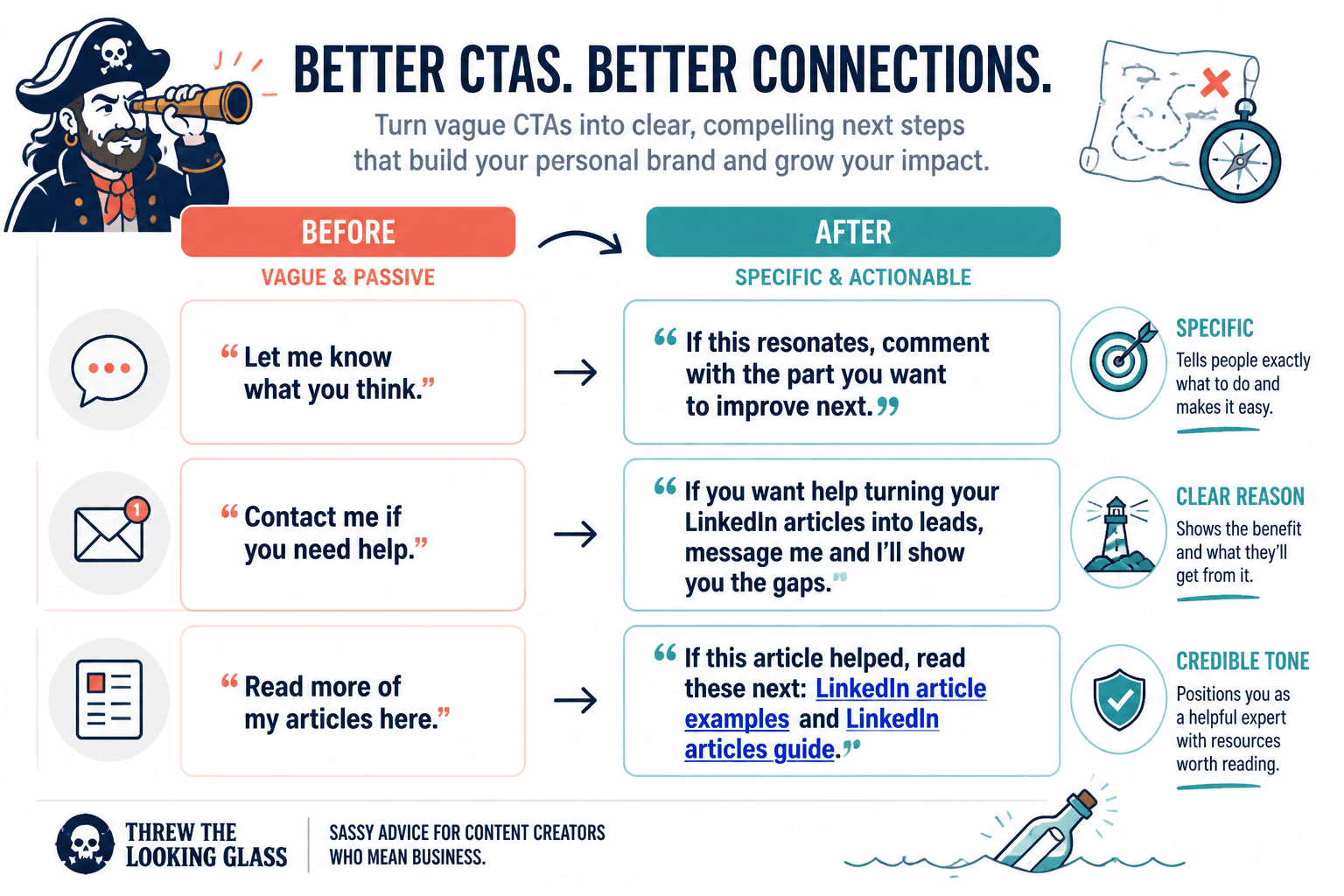
Before-and-after CTA rewrites
Here’s what stronger LinkedIn article CTAs look like in practice.
Rewrite 1: Generic engagement CTA
Before: “What do you think? Share your thoughts in the comments.”
After: “If you write LinkedIn articles for your business, what usually breaks first: the headline, the intro, or the CTA?”
The second version gives the reader a frame. That makes replying easier and more relevant.
Rewrite 2: Too-hard sales close
Before: “If you need help with your content strategy, book a free discovery call now.”
After: “If your LinkedIn articles are getting polite views but no real business traction, that’s usually a positioning or conversion problem, not just a writing problem. That’s work I help clients with.”
The stronger version feels less desperate and more credible. It sounds like someone who knows what they solve.
Rewrite 3: Flat resource CTA
Before: “Read more of my articles here.”
After: “If this article helped, you’ll probably want these next: LinkedIn article examples for coaches, consultants, and personal brands and this LinkedIn articles guide for creators who want better results.”
Specific beats vague. Every time.
A simple framework for writing better LinkedIn article CTAs
If you want a repeatable way to improve your endings, use this:
- Name the value just delivered.
Remind the reader what this article helped with. - Pick one next step.
Comment, click, subscribe, visit profile, or inquire. - Give a reason.
Why should they take that step? - Make the action easy.
One clear sentence is often enough.
Here’s the formula in plain English:
If this helped with [specific problem], the next useful step is [single action] because [clear reason].
Example:
“If this helped you spot why your article endings keep falling flat, read how to write better LinkedIn articles next. Better CTAs work much better when the rest of the article earns them.”
That last line matters. A CTA is rarely the only issue. If the intro is weak, the structure drags, or the article says nothing new, the CTA is trying to save a sinking boat with a teaspoon.
How personal brands should handle commercial CTAs without sounding gross
There is a weird fear some personal brands have around asking for business. They either avoid it completely or swing too far and start ending useful articles like low-budget landing pages.
You do not need to choose between “never sell” and “sell like a maniac.” There is a middle ground, and it tends to work better anyway.
The best commercial CTAs in LinkedIn articles usually do three things:
- Name a specific problem
- Signal who the help is for
- Leave room for the reader to self-identify
For example:
The bigger point is simple: clearer structure and clearer writing make the piece more useful. That is usually what makes the ending land better too.