
Most creators do not have a LinkedIn article problem. They have an idea problem.
They publish broad, beige pieces like “5 Tips for Personal Branding” and then wonder why nothing happens. No shares. No leads. No real authority. Just a polite little content corpse sitting on their profile.
The good news is that LinkedIn articles can still do useful work. They are not the best format for fast reach, but they are solid for depth, credibility, search visibility, and turning “I post online sometimes” into “this person clearly knows what they’re talking about.” That matters if you’re a creator, coach, consultant, writer, freelancer, or founder trying to build trust with people who may eventually pay you.
This guide covers the best LinkedIn Articles Ideas and Examples for Creators, with practical angles you can actually write, not vague topic buckets you’ll abandon after 12 minutes. You’ll get idea categories, example headlines, what makes them work, and how to choose article topics that fit your expertise instead of sounding like recycled thought leadership mulch.
If you want a broader foundation first, start with LinkedIn articles and then come back here with sharper instincts.
For the main guide behind this topic, visit the parent guide.
What makes a good LinkedIn article idea for creators
A good LinkedIn article idea does at least one of these things:
- Shows how you think
- Solves a specific problem
- Explains a process people pay for
- Turns experience into usable guidance
- Clarifies a strong opinion with proof
- Helps the right reader self-identify
A bad idea is usually too broad, too obvious, or too detached from your real work.
For example, “How to Build a Personal Brand” is broad enough to be useless. “How consultants can write a LinkedIn headline that doesn’t sound like corporate wallpaper” is much better. It has an audience, a problem, and some teeth.
That’s the shift: stop writing articles that could belong to anyone. Write the kind that quietly make the right person think, “Annoying. I need this.”
If your article idea could be published by 40,000 other creators with no changes, the idea probably is not strong enough yet.
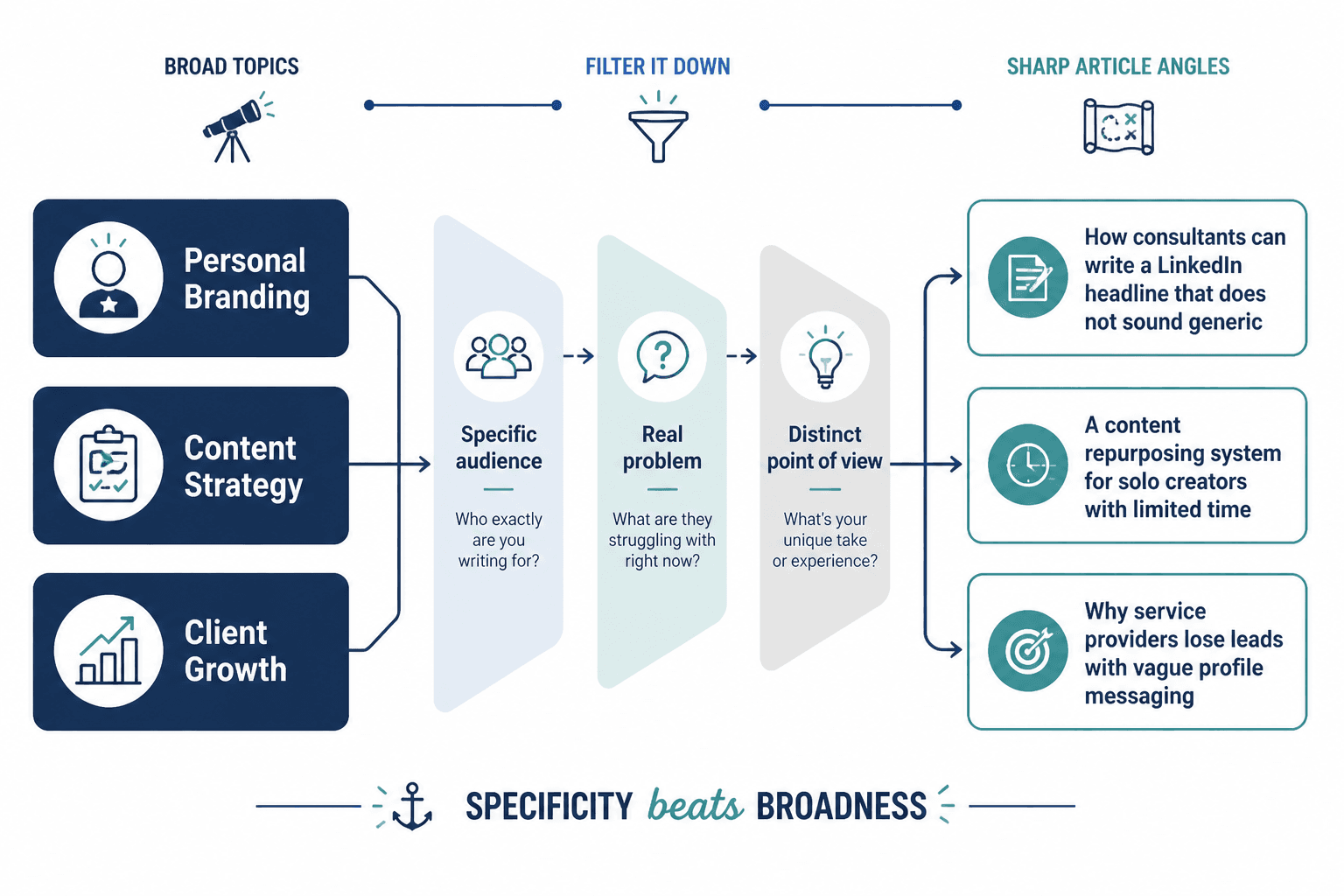
The best LinkedIn article categories for creators
You do not need endless originality. You need useful specificity. These categories tend to work because they align with what LinkedIn articles do well: depth, explanation, positioning, and evergreen trust.
1. Process breakdown articles
These explain how you do something in a way that shows expertise without becoming a free 97-page workshop.
Good for writers, marketers, designers, consultants, coaches, strategists, and service businesses.
Examples:
- How I turn one client call into two weeks of LinkedIn content
- The article writing workflow I use to turn rough ideas into authority content
- My 5-step process for planning a creator content funnel without making it weird
- How to research a niche audience before writing a single post
- The exact framework I use to rewrite boring expert content
Why these work: they reveal method, not just opinion. Readers can imagine hiring you because they can see your thinking in motion.
2. Mistake-focused articles
These perform well because people are often more motivated to fix a mistake than to pursue abstract improvement. Also, LinkedIn is full of repeated bad habits, so you won’t run out anytime soon.
Examples:
- 7 LinkedIn article mistakes that make smart creators sound generic
- Why your content sounds polished but still gets ignored
- The biggest mistake consultants make when writing authority content
- What most personal brands get wrong about thought leadership articles
- Why posting more is not fixing your weak content strategy
Why these work: they create tension fast and make the reader want to diagnose themselves. Just make sure you go beyond finger-wagging and actually show what better looks like.
3. Contrarian or myth-busting articles
This is where creators with a point of view can stand out. But the key word is point. “Hot takes” without proof are just attention-seeking in nicer shoes.
Examples:
- Why most LinkedIn personal branding advice makes people less memorable
- You do not need to post every day to build authority on LinkedIn
- Why “provide value” is bad content advice for creators
- The problem with writing LinkedIn articles like blog posts from 2018
- Why polished content often loses to clear content
Why these work: they create curiosity and invite readers into your worldview. They are especially useful if your business depends on positioning and trust.
4. Example and teardown articles
Examples make advice easier to trust because they show the thing, not just describe it. This matters a lot on LinkedIn, where people have read enough vague content tips to last several lifetimes.
Examples:
- 5 strong LinkedIn article intros and why they work
- Before-and-after rewrites: turning bland expert content into readable authority pieces
- LinkedIn article examples creators can adapt without sounding copied
- 3 article structures that make complex ideas easier to read
- How to turn messy expertise into clean article sections
Why these work: readers can borrow the pattern immediately. They also naturally lead into your services, templates, or deeper resources.
If you want to build these more systematically, pair this with LinkedIn article structures and examples creators can adapt fast.
5. Opinion-plus-proof articles
This is a strong format for consultants, strategists, coaches, and creators with enough hands-on experience to back up a claim.
Examples:
- Why most creator funnels fail before the CTA
- What I’ve learned from reviewing 100 weak LinkedIn profiles
- Why niche clarity beats posting frequency for small creators
- The content habits that quietly kill trust
- What separates useful authority content from self-important noise
Why these work: they combine perspective with evidence. That is far more persuasive than generic listicles with no scars on them.
6. Audience-specific articles
These are often stronger than general articles because they attract the right people faster. Small and specific beats broad and forgettable.
Examples:
- LinkedIn article ideas for coaches who hate sounding salesy
- How freelance writers can use LinkedIn articles to attract better clients
- A simple article strategy for solo consultants with tiny audiences
- What creators selling services should write about on LinkedIn
- How B2B founders can publish articles without sounding like a content committee
Why these work: specificity creates relevance. Relevance creates trust. And trust is still doing most of the heavy lifting, despite what internet hustle culture keeps trying to sell you.
25 LinkedIn article ideas creators can actually use
Here are practical, adaptable ideas. Steal the angle, not the exact wording. Your job is to make the article sound like your experience, your niche, and your actual expertise.
- How I developed a content workflow that wastes less time and produces better posts
- The biggest mistake creators make when trying to build authority on LinkedIn
- What most people misunderstand about writing for trust instead of vanity metrics
- How to choose content topics that attract clients, not random applause
- Why your LinkedIn article intros are getting skipped
- 3 article structures I use when I want to explain something clearly
- What to write about when you have expertise but no “content ideas”
- How to turn client questions into strong LinkedIn articles
- The content advice I ignored, and why that was the right move
- How creators can repurpose one article into posts, carousels, and email content
- Why vague authority content fails even when the writing is decent
- What my article editing process looks like before I hit publish
- How to write a LinkedIn article that leads naturally into your offer
- 5 weak article openings and sharper rewrites
- How small creators can use LinkedIn articles without posting every day
- The difference between educational content and convincing content
- How I’d build a simple LinkedIn article strategy from scratch
- Why fake thought leadership is easy to spot
- What to include in a LinkedIn article if you want leads, not just views
- How to write useful opinion pieces without sounding smug
- The best article topics for coaches, consultants, and service-based creators
- How to make complex expertise readable for busy people
- What your article CTA should actually do
- Why some articles build authority for months and others die on arrival
- How to create a content library on LinkedIn that keeps selling your expertise
Notice what these do not do. They do not chase novelty for its own sake. They aim for useful specificity, clear tension, and direct relevance to the kind of reader who may eventually hire, subscribe, inquire, or refer.
That is the bar. Not “did this sound smart enough.” Not “did this feel thought leader-ish.” Just: did this help the right person trust me faster?
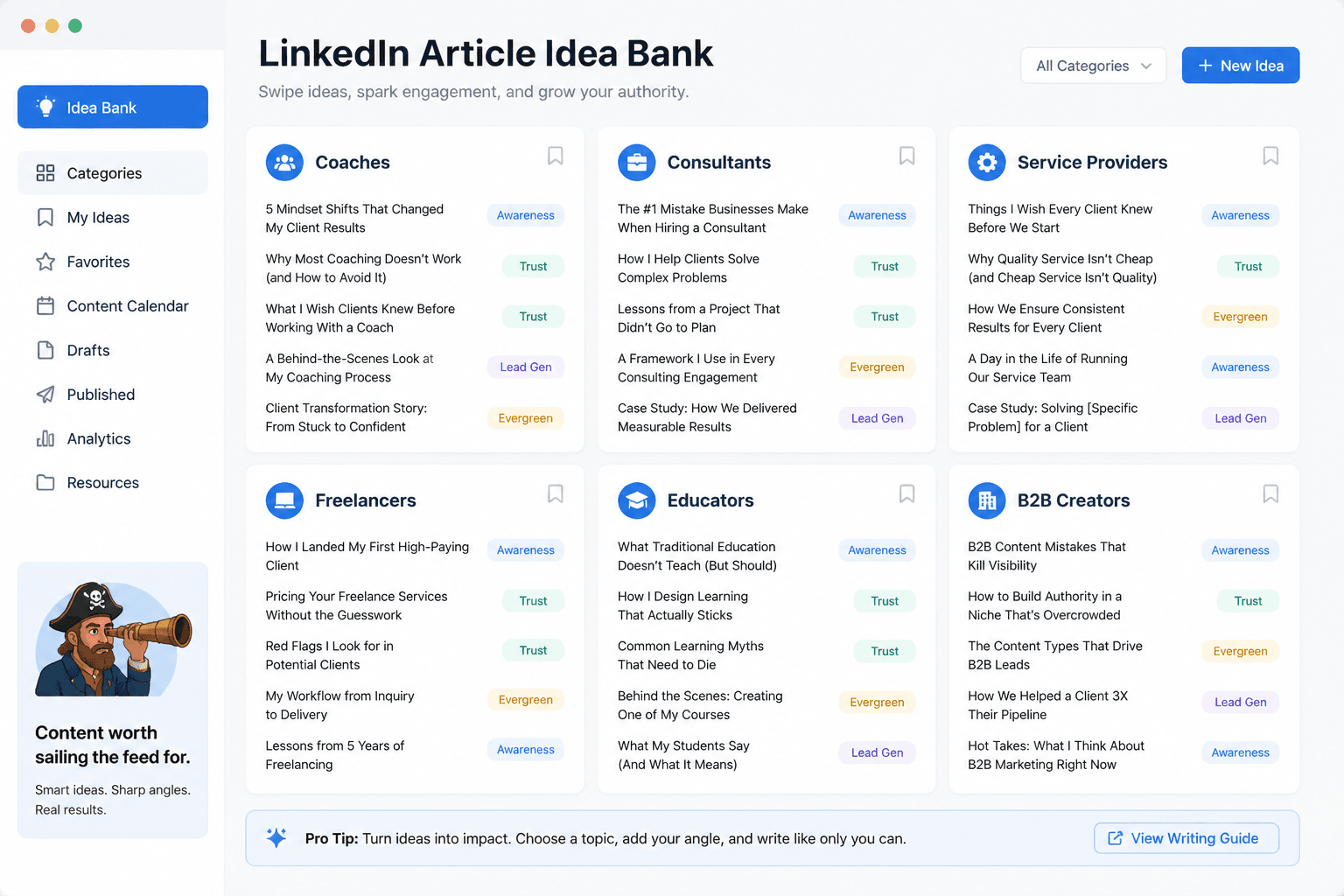
Examples of strong LinkedIn article angles by creator type
The same topic can feel flat or sharp depending on who it is for. Here’s how to shape ideas based on your business model.
For coaches
- Why most coaching content sounds supportive but says very little
- How to write authority content without turning every post into advice soup
- The client belief shifts that matter before someone is ready to buy coaching
- How to explain your coaching process in plain English
Coaches should avoid fluffy inspiration and focus more on insight, patterns, decision-making, and practical transformation. If every article sounds like a motivational mug, the reader has no reason to trust your depth.
For consultants
- The strategic mistakes I see before a company’s content starts underperforming
- How I audit a brand’s message before fixing its funnel
- What clients usually think their problem is versus what’s actually broken
- Why clearer positioning fixes more than another batch of content
Consultants do well with diagnosis articles, process explainers, and sharp point-of-view pieces. You are selling judgment. Your articles should show that.
For writers and content creators
- How to make educational content sound less generic
- What I cut first when a post feels boring
- How to write stronger hooks without sounding like a template zombie
- The editing rules I use to tighten client content fast
Writers should not just tell people to be authentic. That advice has been beaten into powder. Show craft. Show choices. Show rewrites. That is much more convincing.
For solo founders
- What building an offer taught me about messaging that actually converts
- The mistakes I made trying to sound bigger than the business was
- How I explain what we do without using startup wallpaper language
- What early customer conversations revealed that analytics didn’t
Founders have a useful edge when they write with clarity about real decisions, customer understanding, and market lessons. Just do not confuse vague “building in public” updates with useful authority content.
How to turn one vague idea into a strong LinkedIn article
Most article ideas are not bad. They’re just lazy in their first draft form. Here’s a quick way to sharpen them.
Weak idea: Personal branding tips for creators
This is broad, tired, and likely to attract the same kind of attention as beige office carpeting.
Better angles
- Why most creator personal brands feel forgettable on LinkedIn
- 3 profile mistakes that make experienced creators look interchangeable
- How to describe what you do without sounding self-important
- The fastest way to make your creator brand more specific
See the difference? Same territory. Better tension. Better specificity. Better chance of someone actually reading past the headline.
A simple article-angle formula
Use this:
- Topic: What broad area are you discussing?
- Audience: Who is this really for?
- Problem: What specific frustration or mistake are they dealing with?
- Point: What do you believe or recommend?
- Proof: What examples, patterns, or experiences support it?
For example:
- Topic: LinkedIn articles
- Audience: creators selling services
- Problem: their content feels polished but generic
- Point: specificity and article structure matter more than volume
- Proof: examples of weak and stronger angles
That quickly turns into a workable article.
What a strong LinkedIn article should include
A strong idea helps, but execution still decides whether the article earns trust or just takes up space on your profile.
At minimum, your article should include:
- A clear, specific headline
- An opening that gets to the tension fast
- A focused point, not five mushy subtopics
- Useful examples, rewrites, or explanation
- Structure that is easy to scan
- A natural CTA or next step
This is where many creators fumble it. They find a decent topic and then write an intro that spends three paragraphs warming up like the article is about to perform hamstring stretches.
Get to the point faster. State the problem. Show what is broken. Then help the reader fix it.
If you want a fuller walkthrough, read this guide for creators who want better results from LinkedIn articles.
What to avoid when choosing LinkedIn article topics
- Broad topics with no audience angle
- Generic inspiration disguised as expertise
- Topics you cannot support with proof or examples
- Ideas chosen only because they seem “professional”
- Trying to sound impressive instead of useful
- Writing articles that repeat your posts without adding depth
LinkedIn articles are not just longer posts. They should go deeper, carry more authority, and reward the reader for spending more time with you.
If your article could have been a 7-line post with no loss in value, it probably did not need to be an article.
How often creators should publish LinkedIn articles
Not daily. Please relax.
For most creators, one solid article every two to four weeks is enough if the article is genuinely useful and connected to a wider content system. Articles work best when they support your positioning, deepen trust, and give you something substantial to repurpose into posts, emails, talking points, and lead magnets.
That means a smaller number of strong articles can outperform a larger pile of forgettable ones. Especially if each article is tied to a relevant service, offer, newsletter, profile CTA, or conversation path.
For planning and drafting help, these can help:
Use tools to speed up research, outlining, and repurposing. Do not expect them to invent taste, sharpen your positioning, or rescue a dull point. Software is many things. A personality transplant is not one of them.
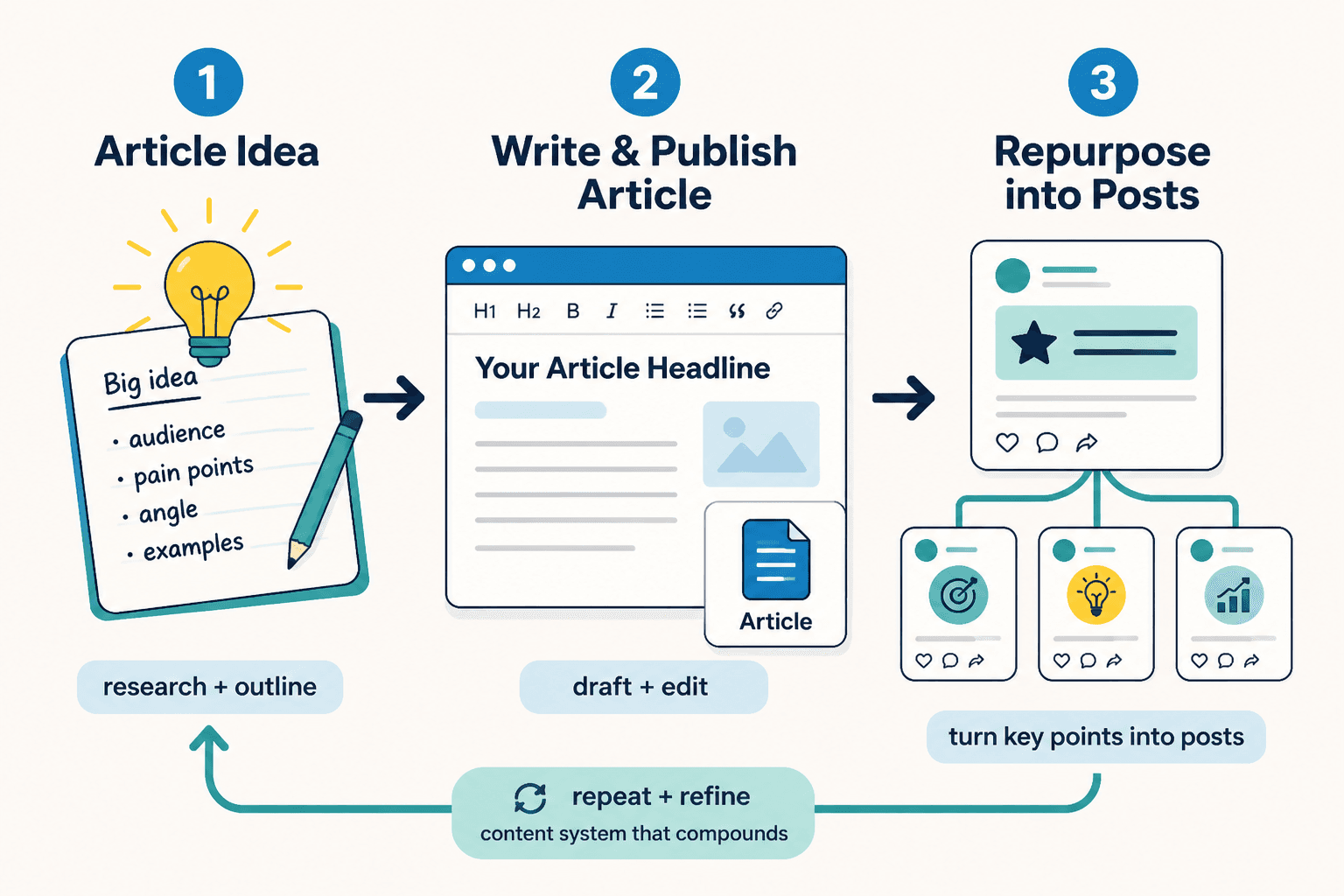
A simple content system for LinkedIn article ideas
If you want article ideas that do not feel random, build from what already happens in your work.
Create four running lists:
- Questions clients keep asking
- Mistakes you keep seeing
- Opinions you can defend
- Processes you repeat often
That alone can feed months of LinkedIn articles.
Then use this simple filter before you write:
- Is this specific enough?
- Is this useful to the kind of person I want to attract?
- Can I add examples, proof, or a clear process?
- Does this reveal my thinking or just restate obvious advice?
- Can this article support a service, offer, profile visit, or deeper conversation naturally?
If the answer is no to most of those, the topic needs sharpening. Or mercy killing. Either is fine.
You can also browse more related resources under social media writing and LinkedIn writing, though frankly that URL situation is trying its best to make things harder than necessary.
Quick FAQ
What are the best LinkedIn article topics for creators?
The best topics are specific, useful, and tied to your actual expertise. Process breakdowns, common mistakes, strong opinions with proof, and example-based articles tend to work well.
How long should a LinkedIn article be?
Long enough to be useful, short enough to stay focused. For most creators, around 800 to 1,800 words works well, but depth matters more than hitting a neat number.
Are LinkedIn articles better than LinkedIn posts?
Not better across the board. Posts are often better for reach and conversation. Articles are better for depth, authority, evergreen value, and giving interested readers something more substantial.
Should creators use AI for LinkedIn articles?
Use AI for speed, outlines, idea expansion, and rough drafting if you want. Do not let it flatten your perspective into generic business paste. Your judgment still matters more.
Pick sharper ideas and the articles get easier
The bigger point is simple: clearer structure and clearer writing make the piece more useful. That is usually what makes the ending land better too.
LinkedIn articles work best when the structure makes the main idea easy to follow and easy to act on. Clearer writing usually carries more weight than heavier formatting.