
Most people do not have a LinkedIn monetization problem.
They have a trust demolition problem.
The posts start out helpful enough. Then suddenly every insight becomes a setup for a pitch, every story ends in a booking link, and every comment thread somehow turns into a sales ambush. Technically, yes, they are “monetizing.” In the same way a guy with a megaphone at your window is “doing outreach.”
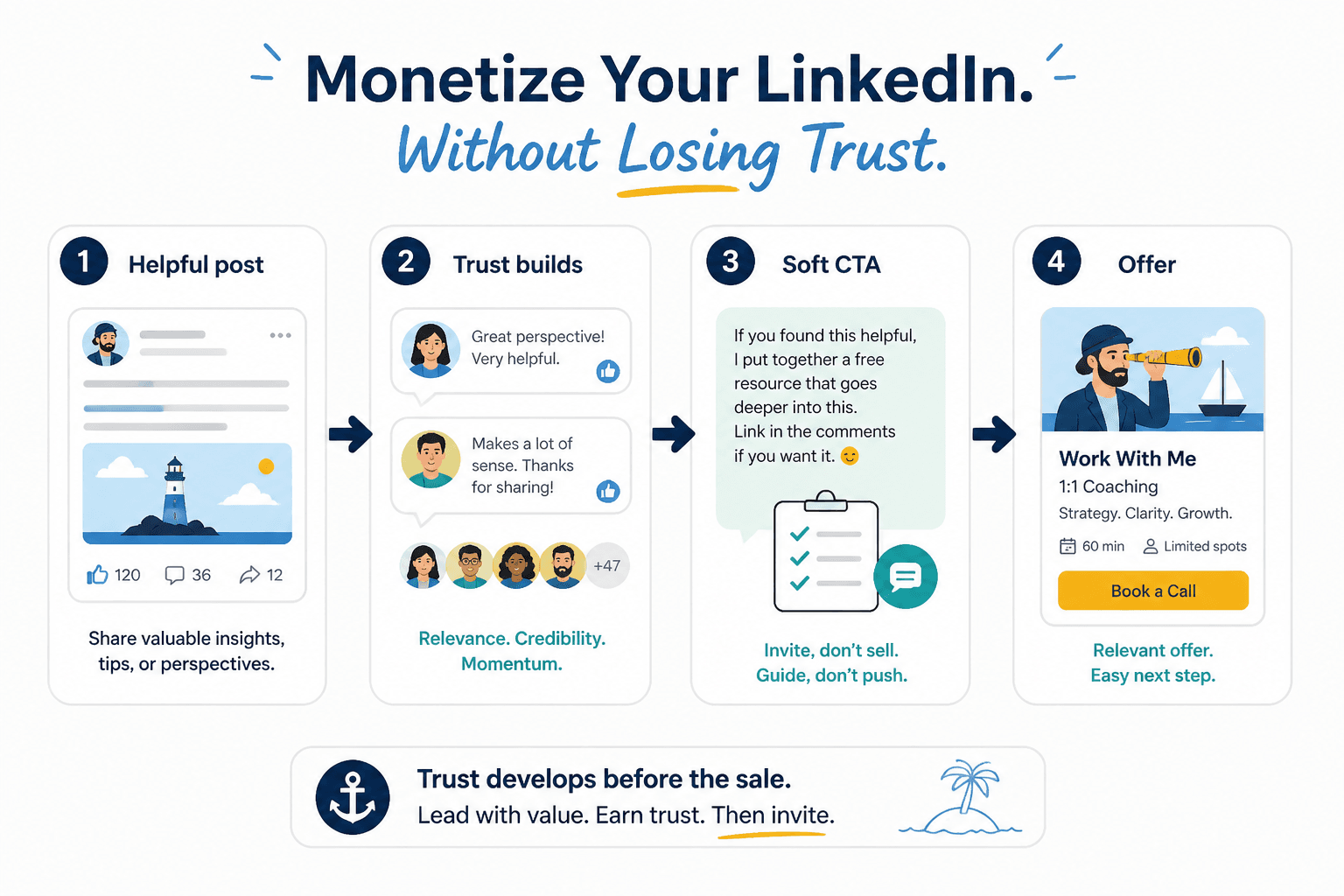
If you want to learn How to Monetize LinkedIn Posts Without Wrecking Trust, the real skill is not squeezing money out of every post. It is building enough relevance, credibility, and momentum that offers feel like the natural next step instead of a trap door.
That means better post-to-offer alignment, cleaner calls to action, more patience, and a little less desperation in the copy. Helpful, I know.
Here is how to make LinkedIn posts lead to revenue without making people regret following you in the first place.
To see how this fits into the wider strategy, open the parent guide.
Why monetizing LinkedIn posts goes wrong so fast
LinkedIn makes it dangerously easy to confuse attention with buying intent.
A post gets comments. A few people like it. Someone says, “This is so true.” You feel a little surge of possibility and decide this is the perfect moment to pitch your offer like rent is due in six minutes.
Usually, that is where things go sideways.
People do not trust you just because they read one decent post. They trust you when your content repeatedly proves three things:
- You understand a problem they actually have
- You can explain it clearly
- You probably have a useful way to help solve it
If your content skips that sequence and goes straight to “DM me for details,” your monetization will feel sticky, rushed, and weird.
This is also why a lot of “content monetization advice” falls apart in the wild. It treats every post like a direct-response ad. But LinkedIn is not just a sales page with profile pictures. It is an ongoing trust environment. People are reading you while quietly asking:
- Does this person know what they are talking about?
- Are they useful or just polished?
- Do they help before they ask?
- Would working with them feel smart or exhausting?
That last one matters more than people admit.
What monetization on LinkedIn should actually look like
Healthy monetization on LinkedIn does not mean every post sells. It means your posts support a clear path to business.
That path can be simple:
- Post → profile → lead magnet
- Post → profile → booking page
- Post → article or newsletter → offer
- Post → comments → conversation → soft DM
- Post → case study → consultation
Notice what is missing: the constant hard close.
A good LinkedIn monetization system lets the post do one job well. Maybe the job is earning attention. Maybe it is showing expertise. Maybe it is creating trust. Maybe it is warming people up to a problem they have not named properly yet.
Not every post needs to carry the full sales process on its back like an overworked intern.
If your posts are useful, your profile is clear, and your offer makes sense, monetization becomes less about forcing action and more about making the next step obvious.
The 5 rules for monetizing LinkedIn posts without wrecking trust
1. Earn attention before you ask for anything
This sounds obvious. It is still where a lot of creators, consultants, and founders blow it.
If your first useful interaction with someone is immediately followed by a pitch, they do not experience that as efficient. They experience it as bait.
Your post should first do at least one of these things:
- Teach something specific
- Reframe a problem clearly
- Show proof of experience
- Name a mistake the reader keeps making
- Give a usable idea they can apply today
Then, if there is a next step, it should feel proportionate.
For example, if you wrote a post explaining why most LinkedIn hooks fail because they are too vague, a reasonable CTA might be:
If you want to sharpen your first lines, I put together a simple framework in my profile resources.
A less reasonable CTA would be:
Comment HOOKS and I’ll tell you how my premium authority accelerator helps you dominate your niche.
One feels useful. The other feels like you learned marketing from a hostage note.
2. Match the offer to the post
Bad monetization often is not too salesy. It is too disconnected.
You write a post about content clarity and then pitch leadership coaching. You share a post about LinkedIn formatting and then link to a generic mindset workshop. You rant about bad funnels and then ask people to buy a template bundle that does not solve the issue you just raised.
If the offer does not fit the post, trust drops fast.
The cleanest monetization happens when the post and the next step are tightly aligned.
| Post topic | Good next step |
|---|---|
| Weak LinkedIn hooks | Free hook guide, post-writing service, messaging consult |
| Content that gets leads | Lead gen audit, funnel consult, newsletter opt-in |
| Profile positioning mistakes | Profile review offer, bio template, brand messaging session |
| Case study on client growth | Discovery call, related service page, waitlist |
This is one reason it helps to build content around your actual commercial lanes instead of posting random “thought leadership” and hoping money appears. Useful content is great. Useful content that also connects naturally to what you sell is much better.
3. Use soft CTAs more often than hard ones
Not every post needs “book a call.” In fact, that CTA gets stale fast, especially if the post itself did not earn it.
Soft CTAs keep momentum without making the post feel like a disguised ad.
Good soft CTA options:
- Point people to your profile for a resource
- Invite readers to follow for more on a specific topic
- Ask a relevant question that starts useful conversation
- Offer a simple template or checklist
- Direct readers to a deeper article or related post
For example:
- “If your posts are useful but still falling flat, read How to Start LinkedIn Posts Without a Weak Opening next.”
- “If you want a cleaner system behind this, I break it down in How to Turn LinkedIn Posts Into More Leads or Sales.”
- “If your writing still sounds polished but strangely lifeless, this will help: How to Write LinkedIn Posts Without Sounding Salesy or Robotic.”
That kind of CTA keeps the reader moving deeper into your world without trying to close too early.
Hard CTAs still have a place. They work best when the post has strong relevance, real proof, and a clear bridge to the offer. But if every post ends with a hard ask, people stop seeing your posts as content and start seeing them as funnel debris.
4. Show proof without turning every post into a victory lap
You need proof to monetize trustably. That part is real.
But LinkedIn has a weird disease where proof often gets dressed up as smug storytelling. The post starts with “I was reflecting this morning…” and ends with revenue screenshots, vague empowerment, and an offer to help you do the same. Nobody has died from reading that, but it does make the platform worse.
Better proof is specific, relevant, and restrained.
Strong proof can look like:
- A small case study with a clear problem and result
- A client example showing what changed and why
- A before-and-after rewrite
- A short process breakdown
- A practical lesson from repeated work, not one lucky win
Example:
A consultant I worked with was posting decent advice and getting polite engagement, but almost no inquiries. The fix was not “post more.” We tightened the hooks, made the audience clearer, and changed the CTA from generic connection-bait to a relevant profile next step. In six weeks, the posts started driving actual calls instead of compliments.
That gives the reader a reason to trust you. It also hints at your offer without screaming about it.
5. Make your profile do some of the selling
If every post is carrying your entire monetization strategy, no wonder things feel aggressive.
Your profile should handle a chunk of the conversion work. That way your posts can focus on earning attention and trust, while the profile gives people a clear next step when they are ready.
Your profile should answer four things quickly:
- Who you help
- What you help them do
- Why they should trust you
- What they should do next
If your headline is vague, your about section is fluffy, and your featured section is a junk drawer, your posts will have to work much harder to monetize. Usually too hard.
Content builds interest. Profiles convert interest into action. Those jobs should work together.
If you want a broader base for this, the parent resource on LinkedIn posts is worth keeping nearby, along with the wider social media writing and LinkedIn writing hub.
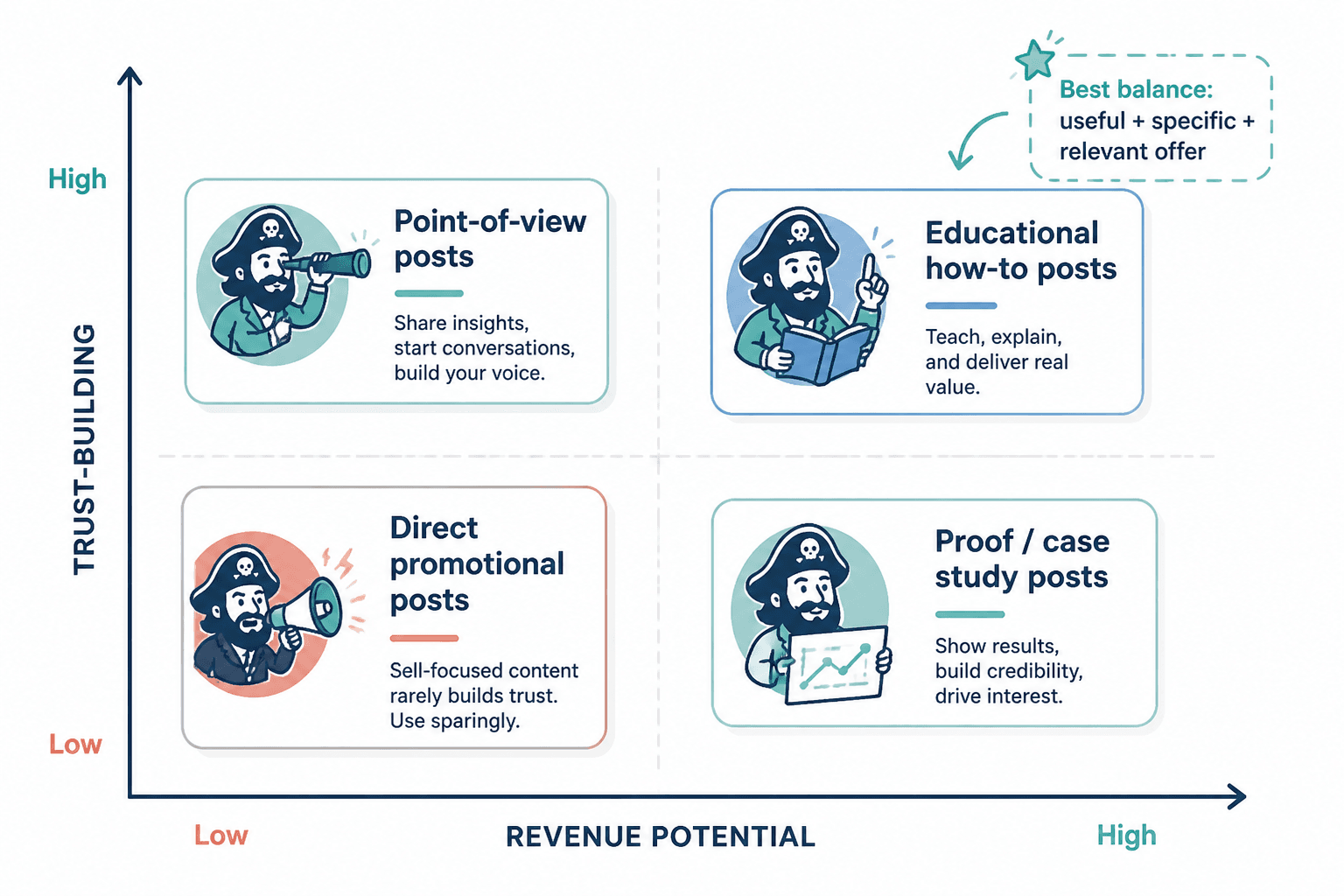
What to post if you want LinkedIn content to lead to revenue
If you only post generic advice, inspirational filler, or recycled platform commentary, monetization will stay weak because nothing in the content points clearly toward your work.
You need content types that build both trust and commercial relevance.
1. Problem-framing posts
These posts help readers understand what is actually going wrong.
Example angles:
- Why useful posts still do not get leads
- Why your profile is leaking intent
- Why “just be consistent” is incomplete advice
- Why posts fail before the second line
These work because people pay for clarity before they pay for execution.
2. Process posts
Show how you think, not just what you believe.
For service businesses especially, process posts are underrated. They make your work feel real. Instead of “I help clients grow on LinkedIn,” show the mechanism.
- How you audit weak posts
- How you turn expertise into a content pipeline
- How you rewrite vague offers
- How you build post-to-profile alignment
That kind of content attracts better-fit buyers because it lets them preview your brain before they ever talk to you.
3. Case study posts
Case studies are one of the cleanest monetization tools on LinkedIn because they combine proof, specificity, and implied demand.
Keep them simple:
- The problem
- What was not working
- What changed
- The result
- The lesson for the reader
Do not make the lesson “hire me.” Let the evidence do some work.
4. Point-of-view posts
Buyers often choose the person whose thinking makes the most sense, not just the one with the longest service menu.
A sharp point-of-view post can do a lot of trust-building if it is grounded in practical truth rather than performative hot takes.
For example:
- Why most content funnels break trust too early
- Why thought leadership without specificity is just expensive wallpaper
- Why lead magnets fail when the post does not earn the click
Opinion helps monetization when it clarifies your standards. It hurts monetization when it turns you into a full-time contrarian with nothing useful to sell.
How to write monetized LinkedIn CTAs that do not feel grimy
A CTA should fit the heat of the post.
If the post is light, keep the CTA light. If the post is deep, specific, and clearly connected to your offer, you can ask for more. People are usually fine with being sold to when the sale makes sense. What they hate is being rushed.
Weak CTA vs stronger CTA examples
| Weak | Stronger |
|---|---|
| DM me if you need help growing on LinkedIn | If your posts are getting engagement but not inquiries, that is exactly the gap I help fix |
| Book a call now | If this is the bottleneck in your content, my profile has the next step |
| Comment YES and I’ll send details | If you want the checklist I use for post-to-offer alignment, it is in my featured section |
| I have 2 spots left this month | If you want help applying this to your own content, you can reach out through my profile |
Notice the difference. The stronger versions are calmer, more specific, and less needy. They assume the reader can make an adult decision without being yanked through a gimmick.
That matters because trust is not just about what you sell. It is about how you ask.
A simple LinkedIn monetization framework that does not feel like a funnel costume
If you want your LinkedIn posts to support revenue consistently, use a simple three-part rhythm:
1. Trust posts
These are your useful teaching posts, insight posts, reframes, breakdowns, and examples. Their job is to earn attention and build credibility.
2. Proof posts
These show evidence that your thinking works in practice. Case studies, client examples, before-and-after rewrites, or mini process walkthroughs all fit here.
3. Offer-adjacent posts
These are the posts where a clearer CTA makes sense because the bridge is already built. Maybe you are discussing a problem your service solves directly. Maybe you are sharing a strong case study. Maybe you are inviting people to a relevant resource or consult.
That rhythm keeps your feed from becoming one long sales brochure while still giving the business side somewhere to live.
And yes, you can repeat this cycle. In fact, you should. Monetization usually improves when your content feels coherent over time, not when every individual post tries to close the deal alone.
Mistakes that kill trust before the sale ever has a chance
Some of these are common enough that they deserve public shaming. Gentle public shaming, but still.
- Turning every post into a pitch. People stop listening when they know the sales turn is always coming.
- Using fake vulnerability as a lead gen tactic. If the emotional confession ends in a calendar link, readers notice.
- Writing broad posts with narrow offers. If the content is vague, the right buyers will not recognize themselves in it.
- Making offers with no proof. Claims are cheap. Receipts help.
- Using thirsty CTAs. “DM me” is not a strategy. It is a shrug with ambition.
- Ignoring the profile. If the post works but the profile confuses people, monetization stalls.
- Sounding robotic. Over-polished AI-ish copy makes trust harder, especially on a platform already drowning in business cosplay.
If that last point is your issue, read How to Write Better LinkedIn Posts alongside this one. Better monetization often starts with better writing, not better closing tricks.
A practical posting mix for revenue without overpitching
You do not need a perfect ratio, but you do need some balance.
A workable mix for many service-based creators and consultants looks something like this over 10 posts:
The bigger point is simple: clearer structure and clearer writing make the piece more useful. That is usually what makes the ending land better too.