Most people are sitting on far more LinkedIn post material than they think.
The problem is not a lack of ideas. It is that they keep trying to post something “new” when they already have old content that could be turned into something sharper, more relevant, and more readable for LinkedIn.
That old webinar, newsletter, blog post, client note, podcast transcript, workshop outline, sales email, or half-decent rant in your notes app? It is probably carrying three to ten usable LinkedIn posts already. It just should not be copied and pasted raw unless your goal is to make people scroll past with professional indifference.
Here’s how to turn old content into better LinkedIn posts without sounding recycled, bloated, or weirdly formal. The goal is not to “repurpose” in the lazy content factory sense. The goal is to extract the strongest ideas, reframe them for the platform, and publish posts that feel native to LinkedIn and useful to actual humans.
To see how this fits into the wider strategy, open the parent guide.
Why old content usually flops on LinkedIn when reused badly
LinkedIn posts are not mini blog posts with line breaks.
They work best when they get to the point quickly, make one clear argument, and give the reader a reason to care within the first line or two. Old content usually fails because people bring over too much context, too much padding, and not enough tension.
A blog post might need setup. A webinar might need transitions. A podcast might wander before it finds the good bit. A LinkedIn post does not have that luxury.
If you want to know how to write better LinkedIn posts, this is one of the biggest upgrades you can make: stop asking, “How do I repost this?” and start asking, “What is the most post-worthy idea buried in here?”
- Do not republish the whole thing
- Do not preserve the original structure out of loyalty
- Do not keep all the background if the point works without it
- Do not assume long equals thoughtful
LinkedIn rewards clarity, not your attachment to the original draft.
What makes old content worth turning into a LinkedIn post
Not every old piece deserves a second life. Some content is dead for a reason.
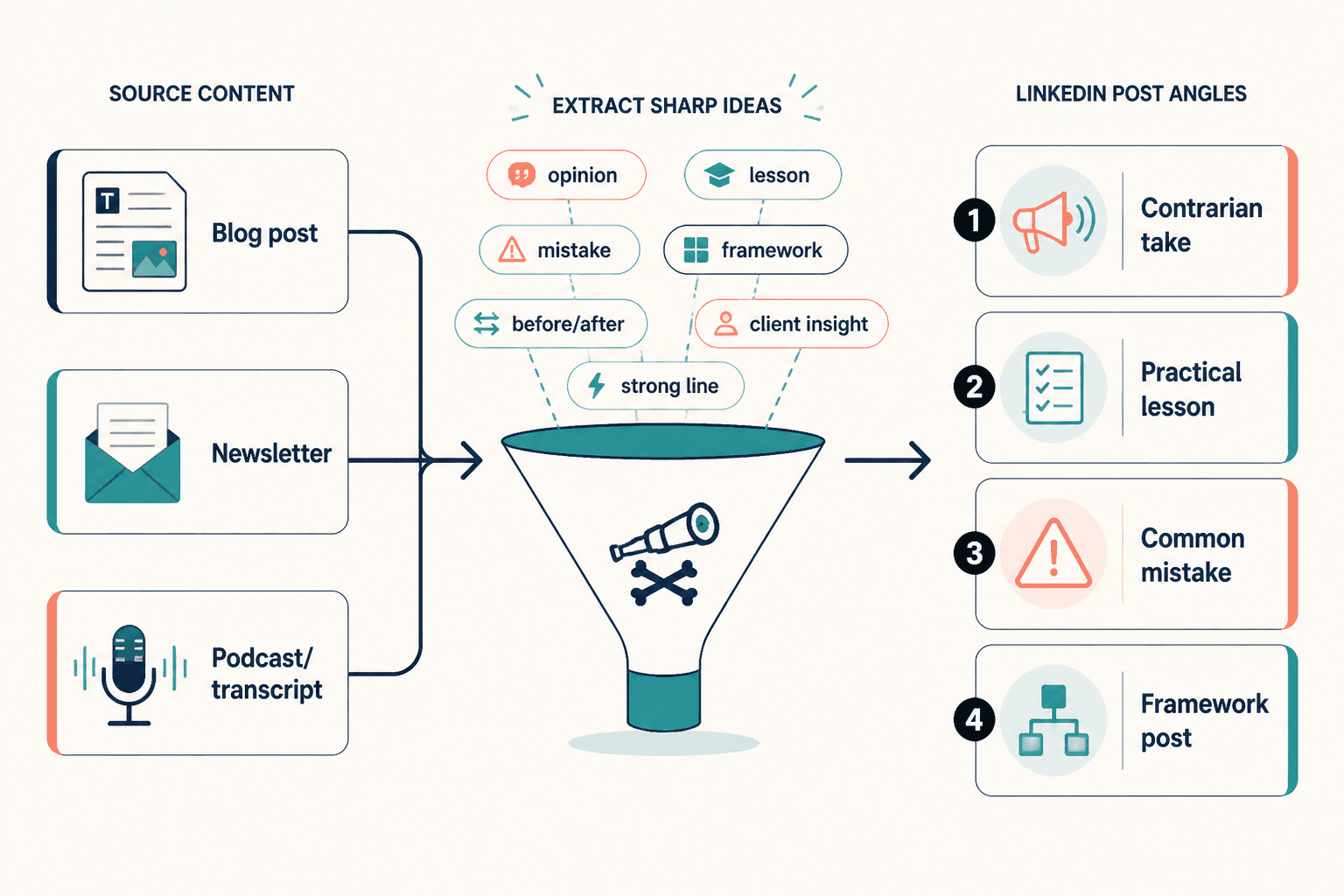
The best source material usually has at least one of these:
- A strong opinion
- A useful lesson
- A specific mistake people keep making
- A framework with a practical payoff
- A clear before/after contrast
- A client insight you can share safely
- A sentence that makes people stop and think, “That’s annoyingly true”
Look for moments that can stand on their own. One useful LinkedIn post often comes from one sharp idea, not from trying to summarize a 2,000-word article into mush.
If your old content is packed with examples, contrarian takes, step-by-step advice, or strong phrasing, good. That is actual material. If it is mostly warm generalities about mindset, growth, and showing up consistently, that is less “content asset” and more digital wallpaper.
How to turn old content into better LinkedIn posts, step by step
Here is the clean process.
1. Find the strongest idea, not the broad topic
“Content strategy” is a topic. “Most content strategy fails because the creator is publishing formats instead of arguments” is a post angle.
That difference matters. Broad topics make bland posts. Sharp angles make readable ones.
As you review old content, pull out:
- The line that says something clearly
- The section where the real opinion appears
- The example people would actually remember
- The part you’d highlight if someone only read one paragraph
If you cannot identify the core idea in one sentence, you are not ready to turn it into a post yet.
2. Match the idea to a LinkedIn-native format
Old content can become different kinds of LinkedIn posts. The trick is picking the format that suits the idea instead of forcing everything into the same shape.
| Old content type | Best LinkedIn post angle |
|---|---|
| Blog post | One contrarian takeaway, one lesson, or one clear framework |
| Newsletter | Opinion post, short story, or pattern you keep seeing |
| Podcast transcript | Quote-led post, insight post, or myth-vs-reality post |
| Webinar or workshop | Checklist post, mistakes post, or simplified process post |
| Sales call notes | Common objection post or misconception post |
| Case study | Before/after breakdown, lesson post, or proof-led insight |
| Email sequence | Short educational post or CTA-led trust-building post |
This is one reason platform fit matters so much. LinkedIn posts thrive on focused utility, practical observations, proof, and clear opinion. If you want a wider view of the platform’s writing style, the LinkedIn posts hub is worth bookmarking.
3. Cut everything the reader does not need immediately
This is where most repurposing goes wrong.
People keep the original setup because they think context makes the post smarter. Usually it just makes the opening slower. LinkedIn readers are not waiting patiently for your scene-setting. They are scanning for relevance.
Cut:
- Long intros
- Background paragraphs
- Corporate throat-clearing
- Anything that only exists to sound polished
- Repeated points from the original piece
Keep the sharpest version of the point. If that feels a little abrupt, good. You can always add one sentence of framing later. Better slightly brisk than painfully padded.
4. Rewrite the opening for attention, not chronology
Old content often begins at the beginning. LinkedIn posts should begin where the interest is.
Bad reused opening:
Last month I gave a workshop on content repurposing, and one of the questions I got from attendees was about how often they should recycle old content across multiple platforms.
Better LinkedIn opening:
Most people do not need more content ideas.
They need to stop ignoring the good ideas buried in the content they already made.
See the difference? One starts with event logistics. The other starts with the point.
If your opening line does not create clarity, tension, curiosity, contrast, or recognition, rewrite it.
And yes, this is often the difference between a post that gets polite silence and one that earns saves, comments, profile clicks, and maybe even business.
5. Make it about the reader faster
Your old content may be centered on your process, your presentation, your article, or your experience. That is fine at source level. But the LinkedIn version needs to connect the idea to the reader’s problem fast.
Ask:
- Why should this matter to someone scrolling LinkedIn today?
- What mistake does this help them fix?
- What result does this improve?
- What belief does this challenge?
Then build the post around that angle.
For example, a workshop section called “Repurposing your content ecosystem” probably should not survive intact. A LinkedIn version might become:
If your old content keeps underperforming on LinkedIn, the problem usually is not the idea.
It is that you are reposting formats instead of rewriting for the platform.
Same underlying concept. Much better packaging.
6. Add proof, examples, or contrast
A lot of repurposed posts sound tidy but forgettable because they make claims without texture.
If you want the post to feel grounded, add one of these:
- A quick before/after rewrite
- A specific mistake you keep seeing
- A short client-safe observation
- A simple example from your own work
- A contrast between weak and strong execution
Example:
Weak repurposed point: Repurposing helps you save time and maximize your content output.
Better LinkedIn version: If your “repurposed” LinkedIn post still reads like a webinar transcript with line breaks, you did not save time. You just moved the boredom to a new platform.
That one has shape. It has tension. It actually says something.
7. End with a CTA that fits the post
Do not drag a sales CTA onto every reused post like a folding chair at a wedding.
Some repurposed posts should simply build trust. Others can invite conversation. Some can point to a resource, article, or offer. The key is fit.
- Insight-heavy post: invite reflection or discussion
- Teaching post: point to a related resource
- Proof-led post: invite profile visit or inquiry
- Opinion post: ask a sharp question if it genuinely adds something
If CTA endings are where your post goes slightly limp, read better LinkedIn posts CTA endings for personal brands. It will save you from ending everything with “What do you think?” like a nervous panel moderator.
A simple rewrite framework for old content
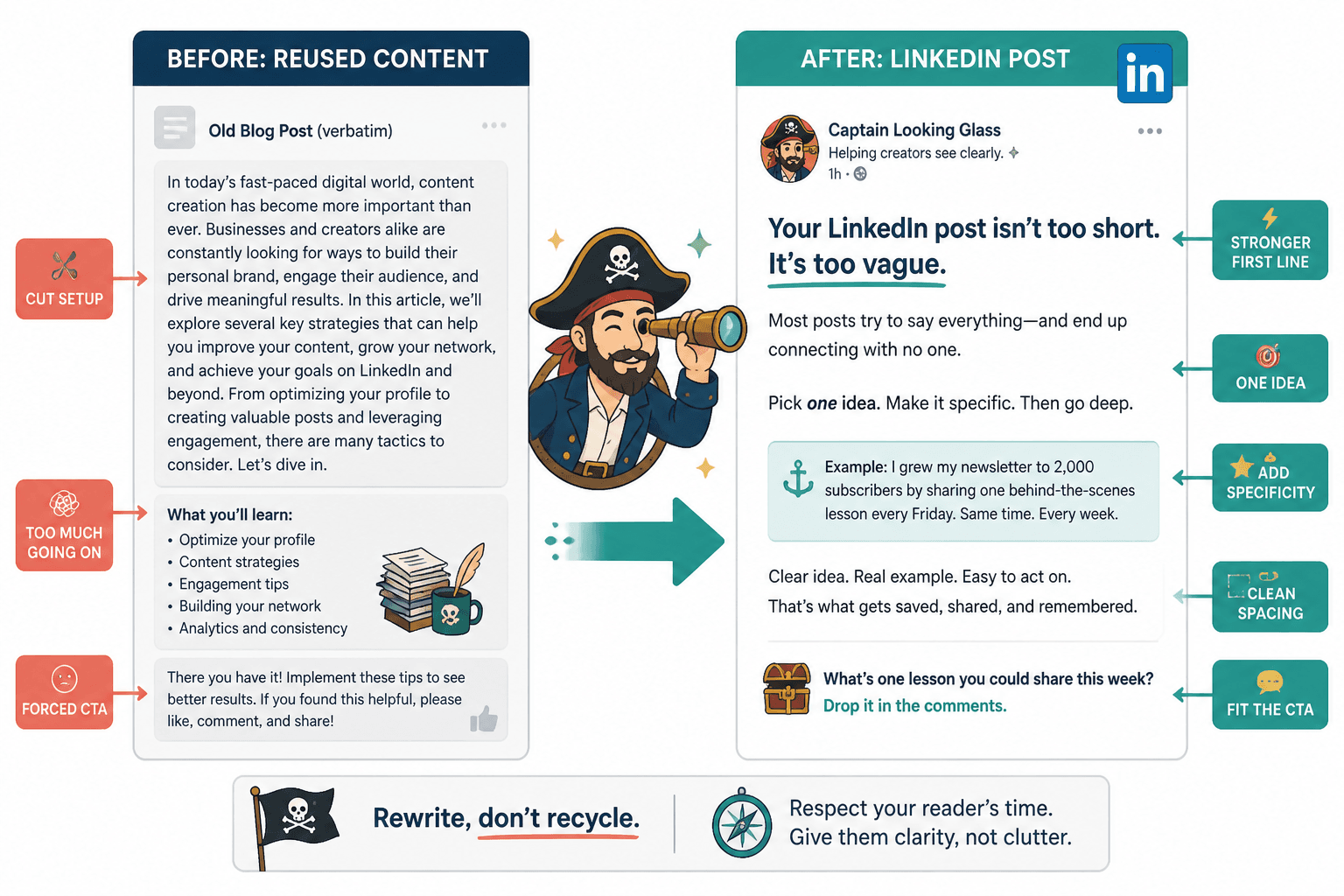
When you want a repeatable method, use this:
- Pull the source: blog, email, transcript, notes, article, workshop, thread
- Highlight 3 strong ideas: not topics, actual claims or lessons
- Choose 1 idea per post: do not cram all 3 into one update
- Write a stronger first line: lead with the point, tension, or mistake
- Cut the setup: remove anything not needed for the post to work
- Add specificity: example, contrast, proof, or quick breakdown
- Format for LinkedIn: readable spacing, clean rhythm, no giant slab
- Finish with the right CTA: comment, profile, resource, lead magnet, offer
That process works because it respects the platform instead of treating LinkedIn like a recycling bin with a logo.
Before-and-after examples
Example 1: Turning a blog paragraph into a stronger post
Original blog line:
Building an effective content strategy requires understanding the needs of your audience and creating content that aligns with each stage of the customer journey.
Repurposed badly:
To create better content, you need to understand your audience and meet them where they are in the customer journey.
Repurposed properly for LinkedIn:
Most content strategy advice sounds smart until you try to use it.
“Meet your audience where they are” is not wrong.
It is just too vague to help.
A better question is:
What does this person need to believe before they buy from me?
That question gives you something to write.
“Know your audience” does not.
Example 2: Turning workshop notes into a post
Original workshop point:
Repurposing content can improve efficiency by reducing the time spent ideating and drafting across multiple channels.
Better LinkedIn post angle:
Repurposing is not copying the same content onto five platforms.
It is taking one solid idea and rebuilding it for five different reading environments.
Same idea.
Different hook.
Different pacing.
Different payoff.
If you skip that part, your “efficient” content starts sounding like it was mailed in by a committee.
The bigger point is simple: clearer structure and clearer writing make the piece more useful. That is usually what makes the ending land better too.