
Most LinkedIn post examples are either painfully generic or weirdly performative.
You get the usual suspects: the fake vulnerable confession, the “5 lessons from my journey” post that says nothing, or the smug little story clearly written to funnel people into a discovery call they did not ask for. None of that helps coaches, consultants, or personal brands build actual trust.
If you want better LinkedIn posts, you need examples that match how real experts grow: clear opinions, useful ideas, a bit of personality, and a format that does not read like AI in a blazer.
This guide gives you exactly that. You will get LinkedIn posts examples for coaches, consultants, and personal brands, plus why each one works, where people usually ruin it, and how to adapt the structure to your own business without sounding copied and pasted.
To see how this fits into the wider strategy, open the parent guide.
What good LinkedIn posts examples actually show
A useful LinkedIn post example should do at least one of these well:
- Make a sharp point fast
- Show expertise without sounding desperate to prove it
- Turn a client insight into something broadly useful
- Build trust without oversharing for applause
- Lead naturally to conversation, profile visits, or inquiries
That is the standard. Not “went viral.” Not “got 500 comments from other creators congratulating each other.” Just useful, credible, readable content that moves the right people closer.
And yes, the format matters. A strong idea buried under a weak first line is still a weak post in practice. If your hooks and formatting need work, read this guide to better LinkedIn hooks and formatting after this one.
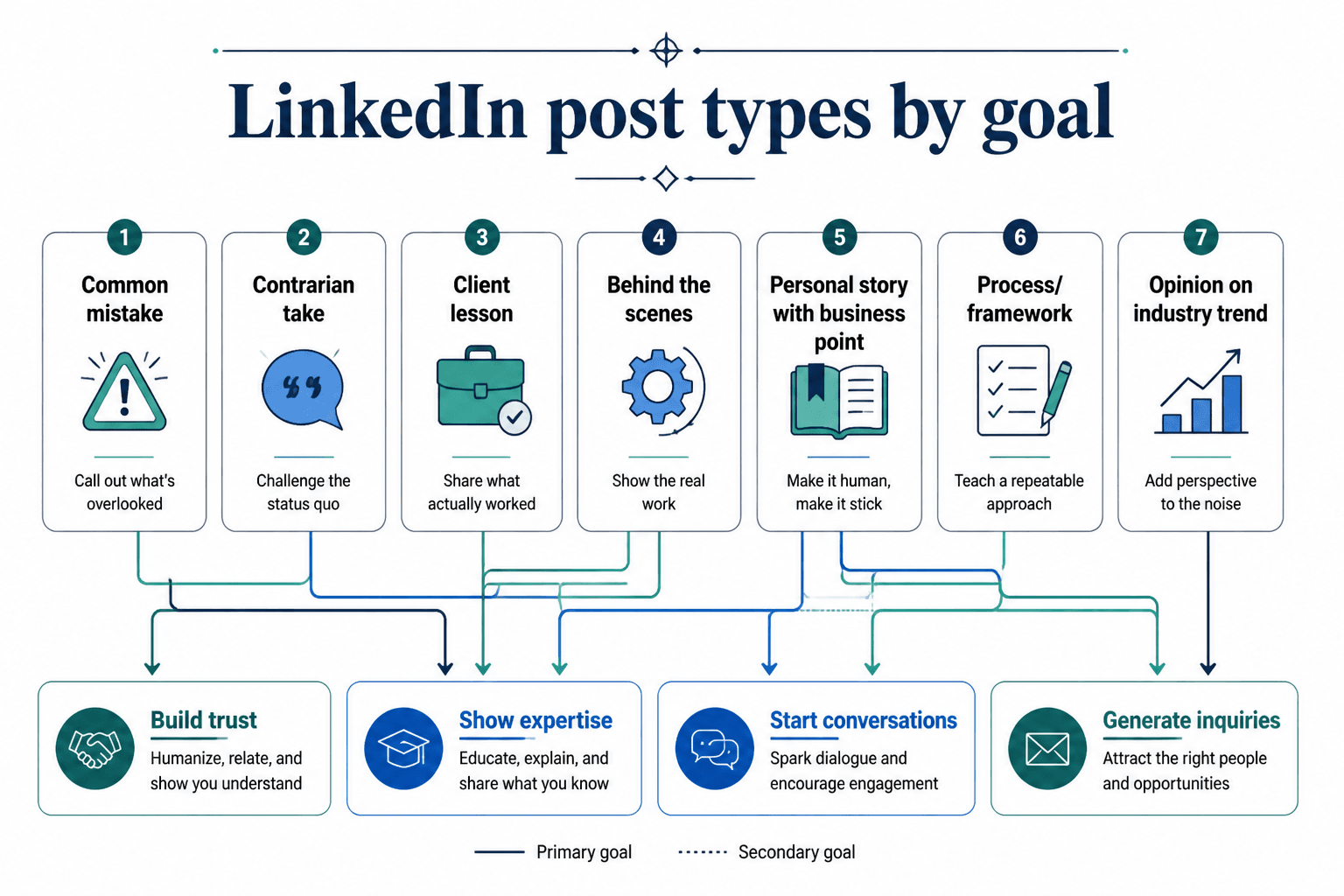
7 LinkedIn post examples that actually work
These are not magic formulas. They are practical post types that tend to work well for coaches, consultants, and personal brands because they combine insight, clarity, and relevance.
1. The “common mistake” post
This works because people pay attention when you name a mistake they are probably making right now.
Most consultants do not have a lead problem.
They have a clarity problem.
Their posts talk about “transformations,” “results,” and “strategy” in the abstract.
But the buyer is wondering something much simpler:
Can you solve a specific problem I actually have?
If your content sounds polished but vague, people do not assume you are premium.
They assume you are hiding behind language.
Clear beats impressive almost every time.
Why it works: It starts with tension, challenges a lazy assumption, and lands on a practical truth. It sounds like someone who has seen the pattern before.
Use it when: You want to show expertise quickly and attract people dealing with a specific problem.
2. The client-pattern post
This is one of the best LinkedIn posts examples for service businesses because it turns private work into public credibility without exposing client details.
A pattern I keep seeing with smart founders:
They are not bad at content.
They are trying to make one post do four jobs.
Teach.
Tell a personal story.
Pitch the offer.
Sound impressive.
That is why the post feels muddy.
A better approach:
Write one post to earn attention.
Another to build trust.
Another to drive action.
Content gets better when each post has one main job.
Why it works: It borrows authority from lived pattern recognition. It also gives the reader a clean mental model they can use immediately.
Watch out for: Vague “my clients struggle with mindset” fluff. If the pattern is not concrete, the post dies quietly.
3. The opinion post with teeth
LinkedIn is full of timid opinions dressed up as insights. A good opinion post is not loud for the sake of it. It just says something clearly enough that people know where you stand.
Hot take: not every expert needs a newsletter.
If you cannot turn one useful idea into one strong post a week, a newsletter is not your next move.
It is just another place to be inconsistent.
Build demand first.
Then build infrastructure around demand.
Too many personal brands are creating containers for attention they have not earned yet.
Why it works: It is clear, slightly provocative, and backs the opinion with logic instead of drama.
Use it when: You want to sharpen positioning and attract people who agree with your approach.
Done well, this kind of post makes your content feel more alive. Done badly, it turns into theatrical contrarianism. There is a difference. One has a point. The other just wants comments.
4. The mini case study post
If you are a coach or consultant, this is one of the cleanest ways to build trust. It gives proof without needing a giant testimonial graphic every five minutes.
One simple fix improved a client’s LinkedIn post performance fast:
We stopped opening with context and started opening with the actual point.
Before:
“I have been thinking a lot lately about what makes content connect…”
After:
“Most content does not fail in the middle. It fails in the first line.”
Same expertise.
Much better packaging.
A lot of “underperforming content” is really just weak framing.
Why it works: It shows process, not just outcome. That makes you sound more credible than a chest-thumping “helped my client 10x their growth” post with no explanation.
If you want more examples in this lane, pair this article with these LinkedIn post ideas and examples for creators.
5. The simple framework post
People love frameworks because they make expertise feel usable. The trick is not making them sound like they were generated by a consultant bingo machine.
A simple test for stronger LinkedIn posts:
Before you publish, check for 3 things:
1. A clear point
2. A specific angle
3. A reason to care nowIf one is missing, the post probably feels flat.
Useful is not enough.
It also has to feel relevant, readable, and worth stopping for.
Why it works: Easy to skim. Easy to remember. Easy to apply.
Use it when: You want saves, shares, and profile credibility.
6. The behind-the-scenes decision post
This works well for personal brands because it shows how you think, not just what you know. That matters a lot when people are deciding whether to hire you.
One content decision I made this year:
I stopped trying to sound universally appealing.
My posts got clearer when I wrote for people who already value sharp positioning, practical strategy, and clean messaging.
That means some people will find my content too direct.
Fine.
Broad appeal is expensive. It usually costs clarity first.
Why it works: It reveals standards, taste, and positioning. Those are underrated sales assets.
This type of post is especially good if your work involves strategy, messaging, branding, leadership, content, or any service where buyers are partly hiring your judgment.
7. The soft CTA post
A lot of people ruin good LinkedIn posts with endings that sound like they were stolen from a webinar landing page.
If your content is useful but your profile is vague, you are making people work too hard.
Your posts earn attention.
Your profile should convert that attention into the next step.
Not with hype.
With clarity.
If you help a specific kind of client solve a specific kind of problem, your profile should make that obvious in seconds.
If you are fixing your LinkedIn content right now, start there.
Why it works: It has a clear next step without sounding clingy or forced.
If your post endings are weak, go read these better LinkedIn post CTA endings. A strong ending can rescue a decent post. A bad one can make the whole thing smell like a pitch.
How to adapt these LinkedIn posts examples to your business
Copying the structure is fine. Copying the voice, point, and angle is not. That is how your content starts sounding suspiciously familiar and strangely hollow.
Use this simple process instead.
- Pick one real idea you actually believe.
Not a topic. An actual point. - Choose the post type that fits it.
Mistake, pattern, opinion, case study, framework, decision, or soft CTA. - Make it specific to your audience.
Say who this is for or what situation this applies to. - Lead with the sharpest line.
Do not warm up for five sentences first. - Cut anything that sounds inflated.
If it smells like “thought leader” cosplay, remove it.
That last bit matters more than people think. A lot of decent experts ruin their posts by trying to sound more impressive than they are. Which is odd, because being specific and useful is usually what sounds impressive in the first place.
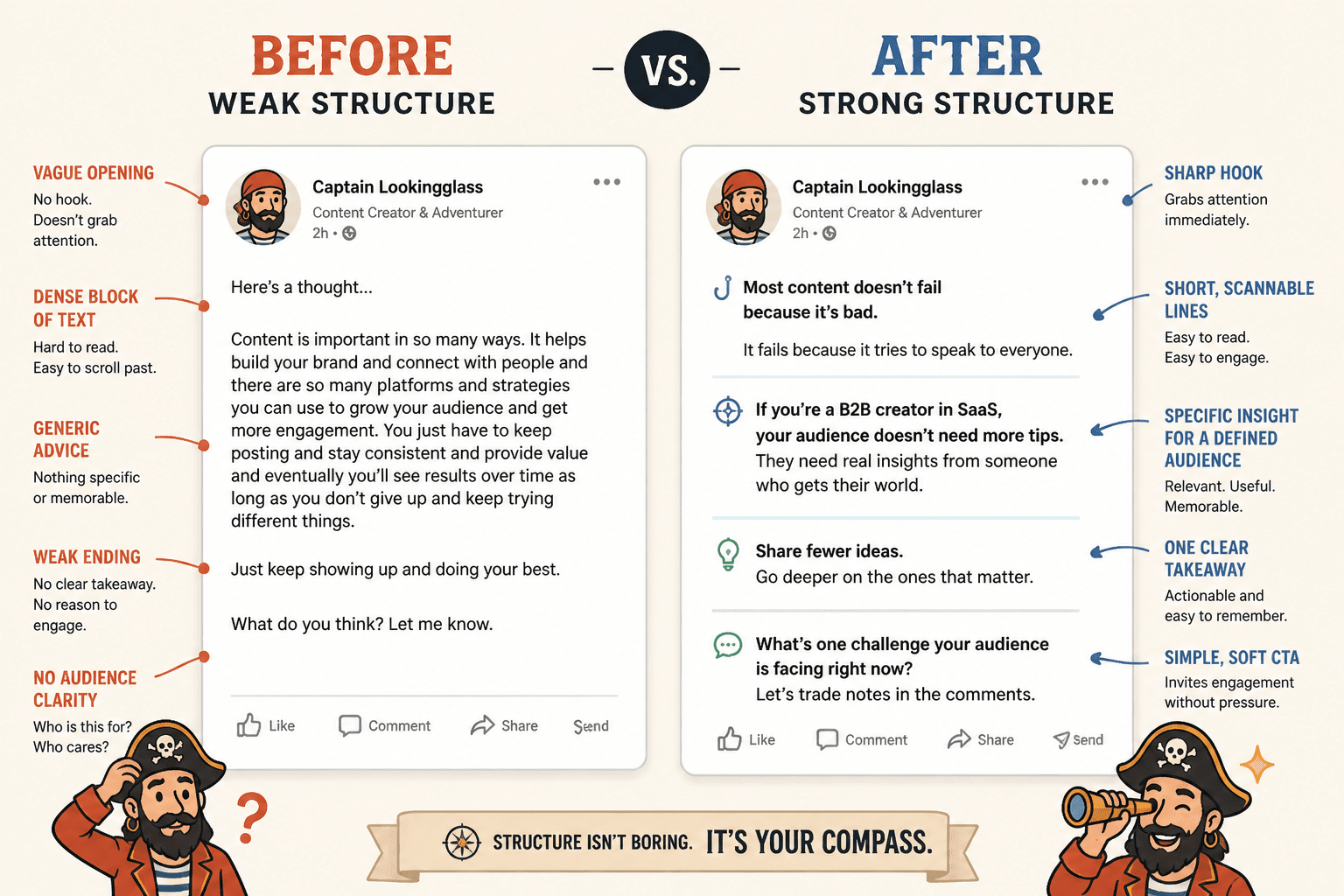
Before and after: boring LinkedIn post vs stronger LinkedIn post
Here is a quick rewrite example, because sometimes the difference is easier to see than explain.
Before
I have been reflecting on the importance of authenticity in personal branding. In a world where so many people are trying to stand out, it is essential to be true to yourself and communicate your unique value. Authenticity builds trust and helps you connect with your audience on a deeper level.
This is not terrible. It is just foggy, generic, and extremely easy to ignore.
After
“Be authentic” is useless branding advice.
Not because authenticity is bad.
Because it is too vague to help anyone write better.
A better question is:
What do you consistently sound like when you are being clear, honest, and specific?
That is usually where a real brand voice starts.
Not in self-expression for its own sake.
In recognizable clarity.
Same broad topic. Much stronger post. It has tension, a clear angle, and a phrase worth remembering.
What coaches, consultants, and personal brands should stop posting
A quick reality check. Better examples help, but so does knowing what to stop doing.
- The fake humblebrag: “Still processing this incredible honor…” followed by 11 paragraphs of self-congratulation.
- The lesson list with no lesson: “3 things entrepreneurship taught me” and all 3 are obvious.
- The vague inspirational sermon: sounds warm, says nothing.
- The disguised pitch post: pretends to teach, exists to shove people into a funnel.
- The AI oatmeal post: polished, balanced, empty, and weirdly bloodless.
If your content keeps underperforming, it may not need more consistency. It may need more point of view. There is a difference, and LinkedIn notices it faster than people think.
A simple LinkedIn post template you can actually use
If you want one flexible structure from these LinkedIn posts examples for coaches, consultants, and personal brands, use this:
- Opening line: say the sharpest true thing first
- Expansion: explain why that point matters
- Example or pattern: add proof, context, or contrast
- Takeaway: state the useful lesson plainly
- Ending: invite reflection, profile action, or conversation softly
Filled-in example:
The bigger point is simple: clearer structure and clearer writing make the piece more useful. That is usually what makes the ending land better too.