Most LinkedIn posts do not flop because the idea is bad. They flop because the first line is sleepy, vague, or trying way too hard to sound important.
A weak hook makes a solid post invisible. A sharp hook gives the post a chance. Not a guarantee. Just a chance, which is already better than opening with “I’ve been reflecting lately…” and watching the feed move on without you.
If you want better LinkedIn hook examples creators can adapt fast, the real job is not copying dramatic one-liners from people cosplaying as thought leaders. It is learning what a good hook is actually doing so you can write your own without sounding borrowed.
Here’s how to write hooks that feel clear, specific, scroll-stopping, and still human. You’ll get examples, rewrites, plug-and-play templates, and a simple way to match the hook to the kind of post you’re publishing.
To see how this fits into the wider strategy, open the parent guide.
What a LinkedIn hook is supposed to do
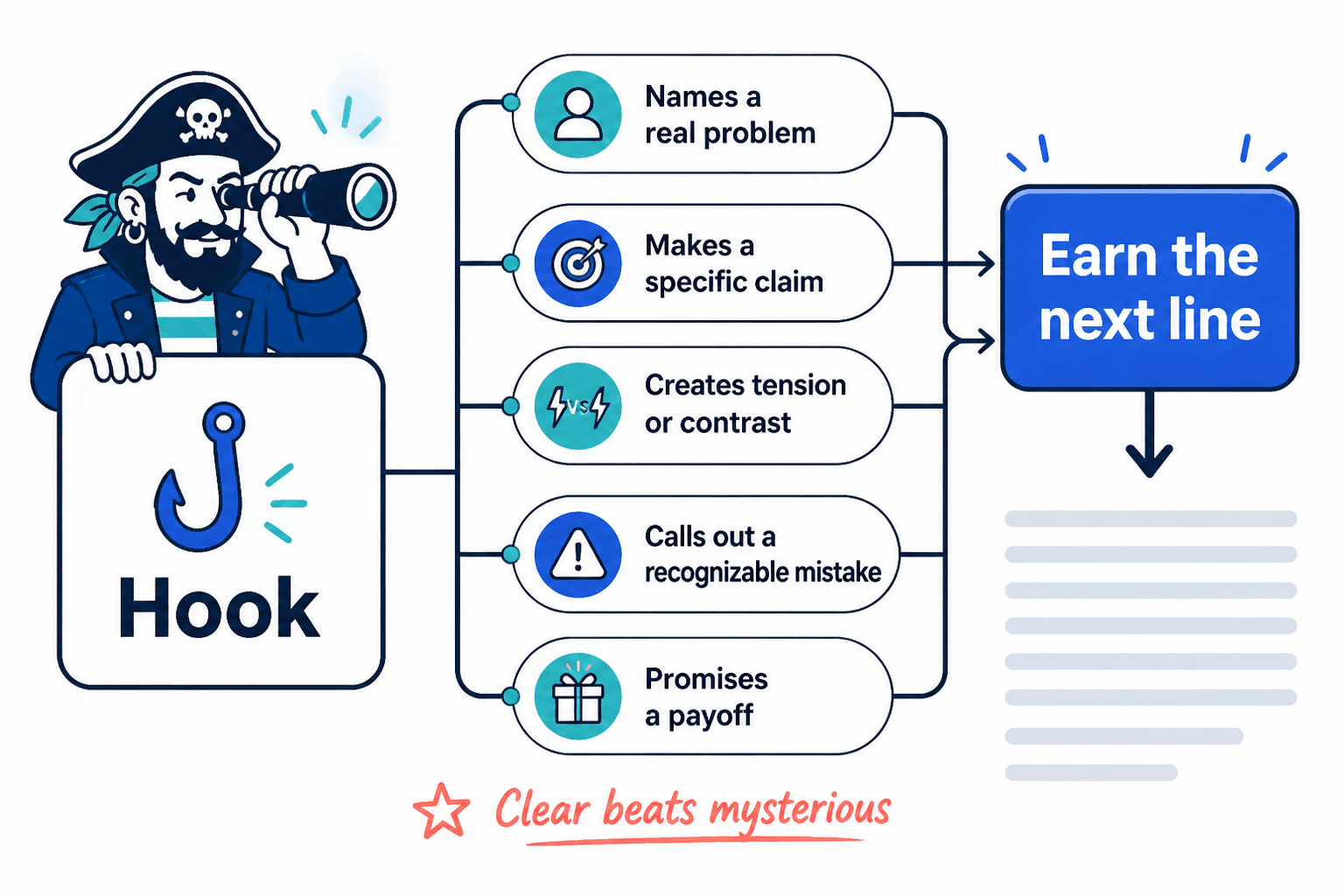
A hook is not there to be clever for its own sake. It has one job: earn the next line.
That means a strong first line usually does at least one of these things:
- Names a real problem fast
- Makes a specific claim
- Creates useful tension or contrast
- Calls out a mistake the reader recognizes
- Promises a payoff without sounding like clickbait
Good hooks do not need to be mysterious. In fact, most bad hooks fail because they are trying to be mysterious instead of clear.
On LinkedIn, clarity usually beats theatrics. People are scrolling between meetings, inboxes, client work, and low-level existential fatigue. You do not have ten lines to warm up. You have one line to make the post feel worth reading.
Why most LinkedIn hooks fall flat
If your hooks are getting polite silence, one of these is probably happening.
1. They are too vague
“Something changed for me this year.”
Changed how? Why should anyone care yet? This kind of opening asks the reader to do emotional admin before you’ve earned it.
2. They sound like recycled LinkedIn wallpaper
“Here’s what nobody tells you about success.”
Plenty of people tell us plenty of things about success. Usually too many things. This line feels generic because it is generic.
3. They hide the point
Some creators think holding back the main idea creates curiosity. Usually it just creates friction.
Curiosity works best when the reader understands the category of value they are about to get.
4. They use drama where specificity would work better
“I almost quit everything.”
Maybe true. Still weak if the post turns out to be about changing your content calendar or updating your bio. The tension has to match the payoff.
A simple formula for writing better hooks faster
If you want a practical shortcut, use this:
Specific problem or point + clear angle + implied payoff
Example:
Weak: I learned an important lesson about content this week.
Stronger: Most content advice fails because it assumes your audience has more patience than they actually do.
The second one works better because it has a point. It creates a small jolt of recognition. It also hints that the post will explain what to do instead.
If you want more on first-line structure and scannability, this guide on LinkedIn hooks and formatting scroll stoppers pairs well with what you’re reading here.
LinkedIn hook examples creators can adapt fast
Below are hook types that actually fit the platform. Not because LinkedIn users are magical business elves, but because professional feeds reward clarity, relevance, and useful tension more than empty drama.
1. The mistake hook
Use this when the post corrects a common assumption.
- Most LinkedIn posts do not fail because the writing is bad. They fail because the angle is forgettable.
- The problem with most creator bios is not that they are too short. It is that they say nothing specific.
- A lot of consultants are posting “valuable” content that never leads to business.
- Most calls to action feel awkward because they arrive like a pitch slap, not a natural next step.
Template: Most [thing] do not fail because [obvious reason]. They fail because [actual reason].
2. The uncomfortable truth hook
Good for opinion posts, authority posts, or contrarian takes that are still useful.
- If your content only sounds polished, it is probably also easy to ignore.
- Being “consistent” is not enough if every post sounds like a softer version of the last one.
- More content will not fix weak positioning.
- You do not need a better content calendar as much as you need stronger points of view.
Template: [Common advice] is not enough if [deeper issue].
3. The specific observation hook
This works well when you want to sound thoughtful without sounding inflated.
- The fastest way to make a smart post feel dull is to bury the point under a polite introduction.
- There is a weird trend on LinkedIn where people write like they are accepting an award for having a calendar.
- Short posts work beautifully when the idea is sharp. They fail miserably when they are just underwritten.
- The more expertise someone has, the more likely they are to over-explain the easy part and skip the useful part.
4. The direct problem hook
Useful when your reader already knows the pain and wants help quickly.
- Still posting useful advice that gets polite silence?
- If your LinkedIn posts sound smart but never start conversations, this is probably why.
- Getting views but no leads from LinkedIn usually means one thing.
- If writing the first line takes longer than the rest of the post, use this approach.
Template: If your [content/result] is [frustrating outcome], this is probably why.
5. The contrast hook
Contrast is one of the easiest ways to make a hook feel sharp.
- Helpful content gets attention. Useful opinions build authority.
- Reach content gets seen. Trust-building content gets remembered.
- Being clear is good. Being clear and specific is better.
- A polished post can impress people. A precise post can convert them.
These work because the reader can feel the distinction immediately.
6. The proof-led hook
Use this if you have actual evidence, results, or experience worth naming.
- I reviewed 50 creator bios last month. Most of them had the same problem.
- After rewriting dozens of LinkedIn intros, one pattern keeps showing up.
- The highest-converting posts I see are usually not the longest or the loudest.
- I keep seeing founders bury their best idea in paragraph four.
Notice the difference between proof and fake authority. Proof sounds grounded. Fake authority sounds like someone rented confidence by the hour.
For more examples of post structure after the hook, this collection of LinkedIn post examples for coaches, consultants, and personal brands can help.
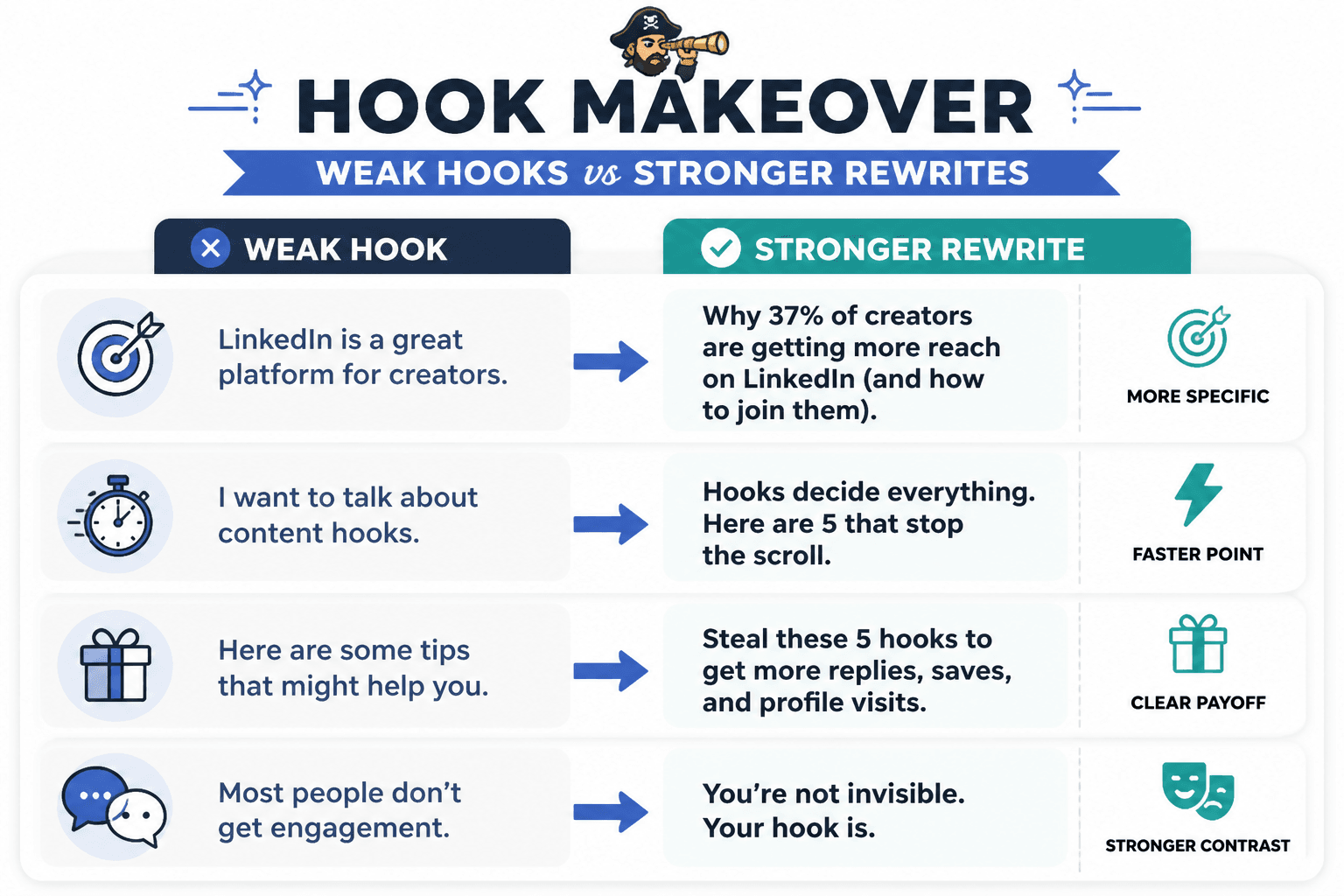
Before-and-after LinkedIn hook rewrites
Sometimes the fastest way to improve is to see the bad version beside the better one.
| Weak hook | Stronger rewrite |
|---|---|
| I have been thinking a lot about content lately. | Most creators do not need more content ideas. They need stronger ways to package the ones they already have. |
| Here is something nobody tells you about personal branding. | Personal branding advice gets weird fast when it forgets the audience is supposed to understand what you actually do. |
| I learned an interesting lesson from a recent client project. | A recent client project reminded me how often experts explain the process and skip the result people actually care about. |
| I used to think consistency was everything. | Consistency matters, but repetitive content does not become valuable just because you posted it every day. |
| Excited to share a few thoughts on LinkedIn posting. | If your LinkedIn posts feel solid but keep disappearing into silence, fix the first line before you fix anything else. |
See the pattern? The stronger versions get to the point faster, say something more specific, and imply a useful payoff.
How to choose the right hook for the kind of post you are writing
Not every hook type fits every post. You will save yourself a lot of awkward first lines if you match the opening to the post’s actual job.
For educational posts
Use mistake hooks, direct problem hooks, or proof-led hooks.
Example: Most LinkedIn posts with “good advice” still fail because the takeaway is too broad to use.
For opinion posts
Use uncomfortable truth hooks, contrast hooks, or sharp observations.
Example: Not every creator needs a content system. Some need a stronger opinion and fewer templates.
For story posts
Use specific tension, not vague drama.
Example: A client cut their LinkedIn post in half and got better replies for a very predictable reason.
That gives the reader a reason to continue without resorting to melodrama.
For lead-generation posts
Use direct problem hooks and practical promise hooks.
Example: If your posts get attention but your profile is doing none of the conversion work, fix these three lines first.
If you are building a broader posting system, this guide for creators who want better LinkedIn post results is a useful next read.
Hook templates you can actually adapt without sounding like a template
Templates are helpful right up until they make everyone sound like the same mildly smug content clone. Use these as structures, not scripts.
- Most people think [common belief]. The real issue is [better insight].
- If your [content/result] is [bad outcome], you probably have a [specific problem].
- The fastest way to ruin a good [post/offer/profile] is to [common mistake].
- A lot of [audience] are doing [visible action] but missing [important point].
- You do not need [popular thing]. You need [more useful thing].
- I keep seeing [pattern]. It is hurting [result].
Filled-in examples:
- You do not need more post ideas. You need better angles for the ones already sitting in your notes app.
- The fastest way to ruin a good LinkedIn post is to spend six lines warming up before making a point.
- A lot of coaches are posting “value” but missing the one thing that makes people trust expertise: specificity.
The bigger point is simple: clearer structure and clearer writing make the piece more useful. That is usually what makes the ending land better too.