
Most creators do not run out of things to say on LinkedIn.
They run out of ways to say something that makes a busy stranger stop, care, and remember them.
That is the real problem behind most “I need LinkedIn post ideas” searches. It is not a lack of content. It is a lack of angles, structure, and packaging. Smart people with useful expertise keep posting bland summaries, soft opinions, and vague lessons, then act shocked when the response is polite silence.
If you want the best LinkedIn posts ideas and examples for creators, you do not need 200 random prompts copied from a content calendar generator. You need a handful of post types that actually fit how creators build trust: useful ideas, sharp opinions, credibility signals, specific stories, and clear invitations to take the next step.
This article will help you come up with stronger LinkedIn posts, write them in a way people will actually read, and avoid the weirdly polished nonsense that makes half the platform sound like a networking event trapped in a spreadsheet.
For the main guide behind this topic, visit the parent guide.
What makes a LinkedIn post work for creators
LinkedIn is not just for job updates and corporate flossing. For creators, it can be a strong place to build authority, start conversations, attract leads, and make your expertise visible without shouting.
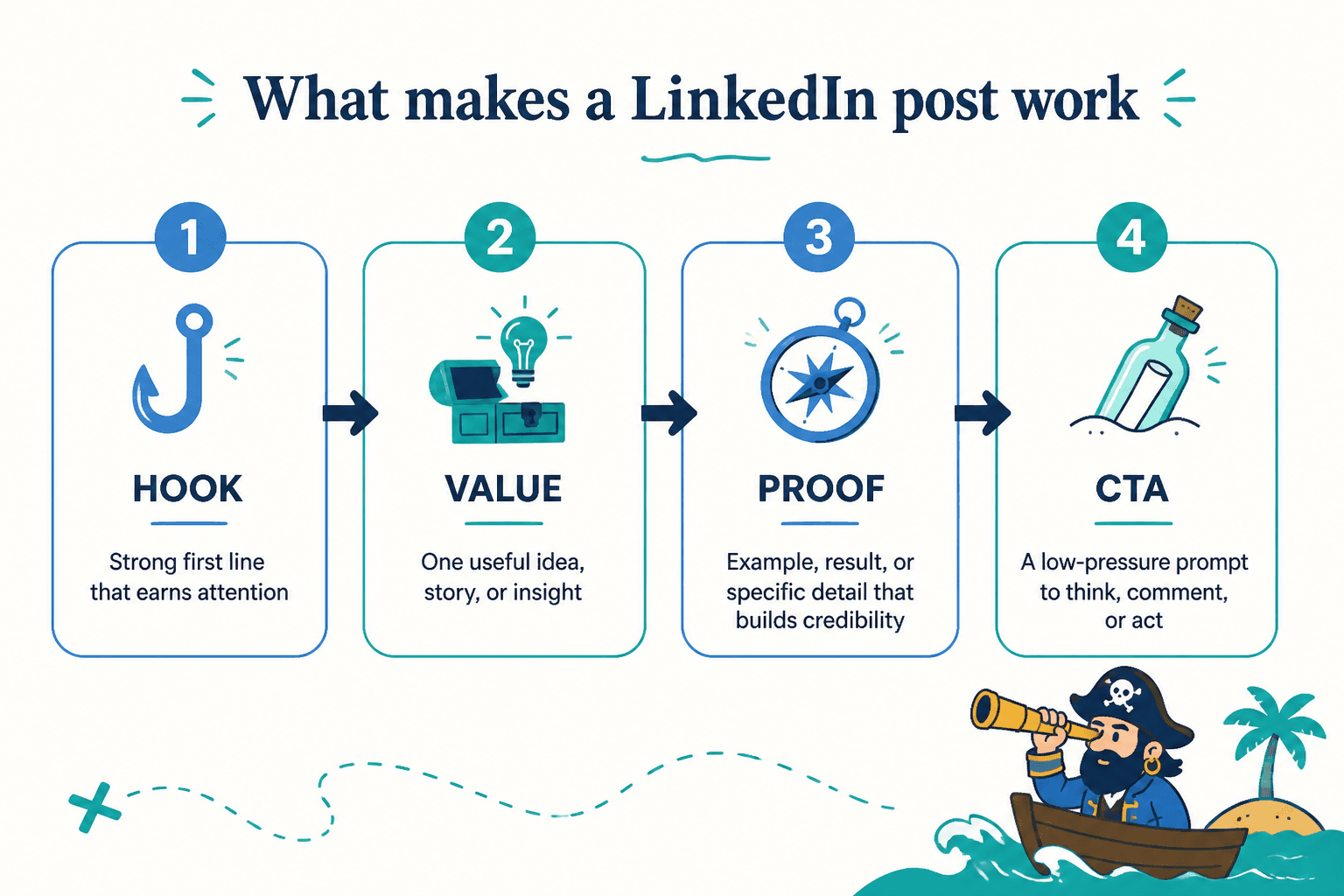
But good LinkedIn posts for creators usually do a few simple things well:
- They make one clear point
- They speak to a specific kind of reader
- They open with a strong first line
- They include a useful idea, story, example, or opinion
- They sound like a person, not a committee
- They give the reader a reason to care now
That last part matters more than people think. A post can be insightful and still feel skippable. If the opening is mushy, the point is buried, or the lesson feels recycled, people move on.
So before we get into post ideas, here is the framing: do not ask, “What should I post?” Ask, “What would make the right person think this creator gets it?” That question produces much better content.
12 of the best LinkedIn posts ideas and examples for creators
These are not random filler formats. These are post types that help creators show expertise, personality, credibility, and relevance without becoming unbearably self-important.
1. The sharp opinion post
A useful opinion post works because it gives people something to react to. Not fake controversy. Not hot takes for attention. Just a clear stance on something your audience deals with.
Weak version: Consistency is important for creators.
Better version: Most creators do not have a consistency problem. They have a standards problem. They are trying to publish polished content at a pace that only works if they have a team, a clone, or a mild caffeine crisis.
Why it works: It creates tension fast. It sounds like a real point. It invites agreement, disagreement, and curiosity.
Template:
Your audience does not have a [common assumed problem] problem.
They have a [deeper real problem] problem.
Here is what that looks like:
•
•
•
Fix this first.
2. The behind-the-work post
Creators often hide the interesting part. They share the final output but not the thinking behind it. That is a miss.
Your process is content. Your decisions are content. Your edits are content. The way you simplify something for clients is content.
Example:
I cut 42% of a client’s LinkedIn post before publishing it.
Not because it was bad.
Because it took 170 words to say one useful thing.
Here is what I removed:
• generic opener
• throat-clearing context
• a fake “big lesson” ending
Here is what stayed:
• the actual point
• one example
• one clean CTA
Most posts do not need more polish.
They need less padding.
This kind of post builds credibility because it shows your eye, not just your outcome.
3. The mistake breakdown post
People love seeing what is going wrong, especially when the explanation is specific and fixable. This is one of the best LinkedIn posts ideas and examples for creators because it gives immediate value without requiring a huge story.
Example:
3 reasons your LinkedIn posts sound smarter than they perform:
1. The first line says nothing.
“A thought on content strategy” is not a hook. It is a warning.
2. You are summarizing instead of arguing.
People remember points. They do not remember tidy little overviews.
3. The CTA sounds borrowed.
If your ending feels like a webinar registration page from 2018, fix that.
Template:
[number] mistakes I keep seeing in [topic]
1. [mistake]
Why it hurts:
What to do instead:
2. [mistake]
Why it hurts:
What to do instead:
4. The mini case study post
If you work with clients, sell services, build offers, or help people solve a business problem, use mini case studies. They are one of the cleanest ways to turn expertise into trust.
The trick is to make them useful, not self-congratulatory.
Bad case study post: Helped a client grow impressions by 300%. So grateful. So proud.
Better case study post:
A client’s LinkedIn posts were getting decent reach and weak leads.
The problem was not visibility.
It was positioning.
We changed 3 things:
• swapped broad advice for audience-specific pain points
• added proof instead of generic claims
• changed the CTA from “thoughts?” to a clear next step
Result: fewer vanity comments, more relevant conversations.
Attention is nice. Qualified attention is rent money.
Notice what happened there. The post teaches while it proves. That is the sweet spot.
5. The contrarian truth post
This is useful when your audience is following bad advice that sounds popular but does not hold up in practice.
Example:
“Post every day” is mediocre LinkedIn advice for most creators.
If posting daily helps you stay visible, fine.
But if it forces you to publish watered-down content five times a week, you are not building authority.
You are training your audience to scroll past your name.
Good contrarian posts do not exist just to be edgy. They challenge bad defaults and offer a better one.
6. The story with a business point
Stories still work on LinkedIn. The issue is not storytelling. The issue is bad storytelling: vague setup, manufactured struggle, and a life lesson that lands like a fridge magnet.
A good creator story on LinkedIn should be short, specific, and tied to an actual takeaway.
Example:
I scrapped a post after writing 900 words of it.
Why?
Because I realized I was writing to sound complete, not clear.
The original draft explained everything.
The final post made one point:
If your content needs too much context to work, the idea probably is not ready yet.
That change got me a better post and a cleaner framework I now use with clients.
That kind of story works because it does not perform vulnerability. It earns relevance.
7. The practical framework post
People save frameworks because they reduce complexity. They help your audience apply your thinking quickly.
Example:
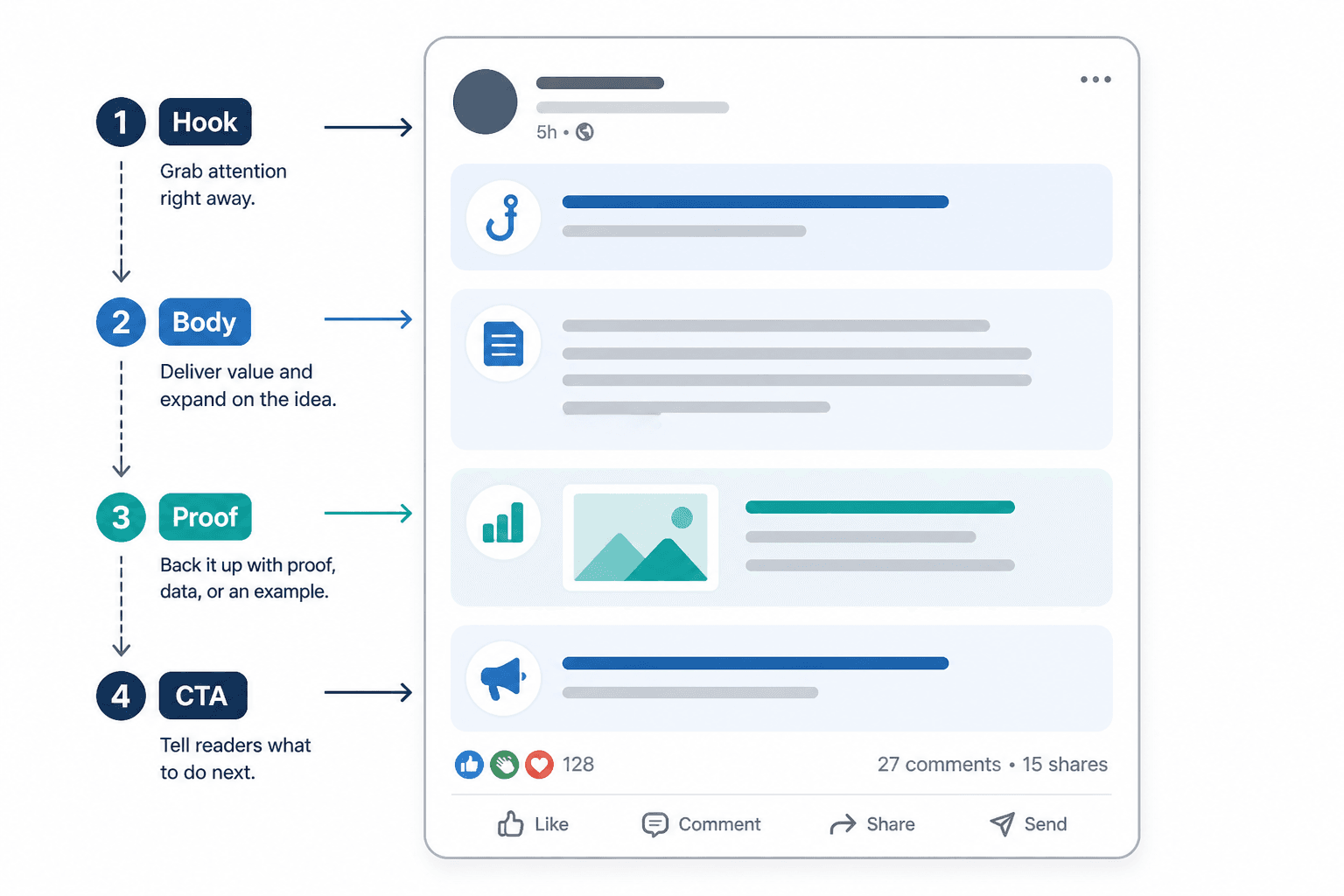
A simple way to write stronger LinkedIn posts:
Hook → point → proof → CTA
Hook: say something clear enough to stop the scroll
Point: make one argument, not six
Proof: add an example, result, observation, or contrast
CTA: give the reader one obvious next move
That is enough for most posts.
You do not need a seven-part content cathedral.
Framework posts work especially well when paired with examples. If you have a whole library of these, it makes sense to point readers toward related resources like templates and tools for LinkedIn posts or AI tools for LinkedIn posts that help speed up drafting without flattening your voice.
8. The before-and-after rewrite post
This one is gold for writers, coaches, consultants, marketers, and anyone whose work involves messaging, positioning, or communication.
Example:
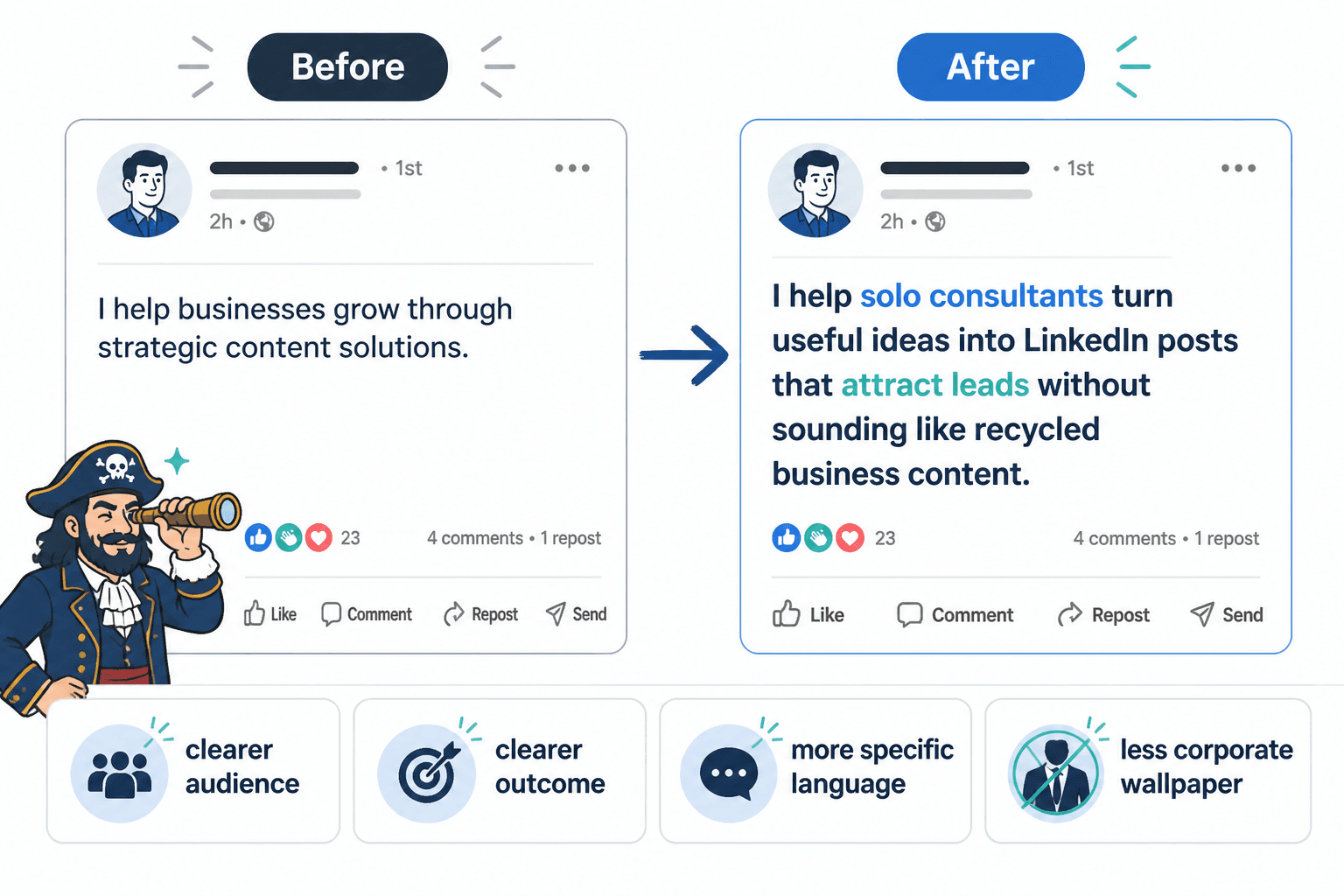
Before:
“I help businesses grow through strategic content solutions.”
After:
“I help solo consultants turn useful ideas into LinkedIn posts that attract leads without sounding like recycled business content.”
What changed?
• clearer audience
• clearer outcome
• more specific language
• less corporate wallpaper
These posts are satisfying because the improvement is visible. The reader learns by comparison, which is often more effective than explanation alone.
9. The belief-shift post
Some of your best content will not teach a tactic. It will change how your audience sees the problem.
Example:
Creators keep asking how to “beat the algorithm.”
Usually the better question is:
Would a real person find this useful, clear, or memorable enough to care?
Because distribution problems often start as message problems.
These posts are strong for authority because they make people think differently, not just act differently.
10. The audience callout post
If you want better-fit readers, call them out more directly. Not with cheesy “attention founders” stuff. Just with relevance.
Example:
If you are a coach posting thoughtful LinkedIn content and getting almost no leads, your problem may not be the content quality.
It may be that your posts never make it obvious:
• who you help
• what problem you solve
• what people should do next
This works because the right reader sees themselves quickly. Broad content gets broad indifference.
If your niche includes service businesses and personal brands, you can also point readers toward LinkedIn post examples for coaches, consultants, and personal brands for more tailored angles.
11. The myth-vs-reality post
This is a neat format because it creates built-in contrast.
Example:
LinkedIn post myth: You need to sound more professional to be taken seriously.
Reality: You need to sound more specific.
Professional is not the same as stiff.
And stiff writing rarely earns trust.
You can do this with pricing, positioning, content strategy, lead generation, audience growth, offers, funnels, messaging, and pretty much any topic where bad assumptions spread faster than useful ones.
12. The soft CTA post
Not every LinkedIn post needs a CTA, but if you are using the platform for business, some of them should point somewhere. Gently. Like a functioning adult.
Example:
If you are getting views but not many useful leads from LinkedIn, look at the gap between your posts and your next step.
A lot of creators have decent content and messy conversion paths.
If you want ideas, I put together some of the best funnel ideas to pair with LinkedIn posts. Start there before writing another “comment GUIDE” post into the void.
That CTA works because it is relevant to the post and does not arrive wearing a fake tuxedo.
How to come up with LinkedIn post ideas without staring at the void
A lot of creators think content ideation means brainstorming from scratch every week. That is exhausting and unnecessary.
The better approach is to mine your work, your opinions, your repeated conversations, and your audience’s friction points.
Start here:
- Questions clients keep asking you
- Mistakes you keep correcting
- Advice in your industry that sounds nice but fails in practice
- Things you believe that your audience has not heard clearly enough
- Processes you use behind the scenes
- Examples of weak content you could improve
- Small lessons from real work, not random inspiration fog
One useful trick: instead of collecting “topics,” collect friction. Topic: LinkedIn content. Friction: “My posts get likes but not leads.” Topic: personal branding. Friction: “My bio sounds polished but vague.” Friction gives you stronger raw material because it is tied to a real problem.
If you need a broader home base for this kind of planning, it helps to browse your main LinkedIn writing resources together, especially your LinkedIn posts hub and related content under social media writing and LinkedIn writing. Not glamorous, but useful.
How to make your LinkedIn post ideas actually readable
A strong idea can still die in a weak post. This is where a lot of creators lose the plot. They have substance, then wrap it in sleepy openings and overexplained middles.
Here is the basic fix.
Open faster
Your first line has one job: make the right person curious enough to keep going.
Weak:
I have been reflecting on content a lot lately.
Better:
Most content does not fail because the idea is bad.
It fails because the packaging is sleepy.
Make one point, not a buffet
If a post is trying to teach five things, it usually teaches none of them well. Pick the strongest point and build around it.
Use proof
Proof can be a result, a client pattern, a rewrite, an observation, a concrete example, or a simple contrast. It does not have to be a giant case study. It just has to make the point feel earned.
Format for scanning, not chaos
LinkedIn posts need breathing room, but not every sentence needs its own dramatic staircase.
Good formatting usually means:
- Short paragraphs
- Clean spacing
- Occasional bullets when they help
- No giant blocks of text
- No line break after every three words unless the rhythm truly needs it
Yes, readability matters. No, your post does not need to look like it is hyperventilating.
End with a natural next step
Your CTA does not need to beg for comments. It can invite a response, point to a resource, or simply land the idea.
Examples:
- Worth checking if your posts are getting attention but not action.
- If this is where your content is breaking, fix this before posting more often.
- If you want more examples like this, start with these templates.
- Curious what part of this is hardest in your own posting.
That is usually enough.
A simple weekly LinkedIn content mix for creators
If you want variety without overcomplicating things, use a simple mix across the week. Not because LinkedIn demands a sacred posting formula, but because repeating one format forever gets stale fast.
| Day | Post type | Purpose |
|---|---|---|
| 1 | Sharp opinion | Attention and positioning |
| 2 | Practical framework | Value and saves |
| 3 | Mini case study | Proof and trust |
| 4 | Story with lesson | Relatability and memory |
| 5 | Mistake breakdown or rewrite | Authority and engagement |
You do not have to post five times a week, either. Three strong posts will usually outperform five diluted ones, especially if you are still building your voice and angle.
Common LinkedIn post mistakes creators keep making
Some mistakes are so common they deserve their own little wall of shame.
- Starting too softly: If your first line feels optional, people will treat it that way.
- Sounding polished but generic: Clean writing is good. Generic writing is not.
- Posting broad advice to everyone: Specificity gets remembered.
- Using fake vulnerability as strategy: People can smell performance.
- Writing “lessons learned” posts with no actual lesson: If the insight could fit on a mug, it probably is not enough.
- Ending with limp engagement bait: “Thoughts?” is not always wrong. It is just often lazy.
- No bridge to business: If your content never points anywhere, do not be surprised when it stays as “awareness.”
None of this means every post must convert. That would make your feed unbearable. But if you are a creator using LinkedIn intentionally, your content should build toward something: trust, recognition, profile visits, conversations, subscribers, leads, inquiries, sales. Pick one.
Quick examples you can adapt this week
Here are a few plug-and-play examples you can reshape for your niche.
Example: creator coach
Most creator advice breaks because it assumes you have endless time and a full-time content brain.
You probably do not need a bigger strategy.
You need a smaller one you will actually follow.
That usually means:
• fewer content pillars
• stronger repeatable formats
• clearer offers
• less reinvention every week
Example: writer
Most boring content does not come from boring people.
It comes from people translating sharp ideas into “professional” language and draining the pulse out of them on purpose.
The bigger point is simple: clearer structure and clearer writing make the piece more useful. That is usually what makes the ending land better too.