
Most creator email sequences fail for a very boring reason: they are either too vague to matter or too pushy to trust.
You can usually spot the problem fast. Email one says “welcome.” Email two says “here’s my story.” Email three suddenly wants the sale like you have been building a deep bond in under 48 hours. Lovely ambition. Bad sequence.
The best creator email sequence ideas and examples are not fancy. They are clear, intentional, and built around what the reader actually needs next. Not what your template told you to send. Not what some bro-marketer said “converts like crazy.” Not what sounded impressive in a funnel course from 2021.
If you are a creator, coach, consultant, personal brand, or solo founder, this guide will help you build email sequences that welcome subscribers properly, warm them up without rambling, and move them toward the next step without making your list feel like a trapped elevator audience.
You will get practical sequence ideas, real example structures, email-by-email breakdowns, and ways to adapt them for different goals like trust, sales, launches, lead nurturing, and re-engagement. If you need the bigger picture first, start with this guide to creator email sequences. If you already know you want a more complete system, this broader hub on email newsletter writing and the creator email sequences section will help too.
For the full path around this topic, head to the parent guide.
What makes a creator email sequence actually work
Before we get into sequence ideas, let’s fix the core misunderstanding.
An email sequence is not just a pile of emails sent in order. It is a controlled progression. Each email should prepare the reader for the next one. That means every message needs a job.
- One email might orient the reader.
- One might give a quick win.
- One might establish your point of view.
- One might handle the obvious objections.
- One might offer the next step.
That is a sequence. Everything else is just email clutter wearing strategy glasses.
The strongest creator sequences usually do five things well:
- They match intent. A subscriber who joined for a free guide needs a different sequence than someone who clicked a sales page.
- They build momentum. Each email increases clarity, trust, relevance, or desire.
- They stay specific. Broad motivational fluff kills momentum fast.
- They sound human. Nobody wants seven emails that read like polished CRM fumes.
- They lead somewhere. Good sequences do not wander. They move toward a clear outcome.
That outcome might be a booking, a sale, a reply, a resource download, a webinar registration, or simply getting the reader used to opening your emails. Yes, that last one matters. People buy from creators they recognize, trust, and remember. Not from random inbox pop-ups asking for money by email three.
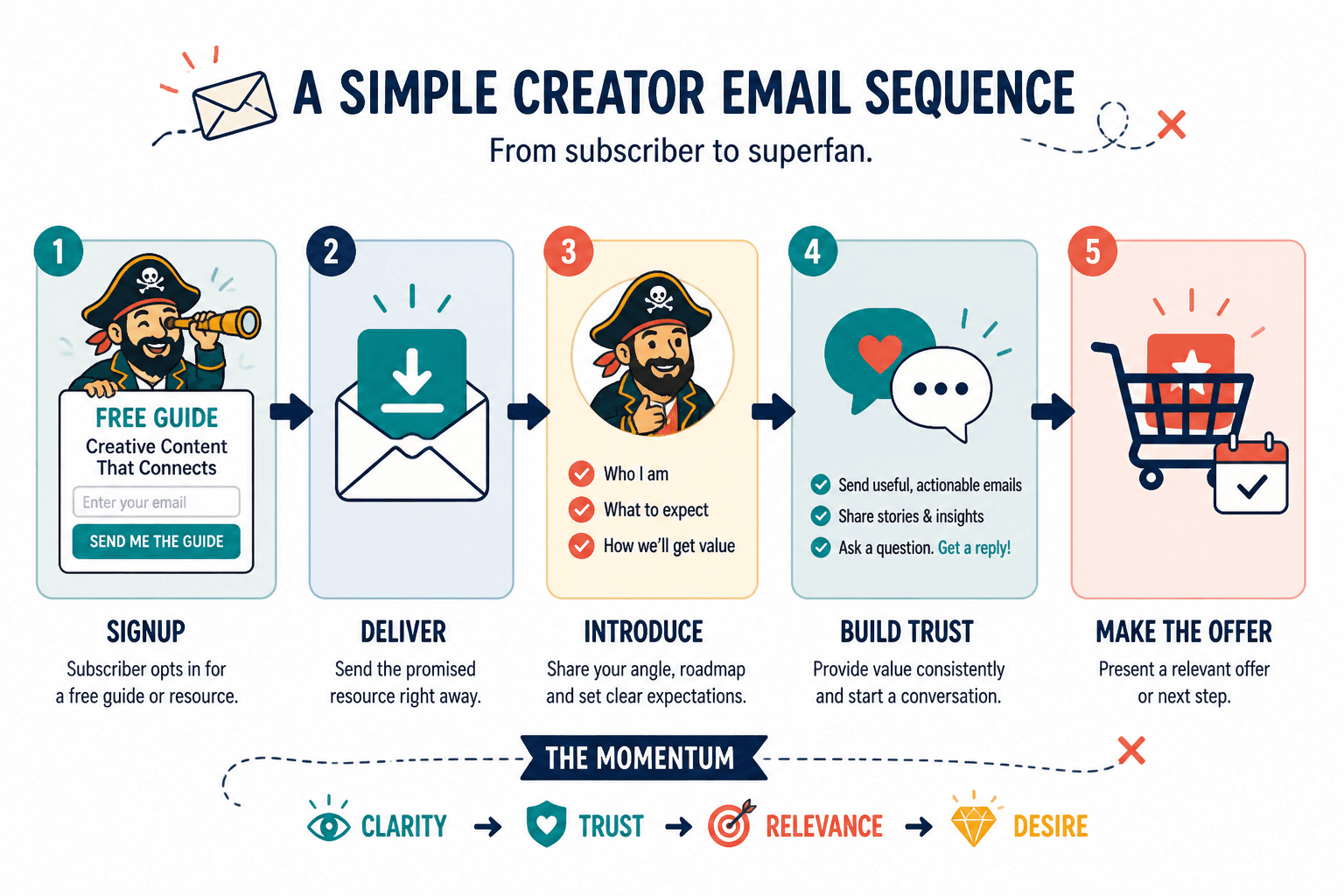
Best creator email sequence ideas and examples by goal
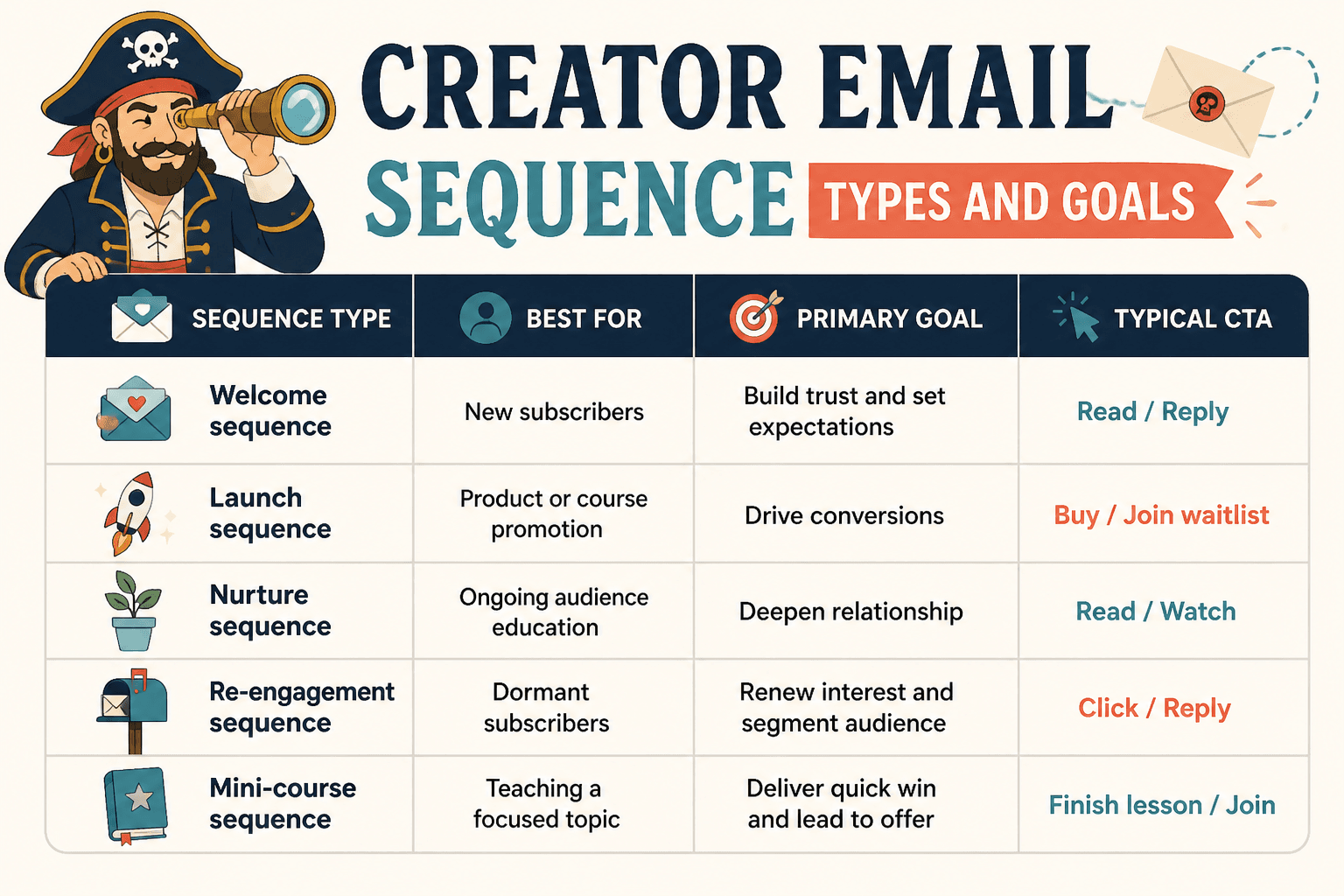
The right sequence depends on what you want the reader to do next. Here are the most useful sequence types for creators, along with when to use them and how to structure them.
1. The welcome sequence
This is the obvious one, but plenty of creators still waste it.
A good welcome sequence does not just say hello. It sets expectations, delivers the promised thing, introduces your angle, and gives the reader a reason to care about future emails. It should make someone think, “Alright, this person gets it,” not “Cool, another list I will ignore until unsubscribing becomes a spring cleaning task.”
Best for: new subscribers, lead magnets, newsletter joins, audience onboarding
Simple 4-email structure:
- Welcome + delivery
Give them the promised resource. Set expectations. Tell them what kind of emails they will get and why those emails are worth opening. - Quick win
Share one useful idea they can apply fast. Keep it practical. - Your framework or philosophy
Explain how you think about the problem differently. - Soft next step
Invite them to read something, reply, book, browse an offer, or follow a deeper path.
Example: creator helping consultants write better authority content
- Email 1 subject: Here’s the content guide you asked for
- Email 2 subject: Why useful content still gets ignored
- Email 3 subject: My rule for writing posts people actually remember
- Email 4 subject: If you want help tightening your content system
Notice what this does not do. It does not spend 900 words on your childhood. It does not force a dramatic founder story where none is needed. It gets the subscriber moving.
2. The nurture sequence
Use this when someone knows who you are but is not ready to buy yet. The nurture sequence exists to build trust through relevance, proof, and useful thinking. Not endless “just checking in” energy.
Best for: longer sales cycles, higher-ticket services, coaching, consulting, education products
What to include:
- Useful lessons tied to the problem you solve
- Strong opinions or perspective shifts
- Mini case studies
- Common mistakes and better alternatives
- Occasional invitations to the next step
Simple 5-email nurture arc:
- The common mistake your audience keeps making
- A better framework or method
- A client or example story that proves it
- An objection-handling email
- A low-pressure CTA
Example CTA options:
- Reply with your biggest sticking point
- Read the full breakdown
- Book a consult
- Grab the template
- Join the workshop waitlist
If your audience needs more time, this kind of sequence matters more than a hard sell sequence. A lot of creators try to skip trust-building because they are tired of waiting. The audience usually responds by continuing not to buy. Funny how that works.
3. The product or service pitch sequence
This is where many creators become weirdly formal, weirdly hypey, or weirdly desperate. You do not need any of those.
A sales sequence works best when it makes the offer feel clear, credible, relevant, and easy to act on. The point is not to sound “salesy.” The point is to remove confusion and hesitation.
Best for: course sales, coaching packages, audits, templates, memberships, digital products
Simple 6-email sales sequence:
- The problem email
Name the issue and why it matters now. - The solution email
Introduce your offer as a clean answer to that issue. - The proof email
Use examples, case studies, outcomes, or specifics. - The objection email
Address cost, timing, fit, complexity, or skepticism. - The behind-the-scenes email
Show what is inside, how it works, or what support looks like. - The decision email
Give a direct CTA and a clean reason to act.
Subject line examples:
- The real reason your email list is not converting
- A simpler way to fix that
- What happened after we tightened the sequence
- “I’m interested, but…”
- What you actually get inside
- Last call if this is the right fit
That last line matters: if this is the right fit. Strong sales emails do not try to bully everyone into saying yes. They help the right buyer decide faster.
If you want more sales-focused structures, the breakdown in simple creator sales email arcs and templates is worth your time.
4. The launch sequence
A launch sequence has more urgency and more concentrated momentum than a regular sales sequence. But urgency is not the same thing as volume. Sending 14 frantic emails in 5 days is not strategy. It is digital pacing.
Best for: limited-time enrollments, cohort programs, workshops, seasonal offers, live launches
Core launch email types:
- Announcement
- Problem agitation
- Value breakdown
- Proof or case study
- Objection handling
- FAQ
- Deadline emails
Launch sequences work best when every email has a distinct angle. If five emails all say “doors are open” in slightly different outfits, expect weaker opens and fewer clicks.
For deeper launch-specific structures, see these creator launch sequence examples you can adapt fast.
5. The re-engagement sequence
If part of your list has gone cold, stop pretending they are still “nurtured.” They are not. They forgot you. That does not mean they are useless. It means you need a cleaner re-entry.
Best for: inactive subscribers, older leads, stale segments, low-open lists
Simple 3-email re-engagement sequence:
- The reset email
Acknowledge the gap. Reintroduce the value. Make the reader care again. - The useful gift email
Give them something practical, timely, or surprisingly good. - The choice email
Invite them to stay, update preferences, click for relevant content, or opt out.
Subject line examples:
- Still want the useful stuff?
- A fresh resource for you
- Should I keep sending these?
Do not guilt people. Do not write wounded breakup emails to subscribers who simply got busy. Calm, useful, clear. That tends to work better than “I noticed you haven’t opened my last 11 emails” which, to be honest, sounds mildly haunted.
6. The application or booking sequence
If your goal is a consultation, discovery call, strategy session, or application, your sequence should reduce uncertainty and raise confidence. The reader should understand what the call is for, who it is for, and what happens next.
Best for: consultants, service providers, coaches, agency owners, strategists
Simple 4-email booking sequence:
- The problem and invitation
- What happens on the call
- Who it is and is not for
- Proof and final invitation
This sequence usually works better than repeatedly shouting “book a call” with zero context. People avoid unclear calls because unclear calls often become awkward sales theater.
Email sequence examples creators can adapt quickly
Here are more concrete examples. These are not rigid scripts. They are strong starting points.
Example 1: Free lead magnet to paid template pack
- Email 1: Deliver the free resource and explain how to use it
- Email 2: Show the common mistake people make even with good templates
- Email 3: Teach a quick framework that improves results
- Email 4: Introduce the paid template pack as the faster, fuller version
- Email 5: Share examples of what is included and who it fits best
Example 2: Newsletter subscriber to strategy call
- Email 1: Welcome and set expectations
- Email 2: Explain your core philosophy or method
- Email 3: Share a client-style transformation example
- Email 4: Break down the most common stuck point
- Email 5: Invite the reader to book a call if they want help applying it
Example 3: Mini-course signup to membership
- Email 1: Deliver lesson one
- Email 2: Deliver lesson two with a practical action step
- Email 3: Deliver lesson three and connect the dots
- Email 4: Explain why consistent support matters after the mini-course
- Email 5: Invite them into the membership with clear benefits
Example 4: Dormant audience to renewed engagement
- Email 1: Reintroduce what you help with now
- Email 2: Send one genuinely strong resource
- Email 3: Ask what they want more help with
- Email 4: Segment based on clicks or replies and follow up accordingly
If you want examples tailored more specifically to service businesses and expert-led brands, this article on email sequence examples for coaches, consultants, and personal brands should help.
A simple framework for writing each email in the sequence
You do not need every email to be brilliant. You need it to do its job well.
One of the easiest ways to write better sequence emails is to use this four-part structure:
- Lead with relevance
Start with the problem, question, mistake, desire, or shift that matters to the reader. - Deliver one core idea
Do not cram six lessons into one email. Pick one useful point. - Add proof, example, or specificity
Make it believable and concrete. - Give one next step
Click, reply, read, buy, apply, watch, or reflect. One main action.
Quick example:
Opening: Most creator emails underperform for a simple reason: they ask for attention before they earn trust.
Core idea: If your first few emails are all about you, the reader has to work too hard to figure out why they should care.
Specificity: A better sequence starts with a quick win, then shows your method, then invites the next step once the value is obvious.
CTA: If you want, reply with “sequence” and I’ll send the structure I recommend.
That is clean. Focused. Useful. No fluff cloud. No dramatic preamble. No fake urgency bolted onto a basic teaching email.
Common email sequence mistakes creators keep making
If your sequence is not performing, there is a decent chance one of these is the reason.
| Mistake | What it looks like | Better move |
|---|---|---|
| No clear sequence goal | Random helpful emails with no direction | Choose one main outcome for the sequence |
| Too much autobiography | Long founder story before delivering value | Use only the parts of your story that support the reader |
| Selling too early | Pitch in email two with no trust built | Earn attention first unless intent is already high |
| Too many ideas per email | One message trying to do everything | One email, one job |
| Weak CTA | “Let me know your thoughts” on every email | Use clear, relevant next steps |
| Same tone every time | Flat, overly polished, generic emails | Vary pace, style, and email purpose |
| No segmentation | Everyone gets the same path forever | Branch based on clicks, replies, or signup source |
Another common issue is trying to make every sequence do everything at once. Welcome people, nurture them, sell to them, educate them, inspire them, and somehow also reactivate old leads. Pick a lane first. You can always stack or branch later once the core sequence works.
How long should a creator email sequence be?
There is no magic number, which is annoying if you wanted a clean little rule. But there are useful ranges.
- Welcome sequences: usually 3 to 5 emails
- Nurture sequences: often 4 to 8 emails, sometimes longer
- Sales sequences: often 4 to 7 emails
- Launch sequences: usually 5 to 10 emails depending on launch length
- Re-engagement sequences: usually 2 to 4 emails
The better question is this: how many emails does it take to move this reader from their current level of awareness to the next decision?
If you are selling a low-cost template to a warm audience, maybe not many. If you are selling a high-ticket consulting package to cold leads, probably more. Sequence length should match friction, complexity, trust requirements, and buying intent. Not your attachment to the number seven.
How to choose the right sequence for your creator business
If you are unsure what to build first, use this quick rule:
- No sequence at all? Start with a welcome sequence.
- People join but do not engage? Build a nurture sequence.
- People engage but do not buy? Build a clearer sales sequence.
- You launch in cycles? Build a launch sequence.
- Your list is stale? Build a re-engagement sequence.
- You sell through calls? Build a booking sequence.
For a lot of creators, the smartest setup is not one giant master sequence. It is a small set of focused sequences connected by behavior. Someone downloads a resource, gets a welcome sequence, clicks the service page, gets a booking sequence, ignores everything for 60 days, gets a re-engagement sequence. That is much more useful than blasting everyone with the same warmed-over emails forever.
You can explore broader systems and sequence planning inside the creator email sequences hub and the wider creator email systems section.
A plug-and-play creator email sequence template
If you want a flexible sequence you can adapt for almost any creator offer, use this 5-email skeleton:
The bigger point is simple: clearer structure and clearer writing make the piece more useful. That is usually what makes the ending land better too.