Most welcome emails do one of two useless things.
They either say a polite version of “hi, thanks for subscribing” and then wander off with no real next step, or they try to sell way too fast like a checkout page wearing a fake mustache.
Neither is a funnel. It is just email-shaped drifting.
The best funnel ideas to pair with welcome emails do something much simpler and much smarter: they use early attention well. Someone just subscribed. They are curious enough to let you into their inbox. That is not the moment to ramble, posture, or fire off a desperate pitch. It is the moment to guide them into the next useful step.
If you get this right, your welcome email stops being a courtesy message and starts doing actual work. It can move readers toward your best content, your offer, a booking page, a lead magnet, a low-friction conversion, or a stronger relationship that turns into revenue later without feeling like a cheap funnel stunt.
This article will show you which funnel types make sense after a welcome email, when to use each one, what they look like in practice, and where people quietly ruin them by asking for too much too soon.
If you need help building the actual email first, start with welcome emails, then come back here and give that email somewhere useful to send people.
If you want the bigger picture, start with the parent guide.
What a welcome email funnel is actually supposed to do
A welcome email funnel is not some grand 14-step automation monster with tags, branches, psychological triggers, and a founder on YouTube whispering about “tripwires.”
Usually, it is just this:
- Someone subscribes
- They get welcomed clearly
- They are pointed toward the next best action
- That action builds trust, intent, or momentum
- Later emails deepen the relationship or make the offer
That next best action is the important part. A good funnel paired with a welcome email should reduce friction, not add it. It should feel like a natural continuation of why they signed up in the first place.
If somebody joins your list for practical writing advice and your welcome email instantly pushes them to book a premium consulting call, the problem is not your CTA button color. The problem is your judgment.
Strong welcome email funnels usually do one of four things:
- Segment attention
- Build trust faster
- Create an easy first conversion
- Move the right people toward a higher-intent action
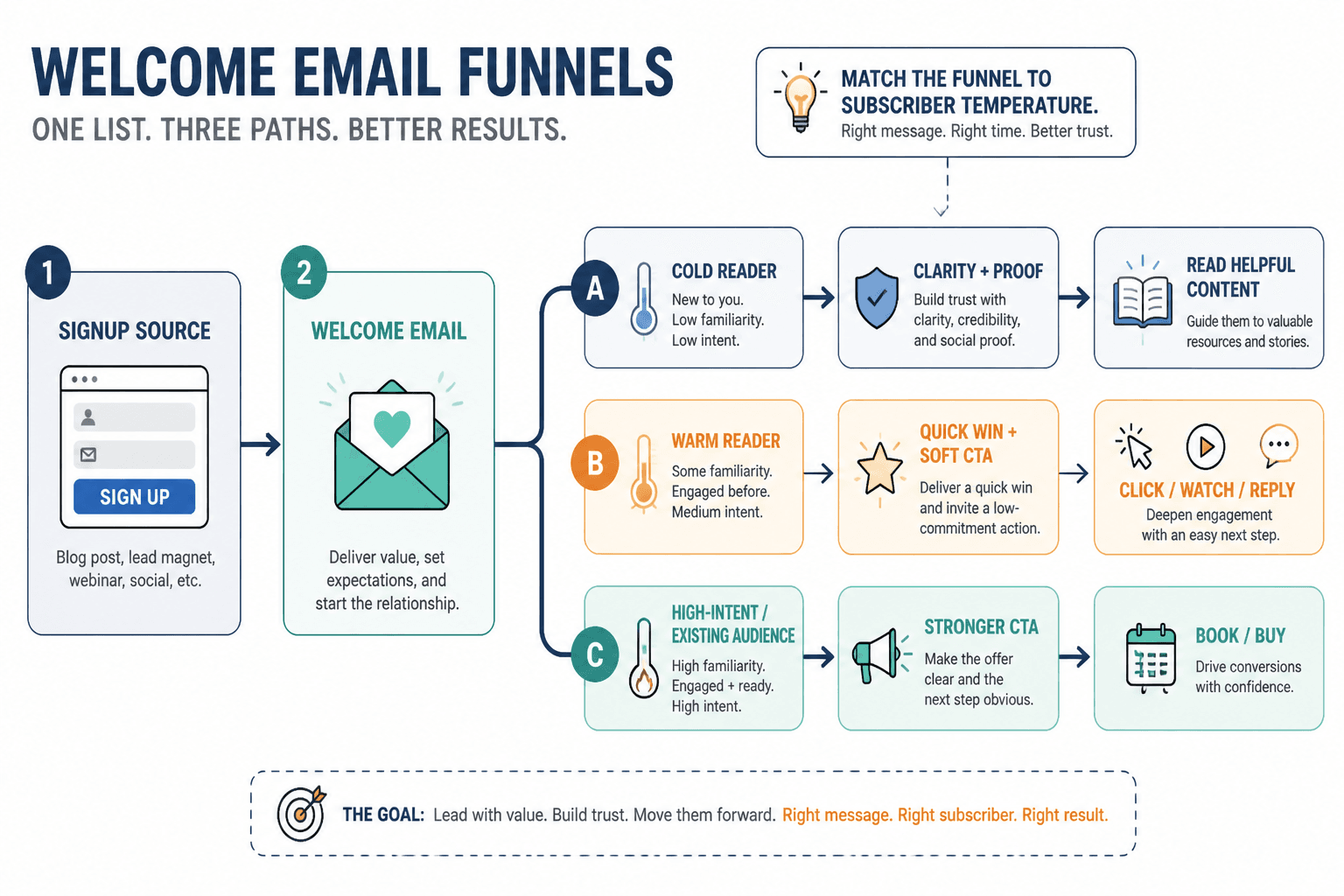
That means your funnel choice should match the subscriber’s temperature. Cold readers need clarity and proof. Warm readers can handle a stronger CTA. Existing audience members joining your list may be ready for direct action sooner.
How to choose the right funnel to pair with your welcome email
Before you pick a funnel, answer three boring but useful questions:
- Why did this person subscribe? A free download, a newsletter, a webinar, a content upgrade, a referral, a social post?
- What level of intent do they probably have? Casual interest, active problem awareness, or buying intent?
- What is the easiest meaningful next step? Read, reply, click, watch, book, buy, or self-identify?
If you skip those questions, you end up with a funnel that looks clean in your automation tool and feels weird to the subscriber. Those are not the same thing.
Here is a simple way to think about it:
| Subscriber type | Best next step | Good funnel fit |
|---|---|---|
| Cold but curious | Build trust | Content path, story path, resource path |
| Problem-aware | Show relevance | Case study path, quiz path, segmented nurture |
| Warm and interested | Increase intent | Booking path, low-ticket path, offer path |
| Broad audience with mixed needs | Sort them | Preference path, segmentation path |
If your audience is still small, that does not disqualify you from using funnels. It just means you should keep them tighter and more human. This guide on welcome emails for creators with small audiences is useful if your list is more “promising little corner” than “newsletter empire.”
Best funnel ideas to pair with welcome emails
These are the funnel types that make the most sense for creators, consultants, coaches, solo founders, and personal brands who want conversion without making every subscriber feel like prey.
1. The best-of content funnel
This is one of the safest and most effective options, especially for newer subscribers who know you a little but not enough to buy anything yet.
Your welcome email sends them to your best 3 to 5 pieces of content. Not your latest content. Not everything you have ever made. Your best stuff. The pieces that explain your core ideas, show how you think, and make people say, “Okay, this person actually knows what they’re talking about.”
Best for: writers, creators, consultants, educators, service providers, and anyone building trust through expertise
What it does well: builds authority without rushing the sale
Typical flow: Subscribe → welcome email → curated content page or 3 direct links → nurture emails → soft CTA later
Good content funnels do not say “look how much content I have.” They say “here is the shortest path to understanding why my work is worth paying attention to.”
This works especially well if your content has clear depth and point of view. If every article says roughly the same vague thing in slightly different blazers, this will not save you.
2. The quick-win resource funnel
This one pairs your welcome email with a practical tool: a checklist, template, swipe file, mini-guide, calculator, worksheet, prompt pack, or framework the reader can use right away.
The key is that the resource should create momentum, not just occupy a Google Drive folder forever.
Best for: creators with tactical offers, service businesses, coaches, educators, and productized services
What it does well: gets the subscriber a small result fast, which makes future emails matter more
Typical flow: Subscribe → welcome email with resource → follow-up email showing how to use it → case study or example → CTA
For example, if you help consultants improve discovery calls, your welcome email might deliver a “15-question discovery call prep sheet,” then the next email shows how one section prevents weak leads and awkward pricing conversations.
That is a funnel. A useful, low-drama, dignity-preserving funnel.
3. The segmentation funnel
If your audience has multiple needs, a welcome email can ask a simple preference question and send people down more relevant paths.
Something like:
- Want help with content strategy?
- Trying to improve your emails?
- Need better conversion from your audience?
Each option can lead to a different email sequence, resource, or content bundle. This is one of the best funnel ideas to pair with welcome emails if your business covers several related offers and you do not want to blast everyone with the same generic sequence.
Best for: multi-offer businesses, agencies, consultants, coaches with multiple problem areas, and creators with broad educational ecosystems
What it does well: improves relevance and reduces unsubscribe energy caused by “why are you emailing me this?”
Typical flow: Subscribe → welcome email with “choose your path” links → segmented sequence → relevant CTA
Keep the choices simple. Three options is usually plenty. If your welcome email starts reading like a software setup wizard, you have gone too far.
4. The reply-and-conversation funnel
This is underrated because it looks too simple to count as a funnel. It counts.
Your welcome email asks the subscriber to reply with a short answer: what they are stuck on, what they are trying to improve, what kind of content they want, or what offer they are considering.
That reply can do several useful things at once:
- increase inbox placement and engagement signals
- give you research language straight from your audience
- start sales conversations naturally
- help you manually segment high-intent subscribers
Best for: consultants, coaches, service providers, experts with high-ticket offers, and anyone whose business benefits from conversation
What it does well: creates trust and opens soft sales paths without acting weird
Typical flow: Subscribe → welcome email asks one smart question → subscriber replies → human follow-up or tagged nurture → relevant offer later
The mistake here is asking lazy questions. “What are your biggest struggles?” sounds like survey sludge. Better questions are narrower and easier to answer.
For example:
- What are you trying to improve first: content, leads, or conversions?
- What is one thing in your funnel that feels messier than it should?
- What made you join this list today?
5. The case study funnel
If you sell a service, consulting offer, or coaching package, trust usually grows faster when people see the work in action.
A case study funnel uses the welcome email to direct subscribers toward a story with evidence: what the client problem was, what changed, what approach worked, what result happened, and why.
Best for: consultants, agencies, copywriters, strategists, service providers, and premium offers
What it does well: turns “sounds smart” into “has done this before”
Typical flow: Subscribe → welcome email → case study → follow-up unpacking the method → CTA to book or inquire
This works best when the case study is specific. “Helped a founder improve brand clarity” is not a case study. It is a sentence wearing expensive shoes. Give the reader enough detail to understand the before, the intervention, and the payoff.
6. The low-ticket offer funnel
If you have a genuinely useful, low-friction paid offer, your welcome email can point subscribers toward it. This works well when the offer is closely matched to signup intent and does not require a giant trust leap.
Think mini-products, audits, templates, short workshops, starter kits, teardown recordings, or small paid resources.
Best for: creators with digital products, educators, solo founders, service businesses with entry offers
What it does well: converts high-intent subscribers quickly and qualifies buyers without heavy sales work
Typical flow: Subscribe → welcome email → low-ticket offer → post-purchase nurture or upsell path
Important caveat: this is not permission to jam a product in front of every new subscriber the second they arrive. If your welcome email is all pitch and no orientation, it will feel cheap. The fix is simple: welcome first, contextualize the offer, explain why it helps, then present it cleanly.
7. The call booking funnel
If your business sells strategy, consulting, coaching, retained services, or bespoke projects, your welcome email can guide qualified subscribers toward a call. But only if the timing and framing make sense.
This is not for everyone. If your subscribers are broad, cold, or casually curious, sending all of them to a booking page is a fast way to collect empty calendar slots and mild resentment.
Best for: high-intent lead magnets, referral traffic, webinar attendees, waitlists, application-driven services
What it does well: captures action from readers who are already close to buying
Typical flow: Subscribe → welcome email → booking page → qualification step → sales conversation
A better version of this often uses a bridge. Instead of “book a call,” try “if you want help applying this to your business, here is what working together looks like.” Then link to your offer page or booking page.
That little bit of context matters. People like understanding where a click is taking them.
8. The mini nurture sequence funnel
Sometimes the best funnel idea is not one click from the welcome email. It is a short sequence that earns the CTA over several emails.
This might look like:
- Email 1: welcome + what to expect + one useful link
- Email 2: core mistake your audience keeps making
- Email 3: practical framework or process
- Email 4: case study or proof
- Email 5: soft offer or next step
Best for: most creators and service businesses, especially when trust matters before conversion
What it does well: gives readers a reason to care before asking them to act
Typical flow: Subscribe → welcome → short nurture → CTA matched to offer
If you want practical examples of what to put in those emails, these welcome email ideas and examples for creators should help.
How to match the funnel to the business model
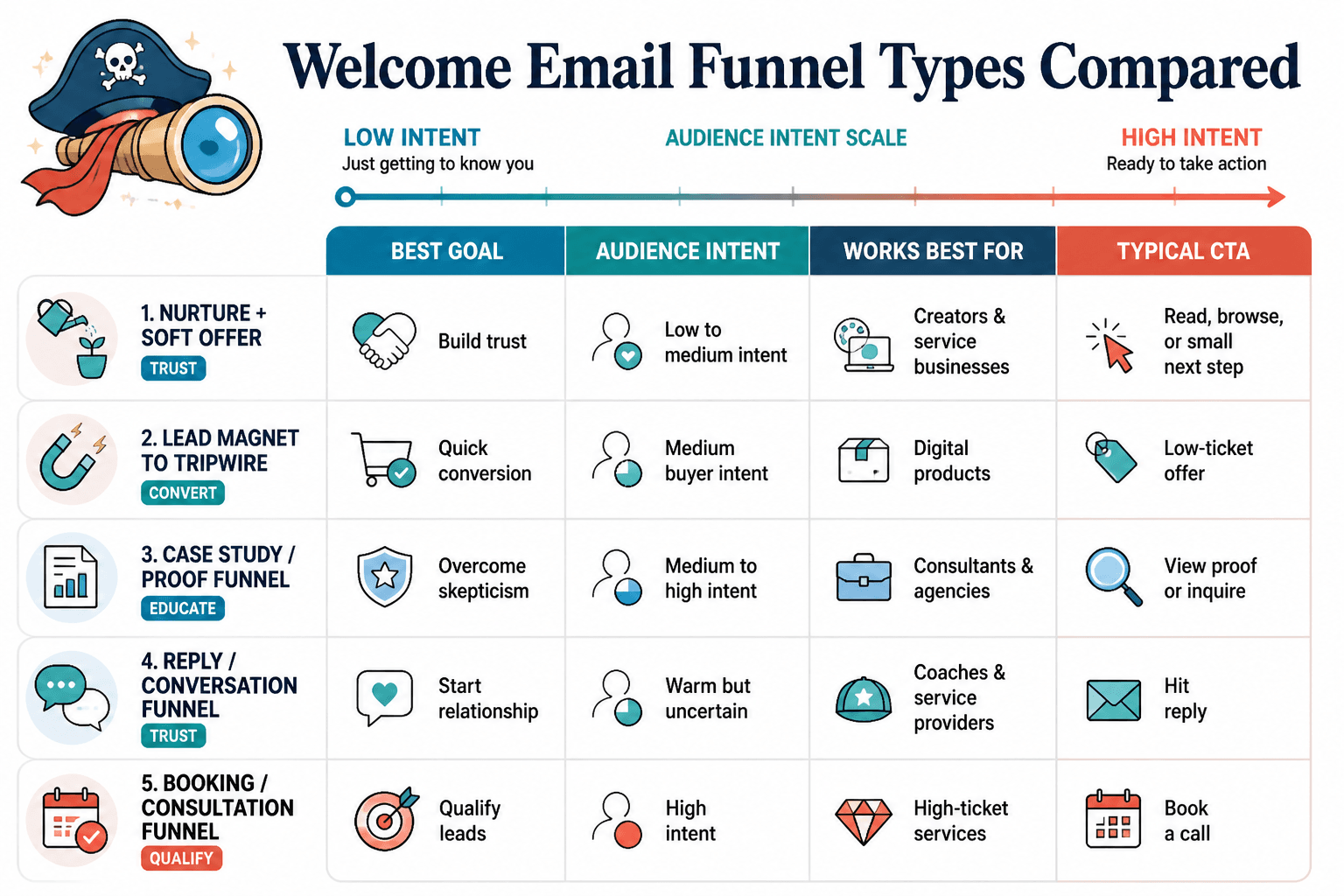
One reason funnel advice gets messy is that people copy structures from businesses nothing like theirs.
A creator with a newsletter and digital products does not need the same welcome flow as a consultant selling strategy retainers. A coach selling a group program should not copy a SaaS onboarding sequence and then wonder why it feels emotionally dead.
Here is the cleaner version:
If you sell services
- Use case study funnels
- Use reply funnels
- Use booking funnels for warmer leads
- Use nurture sequences with proof
If you sell digital products
- Use quick-win resource funnels
- Use low-ticket offer funnels
- Use best-of content funnels to warm readers
- Use segmented flows if products solve different problems
If you sell coaching or education
- Use mini nurture sequences
- Use story or case-study funnels
- Use reply funnels to uncover goals
- Use call funnels only when intent is already strong
If you are mostly building authority right now
- Use best-of content funnels
- Use segmentation funnels
- Use conversation funnels
- Use resource funnels to create quick wins
You can build more than one funnel over time, but do not start by creating a maze. Start with the one path that best matches subscriber intent and business reality.
What to include in the welcome email itself
The welcome email does not need to do everything. It does need to do a few things well.
- Confirm they are in the right place
- Set expectations for what they will get
- Give one clear next step
- Sound like a person, not a legal notice with branding
A simple structure works fine:
- Quick welcome
- Short positioning line
- What to expect from your emails
- Main CTA into the funnel
- Optional reply prompt or secondary path
That is enough. You do not need a manifesto, three bonuses, and a paragraph about your mission to “empower creators globally.” Calm down.
Common mistakes that make welcome email funnels worse
Pitching before trust exists
If the subscriber barely knows you, lead with usefulness, clarity, or relevance before you ask for the sale.
Giving too many next steps
If your welcome email asks them to read your blog, follow you on three platforms, book a call, buy a toolkit, and reply with their goals, you do not have a funnel. You have a clutter problem.
Sending people to weak content
Your funnel is only as good as the destination. If your CTA leads to vague articles, stale resources, or a sales page with all the charisma of office carpet, expect underwhelming results.
Building for automation instead of human behavior
Just because your email tool can trigger six branches does not mean your subscribers want to live inside them.
No clear conversion path
Some welcome sequences are all nurture, no direction. The reader gets tips, stories, and nice vibes, but no idea what to do if they want help.
Trust matters. So does a next step.
The bigger point is simple: clearer structure and clearer writing make the piece more useful. That is usually what makes the ending land better too.