
Most people asking how long Substack posts and series should be in 2026 are really asking a better question: how much is enough before readers get bored, overwhelmed, or quietly stop opening your stuff.
Because the answer is not “longer is better” and it is definitely not “everyone has a short attention span now.” Both of those takes are lazy. Substack readers will absolutely read long work when it earns the length. They will also abandon a 600-word post if it spends 400 of those words warming up like a keynote speaker who loves the sound of his own bio.
If you want better results from Substack, the real goal is matching length to intent. Some posts should be sharp and quick. Some should go deep. Some ideas deserve a series because one post would crush them into mush. Others really, truly, painfully do not.
Here is how to decide the right length for Substack posts and series in 2026, based on what you are publishing, who it is for, and what you want the reader to do next.
For the full path around this topic, head to the parent guide.
There is no magic Substack word count, and that is annoying but useful
If you came here hoping for one perfect number, sorry. That number does not exist.
The right length depends on five things:
- What kind of post it is
- How complex the idea is
- How much proof or explanation the reader needs
- How warm your audience already is
- What the post is trying to do
A quick opinion piece, a weekly personal note, a tactical how-to, a reported essay, and a multi-part series should not all be the same length. Yet a lot of writers treat “publish on Substack” like one content format. It is not. It is a container. You still have to pick the shape.
In practical terms, the best length is usually the shortest version that fully delivers the promise of the piece. Not the shortest version that technically exists. The shortest version that actually satisfies.
How long should Substack posts be in 2026?
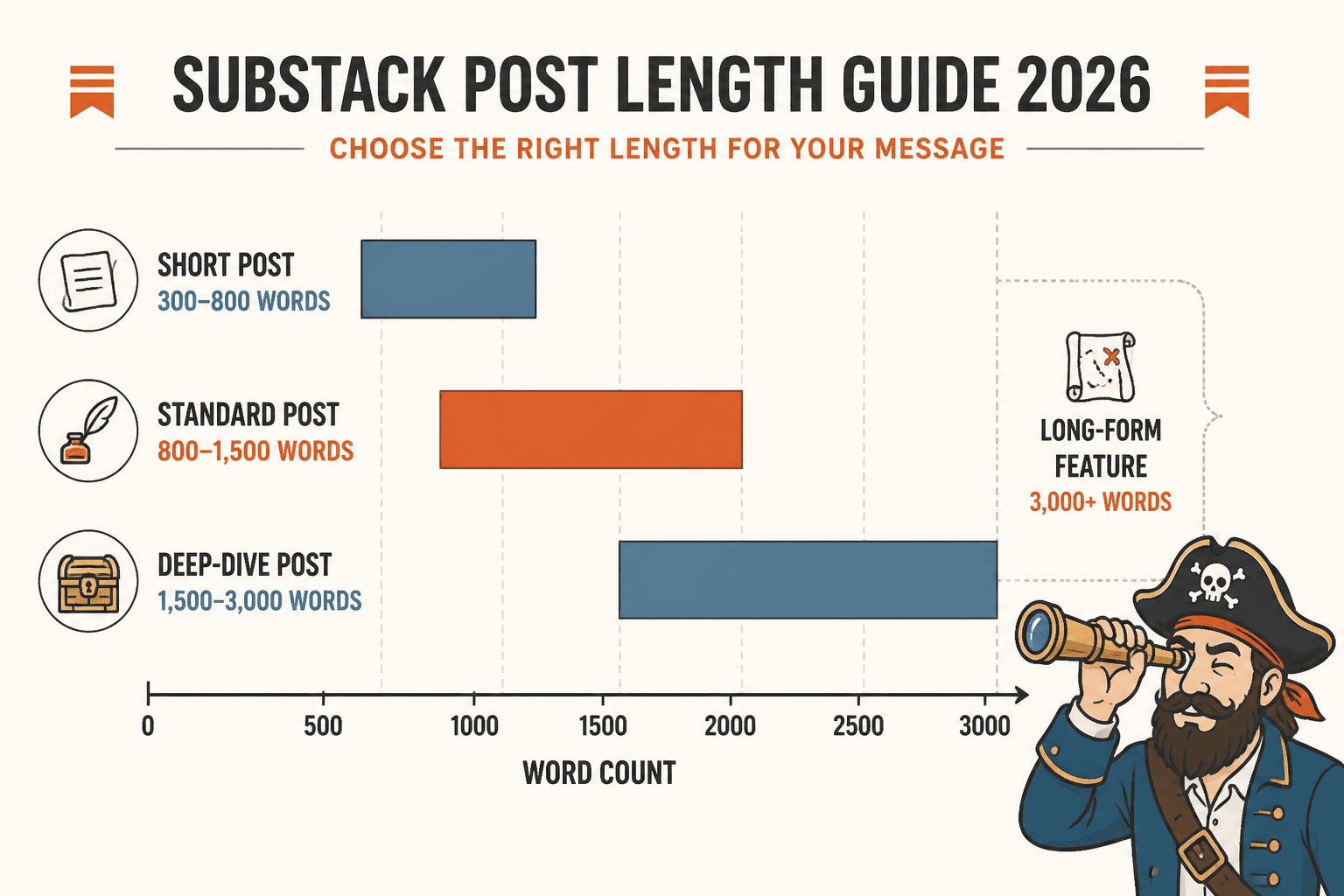
For most creators, coaches, consultants, writers, and niche experts, Substack posts tend to work best in a few practical ranges.
| Post type | Useful range | Best for |
|---|---|---|
| Short note | 300–800 words | Quick opinions, updates, observations, light teaching |
| Standard newsletter post | 800–1,500 words | Most weekly posts, useful essays, stories with a point, practical breakdowns |
| Deep-dive post | 1,500–3,000 words | Authority pieces, detailed teaching, strong arguments, case studies |
| Long-form feature | 3,000+ words | Big essays, reported analysis, substantial frameworks, narrative pieces |
That does not mean every short post is good or every long post is indulgent. It means those ranges are usually realistic for what readers are willing to consume if the writing is strong and the structure is clean.
A lot of Substack writers in 2026 are getting better results with tighter, better-paced pieces than with sprawling “thought leadership” essays that clearly should have been edited with a firmer hand. Readers do not mind length. They mind drag.
Short Substack posts: 300 to 800 words
Short posts work well when the idea is naturally compact. A strong insight. A sharp lesson. One story with one clean takeaway. A timely reaction. A quick recommendation. A useful behind-the-scenes note.
What short posts cannot do well is carry vague thinking. If the point is thin, short just makes it more obvious. A lot of writers confuse brevity with elegance. Sometimes it is elegance. Sometimes it is just underdeveloped.
If your short posts feel flat, read when short Substack posts and series beat long ones. The difference between concise and skimpy matters more than people think.
Standard Substack posts: 800 to 1,500 words
This is the sweet spot for a lot of newsletters.
It gives you enough room to make a point, support it, and land it without asking the reader to commit to a small novel in their inbox. If you publish weekly, this range is often the most sustainable too. It lets you be useful without turning every send into a production cycle that eats your life.
For many readers, this is the ideal middle lane: substantial enough to feel worth opening, short enough to finish over coffee without becoming a weekend project.
Deep-dive Substack posts: 1,500 to 3,000 words
This range works when the topic genuinely needs depth. Think frameworks, nuanced opinions, multi-step tutorials, case studies, breakdowns of what worked and what failed, or essays that build a real argument.
The key is structure. Once you move past 1,500 words, readers need visible signposts. Good subheads. Clean transitions. A logical flow. Maybe a useful list or table if it clarifies something. If the post reads like one long exhale, people will save it for later and then never read it. “I’ll come back to this” is one of the great cemeteries of newsletter writing.
Very long posts: 3,000 words and up
These can work beautifully, but they need to earn the ambition.
If you are writing for highly invested readers, a niche professional audience, or paying subscribers who expect depth, long-form can be a real asset. It builds authority. It creates a sense of substance. It can become evergreen work that new subscribers discover later.
But if every post is 3,500 words because you do not like editing, that is not depth. That is avoidance dressed up as generosity.
How long should a Substack series be?
A Substack series should be as long as it takes to cover one clear theme without repetition. That usually means somewhere between 3 and 7 parts for most creators.
Could it be 10 parts? Sure. Should it be? Usually not.
Series fail when writers stretch one decent idea across too many installments because “series” sounds strategic. Readers can smell padding. If part four says what part two already said in slightly nicer shoes, the series is bloated.
| Series length | Works best when | Main risk |
|---|---|---|
| 2–3 parts | The topic is focused and readers want a quick payoff | May feel too thin if the topic is big |
| 4–5 parts | You are teaching a process or unpacking a layered idea | Needs strong progression |
| 6–7 parts | You have a substantial framework, transformation arc, or deeper body of work | Reader drop-off increases |
| 8+ parts | Only if each part is distinct and worth returning for | Bloat, repetition, fatigue |
If you are building a series, ask this before you map anything out: would the reader feel disappointed if part five disappeared? If the answer is no, cut it.
For a stronger structure, it helps to plan the series around progression, not topic buckets. Readers keep going when each part moves them forward. They drift when each installment feels like “more thoughts about roughly the same thing.”
Use purpose to pick the right length
If you are stuck, stop asking how long your post should be and ask what job it is doing.
If the goal is attention
Go shorter and sharper.
Attention pieces usually benefit from one strong idea, one good angle, and very little warm-up. They are easier to open, easier to share, and easier to finish. This is often where 300 to 1,000 words shines.
If the goal is trust
Go long enough to prove you know what you are talking about.
Trust rarely comes from saying more. It comes from saying something specific, useful, and grounded in reality. That might take 900 words. It might take 2,200. The length is not the point. The felt competence is.
If the goal is authority
Depth helps, if the thinking is good.
Authority posts and series often need room for examples, proof, nuance, and a clear point of view. This is where medium-to-long pieces tend to outperform shallow newsletters that just remix obvious advice with fancy spacing.
If the goal is conversion
Use the minimum length needed to create clarity and readiness.
A conversion-focused post does not have to be long. It has to remove friction. It needs to make the reader think, “Yes, this is for me, and yes, this next step makes sense.” Sometimes that is a tight 700-word piece. Sometimes it is a longer case-study-style post that builds the case properly.
What most Substack writers get wrong about length
- They publish long when the idea is weak.
- They publish short when the idea is undercooked.
- They confuse a series with a pile of leftovers.
- They bury the point halfway down the post.
- They write intros that take 200 words to clear their throat.
- They assume readers want “more value” when readers actually want clearer value.
This is why length advice often feels useless. The problem is rarely the number alone. The real issue is mismatch. The structure, promise, depth, and reader expectation are not aligned.
If your open rates are decent but completion feels weak, your posts may be too long for the payoff. If subscribers like you but do not remember your work, your posts may be too short to create any real depth. If a series starts strong and fades, the middle probably got mushy.
That is not an algorithm problem. That is an editorial problem.
A simple way to decide post length before you write
Use this quick filter.
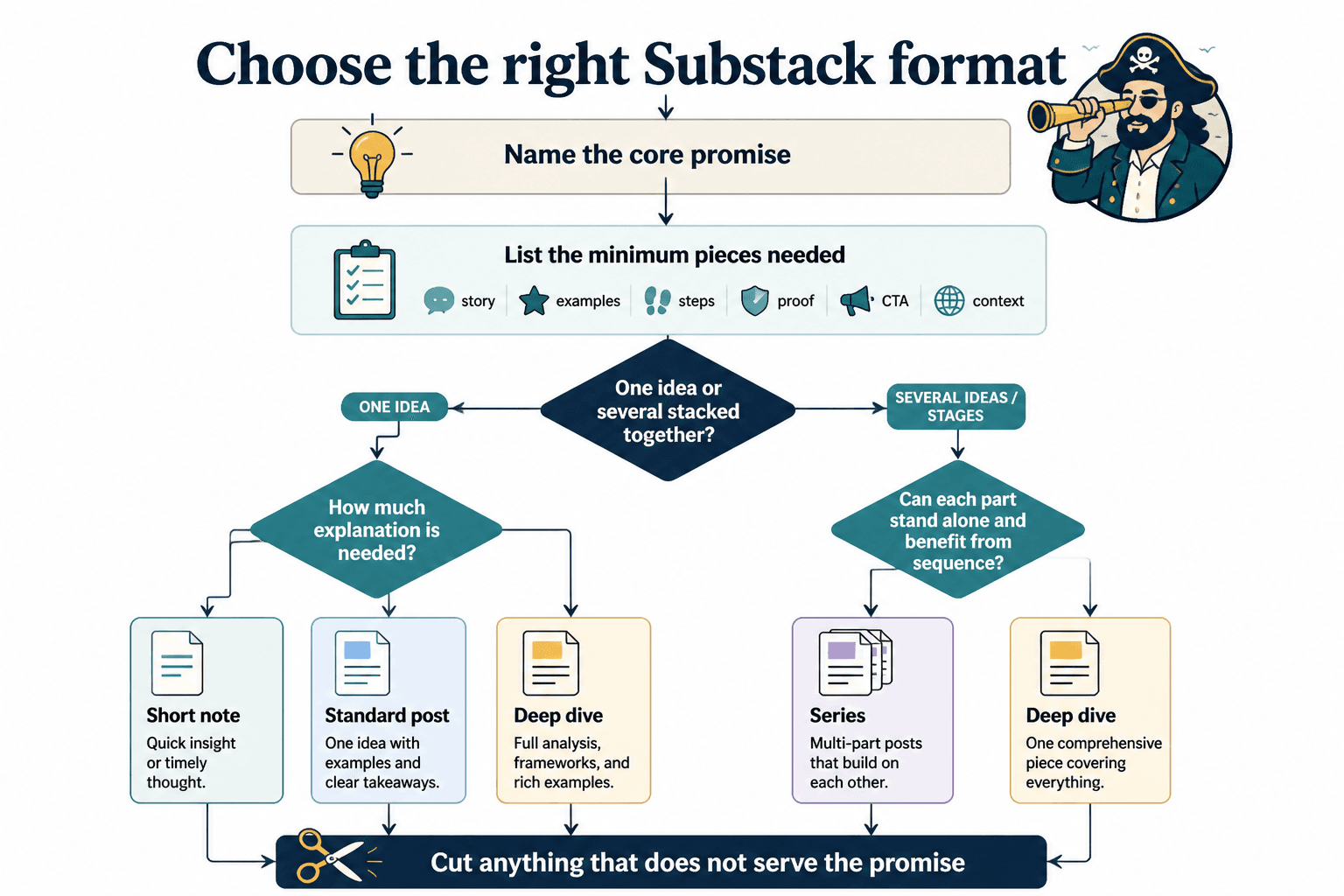
- Name the core promise. What will the reader understand, do, or see differently by the end?
- List the minimum pieces needed. Story, examples, steps, proof, CTA, context.
- Check complexity. Is this one idea or several stacked together?
- Pick the format. Short note, standard post, deep dive, or series.
- Cut anything that does not serve the promise.
That one step alone prevents a lot of bloated newsletters. Writers often draft first and discover too late that they had either half a post or four posts jammed together with no clean spine.
When a post should become a series
Turn one Substack post into a series when:
- The topic has distinct stages or chapters
- Each part can stand on its own but gets stronger in sequence
- The reader benefits from digesting it in smaller chunks
- You want to build anticipation or a repeat reading habit
- There is enough substance to make each part feel complete
Do not turn it into a series just because the draft is long. A long draft is often just an editing problem.
A good series has rhythm. Each part should answer something and open the next thing naturally. It should not feel like the writer cut a giant post into slices with a butter knife and called it strategy.
If you want examples of stronger structures, read best Substack posts and series ideas and examples for creators and Substack posts and series guide for creators who want better results.
Length guidelines by Substack post type
Opinion posts
Usually 500 to 1,200 words.
Enough to make the point and support it. Not enough to become a manifesto unless you truly have something bigger to say.
How-to posts
Usually 1,000 to 2,500 words.
These need room for useful detail, examples, and sequence. Too short, and they become vague. Too long, and they become exhausting.
Personal essays with a business or creator takeaway
Usually 800 to 1,800 words.
The bigger point is simple: clearer structure and clearer writing make the piece more useful. That is usually what makes the ending land better too.
Stronger Substack posts usually come from a clearer point, tighter structure, and a more deliberate series flow. Better pacing often matters more than more volume.