
If you want the bigger picture, start with the parent guide.
Examples: old content turned into better newsletter sections
Newsletter structure works best when each section has one clear job and supports the main point of the issue. Simpler formats usually outperform busier ones when the writing stays sharp.
Newsletter structure works best when each section has one clear job and supports the main point of the issue. Simpler formats usually outperform busier ones when the writing stays sharp.
Most people do not have a newsletter content problem. They have a formatting problem dressed up as a content problem.
They have old posts, half-decent threads, workshop notes, client questions, podcast transcripts, random voice memos, and Google Docs full of usable ideas. But when it is time to send the newsletter, they somehow turn all of that into one long blob with a weak intro and a polite sign-off.
That is usually the mistake. Not lack of ideas. Lack of structure.
How to Turn Old Content Into Better Newsletter Sections and Formats is really about learning how to stop recycling content lazily and start reshaping it so it actually reads well in email. Because email is not your blog. It is not LinkedIn with a subject line. And it definitely is not the dumping ground for every leftover thought you were too attached to delete.
Here is how to take old content and turn it into sharper newsletter sections, better recurring formats, and emails people might actually look forward to opening.
Why old content usually flops in newsletters
Repurposing sounds efficient because it is efficient. But people often do it in the laziest possible way: copy, paste, trim a little, hit send.
That is not repurposing. That is relocation.
Old content tends to flop in newsletters for a few predictable reasons:
- The original format had a different job
- The pacing does not work in an inbox
- The intro assumes too much context
- The structure is built for scrolling, not reading
- The point gets buried under setup
- There is no recurring shape, so every email feels improvised
A post can survive on momentum. A newsletter usually needs more intention. A thread can get away with fragmentation. An email usually needs cleaner transitions. A webinar transcript might have value, but not in its original swollen form.
If you want better results, start treating your old content like raw material, not finished goods.
Start by sorting old content by type, not platform
This part matters more than people think. If you organize old content by platform alone, you end up asking bad questions like, “Can I turn this LinkedIn post into a newsletter?”
Better question: “What kind of asset is this, and what kind of newsletter section could it become?”
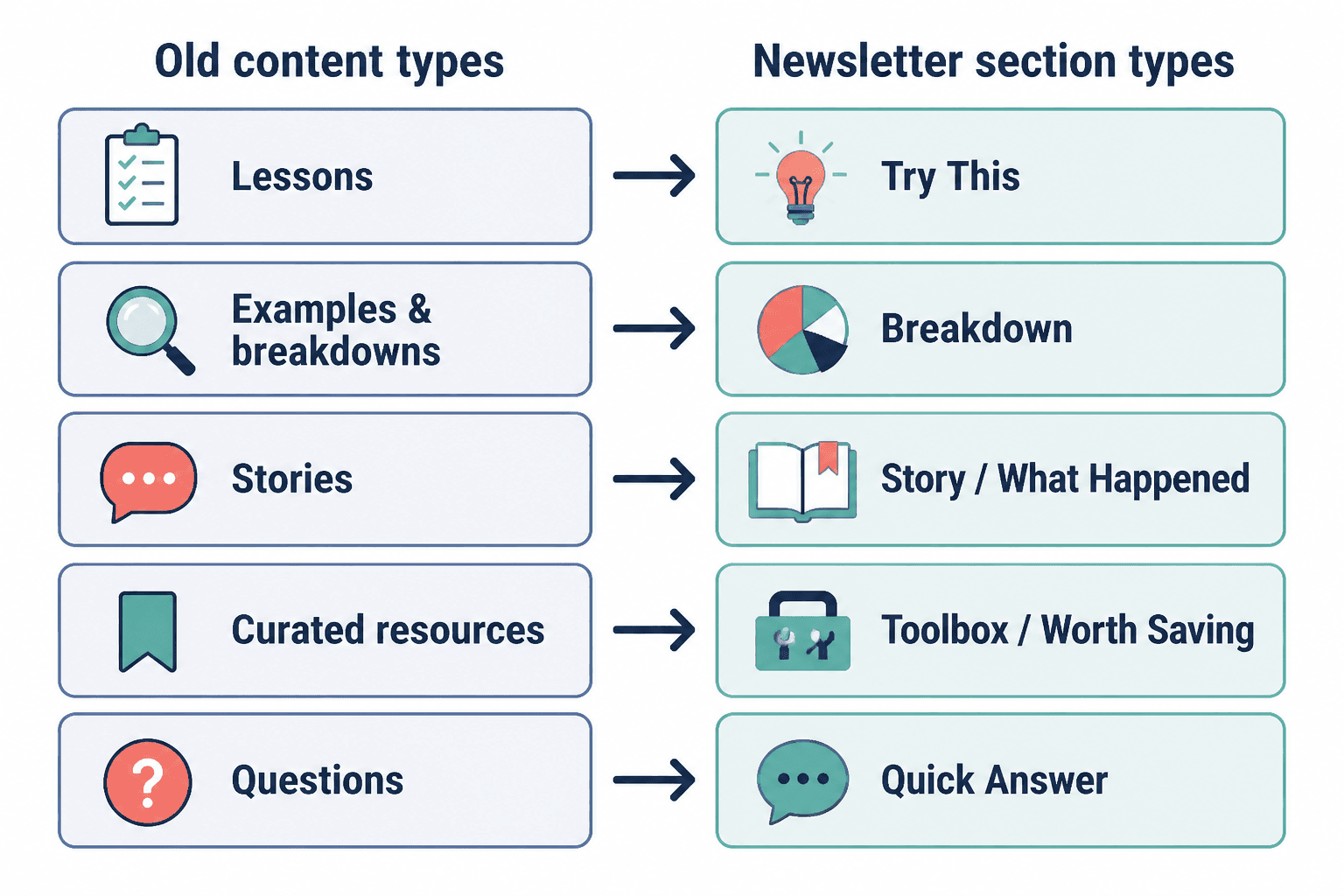
Sort your old content into buckets like these:
- Strong opinions: contrarian takes, myths, hot-ish takes with substance
- Practical lessons: step-by-step advice, frameworks, checklists, process notes
- Examples and breakdowns: teardowns, before/after rewrites, case observations
- Stories: client moments, mistakes, turning points, pattern recognition
- Curated resources: tools, links, prompts, recommendations, saves
- Questions: FAQs, objections, repeated client concerns, audience replies
Those buckets map cleanly to newsletter sections. A practical lesson might become a “Try This” section. A strong opinion might become an “Overrated This Week” section. A repeated audience question might become a “Quick Answer” section.
Once you do that, you stop forcing content into the wrong shape. That alone cleans up a lot.
Choose newsletter sections that fit the way people read email
Good newsletter formats are not just tidy. They reduce friction. They help readers know what they are about to get and help you avoid rewriting your newsletter from scratch every week like some kind of inbox martyr.
Some section formats work especially well because they are easy to repeat and easy to read.
1. The quick lesson
Best for old how-to posts, carousels, threads, workshop clips, and coaching notes.
- One clear takeaway
- Three to five supporting points
- One practical next step
This is great when your old content has value but too much setup. Strip it down to the useful bit.
2. The opinion section
Best for old posts with a point of view, especially the ones that got strong reactions.
- Open with the opinion
- Explain why it matters
- Back it up with one example or contrast
This works because email is a strong place for clear thinking. Not fake controversy. Just a useful opinion stated plainly.
3. The breakdown
Best for old case studies, content teardowns, post analyses, and examples.
- What you are looking at
- Why it worked or failed
- What to copy carefully
Readers love examples when they are specific enough to steal from without becoming weird knockoffs.
4. The recurring prompt
Best for old notes, unfinished ideas, short posts, and content fragments.
- One prompt or question
- A short explanation
- An invitation to reply or think
This is useful when your archive is full of little sparks that are too thin to become full emails but perfect as recurring sections.
5. The swipe or rewrite section
Best for old drafts, weak hooks, stale CTAs, bad bios, and bland copy examples.
- Show the weak version
- Rewrite it
- Explain the improvement
This one pulls a lot of weight because it teaches while giving readers something concrete to use.
If you want a stronger foundation for section planning, this guide to newsletter sections and formats and this breakdown on writing better newsletter sections and formats are worth reading next.
How to turn one old piece into a better newsletter section
Here is the simplest process that works.
Step 1: Find the real point
Old content often contains one useful idea hiding inside twelve sentences of warm-up.
Ask:
- What is the sharpest idea here?
- What would I keep if I had to cut 70 percent?
- What is the part people actually cared about?
If you cannot answer that fast, the content probably was not clear enough the first time either.
Step 2: Match it to a section format
Do not ask, “How can I preserve the original?” Ask, “What format makes this easiest to read and most useful in email?”
A thread might become a quick lesson. A rant might become an opinion section. A webinar clip might become a breakdown. A list of decent one-liners might become a recurring prompt.
Step 3: Rewrite the opening for email
This is where a lot of repurposed newsletter content dies.
Email intros should earn attention quickly. They do not need to be dramatic. They do need to be clear.
Weak repurposed opening: “I was thinking recently about content strategy and how creators can improve the way they communicate online.”
Better newsletter opening: “A lot of creators are not short on ideas. They are short on formats that make those ideas readable.”
Same territory. Much better grip.
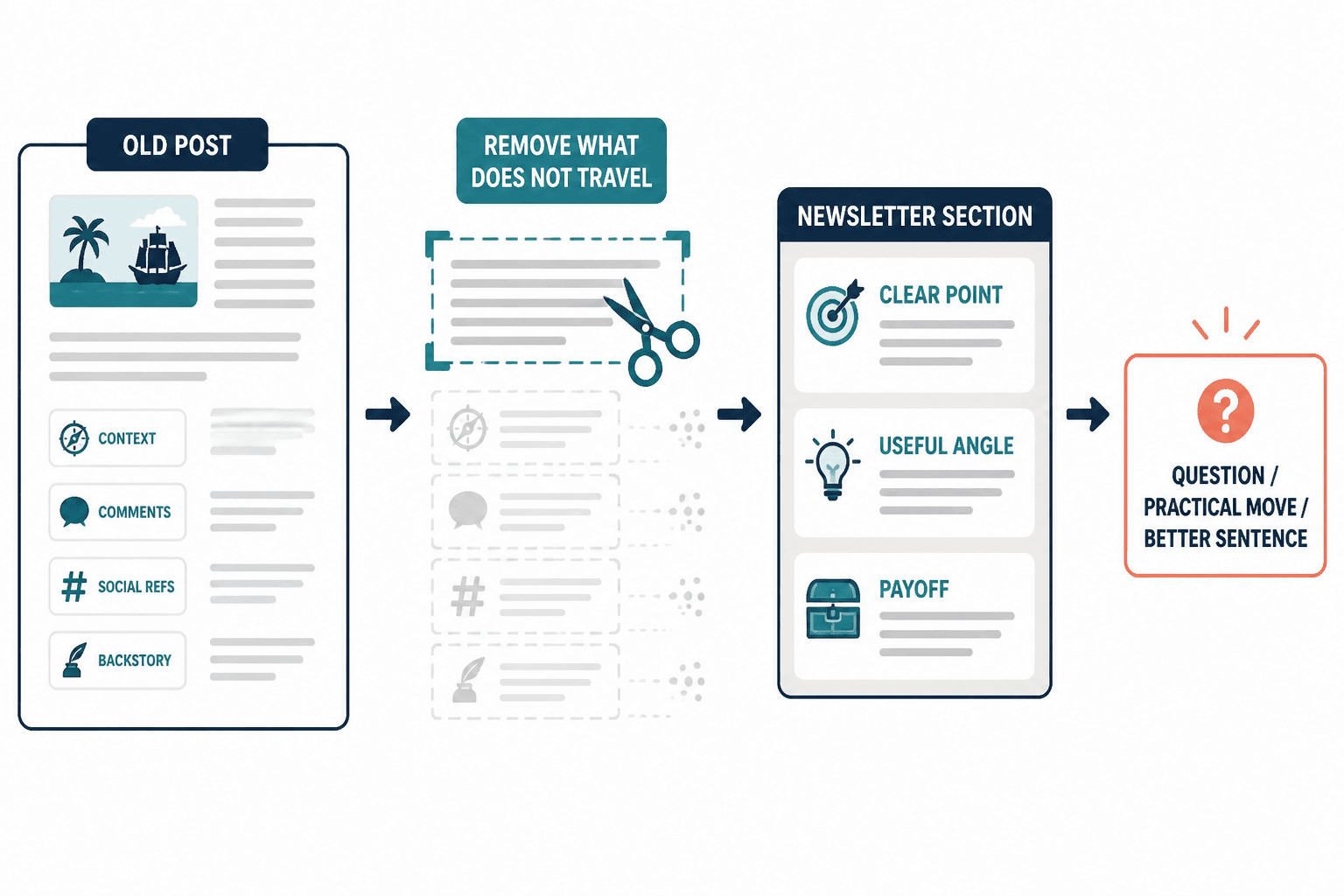
Step 4: Cut anything that depends on platform context
Old content often references comments, visuals, previous posts, trends, screenshots, or platform behavior that your email reader did not see and does not care about.
Remove:
- “As I said in my post yesterday…”
- “This blew up more than expected…”
- “The comments were wild…”
- Context that only makes sense on social
Keep what travels well. Drop what needed the original stage set.
Step 5: Add a payoff
A newsletter section should leave the reader with something. A clearer perspective. A better sentence. A practical move. A question worth replying to.
If the section ends with “just sharing thoughts,” that is usually code for “this did not land.”
Better newsletter formats you can build from old content
If your newsletter feels inconsistent, the fix is often a repeatable structure. Not more brainstorming. Not more apps. Just a better format.
Here are a few simple newsletter formats that are especially good for repurposing old content.
Format 1: One main idea, three useful angles
Use this when you have one strong old post or article and want to deepen it without padding.
- Opening point
- Angle 1: what people get wrong
- Angle 2: what works better
- Angle 3: how to apply it
- Short CTA or reply prompt
Format 2: The weekly field note
Use this when you have scattered content fragments, observations, client notes, and half-finished ideas.
- One thing I noticed
- One thing I changed my mind about
- One thing to try
This keeps your newsletter human without becoming rambling diary sludge.
Format 3: The teardown email
Use this when you have old examples, screenshots, or analyses sitting around.
- Example
- Why it works or fails
- Lesson for the reader
This is one of the strongest authority-building formats because it shows taste, not just opinions.
Format 4: The short stack
Use this when you want a lighter email made from smaller old pieces.
- One short lesson
- One useful tool or resource
- One prompt or question
Great for consistency. Also great when your week got away from you and you still want to send something good instead of ghosting your list again.
Format 5: The before-and-after email
Use this when you have old rewrites, edits, positioning tweaks, hook fixes, or CTA improvements.
- Original version
- Improved version
- Why the new one works better
This format is especially good for consultants, copywriters, marketers, coaches, and anyone selling thinking instead of just information.
What to keep, what to cut, and what to combine
When you repurpose old content into newsletter sections, you usually need to make one of three decisions.
| Decision | Use it when | What it looks like |
|---|---|---|
| Keep | The idea is still sharp and relevant | Light edit, stronger intro, cleaner ending |
| Cut | The content is bloated, dated, or too platform-specific | Trim hard, remove fluff, keep the point |
| Combine | Several old pieces point to the same idea | Merge them into one stronger section or format |
The combine option is underrated. Three short old posts that each say half of something useful can often become one strong newsletter section with actual depth.
That is often better than trying to stretch one flimsy old post into a full email. People can feel when an idea is being dragged around by the ankles.
Examples: old content turned into better newsletter sections
Newsletter structure works best when each section has one clear job and supports the main point of the issue. Simpler formats usually outperform busier ones when the writing stays sharp.
Newsletter structure works best when each section has one clear job and supports the main point of the issue. Simpler formats usually outperform busier ones when the writing stays sharp.