
Weak Substack openings usually do not fail because the writer lacks ideas. They fail because the writer spends the first five lines clearing their throat, setting the scene, apologizing for existing, or warming up like the reader has nowhere else to be.
That is a problem for any post. It is a bigger problem for a Substack post or series, because the opening does more than grab attention. It teaches readers what kind of publication this is, whether you are worth their time, and whether they should come back next week instead of forgetting you the second they close the tab.
If you want to know how to start Substack posts and series without a weak opening, the fix is not “be more creative.” It is much more practical than that. You need to open with tension, clarity, specificity, or a sharp promise. Ideally, more than one. That applies whether you are writing essays, creator notes, how-to posts, opinion pieces, or an ongoing series.
Here is how to make your Substack openings stronger, less generic, and far more likely to keep readers moving.
If you want the bigger picture, start with the parent guide.
Why Substack openings matter more than people admit
On Substack, the opening does a few jobs at once:
- It earns the next paragraph
- It frames the piece so the reader knows what they are getting
- It sets the voice of the publication
- It signals whether this post will be worth forwarding, bookmarking, or subscribing for
- It makes a series feel intentional instead of like a pile of loosely related emails
A lot of writers treat the opening like a runway. They think they need to slowly taxi toward the point. You do not. Readers are already in your plane. Please just take off.
That does not mean every post needs artificial drama. It means the start should carry some kind of energy: a useful claim, a hard truth, a clear question, an unexpected angle, a pattern the reader recognizes, or a specific promise.
If you are building a recurring publication, this matters even more. A strong opening tells readers, “This newsletter knows what it is doing.” A weak one says, “Maybe something interesting will happen eventually, if you are very patient.”
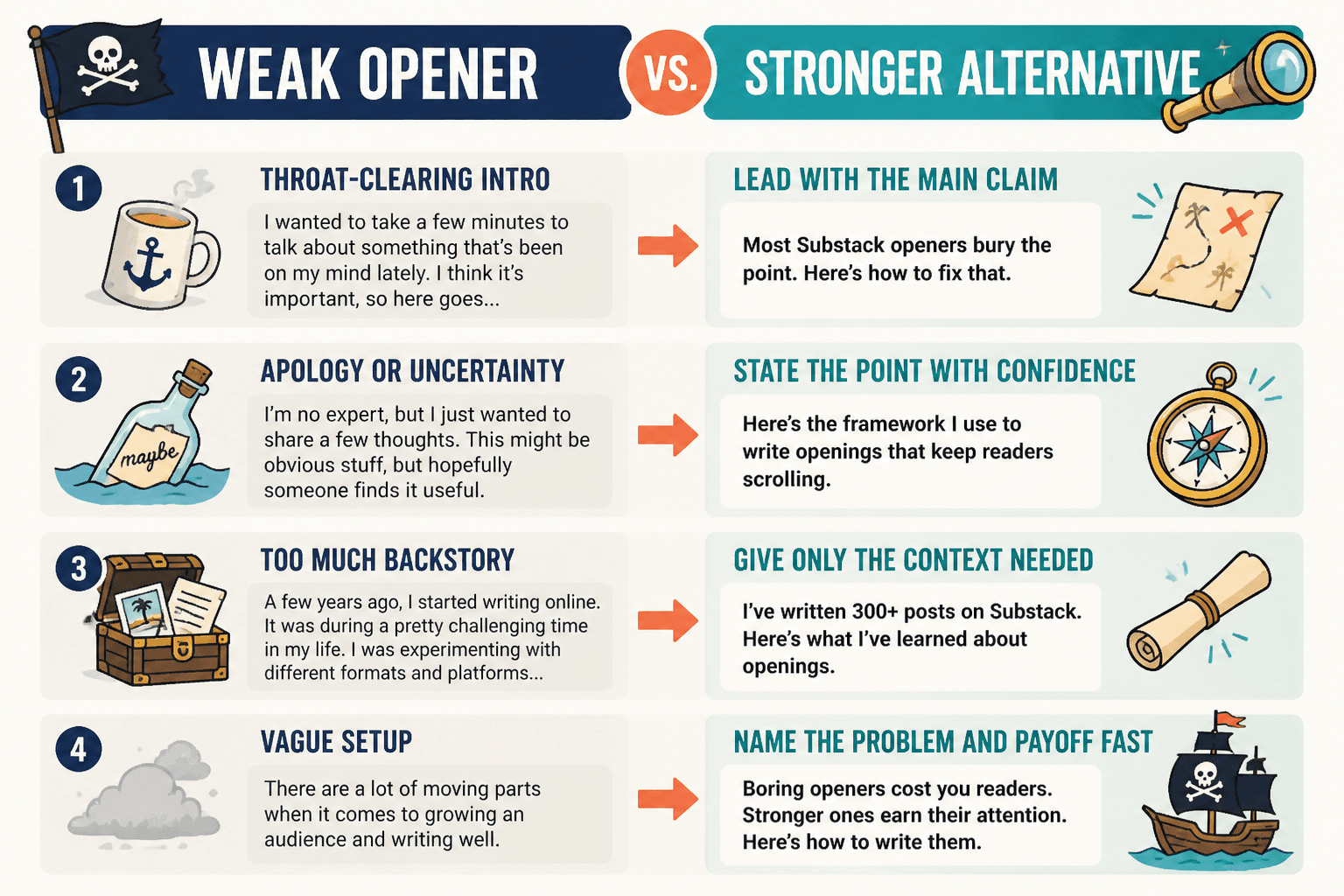
What a weak opening usually looks like
Most weak openings fall into a few predictable traps.
1. The diary-style warm-up
Example:
I have been thinking a lot lately about writing online, and over the past few weeks I have had a few conversations that made me reflect on how creators approach newsletters.
Nothing is wrong with this sentence grammatically. It is just doing absolutely no heavy lifting.
2. The broad philosophical opening
Writing is one of the most powerful tools we have to connect with people in a noisy world.
Sure. Also, this could open 400,000 articles. It does not create urgency, distinction, or curiosity.
3. The vague promise
Today I want to share a few thoughts on what makes a great newsletter.
“A few thoughts” is one of those phrases that instantly lowers confidence. The reader does not want your spare thoughts. They want a sharp idea with a payoff.
4. The context overload opening
Writers often pour in all the setup before giving the actual point. They explain what inspired the piece, where the idea came from, what happened last month, and why they are finally writing it now. By the time the useful part arrives, the reader is gone.
Context is not bad. Front-loading all of it usually is.
For more ways to tighten the front of your posts, see this guide on improving Substack post openings without sounding generic.
What strong Substack openings actually do
A strong opening does not need to be flashy. It just needs to create traction. Usually, it does at least one of these things right away.
- Names a problem the reader already feels
- Makes a clear claim with a real point of view
- Introduces tension or contrast
- Shows the stakes
- Promises a specific payoff
- Starts with a concrete moment that leads somewhere fast
Good openings move. Weak openings hover.
That is the mindset shift. You are not trying to “begin nicely.” You are trying to create momentum.
How to start Substack posts and series without a weak opening
Here are the most reliable ways to open stronger, with examples you can adapt.
Start with the friction, not the background
The fastest way to strengthen an opening is to begin where the tension is. Not before it.
Weak: I have been working on my newsletter strategy recently, and I noticed a few patterns in what seems to resonate with readers.
Stronger: Most newsletters do not lose readers because the ideas are bad. They lose readers because the writing takes too long to get to the point.
The second version gives the reader a reason to keep going immediately. It has a claim, a problem, and a hint that the piece will explain something useful.
Start with a clear opinion
Substack rewards distinctive thinking better than many social platforms do. A clean opinion can carry an opening beautifully, especially if your readers care about your perspective.
Example: Most newsletter intros are trying too hard to sound writerly and not hard enough to be worth reading.
That kind of line works because it is specific enough to mean something and sharp enough to signal voice. Not fake-hot-take sharp. Just alive.
Start with a reader-recognition line
This works well for practical creator newsletters, coaching newsletters, and educational series.
Example: If your newsletter starts with three paragraphs of context before the point shows up, you do not have an intro problem. You have an editing problem.
The reader instantly knows if this is about them. If it is, they stay.
Start with a specific promise
When your post is tactical, be plain about the payoff.
Example: Here is a simple way to open your next Substack post so readers know exactly why they should keep reading by line three.
This is not sexy. It is useful. Useful wins a lot more often than people think.
Start with a concrete moment, then turn fast
Stories can work, but only if they get to the point quickly. Too many writers disappear into memoir fog before the reader knows why the scene matters.
Weak: Last Thursday I was sitting in a coffee shop, watching the rain hit the windows, thinking about how much writing has changed over the last few years…
Stronger: Last Thursday, I opened a newsletter that spent 214 words getting to its point. I quit at word 80. Most readers would have left earlier.
Now the scene is doing actual work.
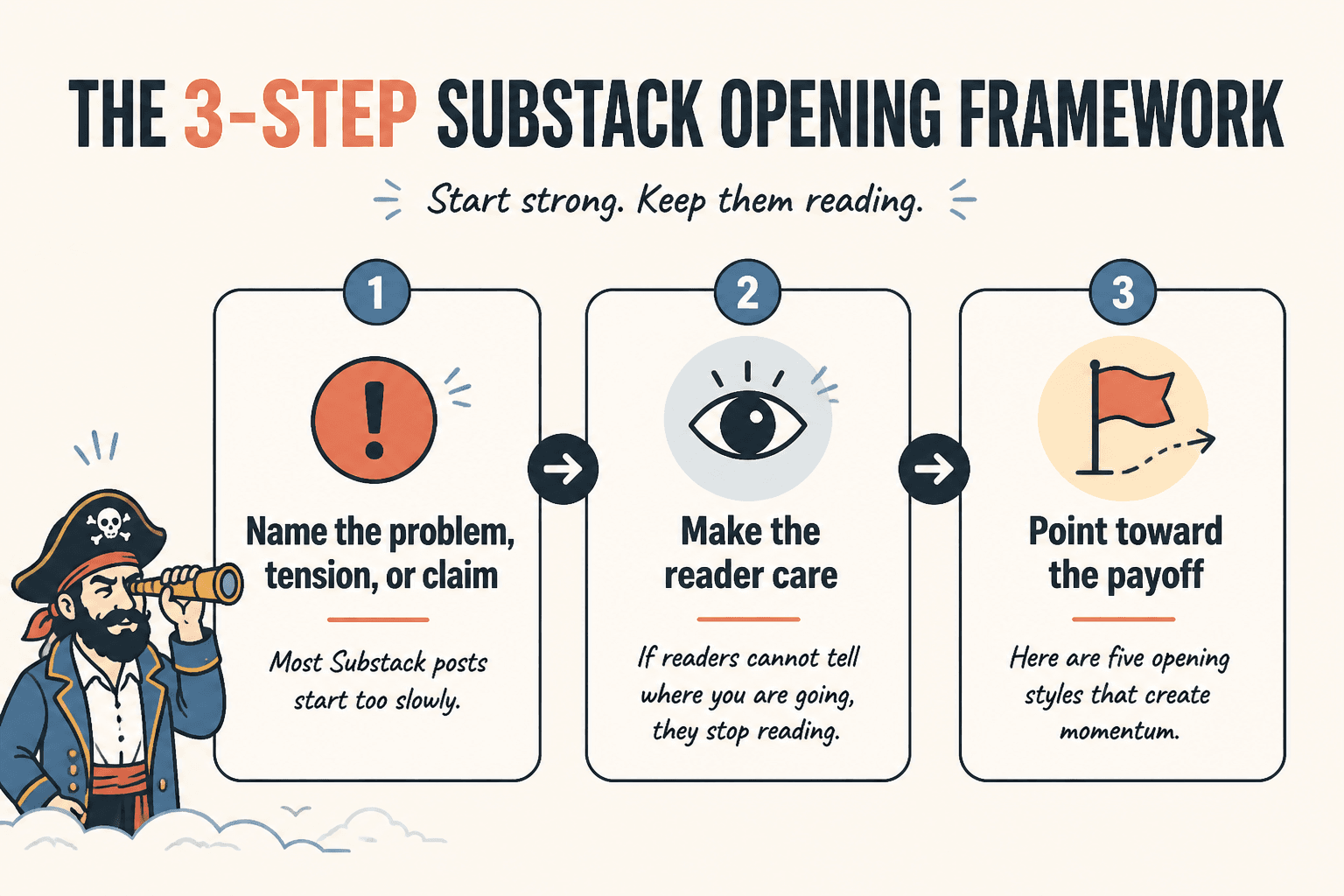
A simple framework for stronger openings
If you tend to freeze at the top of the page, use this:
- Name the problem, tension, or claim
- Make the reader care
- Point toward the payoff
That is it. Not mystical. Not precious. Just functional.
Here is what that can look like in practice:
Problem: Most Substack posts start too slowly.
Why care: If readers cannot tell where you are going, they stop reading before your best point appears.
Payoff: Here are five opening styles that create momentum without sounding forced.
You can make that more polished later. The point is to stop leading with mist.
How series openings differ from one-off post openings
When you are writing a Substack series, the opening has an extra job: it needs to create continuity.
A one-off post can simply win attention. A series opener should also establish the logic of the series, the reader benefit, and the pattern they can expect.
For the first post in a series
The opening should answer three things quickly:
- What is this series about?
- Why does it matter?
- Why should the reader follow along?
Example: Most advice on growing a newsletter talks about tactics after you already have attention. This series is about the part people skip: how to make the writing itself strong enough that subscribers actually want the next email.
That gives shape to the series right away.
For later posts in a series
You do not need to keep re-explaining the entire series every time. You just need a quick bridge.
Example: In this series, we are fixing the parts of Substack writing that quietly lose readers. Today: openings that take too long and say too little.
Clean. Oriented. No speech before the speech.
If you are still shaping your angle, these Substack series ideas and examples can help you build a stronger editorial direction.
Five opening formats that work well on Substack
1. The blunt truth
Template: Most [thing people do] fails not because of [assumed reason], but because of [real reason].
Example: Most newsletter intros do not fail because they are too short. They fail because they say nothing specific with confidence.
2. The sharp contrast
Template: People think [common belief]. Usually, the real issue is [stronger truth].
Example: People think a weak opening means the writer needs a better hook. Usually, they just have not found the actual point yet.
3. The useful promise
Template: If you want to [result], start by [key action]. Here is how.
Example: If you want more people to finish your Substack posts, start by cutting the polite scene-setting. Here is a cleaner way to open.
4. The pattern callout
Template: If your [content type] keeps [bad result], there is a good chance [specific cause].
Example: If your newsletter keeps getting opened but not read, there is a good chance your first paragraph is doing too much warming up and not enough work.
5. The controlled scene
Template: [Specific moment]. [Fast interpretation or takeaway].
Example: I read three creator newsletters this morning. All three buried the point under intros that sounded pleasant and forgettable. This is more common than most writers realize.
How to edit a weak opening into a stronger one
If your draft starts weak, do not keep polishing the weak version. Rebuild it.
The bigger point is simple: clearer structure and clearer writing make the piece more useful. That is usually what makes the ending land better too.