Most creators do not have a Substack writing problem. They have a packaging problem.
They publish decent thoughts, send them to decent people, then act confused when nothing compounds. No momentum. No anticipation. No real reader habit. Just a pile of standalone posts floating around like socks that lost their partners in the dryer.
A good Substack can absolutely work as a casual newsletter. But if you want better results, more opens, more replies, more trust, more paid conversion, more people sticking around, you need more than random decent posts. You need structure. That is where posts and series start pulling their weight.
This Substack Posts & Series Guide for Creators Who Want Better Results will show you how to use one-off posts and recurring series properly, how to choose the right format for the idea, and how to build something readers can actually follow without making your newsletter feel like homework.
If you are still treating every newsletter like a fresh start from zero, that is probably the leak.
For the full path around this topic, head to the parent guide.
Why most Substack posts underperform
The usual advice is to “be consistent” and “provide value.” Fine. Very inspiring. Also wildly incomplete.
Substack posts underperform for more specific reasons:
- The post topic is too broad
- The opening takes too long to get to the point
- The piece sounds polished but says nothing sharp
- There is no clear reader promise
- Every issue feels disconnected from the last one
- The creator is writing what they feel like saying, not what readers would return for
- There is no repeatable format readers can recognize
Readers do not subscribe because you had one smart thought on a Tuesday. They subscribe because they think, “This person is going to keep helping me in a way I can trust and follow.”
That last part matters. Follow. If your newsletter feels messy, even good ideas get wasted. A series solves that by giving your work shape. It creates expectation, and expectation is one of the least glamorous but most useful growth tools you have.
Not everything needs to become a series, obviously. Some ideas work best as a sharp standalone post. But if every issue is a lonely island, your Substack is doing extra labor for no reason.
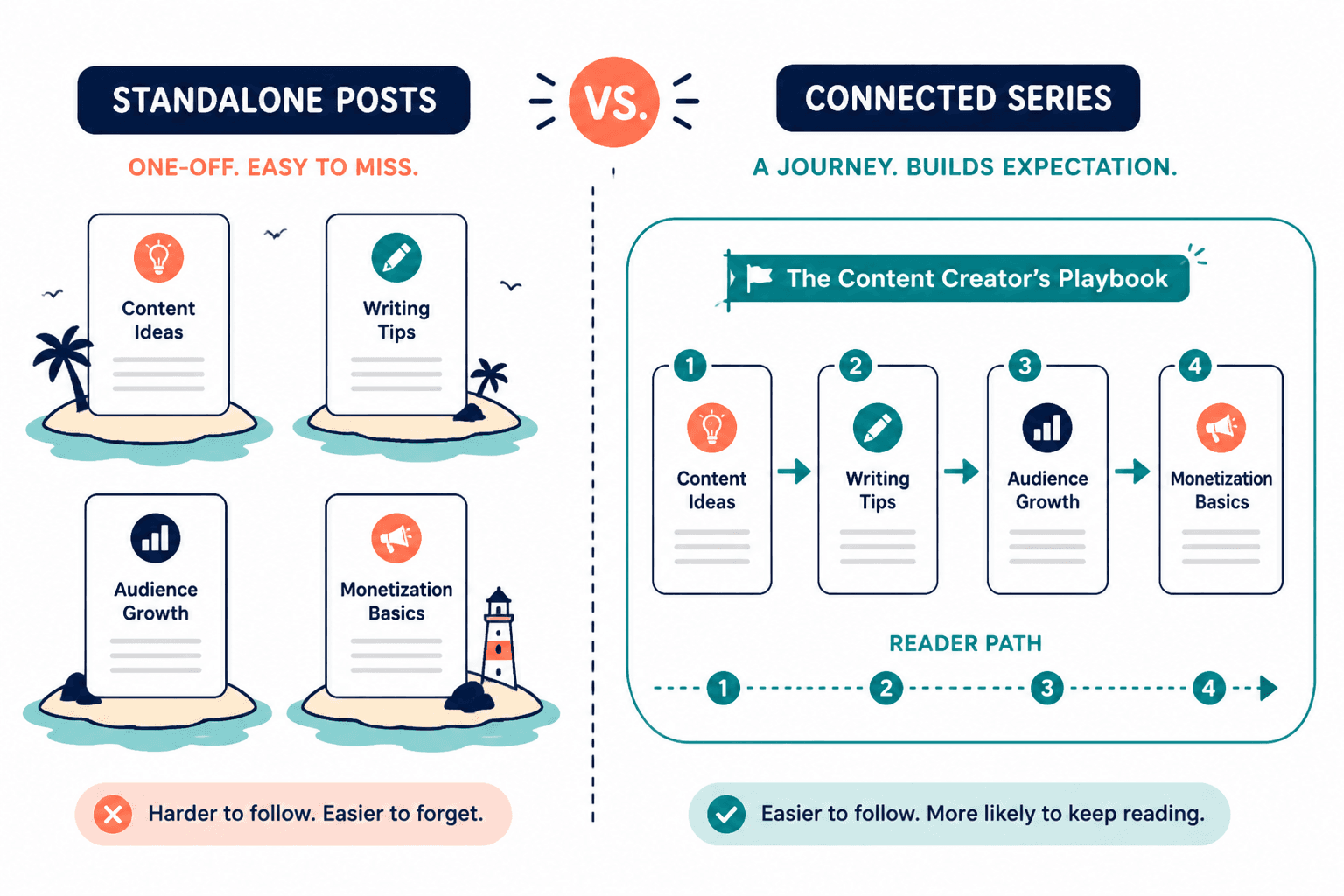
Substack posts vs series: use the right tool for the job
A lot of creators blur these together. That is how you end up with newsletters that are too flimsy to feel substantial and too scattered to feel intentional.
When a standalone post works best
Use a standalone post when the idea can land cleanly in one issue.
- A strong opinion with one clear argument
- A useful breakdown with a fast payoff
- A timely observation
- A short case study
- A behind-the-scenes lesson
- A response to a common reader problem
Standalone posts are great for testing ideas. They are also easier to share and repurpose. If someone finds one and gets value fast, good. That is a clean entry point.
When a series works better
Use a series when the topic has depth, the reader needs progression, or repetition itself creates value.
- Teaching a skill over time
- Breaking down a larger framework
- Running a recurring critique format
- Publishing themed essays around one problem
- Documenting an experiment
- Creating a recognizable franchise inside your newsletter
A series gives readers a reason to come back beyond vague goodwill. It also helps you write faster, because you are not inventing a brand new format every week like some sort of exhausted content raccoon.
Good series reduce decision fatigue for both sides. You know what kind of issue you are writing. Readers know what kind of issue they are opening.
A simple way to decide
| If your idea… | Use this |
|---|---|
| Can make one point clearly and quickly | Standalone post |
| Needs multiple parts or examples to be useful | Series |
| Is timely or reactive | Standalone post |
| Can become a repeatable format readers recognize | Series |
| Is still being tested | Standalone post first |
| Supports deeper authority and reader habit | Series |
What better results on Substack actually look like
“Better results” should mean more than subscriber count. A bloated list with weak reader loyalty is not impressive. It is just expensive disappointment waiting to happen.
For most creators, better Substack results look more like this:
- Higher open rates because readers recognize the format or promise
- More replies because the issue gives them something specific to respond to
- More shares because the post has a clear angle
- More trust because your work feels consistent and coherent
- More paid conversions because readers can see the value pattern over time
- Easier writing because you are not reinventing your newsletter from scratch every week
That is the real win. Not “I posted 42 newsletters in a quarter.” Nobody cares. Readers care if your work helps, teaches, challenges, or sharpens something for them consistently.
How to build a Substack series people actually want to follow
Most bad series fail before issue two because the creator mistakes a topic for a format.
“I’m going to write about creativity” is not a series. That is a large foggy cloud. A real series has a structure readers can understand and a payoff they can anticipate.
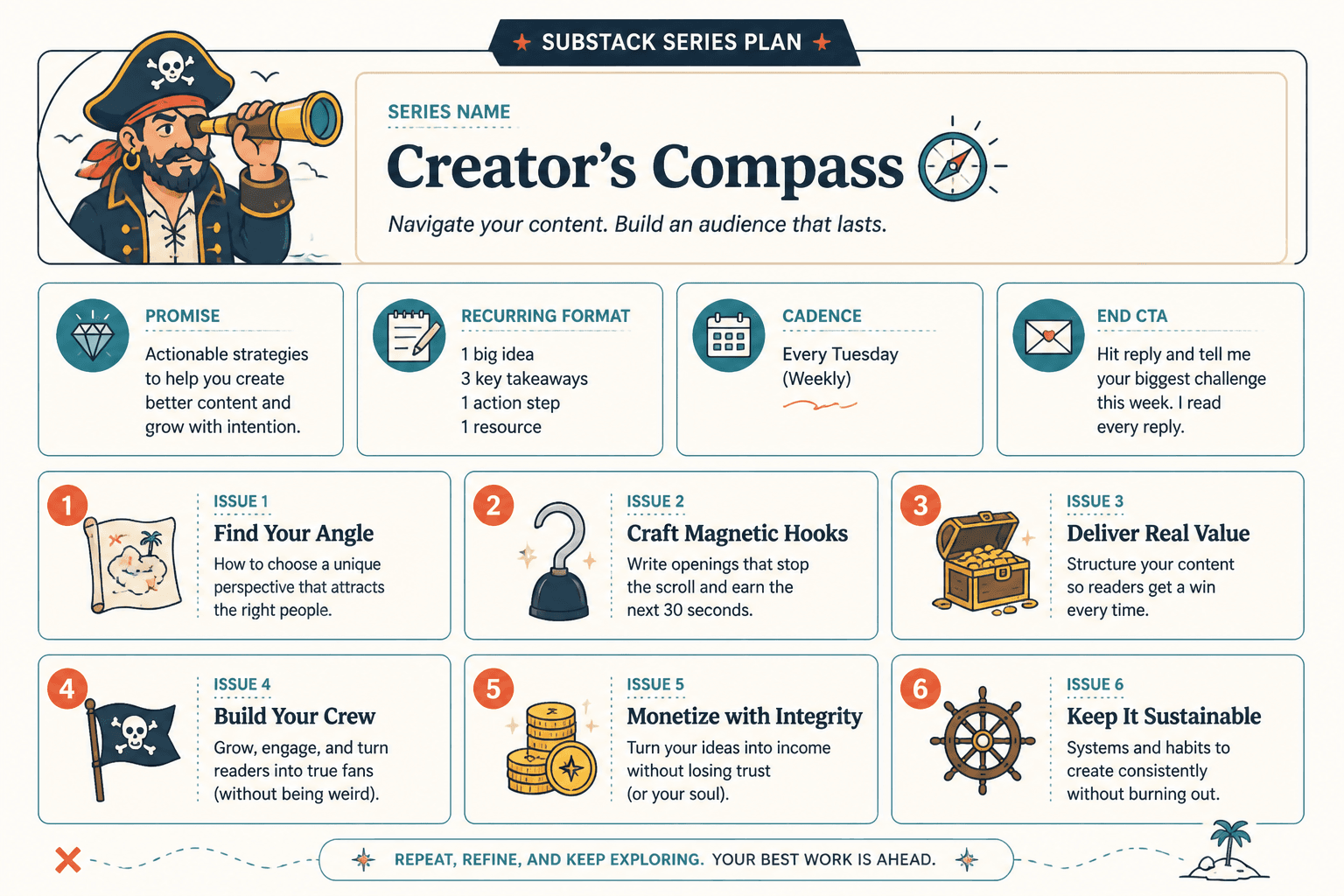
1. Pick a narrow promise
Your series should solve one kind of problem, answer one category of question, or explore one angle deeply.
Weak promise: “Thoughts on building a creator business”
Stronger promise: “Each Friday, I break down one newsletter tactic creators can use to get more replies and referrals.”
Weak promise: “Writing lessons from my work”
Stronger promise: “Every Tuesday, I rewrite one weak piece of creator copy and show exactly why the new version works better.”
Narrow is not limiting. Narrow is memorable.
2. Create a repeatable structure
Readers like familiarity more than creators like admitting it. A repeatable structure does not make your writing boring. It makes it easier to follow.
A simple series structure might look like this:
- Problem
- Why people get it wrong
- Example
- Better approach
- One action step
Or this:
- Question from a reader
- Your answer
- Example or screenshot
- Template
- Reply prompt
When your series has shape, readers know where they are. That helps retention more than people think.
3. Name the series like a human, not a consulting deck
Series names should be clear, not overbranded into nonsense.
Weak:
- The Creator Growth Intelligence Brief
- Newsletter Optimization Insights
- Authority Accelerator Notes
Better:
- Post Clinic
- One Good Funnel
- What I’d Fix
- The Friday Breakdown
- Behind the Draft
- Series Notes
Clarity beats cleverness. Slight texture is nice. Corporate fog is not.
4. Plan the first 4 to 6 entries before you launch it
If you cannot think of at least four solid installments, the idea probably is not ready for a series. It may still be a good standalone post. That is not failure. That is discernment, a tragically underused skill online.
Before launching a series, draft:
- The series promise
- The recurring format
- The first 4 to 6 topics
- How often it runs
- What kind of CTA fits at the end
This also helps you avoid one of the classic newsletter mistakes: announcing a new recurring feature with great confidence, then quietly abandoning it after two weeks when reality arrives.
Best Substack post formats for creators
You do not need thirty formats. You need a few that fit your strengths and reader needs.
Here are post formats that tend to work well for creators, coaches, consultants, writers, and solo business owners.
The sharp lesson post
One useful insight. One clear takeaway. Little to no padding.
Good for:
- Testing ideas
- Shareable posts
- Quick trust building
The breakdown post
You explain how something works, why it works, and how the reader can apply it.
Good for:
- Authority building
- Teaching strategy
- Repurposing into threads or social posts
The teardown or critique
You review a piece of content, funnel step, profile, headline, email, or offer and show what is weak, what is strong, and what you would change.
Good for:
- Specificity
- Demonstrating expertise instead of claiming it
- Interactive formats readers can submit to
The case study post
You walk through a real result, a process, or an experiment and extract the lesson.
Good for:
- Proof
- Trust
- Selling without sounding pushy
The recurring Q&A
You answer one reader question per issue or compile a few around one theme.
Good for:
- Community
- Reply generation
- Staying close to what readers actually care about
The opinion essay with a point
This is not random musing. It is a clear argument with stakes, examples, and a useful takeaway.
Good for:
- Voice
- Differentiation
- Attracting the right people and mildly annoying the wrong ones
If you want more ideas, examples, and angle starters, see best Substack posts and series ideas and examples for creators.
How to structure a strong Substack post
Even a great topic can die in a weak structure. The average newsletter does not fail because the creator lacks expertise. It fails because the writing makes the reader work too hard to find the point.
A simple structure that works for many Substack posts:
- Open with the tension. Name the problem, bad assumption, or costly mistake fast.
- Make the promise. Show what the reader will get from this issue.
- Deliver the point. Give the lesson, argument, framework, or example.
- Add proof or specificity. Use an example, contrast, breakdown, or mini case study.
- End with one next step. Give the reader something clear to do, think about, or reply to.
That is enough. You do not need dramatic scene-setting for every email. You are not auditioning for literary weather descriptions. You are trying to hold attention and earn trust.
If your Substack posts tend to wander, tighten your openings first. A stronger first few lines can rescue a lot.
For a deeper walkthrough on writing stronger issues, read how to write better Substack posts and series.
How to make your series feel connected without getting repetitive
This is where many creators wobble. They either make every issue so different that the series feels fake, or they make every issue so similar that readers can predict the next sentence.
The trick is to keep the frame consistent and the substance fresh.
Keep these stable:
- The series promise
- The general format
- The tone
- The type of payoff readers expect
Vary these:
- The examples
- The angle
- The reader question
- The use case
- The level of depth
- The CTA or reply prompt
Think of it like a good column, not a frozen template. Readers should recognize the kind of issue they are opening, but they should not feel like they accidentally reopened last week’s email.
Common mistakes creators make with Substack series
- Starting too broad. Broad series get blurry fast.
- Overcommitting on frequency. Weekly sounds nice until your calendar starts hissing at you.
- Forcing every idea into the series. Some topics deserve a standalone issue.
- No clear introduction. Readers should know what the series is and why it exists.
- No continuity. If issue 3 does not connect to the larger concept at all, it weakens the whole thing.
- No archive logic. Related issues should be easy to browse and revisit.
- Trying to sound overly important. Readers want useful and readable, not ceremonial.
One practical fix is to briefly frame the series at the top or bottom of each installment. Nothing heavy. Just enough context so new readers can orient themselves and regular readers can feel the continuity.
Example:
This is part 3 of Post Clinic, my series where I break down weak creator content and show how to make it sharper, clearer, and more likely to convert.
That is enough. Short. Useful. Not weirdly grand.
How often should you publish Substack posts or series?
There is no holy frequency. Anyone pretending otherwise is selling certainty because it looks neat in a carousel.
Choose a pace you can sustain without hollowing out the quality.
For most creators, this is a sensible starting point:
- 1 quality post per week if you are building consistency
- 1 core weekly series issue if your format is repeatable and strong
- 1 main issue plus 1 lighter note if you already have good topic flow and audience appetite
If you are newer, consistency matters more than volume. Better to publish one strong, recognizable issue every week than four forgettable ones that teach readers to skim past your name.
If you have a smaller list, this matters even more. You do not need more noise. You need stronger signal. For that angle, see Substack posts and series for creators with small audiences.
How to use Substack posts and series to grow trust and sales
Here is where creators often get twitchy. They want the newsletter to “perform,” so they start stuffing every issue with sales intent. Then they wonder why the thing feels tense and transactional.
Substack works best when the content earns trust first, then channels that trust toward a sensible next step.
Simple paths that work:
- Useful post → profile credibility → paid subscription
- Series issue → related service or offer
- Case study → consultation CTA
- Q&A issue → reply conversation → soft lead
- Popular recurring series → premium archive, workshop, or product
The key is fit. If your CTA feels bolted on, readers can smell it. If the issue naturally leads to the next step, it feels helpful.
For example, if you run a weekly teardown series, a clean CTA might be:
If you want me to review your welcome email or creator bio in a future issue, hit reply and send it over.
Or:
If you want help fixing this inside your own funnel, that is exactly what I help clients do.
Clean. Relevant. Not drenched in funnel cologne.
A simple Substack content system for creators
If you want your newsletter to feel both useful and sustainable, use a mix of repeatable pieces instead of making every issue a creative crisis.
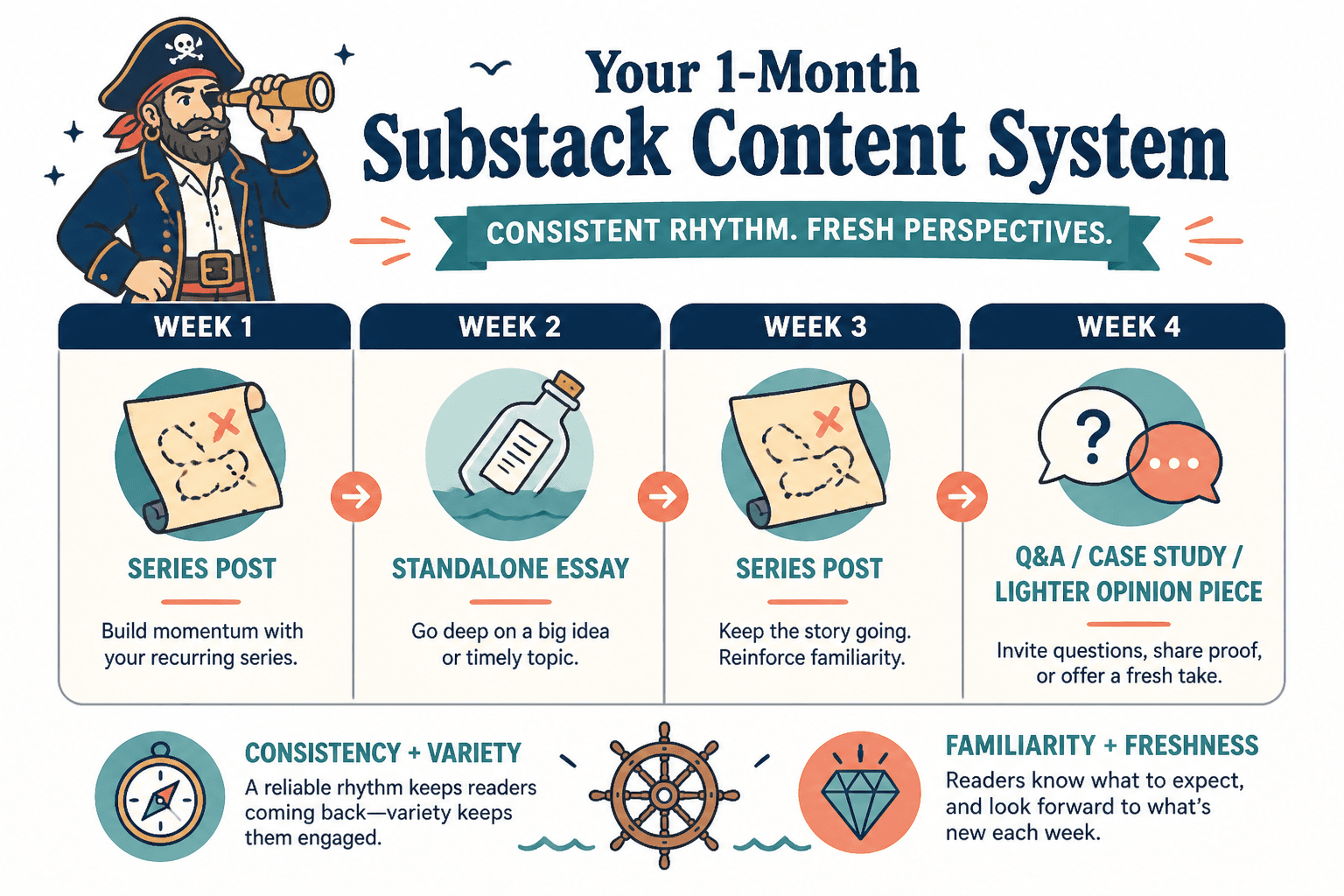
A simple monthly system could look like this:
- Week 1: Core series issue
- Week 2: Standalone lesson post
- Week 3: Core series issue
- Week 4: Q&A, case study, or lighter opinion piece
This gives you consistency without monotony. It also gives readers both familiarity and variety, which is a much nicer combo than total randomness dressed up as authenticity.
If you want help building that system faster, browse best templates and tools for Substack posts and series.
And if you want the bigger category context, you can also explore the email newsletter writing section, the broader newsletter writing hub, and the parent guide on Substack posts and series.
A quick checklist before you publish
The bigger point is simple: clearer structure and clearer writing make the piece more useful. That is usually what makes the ending land better too.
Stronger Substack posts usually come from a clearer point, tighter structure, and a more deliberate series flow. Better pacing often matters more than more volume.