
Most newsletters do not have a writing problem. They have a structure problem.
The advice is decent. The stories are fine. The offer might even be useful. But the whole thing arrives like a kitchen drawer dumped into an inbox: one link, three thoughts, a half-baked life update, and a CTA hanging on for dear life.
If you want your newsletter to feel worth opening, you need better sections and better formats. Not more fluff. Not five “content pillars.” Just a cleaner way to package what you already know so readers can follow it, remember it, and act on it.
This guide on Newsletter Sections and Formats Examples for Coaches, Consultants, and Personal Brands will help you build issues that feel sharper, more readable, and a lot less like a frantic content sandwich. You will get practical section ideas, repeatable issue formats, and examples you can adapt fast.
If you want the broader foundation first, start with the email newsletter writing hub, the newsletter writing section, and the core newsletter sections and formats guide.
If you want the bigger picture, start with the parent guide.
Why newsletter sections matter more than most people think
Readers do not experience your newsletter as “content.” They experience it as flow.
That means they are subconsciously asking a few simple questions:
- What is this issue about?
- Why should I care right now?
- Is this easy to read?
- Is there one useful thing I can take from it?
- What am I supposed to do next, if anything?
Good sections answer those questions without making the newsletter feel stiff or corporate. They create rhythm. They train the reader on what to expect. They also make writing easier, because you are not inventing a new format every time your sending day rolls around and your brain suddenly decides to become decorative wallpaper.
For coaches, consultants, and personal brands, this matters even more. You are not just sharing information. You are building trust, authority, familiarity, and demand. A chaotic newsletter can make smart ideas feel forgettable. A strong format can make fairly simple ideas feel reliable and worth returning to.
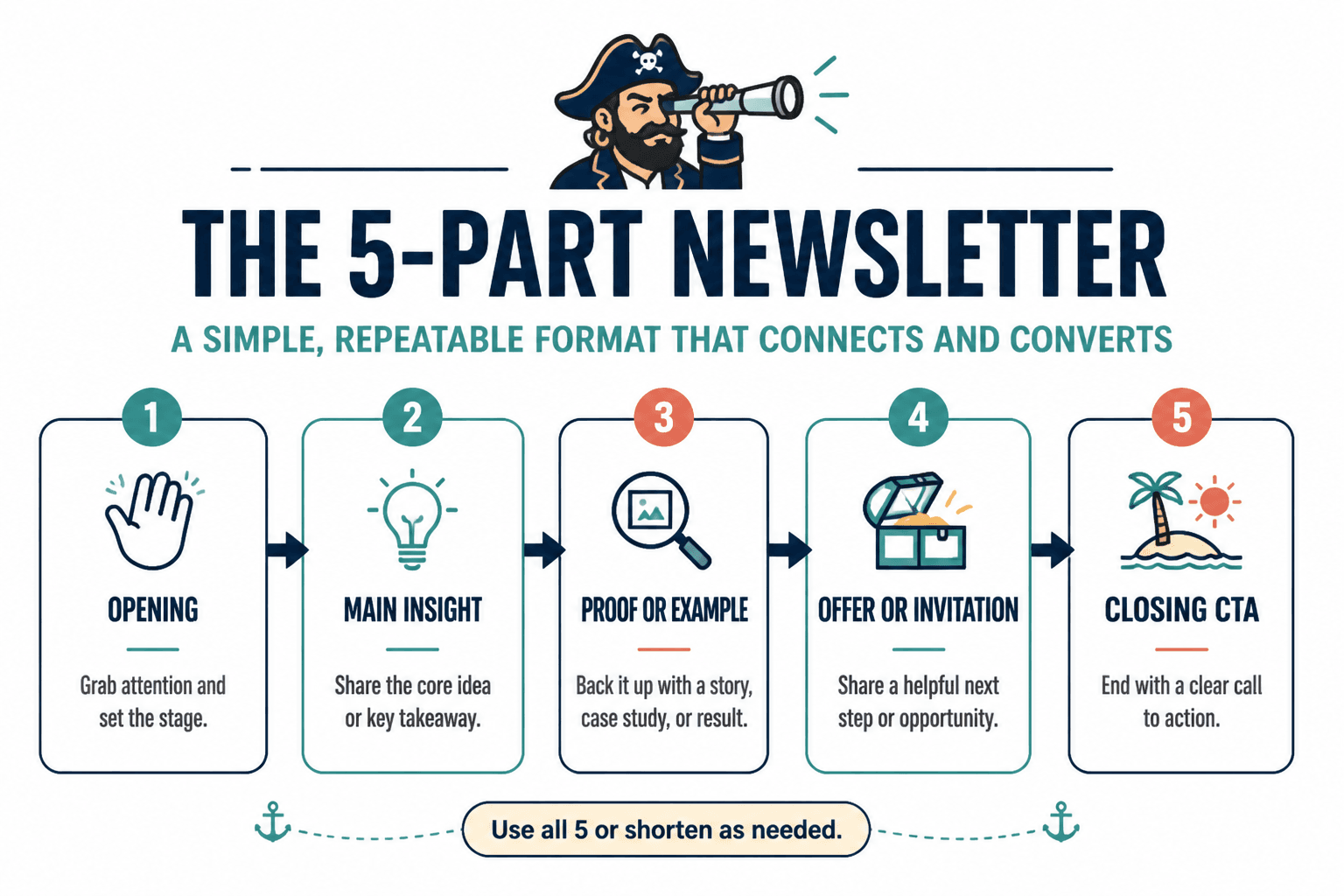
The 5 newsletter sections that do most of the heavy lifting
You do not need all five in every issue. But these are the sections that tend to carry the most weight for service businesses and personal brands.
1. The opening section
This is where you orient the reader fast. It can be a sharp observation, a problem, a quick story, or one useful idea.
The opening is not the place for throat-clearing. Do not waste it on “Happy Tuesday” plus three vague sentences about how fast the week is moving. Your reader already has a week. They do not need yours explained to them.
Better opening examples:
- “Most consultants do not need more content ideas. They need fewer weak ones making it to publish.”
- “A lot of newsletters feel helpful but still do not convert. Usually because they teach without positioning.”
- “If your audience reads your emails but never replies, clicks, or inquires, the issue is often format, not value.”
If you want more help here, this piece on newsletter opening sections examples creators can adapt fast is worth bookmarking.
2. The main lesson or insight
This is the core payload. The actual thing the reader came for.
That could be:
- a practical teaching point
- a framework
- a mistake to avoid
- a strategy shift
- a breakdown of something that worked
- a clear opinion with reasoning
Keep this section focused. One issue does not need to solve branding, sales, content strategy, offer design, confidence, pricing, and inner peace before lunch.
3. The proof or example section
This is where a lot of newsletters quietly fall apart. They make a claim, then move on like they have won the argument by volume.
Examples make advice feel real. That might be a client pattern, a before-and-after rewrite, a mini case study, a scenario, or a specific sentence example. You do not need to overdo it, but readers trust concrete writing more than abstract preaching. Shocking, I know.
Simple proof section examples:
- “A weak CTA: ‘Let me know your thoughts.’ A stronger one: ‘If you want help fixing this in your funnel, reply with AUDIT and I’ll send details.’”
- “One client had solid ideas but buried every email under a 200-word intro. We cut the intro, led with the real point, and replies improved almost immediately.”
- “Instead of saying ‘be more specific,’ say ‘replace broad tips with one example your audience can steal today.’”
4. The curated extra or quick-hit section
This is optional, but useful. It gives your issue some texture without turning it into a content landfill.
You might include:
- a recommended resource
- a tool you are using
- a quote with commentary
- a quick “what I’m noticing” note
- one short tip that did not need a full issue
The key is restraint. One or two extras are enough. Once a newsletter starts behaving like a clearance bin, people stop caring what is in it.
5. The CTA section
Your CTA should fit the issue. It does not need to scream. It does need to make sense.
For coaches, consultants, and personal brands, good newsletter CTAs often point toward:
- a reply
- a consultation
- a service page
- a lead magnet
- a waitlist
- a relevant article
- another issue in the series
Bad CTA energy sounds like a webinar funnel still emotionally attached to 2018. Good CTA energy sounds clear, calm, and relevant.
Example:
If your newsletter is getting opens but not inquiries, your format may be doing half the damage. Reply with “newsletter” if you want help tightening it.
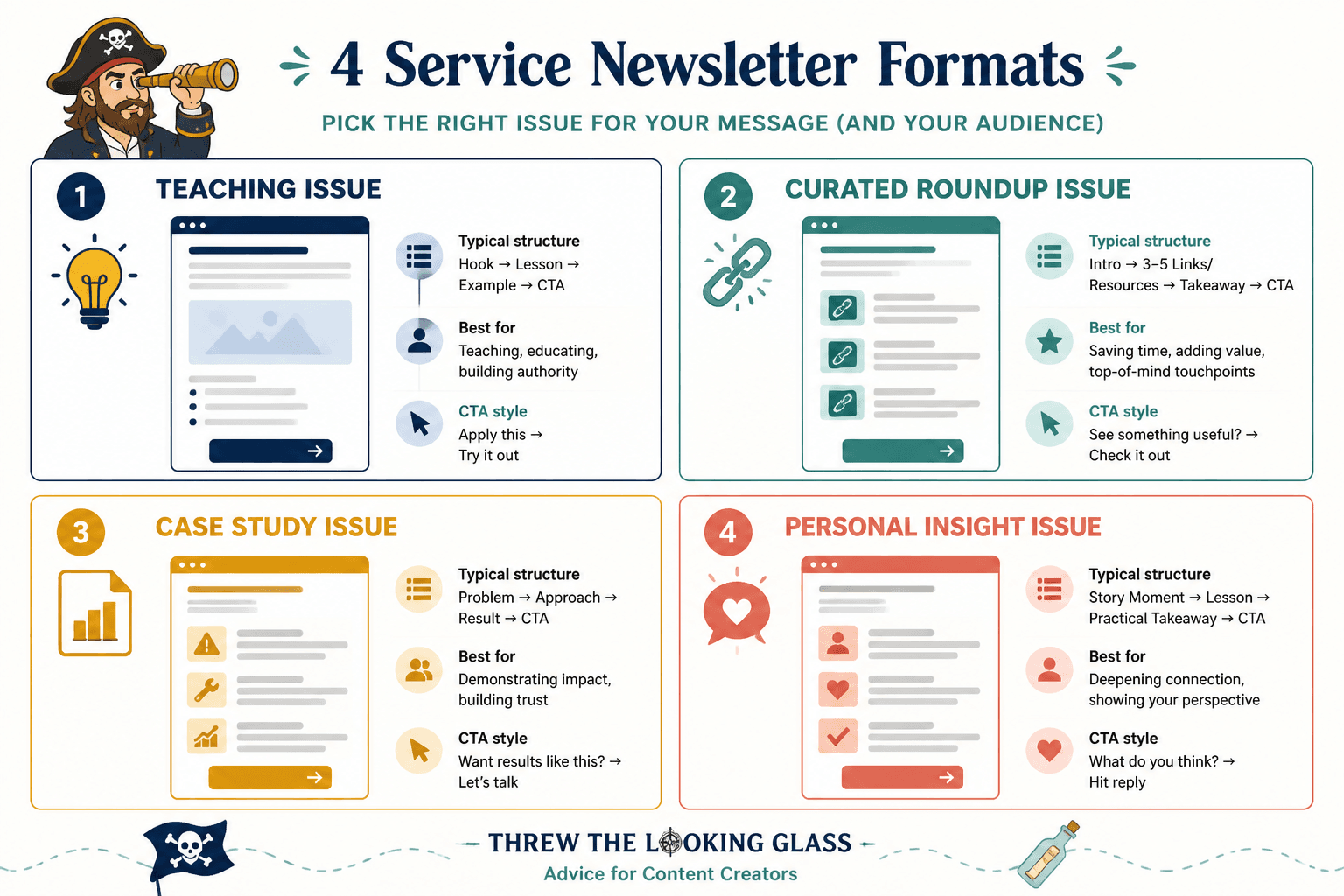
4 newsletter formats that actually work
The best format depends on your business model, audience, and how your brain likes to write. Still, a few formats work unusually well for coaches, consultants, and personal brands because they balance usefulness with trust-building.
Format 1: The one-idea issue
This is the cleanest format and often the best one.
Structure:
- Sharp opening
- One clear lesson
- Example or proof
- Short CTA
Best for:
- consultants with strong opinions
- coaches teaching one practical shift at a time
- personal brands building authority around a niche
Example issue idea:
Subject: Your newsletter does not need more sections. It needs a point.
Opening: Most weak newsletters are not underwritten. They are under-decided.
Main lesson: Why one clear takeaway beats six scattered tips.
Proof: A before-and-after structure example.
CTA: Reply if you want the template I use for one-idea issues.
Format 2: The lesson + example + invitation issue
This format works well if you sell a service and want the newsletter to support conversions without becoming one long sales breath.
Structure:
- Problem or observation
- Teaching point
- Example or mini case study
- Invitation to work together or learn more
Best for:
- consultants
- done-for-you service providers
- coaches with clear outcomes and offers
This one is especially useful when your audience needs to see how you think, not just what you know.
Format 3: The roundup with a spine
Roundups can work. The problem is most people make them too loose.
A good roundup still needs a central theme. It is not “here are some things.” It is “here are three useful things connected by one point.” That spine keeps the issue from feeling random.
Structure:
- Theme-based opening
- 3 short items tied to that theme
- Brief commentary on each
- CTA
Example theme ideas:
- 3 signs your content sounds polished but not persuasive
- 3 newsletter tweaks that increase replies
- 3 ways to make your expertise easier to trust
If you want more structure ideas like this, read better newsletter sections and formats issue formats for personal brands and best newsletter sections and formats ideas and examples for creators.
Format 4: The personal insight issue
This works when personality is part of the brand, but it still needs a business point.
Too many personal-brand newsletters swing from “I had a thought on a walk” straight into “buy my thing,” with no bridge in between. The story is not the strategy. The story is just a vehicle.
Structure:
- Short personal moment or observation
- Meaning or lesson behind it
- Practical takeaway for the reader
- CTA
This format is great if you want more warmth without losing clarity.
Newsletter sections and formats examples by brand type
Different businesses need different rhythms. Here is how this can look in practice.
For coaches
Coaches usually do well with a format that combines perspective, practical help, and a low-pressure invitation.
- Opening: Name a client pattern or mindset issue
- Main section: Teach one shift or framework
- Example: Show how it plays out in real life or business
- CTA: Invite replies, calls, or a relevant program
Example:
“A lot of smart people do not have a consistency problem. They have a decision fatigue problem disguised as inconsistency.”
That line opens a coaching issue well because it identifies a pain point without sounding like motivational wallpaper.
For consultants
Consultants usually benefit from sharper authority signals. That means strong observations, practical frameworks, and evidence that you can diagnose problems well.
- Opening: Call out an expensive mistake or common inefficiency
- Main section: Explain your take
- Proof: Share a mini audit, case pattern, or before/after
- CTA: Point to an audit, call, or service page
Example:
“A lot of B2B newsletters fail for the same reason mediocre landing pages do: they assume clarity is optional if the writer sounds professional enough.”
For personal brands
Personal brands have a bit more flexibility, but that does not mean every issue should become a mood board with a payment link.
- Opening: Opinion, story, or observation
- Main section: Tie it to a useful lesson
- Extra: Include one resource, recommendation, or quick note
- CTA: Invite a reply, click, or next step
Newsletter structure works best when each section has one clear job and supports the main point of the issue. Simpler formats usually outperform busier ones when the writing stays sharp.