
Most newsletter problems do not start in the middle. They start right at the top.
The opening section is where a reader decides if this email feels worth their attention or like another polite little note they will “get back to later” and never read again. A weak opening does not just lower clicks. It makes the whole newsletter feel forgettable, even when the ideas inside are solid.
If you want better newsletter sections and formats, the opening is the first thing to fix. Not because it needs to be dramatic, but because it needs to do a job. Fast.
This guide gives you newsletter opening section examples creators can adapt fast, plus the structure behind them so you are not stuck copying someone else’s personality. If you write as a coach, consultant, solo founder, writer, or personal brand, you will be able to pick a format, shape it to your voice, and stop opening your emails like a nervous intern.
For the full path around this topic, head to the parent guide.
What a newsletter opening section is actually supposed to do
A newsletter opening section is not there to “warm people up” with vague chatter.
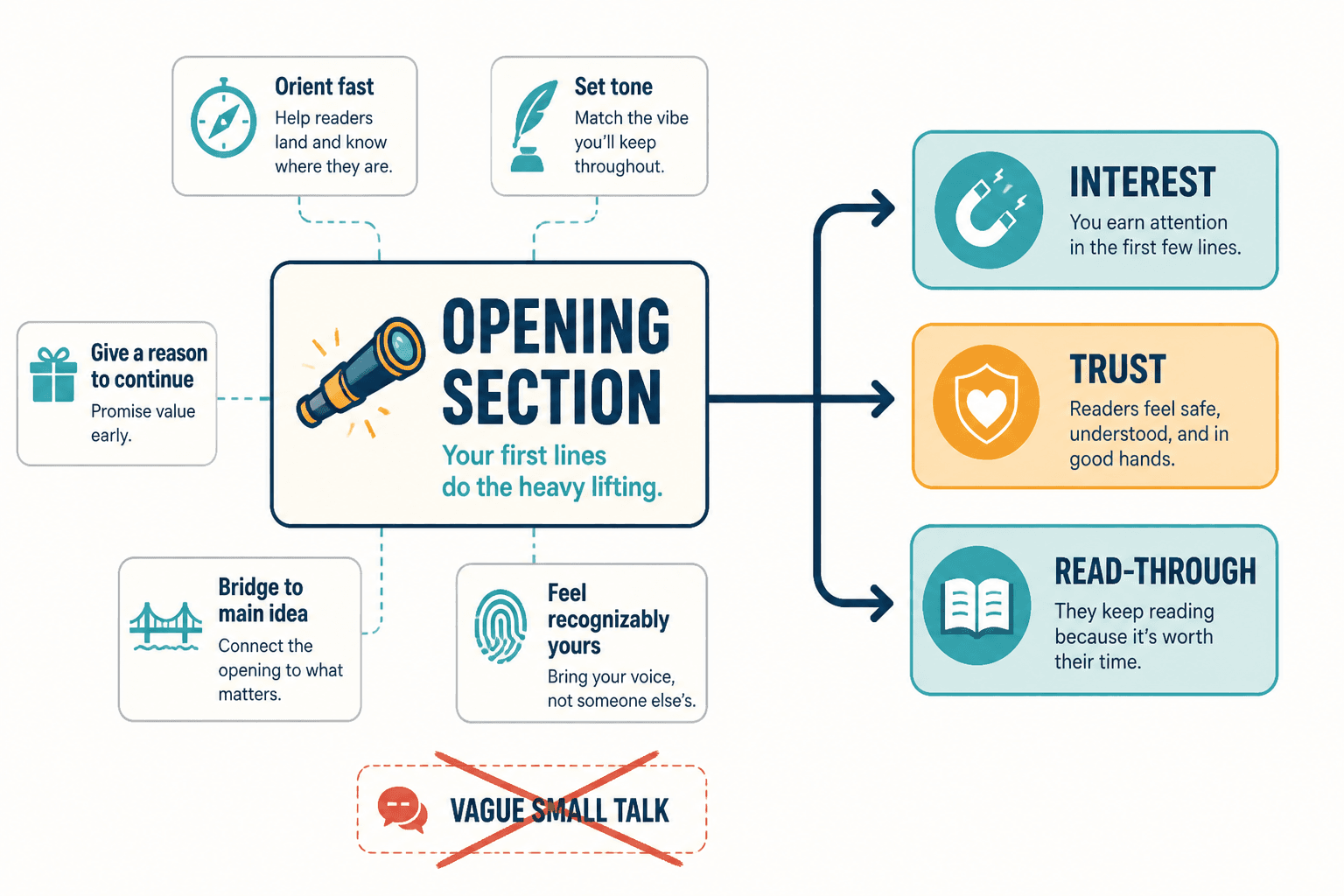
Its job is usually some mix of these:
- Orient the reader quickly
- Give them a reason to keep going
- Set the tone for the issue
- Transition into the main idea, links, lesson, or story
- Make the newsletter feel recognizably yours
That means the opening does not need to be clever. It needs to be useful. Sometimes sharp. Sometimes warm. Sometimes blunt. But always intentional.
If your current intro sounds like, “Hey everyone, hope you’re having a great week,” you do not have an opening section. You have email wallpaper.
The five qualities of a good newsletter opening
Before we get into examples, here is what the best opening sections tend to have in common.
1. They get to the point quickly
Your reader did not open your newsletter hoping for three lines of throat-clearing. Lead with the interesting part, the useful part, or the tension.
2. They create relevance
The reader should be able to think, “Ah, this is for me,” within a few seconds. Relevance usually comes from specificity, not hype.
3. They match the rest of the email
If the opening is playful but the rest reads like a white paper, something feels off. The intro should act like a doorway into the issue, not a random stunt.
4. They sound like a person
Not every opening needs personality fireworks, but it should sound human. A lot of newsletter intros fail because they sound pre-approved by six middle managers and one anxious AI prompt.
5. They earn the scroll
The best test is simple: does this opening make the next section feel easier to read?
If yes, good. If not, trim it, sharpen it, or replace it.
Newsletter opening section examples creators can adapt fast
These are not rigid formulas. Think of them as opening section formats you can steal the bones from and then make sound like you.
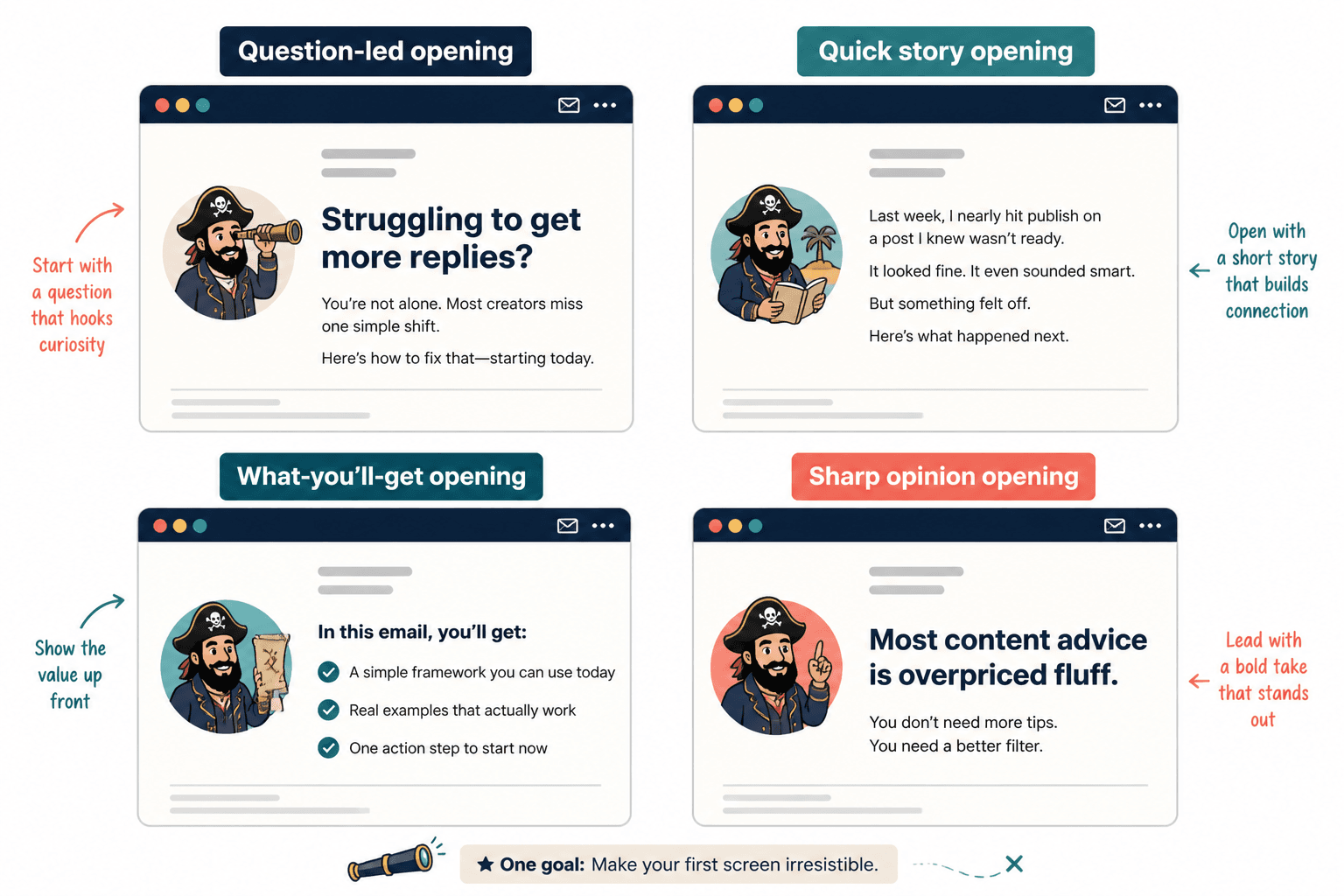
1. The sharp opinion opening
This works well when your newsletter leads with a clear point of view and you want to position yourself as someone with taste, not just information.
Template:
Most people think [common belief].
Usually, the real problem is [more useful truth].
Today’s issue is about [topic].
Example:
Most creators think their newsletter needs more consistency. Often, it needs a stronger reason to open in the first place. This issue is about writing opening sections that do more than politely wave from the top of the email.
Why it works: It creates tension immediately and frames the issue around a useful correction.
2. The reader pain opening
Use this when you want the opening to feel instantly relevant and practical.
Template:
If you have ever [specific struggle], this issue is for you.
Here is what usually goes wrong: [mistake].
Here is what to do instead: [promise].
Example:
If you have ever stared at the top of your newsletter wondering how to start without sounding stiff, this issue is for you. Most weak openings try to be warm before they try to be useful. Below, I will show you a few simple formats that make the rest of your email easier to read.
Why it works: It gives the reader immediate recognition and a reason to continue.
3. The quick story opening
This is useful when you want a little narrative momentum without writing a dramatic memoir intro that takes forever to land.
Template:
Recently, [small moment or observation].
It reminded me of [bigger lesson].
That is what this issue is about.
Example:
Recently, I opened a newsletter from someone smart, experienced, and genuinely useful. The first four lines were still so generic I nearly skipped the rest. It was a good reminder that strong ideas can get buried under weak openings. So this issue is about fixing that part first.
Why it works: It feels human, but still moves quickly toward a point.
4. The “what you’ll get” opening
This is one of the cleanest formats for educational newsletters. It works especially well for busy readers who want practical value fast.
Template:
In this issue:
[Benefit 1]
[Benefit 2]
[Benefit 3]
Example:
In this issue:
Three newsletter opening formats that sound human
Examples you can adapt in under ten minutes
A quick test for knowing if your intro is pulling its weight
Why it works: It reduces friction. No mystery, no wandering, no nonsense.
This format can look almost too simple, but simple is often exactly what helps. Readers do not need a puzzle at the top of every email. Sometimes they just want to know what they are about to get and why it is worth their time.
5. The contrarian opening
Use this if your brand voice is more direct and your audience responds well to challenged assumptions.
Template:
You do not need [popular advice].
You need [more grounded thing].
Here is why.
Example:
You do not need a “catchy intro” for your newsletter. You need an opening section that makes the next section easier to care about. Big difference. Here is how to build one without trying to sound like a mini TED Talk host.
Why it works: It creates a clean pattern interrupt and frames your advice as corrective, not generic.
6. The curated roundup opening
Perfect for link-heavy newsletters, creator roundups, media digests, or resource-based issues.
Template:
This week’s issue is focused on [theme].
I picked [number] things worth your attention because [reason].
Start with [best item or angle].
Example:
This week’s issue is focused on newsletter structure. I pulled together four opening section ideas because most intros are doing too little and taking too long to do it. Start with the first example if your emails tend to sound overly polite and slightly asleep.
Why it works: It gives shape to a curated issue and helps the reader know how to approach it.
7. The one-big-lesson opening
This format is useful when each issue revolves around a single insight.
Template:
One thing worth remembering:
[lesson]
Here is what that looks like in practice.
Example:
One thing worth remembering: your newsletter intro does not need to impress people. It needs to orient them. Once you see that, it gets much easier to write openings that lead somewhere instead of circling the runway.
Why it works: It feels focused, calm, and authoritative without getting stiff.
8. The question-led opening
Questions can work, but only if they are sharp. Not “Have you ever wanted more engagement?” That kind of question deserves jail.
Template:
[Specific question]?
If so, the issue is usually [problem].
Today we are fixing that.
Example:
Does your newsletter usually take too long to get interesting? The issue is often not the content. It is the opening section dragging its feet. Today we are fixing that with a few formats you can reuse immediately.
Why it works: A good question creates self-diagnosis. A bad one just creates eye-rolls.
How to choose the right opening format for your newsletter
Not every issue needs the same kind of intro. The right format depends on the job the email needs to do.
| If your newsletter issue is mainly for… | Best opening styles |
|---|---|
| Teaching one core idea | One-big-lesson, sharp opinion, what-you’ll-get |
| Telling a story with a point | Quick story, reader pain, question-led |
| Curating links or resources | Curated roundup, what-you’ll-get |
| Positioning your expertise | Sharp opinion, contrarian, one-big-lesson |
| Driving clicks into a deeper piece | Reader pain, question-led, what-you’ll-get |
If you are still not sure, start with the simplest question possible: what should the reader understand by the end of the first three lines?
Answer that, and your opening usually gets much better.
Before-and-after rewrites of weak newsletter openings
Sometimes the easiest way to improve your intro is to see what is going wrong in plain English.
Weak opening #1
Hi everyone, hope you are having a great week. I wanted to share a few thoughts on newsletter structure that have been on my mind lately.
Problem: No tension, no relevance, no reason to keep reading.
Stronger version:
Most newsletter structure advice is weirdly obsessed with what to include in the middle. But if the top of the email is flat, the rest has to work harder than it should. Here are three opening formats that make the whole issue easier to read.
Weak opening #2
Today I want to talk about something really important for creators and business owners who want to improve their email marketing results.
Problem: Generic, padded, and allergic to specifics.
Stronger version:
If your newsletter starts slow, readers assume the whole thing will. That is why the opening section matters more than most people think. Let’s fix it with a few formats that do the heavy lifting early.
Weak opening #3
I have been reflecting a lot lately on the power of communication and how the right words can make all the difference.
Problem: This says almost nothing while sounding very pleased with itself.
Stronger version:
A lot of newsletter intros sound thoughtful but do not actually help the reader enter the issue. The goal is not to sound wise. The goal is to make the next paragraph feel worth reading.
A simple formula for writing your opening section faster
If you want a repeatable process, use this:
- Open with the real tension or problem.
- Explain why it matters now.
- Point toward the payoff for reading further.
That is usually enough to make an opening section feel more alive. The job is not to sound wise immediately. It is to make the next paragraph worth reading.