
Most weak blog hooks are not failing because your idea is bad. They are failing because the opening takes too long to get to the point, says something mushy, or sounds like it was assembled by a very polite content machine with no pulse.
Busy creators do this all the time. You sit down to refresh an old post or draft a new one, and the first paragraph turns into a warm-up lap. A little context. A little throat-clearing. A few vague promises. By the time you reach the actual point, the reader has already wandered off to check email, Slack, or their own unfinished draft.
If you want Simple Hook Rewrite Templates for Busy Creators to be more than a nice-sounding phrase, the fix is pretty practical: stop trying to “write a better intro” and start using hook patterns that force clarity. Good hooks make a sharp promise, create tension, or name the mistake fast. They do not politely circle the runway for six paragraphs.
Here’s how to rewrite weak blog openings into hooks people might actually keep reading, with simple templates, before-and-after examples, and a process you can use in about ten minutes instead of turning your intro into an emotional support paragraph.
To see how this fits into the wider strategy, open the parent guide.
Why most blog hooks fall flat
The average weak hook has one of three problems:
- It starts too wide
- It hides the point
- It sounds generic enough to fit 4,000 other posts
That is usually why a post feels boring before it even begins. Not because the topic is boring, but because the opening does not frame the topic in a way that feels specific, urgent, or useful.
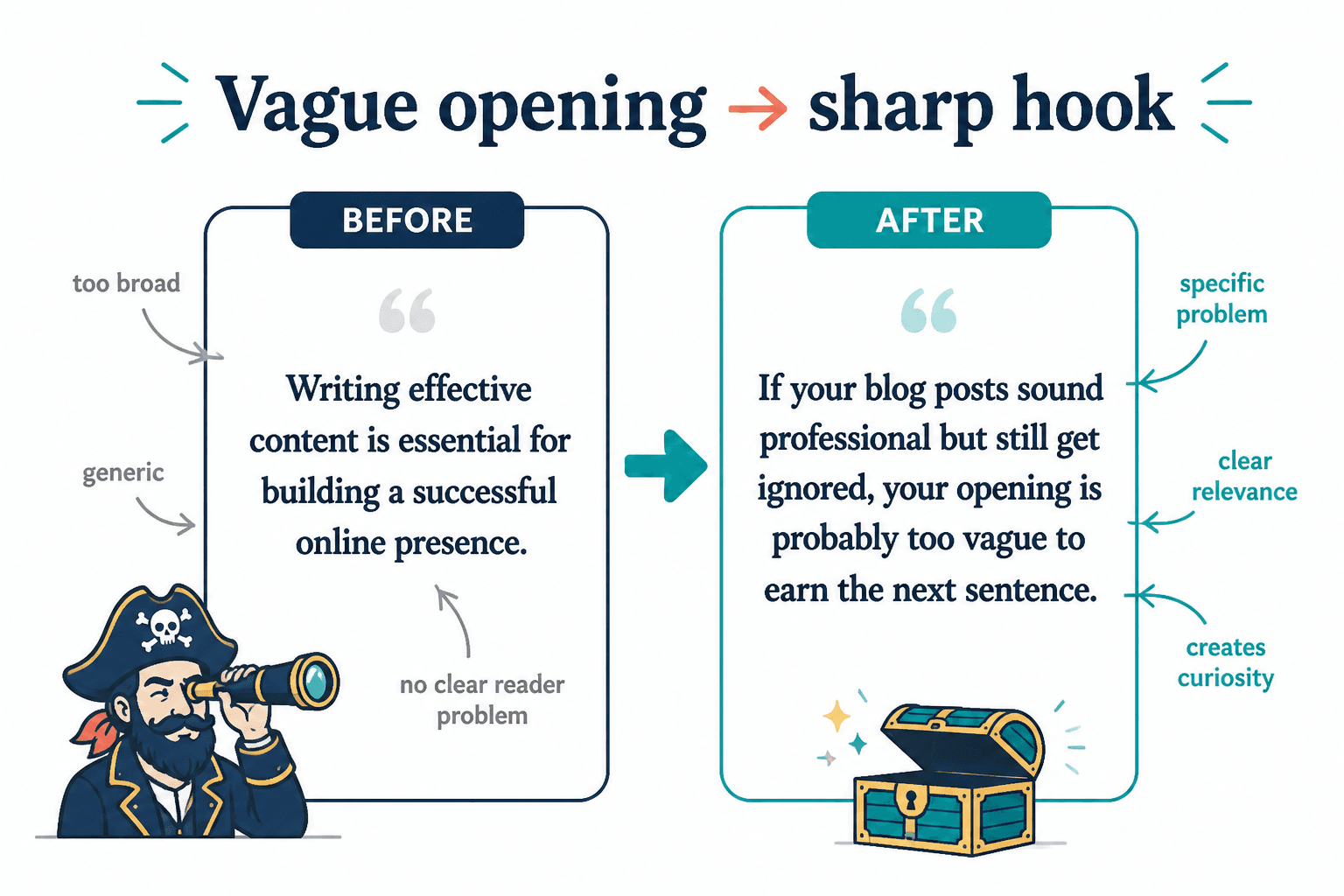
A lot of creators also confuse “professional” with “vague.” So they write things like:
Writing effective content is essential for building a successful online presence.
True? Sure. Useful? Not remotely. That sentence could open an article about blogging, email, social media, SEO, branding, probably goat farming if we tried hard enough.
A strong hook does not need to be dramatic. It just needs to make the reader think, “Yes, that’s my problem,” or “Wait, that’s a better way to look at it.”
What a strong hook actually needs to do
You do not need a cinematic intro. You need an opening that earns the next sentence.
At minimum, a blog hook should do one or more of these:
- Name a real problem quickly
- Challenge a bad assumption
- Promise a useful outcome
- Create contrast between what people do and what works
- Make the topic feel relevant right now
That’s it. You are not auditioning for literary greatness in the first three lines. You are trying to make a busy reader feel oriented, intrigued, and safe enough to continue.
A simple test for your opening
Read your first two paragraphs and ask:
- Would this still make sense if I changed the topic entirely?
- Does the reader know what problem this article solves?
- Have I said anything specific yet?
- Would I keep reading this if I did not write it?
If the answer is ugly, good. Better to notice now than after publishing another post with the energy of expired oatmeal.
The fastest hook rewrite process for busy creators
If you are short on time, do not overcomplicate this. Use a four-step rewrite process.
- Find the real point. What is the article actually helping the reader do, avoid, fix, or understand?
- Cut the soft setup. Remove broad context, filler, obvious statements, and anything that sounds like a workshop handout.
- Add tension. Name the mistake, misconception, or friction that makes the topic matter.
- Make a clean promise. Tell the reader what they will be able to do better after reading.
That process works whether you are refreshing an old post, improving traffic pages, or cleaning up a draft you wrote too fast between client calls. It also works especially well when paired with a tighter rewrite system like the ones covered in these rewrite checklists and examples creators can adapt fast.
7 simple hook rewrite templates for busy creators
Templates are not magic. They are just useful constraints. The point is not to make every intro sound the same. The point is to stop wasting time on weak openings that never get sharper because you are “feeling it out.”
Use these as starting structures, then adjust the language to match your voice and audience.
1. The mistake hook
Template: Most people think [common assumption], but the real problem is [actual issue].
Why it works: It creates contrast fast and positions the article as a correction, not more generic advice.
Example: Most people think their blog posts are underperforming because the topic is too niche, but the real problem is usually the opening. If the hook feels vague, slow, or over-explained, readers leave before the useful part starts.
2. The painful reality hook
Template: If you keep [doing the common thing] and getting [bad outcome], the issue is probably [deeper reason].
Why it works: It feels diagnostic. Readers like feeling understood more than they like reading fluffy intros.
Example: If you keep publishing useful blog posts and getting polite silence, the issue is probably not your expertise. It is that your hook is too weak to make anyone care before the scroll moves on.
3. The blunt truth hook
Template: [Desired result] does not usually fail because of [thing people blame]. It fails because of [real cause].
Why it works: It sounds confident without trying too hard, and it gets to the point quickly.
Example: Blog intros do not usually fail because they are too short. They fail because they say almost nothing with too many words.
4. The “you do not need more” hook
Template: You do not need [overcomplicated fix]. You need [simpler, sharper fix].
Why it works: It cuts through overwhelm and makes the article feel practical right away.
Example: You do not need a more creative intro. You need an opening that tells the reader what is broken, why it matters, and where the article is taking them.
5. The specific frustration hook
Template: [Specific frustrating situation] is usually a sign that [underlying issue].
Why it works: It gives readers a sharp “that’s me” moment.
Example: Spending 40 minutes rewriting your first paragraph and still hating it is usually a sign that you have not decided what the hook is supposed to do.
6. The promise with tension hook
Template: Here is how to [desirable outcome] without [thing readers hate or fear].
Why it works: It makes the payoff clear while removing a common objection.
Example: Here is how to rewrite blog hooks faster without making every intro sound like a recycled copywriting thread from 2021.
7. The callout hook
Template: If your [content type] keeps [bad result], stop [common mistake].
Why it works: It is direct, practical, and immediately useful for readers who already know something is off.
Example: If your blog posts keep losing readers in the first few lines, stop opening with background information nobody asked for.
Before-and-after hook rewrites
This is where things usually click. A lot of creators know an intro feels weak, but they cannot see how to fix it without rewriting the whole article. In reality, one clean hook rewrite can change the entire feel of a post.
| Weak opening | Stronger rewrite |
|---|---|
| Blog writing is an important part of modern content strategy for brands and creators alike. | Most blog posts do not lose readers because the topic is bad. They lose them in the first few lines, where the intro says a lot without saying anything useful. |
| There are many ways to improve your blog content and make it more effective for your audience. | If your content is useful but still not getting traction, the problem may not be the article. It may be the hook doing absolutely none of the heavy lifting. |
| In this post, we will cover some tips for rewriting better blog intros. | Here is how to rewrite a flat blog intro into something sharper, clearer, and much more likely to keep a reader around. |
| As content evolves, creators must adapt their strategies to remain relevant. | Refreshing old blog posts is smart. Refreshing them with the same sleepy opening is not. |
Notice what changed. The stronger versions do not just sound “better.” They create direction. They tell the reader what is wrong, why it matters, and what kind of article this is going to be.
How to choose the right hook style for the article
Not every post needs the same kind of opening. The right hook depends on the angle of the article and what the reader likely needs in the first few seconds.
| If the article does this… | Use this kind of hook |
|---|---|
| Corrects a bad assumption | Mistake hook or blunt truth hook |
| Solves a frustrating problem | Painful reality hook or specific frustration hook |
| Offers a practical shortcut | You do not need more hook |
| Gives a process or framework | Promise with tension hook |
| Calls out underperformance | Callout hook |
If you are refreshing a back-catalog of content, this is especially useful. You do not need to invent a clever opener from scratch every time. Match the article’s job to a hook type, rewrite the first paragraph, and move on with your life.
That kind of practical system matters a lot when you are updating multiple posts, which is why it helps to build this into a broader rewrite workflow like the one in blog rewrites and refreshes.
What to cut from weak hooks immediately
If you want faster rewrites, it helps to know what usually needs to die first.
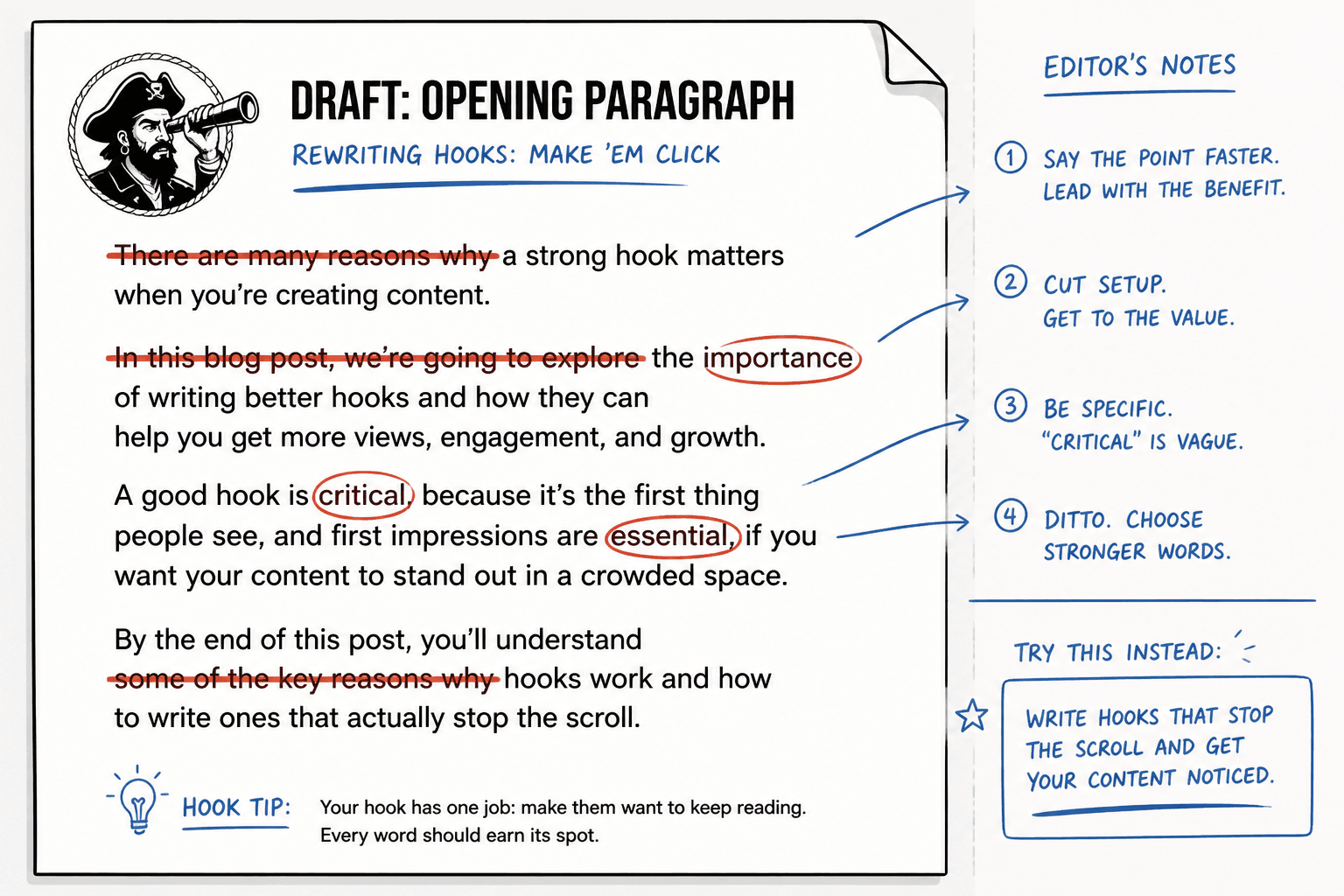
- Broad industry statements: “Content is more important than ever.” No kidding.
- Obvious filler: “There are many reasons why…”
- Polite setup lines: “In this blog post, we’re going to explore…”
- Overlong definitions: readers came for help, not a glossary
- Empty importance language: “critical,” “essential,” “valuable,” with no specifics
- Artificial suspense: “What happened next changed everything.” Please do not.
Busy creators often keep these lines because they feel safe. They are easy to write. They sound “normal.” They also flatten the article before it starts.
A cleaner intro usually feels a little more exposed because it says the thing faster. Good. That is usually a sign you finally cut the padding.
A 10-minute hook refresh workflow for old blog posts
If you are updating old content, start with the hook before touching anything else. It is one of the fastest ways to improve readability, clarity, and perceived quality without rewriting 2,000 words from scratch.
- Read the current intro and underline every vague phrase.
- Write one sentence answering: what is the article really helping with?
- Pick one hook template from this article.
- Draft 3 alternate opening lines in under 5 minutes.
- Choose the sharpest one, then build 1–2 supporting sentences under it.
- Make sure the intro leads naturally into the rest of the article.
That last point matters. A strong hook should sharpen the article, not misrepresent it. Do not write an opening that promises a spicy takedown if the rest of the post is a gentle checklist. Readers are not stupid, and baiting them is a good way to lose trust fast.
If you want a larger system for updating posts without making the process painfully slow, the resources on blog SEO writing and article systems can help you clean up structure, messaging, and performance alongside the hook.
Simple Hook Rewrite Templates for Busy Creators in real workflows
The reason these templates work is not that they are flashy. It is that they reduce decision fatigue. A lot of creators are not struggling with talent. They are struggling with too many micro-decisions at once.
You are trying to think about SEO, readability, audience intent, structure, examples, and conversion all at the same time. Of course the intro gets weird. Templates help because they narrow the opening move. Once the first few lines are clear, the rest of the article usually gets easier to shape.
This is also why hook templates are especially useful for solo creators and small teams. You do not always have the luxury of spending an hour “finding the voice” of every draft. Sometimes you need a sharper opening in ten minutes because there are client calls, content updates, and approximately 800 other tabs open.
If that sounds familiar, you’d probably also get mileage from blog rewrites and refreshes for creators with small audiences. Smaller brands often need sharper positioning and clearer openings even more, because they cannot rely on existing brand momentum to carry a mediocre post.
When templates are not enough
Sometimes the hook is not the real issue. Sometimes the opening is weak because the article itself is too broad, too padded, or not clear on what point it is making.
If every hook rewrite still feels flat, check the article underneath it. You may have one of these problems:
- The topic is too wide to support a sharp promise
- The article mixes three different angles
- The reader problem is not clearly defined
- The structure is bloated
- The post says “helpful” things without saying anything memorable
In that case, fix the article before polishing the intro. A hook can sharpen a strong piece. It cannot save a confused one.
That is where a more complete rewrite can help, especially if you are working from older drafts that were written fast or stuffed with filler. Start with how to rewrite boring blog rewrites and refreshes if the problem is bigger than the first paragraph.
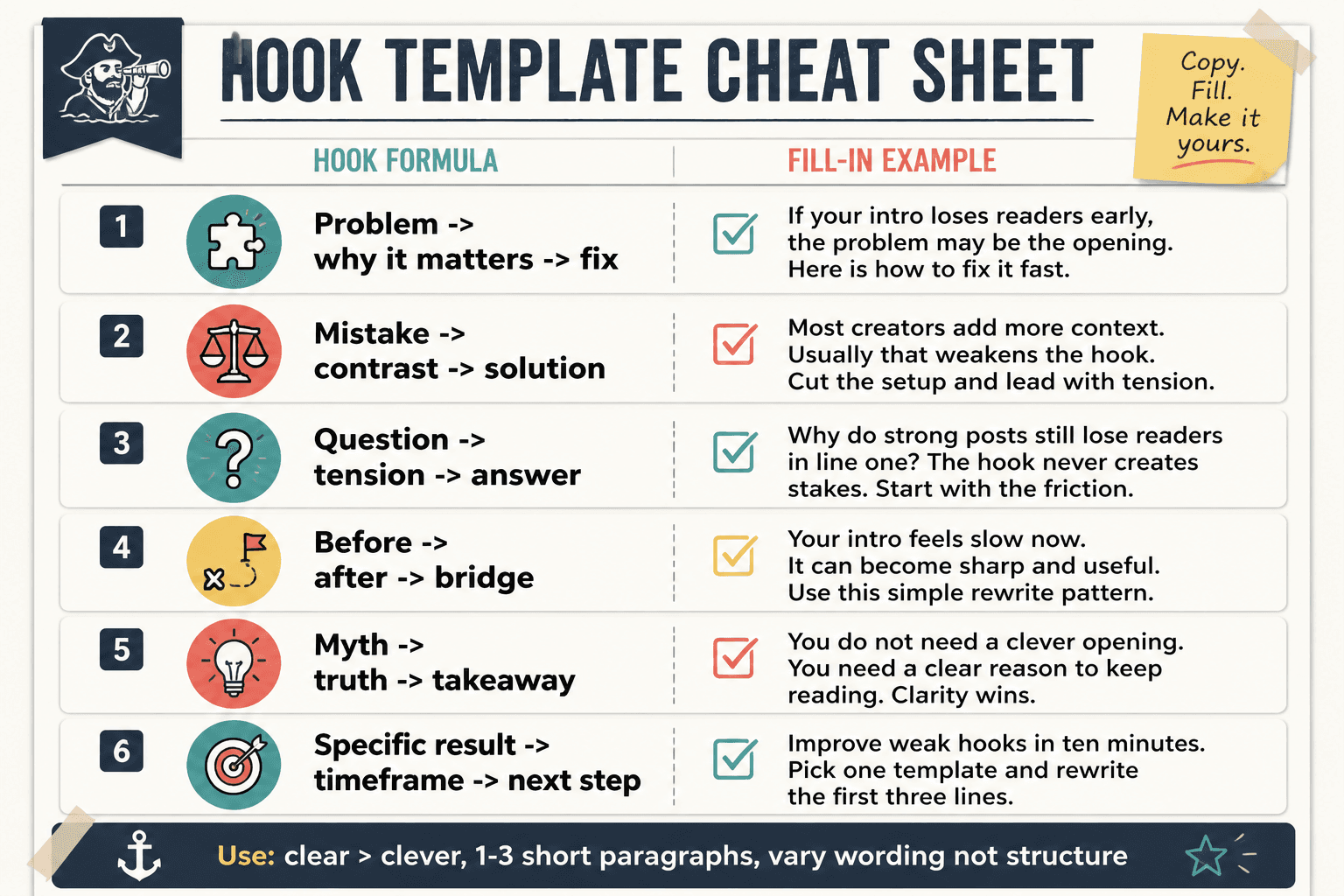
Two quick hook formulas you can keep beside your draft
If you only remember two formulas from this article, make it these:
- Problem → real issue → promise
“If your blog posts keep losing readers early, the problem may not be the topic. It may be the intro doing nothing to frame why the reader should care. Here’s how to fix that fast.” - Mistake → contrast → solution
“Most creators try to improve weak hooks by adding more context. Usually that makes them worse. What works better is cutting the setup and leading with the tension.”
These are simple, flexible, and hard to mess up. Which is exactly what you want when time is tight.
For more swipeable structures and tool support, see best templates and tools for blog rewrites and refreshes. Just do yourself a favor and use tools to speed up decisions, not to mass-produce lifeless intros that all sound vaguely “optimized.”
Quick FAQ
How long should a blog hook be?
Usually 1 to 3 short paragraphs is enough. Long enough to frame the problem and promise the payoff. Short enough not to stall the reader.
Can I use the same hook template often?
Yes, if you vary the wording and the article angle. Readers notice repetition in phrasing more than repetition in structure.
Should a hook be clever or clear?
Clear first. Clever is optional. A smart line helps if it sharpens the point. It hurts if it delays the point.
Do these templates work for refreshes and new posts?
Both. They are especially useful for updating old posts because they help you improve the opening quickly without rewriting the entire article first.
What if my intro sounds too blunt?
Soften the wording a little, not the clarity. Readers rarely need more vagueness. They usually need a faster point.
The bigger point is simple: clearer structure and clearer writing make the piece more useful. That is usually what makes the ending land better too.