
Most blog posts do not need to be deleted. They need to be rewritten by someone willing to remove the fog, tighten the point, and stop treating “more words” like a strategy.
That is why a solid blog rewrite checklist matters. Not because checklists are glamorous. They are not. But they do stop you from doing the chaotic creator thing where you “refresh” a post by changing three adjectives, adding one subheading, and hoping Google or humans suddenly care.
If you have old posts that are underperforming, outdated, vague, too long, too thin, or just painfully beige, this will help. You will get practical rewrite checklists, before-and-after style examples, and a fast process creators can adapt without turning every update into a full editorial production.
The goal is simple: make your existing content clearer, more useful, more current, and more likely to earn trust, traffic, or conversions without starting from zero every time.
To see how this fits into the wider strategy, open the parent guide.
What a blog rewrite is actually supposed to fix
A rewrite is not just a cleanup pass. It is not proofreading with better posture.
A real rewrite improves the article’s ability to do its job. That might mean:
- getting the point across faster
- matching current search intent better
- making the structure easier to scan
- updating weak examples
- improving internal links
- cutting generic filler
- adding sharper hooks and stronger conclusions
- making the CTA feel relevant instead of bolted on at the last second
If a post gets some traffic but no action, the problem is probably not just SEO. If a post is useful but no one reads past the intro, the problem is probably not your expertise. And if a post sounds like a robot intern stitched together ten search results and called it thought leadership, the problem is definitely the writing.
A rewrite fixes performance problems. A refresh updates accuracy. Good content teams do both. Smart solo creators should too.
For a broader system around updating old content, it helps to review your overall blog rewrites and refreshes process before you start hacking at individual posts.
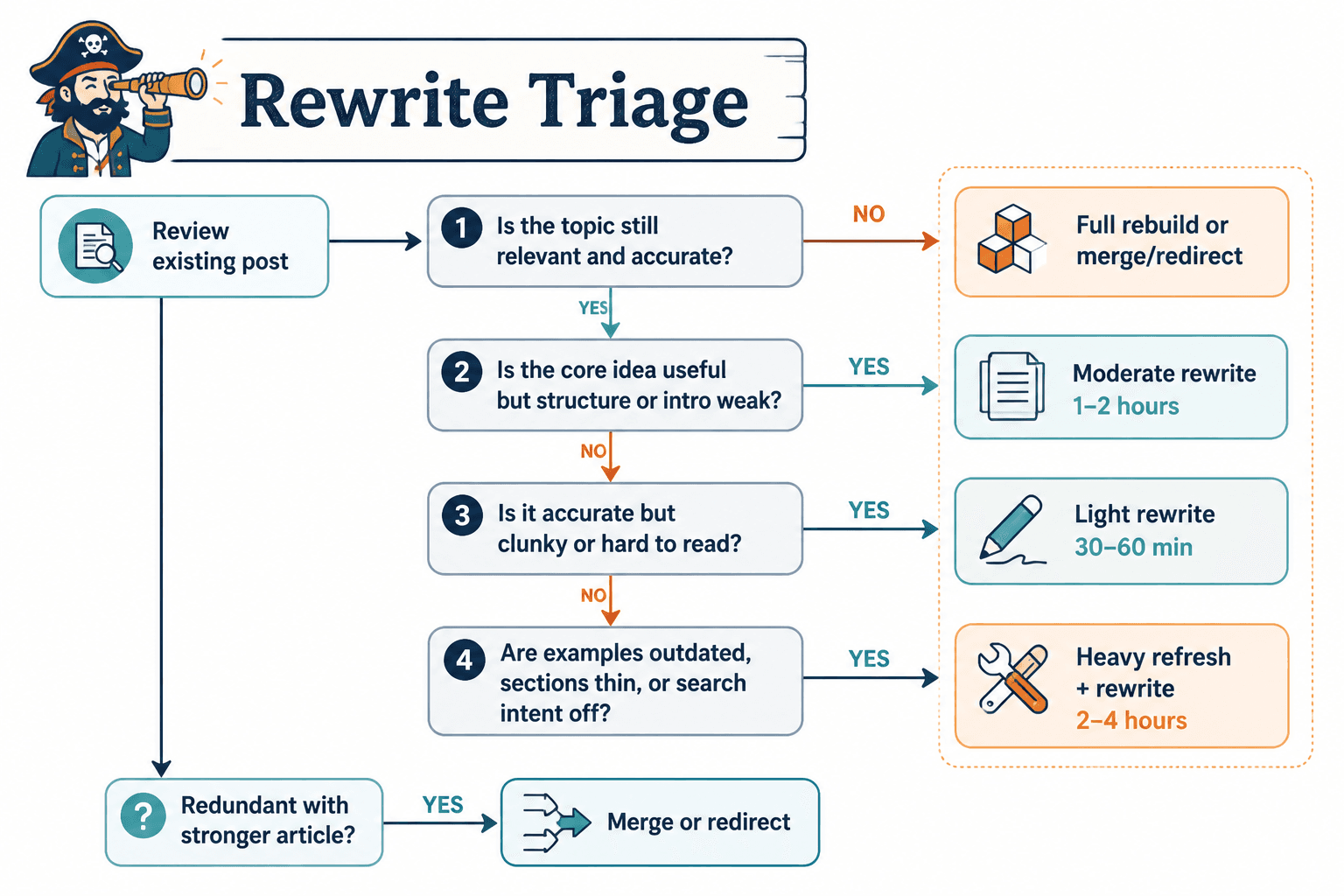
The fast triage: decide what kind of rewrite the post needs
Do not give every weak article the same treatment. Some need a polish. Some need a rebuild. Some need to be merged into something stronger and put out of their misery.
| Post condition | What it needs | How much work |
|---|---|---|
| Accurate but clunky | Light rewrite | 30–60 minutes |
| Useful idea, weak structure, weak intro | Moderate rewrite | 1–2 hours |
| Outdated examples, thin sections, poor search fit | Heavy refresh + rewrite | 2–4 hours |
| Broad, generic, no clear angle | Full repositioning | Often easier to rebuild |
| Redundant with a stronger article | Merge or redirect | Strategic cleanup |
That one decision saves time. It also stops you from spending three hours polishing a post that should have been re-angled from the first sentence.
The core blog rewrite checklist
This is the main checklist. If you only use one, use this one.
1. Check the actual point of the article
Before editing a single sentence, answer this:
- What is this post trying to help the reader do?
- Who is it for?
- What is the sharpest angle?
- Why would someone care now?
If you cannot answer those quickly, the article is probably too vague. That means line editing is not the first fix. Positioning is.
2. Rewrite the intro before the middle
Most weak articles lose people in the opening. They start too wide, too polite, or too sleepy.
Cut:
- dictionary-style openings
- history lessons nobody asked for
- obvious statements like “blogging is important for businesses”
- throat-clearing paragraphs that stall before the point
Add:
- a clear problem
- a sharper tension
- a fast promise
- a stronger sense of who the post is for
3. Fix the structure so people can actually use it
Good blog posts do not just contain useful information. They deliver it in the order a reader needs.
Check for:
- clear H2s that signal what each section does
- H3s where detail or process needs breaking up
- steps in a logical sequence
- examples after claims, not before the point is clear
- lists used where they help, not everywhere like seasoning gone wrong
If the article feels messy, try reordering sections before rewriting them. A bad order can make good content feel weak.
4. Cut filler without mercy
This part is less glamorous but very effective.
- remove repeated points
- cut generic advice that could apply to anything
- delete bloated transitions
- trim obvious sentences
- replace abstract claims with specifics
If a paragraph says nothing a smart reader could act on, it is decoration. Lovely in a lamp. Less useful in an article.
5. Add proof, examples, or contrast
One reason blog posts feel flat is that they stay in advice mode the whole time. The reader gets told what matters, but never gets shown what that looks like.
Improve that by adding:
- before and after rewrites
- example headlines
- bad versus better versions
- mini templates
- specific scenarios for creators, coaches, consultants, or personal brands
6. Update stale details
Refresh anything that makes the post feel old or careless:
- outdated tools
- dated platform references
- old year mentions
- broken internal logic
- examples that no longer fit the audience
You do not need to stuff the article with trend-chasing updates. You do need to stop making readers wonder if the piece has been sitting in a digital basement since 2021.
7. Improve internal links and next steps
A rewritten article should connect readers to the rest of your content. If it does not, you are wasting earned attention.
Link naturally to:
- related topic hubs
- deeper examples
- companion templates
- adjacent strategy articles
For this topic, relevant next reads might include rewrite ideas and examples for creators, rewrite examples for coaches, consultants, and personal brands, hook rewrite templates for busy creators, and how to rewrite boring blog content.
8. Rewrite the CTA so it matches the article
A lot of CTAs fail because they arrive from another universe.
If the post just helped someone improve a blog article, the next step should fit that momentum. Not “Book a discovery call” because apparently every paragraph must end in a funnel tantrum.
Better CTA directions:
- read a related guide
- use a rewrite template
- audit another article with the same checklist
- join your email list for more writing systems
- explore a service if the reader clearly needs hands-on help
A quick rewrite checklist for busy creators
If you do not have time for a full rewrite session, use this short version. It catches the biggest problems fast.
- Can the intro say the point in under 3 paragraphs?
- Does the headline still match what readers want?
- Are the subheadings clear and useful?
- Can at least 15 percent of the article be cut without losing meaning?
- Is there at least one concrete example?
- Are any sections repetitive, vague, or outdated?
- Does the CTA make sense for this article?
- Are there internal links to the next useful step?
If you answer “no” to more than two of those, the post probably needs more than cosmetic editing.
Blog rewrite checklist examples creators can adapt fast
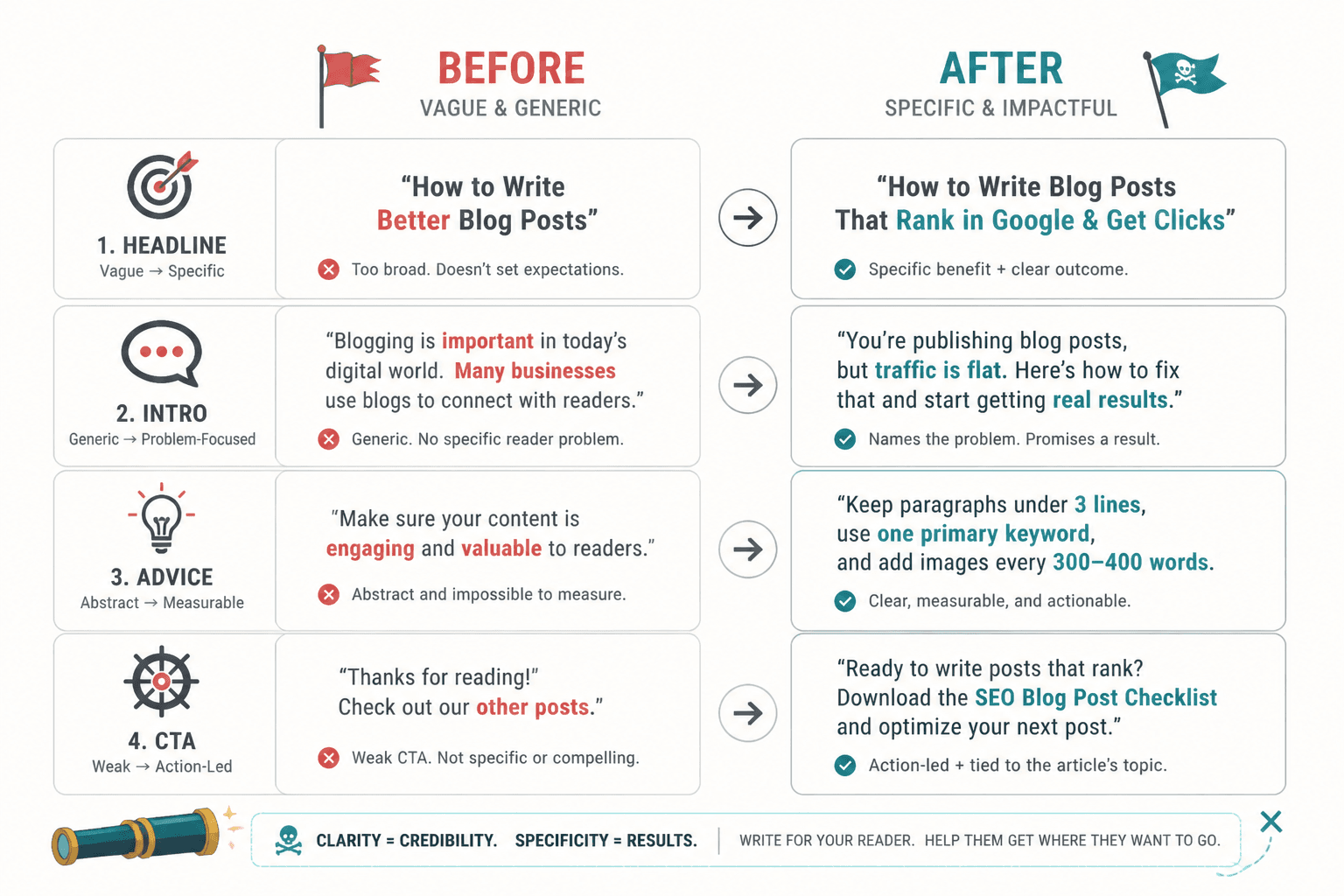
Now for the part people actually need: examples. A checklist is helpful. A checklist plus rewrites is better.
Example 1: Weak intro rewrite
Before: Blogging has become an essential part of modern digital marketing for brands of all sizes. In a competitive online environment, businesses need high-quality content to stand out and connect with their target audience.
After: If your blog post says “quality content matters” before doing anything useful, readers are already halfway out the door. A stronger intro gets to the problem faster, makes a clear promise, and gives people a reason to keep going.
What changed:
- cut generic industry wallpaper
- named the actual problem
- made the takeaway immediate
- used voice without getting goofy
Example 2: Flabby subheading rewrite
Before: Important Things to Consider When Trying to Improve the Performance of Your Existing Blog Content
After: What to fix first in an underperforming blog post
The second one is shorter, clearer, and sounds like a person wrote it during waking hours.
Example 3: Generic advice turned useful
Before: Make sure your content is engaging and valuable to your audience.
After: Replace abstract claims with one useful example, one sharper opinion, or one clear step the reader can apply today. “Be valuable” is not advice. It is a poster.
That second version gives a standard, not just a nice thought.
Example 4: Weak CTA rewrite
Before: Contact us today to learn more about our services.
After: Pick one old post this week and run it through this checklist. If you want more help tightening hooks and structure, read the companion guide on hook rewrites and templates.
The better CTA keeps the reader moving in the same direction. That matters.
A section-by-section blog refresh checklist
Sometimes the easiest way to rewrite faster is to stop thinking about the article as one giant problem. Break it into parts.
Headline
- Does it match what the article really delivers?
- Is it specific enough to attract the right reader?
- Can it be made clearer without becoming longer?
- Does it avoid vague promise language?
Intro
- Does it identify the real problem fast?
- Does it avoid generic setup?
- Does it tell the reader what they will get?
- Would a busy person keep reading?
Main sections
- Does each section earn its place?
- Is there unnecessary overlap?
- Are examples included where needed?
- Is the sequence logical?
- Are any sections thin enough to merge or remove?
Voice and clarity
- Does the piece sound human?
- Are there vague business phrases that should be cut?
- Are long sentences doing too much?
- Is the advice concrete enough to act on?
Conclusion and CTA
- Does the ending land cleanly?
- Is the final takeaway memorable?
- Is the next step relevant?
- Is the CTA useful rather than needy?
How to rewrite blog content without rewriting everything
This is where a lot of creators get stuck. They know a post needs work, but the idea of redoing the whole thing feels annoying enough that they keep postponing it for six months.
Fair. But a good rewrite process is not “start over and suffer.” It is selective.
- Audit the article first. Read it once without editing and mark the real issues: weak intro, broad angle, filler, poor structure, stale examples.
- Prioritize high-impact fixes. Usually that means headline, intro, subheads, examples, and CTA before line-level polish.
- Keep what is still good. If one section is clear and useful, leave it alone.
- Add one layer of depth. A better example, sharper framework, or stronger contrast can do more than three extra paragraphs.
- Tighten last. Once the structure works, clean up the wording.
This is also why rewrite checklists are useful for teams and solo operators alike. They create a repeatable editing standard. You stop relying on vague instincts like “it just feels kind of off,” which is true but not exactly operational.
If you are building a bigger content workflow, the wider blog SEO and article systems library can help you connect rewrites to a more durable publishing process.
What creators usually get wrong when refreshing old blog posts
A few mistakes show up constantly.
- They only update surface details. Changing a date and adding a sentence is not a meaningful rewrite if the piece is still dull or unclear.
- They keep the original bad angle. Sometimes the problem is not the wording. It is the premise.
- They add length instead of clarity. More sections do not automatically make a post better. Sometimes they just make it harder to finish.
- They skip examples. Advice without demonstration feels thin, even when it is technically correct.
- They forget internal linking. One improved article should strengthen the rest of the site too.
- They leave the CTA untouched. So the article gets better, but the conversion path stays awkward.
The bigger issue underneath all of this is that people treat rewriting like maintenance. Sometimes it is. But often it is leverage. Updating a decent old post into a strong current one can be far easier than publishing a fresh article from scratch, especially if the topic is still relevant and the bones are good.
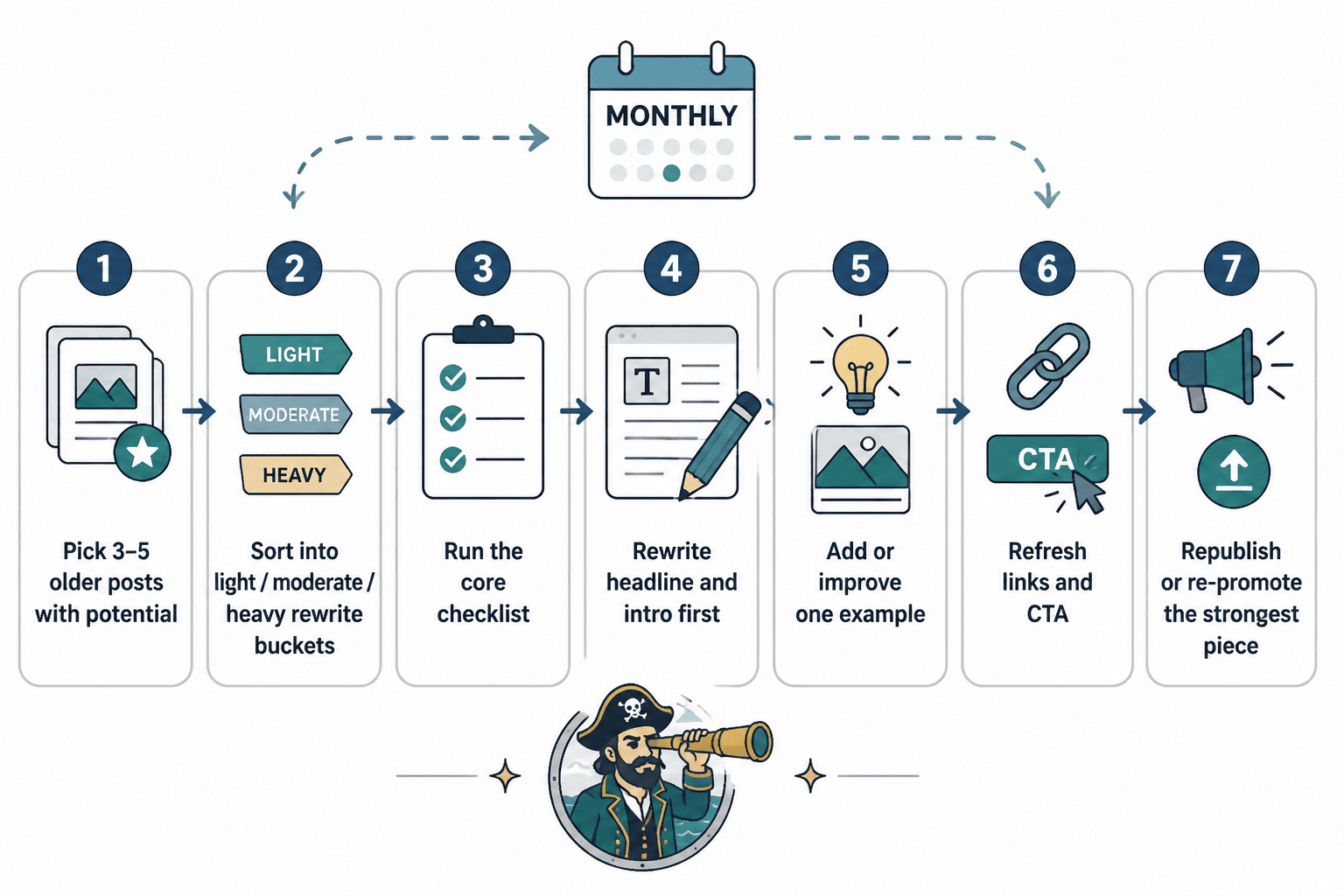
A practical rewrite workflow you can reuse every month
If you have a content archive, this gets easier when you stop doing it randomly. Try a monthly rewrite sprint:
- Pick 3 to 5 older posts with potential.
- Sort them into light, moderate, or heavy rewrite buckets.
- Run the core checklist on each one.
- Rewrite the headline and intro first.
- Add or improve one example in each article.
- Refresh links and CTA.
- Republish or re-promote the strongest updated piece.
That is enough to materially improve your content library over time without creating a second job for yourself.
Use this simple blog rewrite scorecard
If you want a faster yes-or-no decision, score each article from 1 to 5 on the categories below.
| Category | Question |
|---|---|
| Clarity | Is the point obvious quickly? |
| Structure | Is the article easy to scan and follow? |
| Specificity | Does it use concrete advice and examples? |
| Relevance | Does it still fit current reader needs? |
| Voice | Does it sound human and credible? |
| Conversion | Does it lead naturally to a next step? |
If a post scores under 20 total, it likely needs a meaningful rewrite. Under 15, stop polishing and rethink the article more aggressively.
The bigger point is simple: clearer structure and clearer writing make the piece more useful. That is usually what makes the ending land better too.