
Most people do not have a headline problem. They have a thinking problem dressed up as a headline problem.
They open a tool, paste in a rough idea, get a score, shuffle a few words around, and hope the title becomes search-friendly and click-worthy by magic. It usually does not. Because a tool can help you sharpen an angle, spot search phrasing, or organize topic clusters. It cannot rescue a vague idea with the charisma of wet cardboard.
The best SEO headline tools and content planning tools for blog titles and headlines are useful for research, structure, and iteration. They are not there to replace judgment. They are there to help you make better choices faster.
This guide will show you which kinds of tools are actually worth using, what each type does well, where they fall short, and how to build a cleaner workflow for stronger blog titles. If your current process is “stare at blinking cursor, panic, write something with 14 words and no angle,” this should help.
To see how this fits into the wider strategy, open the parent guide.
What good headline tools actually help with
Before naming tool categories, it helps to get clear on what a good title needs to do.
A strong blog headline usually balances four things:
- Clarity: the reader quickly understands the topic
- Search intent: the wording matches what people are likely looking for
- Specificity: it promises something concrete, not vague usefulness
- Interest: it gives the reader a reason to care now
Good tools can support each of those. They can show related phrases, help you compare versions, reveal questions people ask, cluster subtopics, and keep your title ideas tied to an actual content plan instead of random bursts of inspiration.
Bad usage looks like this: chasing a score, stuffing in every keyword variation, or writing titles that sound like they were assembled by a committee of anxious robots.
A headline tool should help you think more clearly, not tempt you into writing titles no human would voluntarily click.
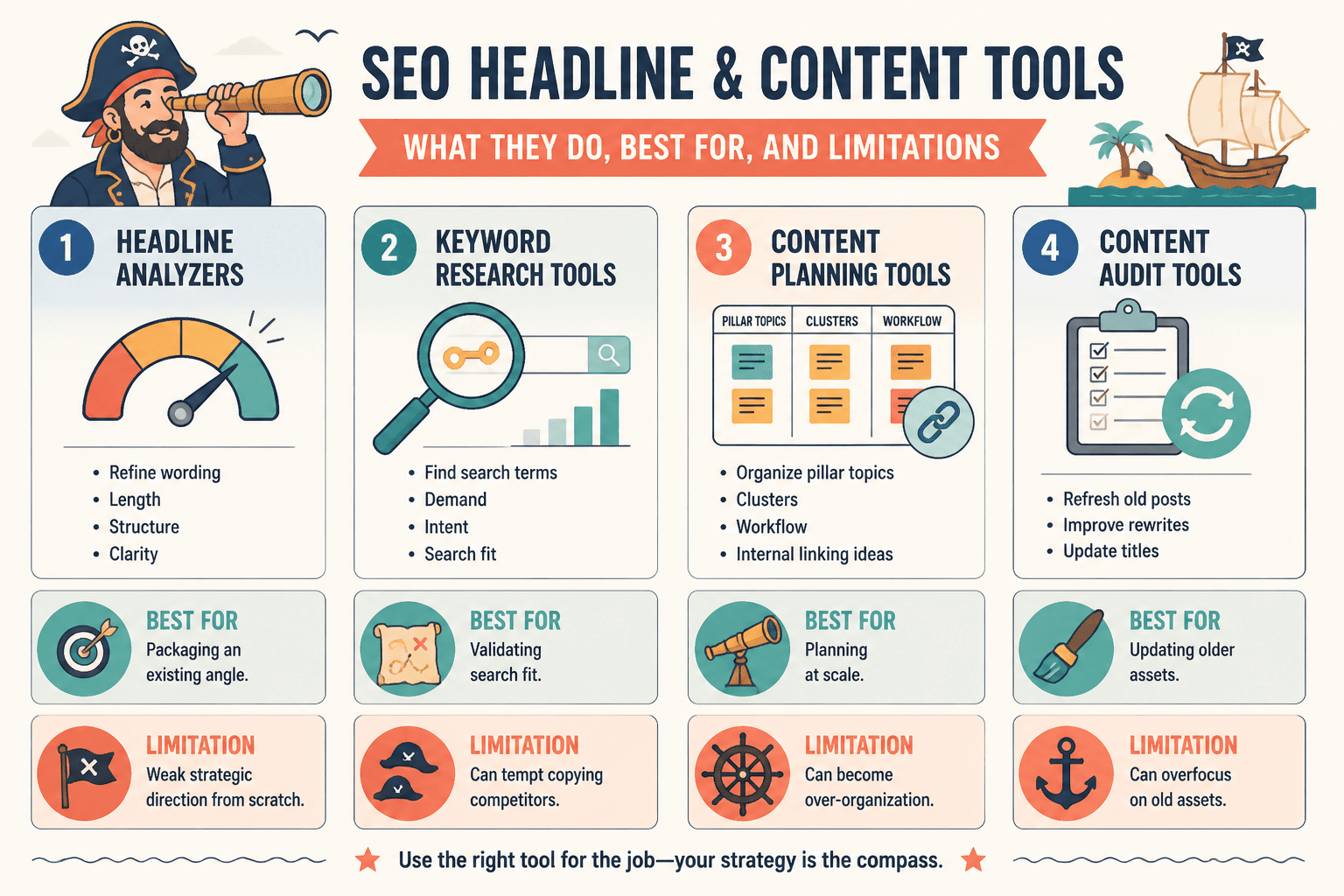
The main types of SEO headline tools and content planning tools
You do not need one giant “do everything” platform. In practice, most creators and small teams do better with a small stack of tools that each handle one job well.
| Tool type | Best for | What it helps improve | Main risk |
|---|---|---|---|
| Headline analyzers | Evaluating wording and structure | Clarity, emotional pull, readability | Over-optimizing for arbitrary scores |
| Keyword research tools | Finding search language | Search intent, phrasing, demand | Writing for keywords instead of readers |
| Content planning tools | Organizing title ideas and clusters | Coverage, consistency, article planning | Making giant plans you never publish |
| AI drafting tools | Generating variations fast | Volume, ideation, rewrites | Generic sludge and recycled patterns |
| SERP review tools | Checking ranking title patterns | Competitive framing, search fit | Copying everyone else |
| Content audit tools | Refreshing older posts | Better rewrites and title updates | Fixating on old assets without a strategy |
If you already have a decent idea-generation system, you may only need keyword research plus a simple planning board. If you publish at scale, you will probably want a stronger workflow that ties title ideation to pillar topics, internal linking, and content refreshes.
That is especially useful if you are building around a broader article system like the one covered in blog article systems and a dedicated framework for blog titles and headlines.
Best headline analyzer tools for tightening blog titles
Headline analyzers are useful when you already have an angle and need to improve the packaging. They are not great at giving you strategic direction from scratch.
What headline analyzers do well
- Spot weak wording
- Flag overly long titles
- Encourage stronger structure
- Push you toward clearer phrasing
- Help compare several title options quickly
What they do badly
- Understanding your audience nuance
- Recognizing when a lower-scoring title is actually better
- Judging expertise, trust, or positioning
- Knowing if a title promises the right thing for your offer or business
A lot of people get weirdly obedient around these tools. If the score says 82, they feel brilliant. If it says 61, they panic and start adding adjectives like seasoning. Relax. The score is a hint, not a verdict.
Use a headline analyzer to compare versions like these:
- Weak: Better Blog Title Tips for More Clicks
- Stronger: 11 Blog Title Tweaks That Make Good Posts More Clickable
- Weak: How to Write Headlines That Work
- Stronger: How to Write Blog Headlines That Are Clear, Searchable, and Worth Clicking
The better version is not better because some machine liked the emotional word count. It is better because the promise is clearer and the payoff feels more concrete.
Best keyword research tools for SEO headline ideas
If headline analyzers polish the wording, keyword tools help you choose the wording in the first place.
This is where you find the phrases, variants, questions, and adjacent topics people are actually searching for. That matters because your audience may not use the same language you use in your head.
For example, you might want to write about “title optimization systems.” Your reader may be searching for “blog title generator,” “SEO headline analyzer,” or “how to write better blog headlines.” Those are not identical intents, and the title should reflect the difference.
What to look for in a keyword tool
- Related keyword variations
- Question-based phrases
- SERP title previews
- Topic grouping or clustering
- Difficulty and volume estimates as directional data, not holy scripture
- Historical or comparative term trends
The best use of keyword tools for titles is not “stuff the exact phrase in and pray.” It is this:
- Find the main phrase
- Identify what searcher wants from it
- Notice common modifiers
- Choose a strong angle
- Write a title that sounds human
That means a title like “Best SEO Headline Tools and Content Planning Tools for Blog Titles and Headlines” can work because it matches a tool-comparison intent. But inside the article, you still need natural supporting language like headline analyzers, title ideation tools, keyword planning, content calendars, title templates, and content refresh workflows.
A smarter way to use keyword data
Do not just ask, “What phrase gets searched?” Also ask, “What is the reader trying to decide?”
Someone searching for headline tools may want software recommendations. Someone searching for blog title ideas may want templates. Someone searching for better titles for old posts may want a refresh process. Three similar phrases. Three different jobs.
That is where internal content mapping helps. If you are covering this topic deeply, it makes sense to connect this article to related resources like best AI tools for blog titles and headlines, best templates and tools for blog titles and headlines, and how to turn old content into better blog titles and headlines.
Best content planning tools for blog titles and headline strategy
A headline is not just a line on a page. It is part of a content system. If your title process lives in random notes, screenshots, and tabs you promise to come back to “later,” you do not need more inspiration. You need a planning setup that is less chaotic.
Content planning tools help you organize title ideas by theme, stage of funnel, search intent, content type, and priority. This is what stops your content library from becoming a pile of disconnected articles that all kind of sound the same.
Useful planning features
- Topic clusters and pillar mapping
- Status tracking from idea to published
- Fields for keyword target, angle, CTA, and internal links
- Tagging by audience segment
- A place to store alternate titles and refresh ideas
- Editorial calendar views when needed
The best content planning tool is often the one you will actually keep updated. That might be a spreadsheet, a lightweight database, a project board, or a dedicated content ops tool. Fancy software is not a personality trait. If your system is too bloated to use weekly, it is not helping.
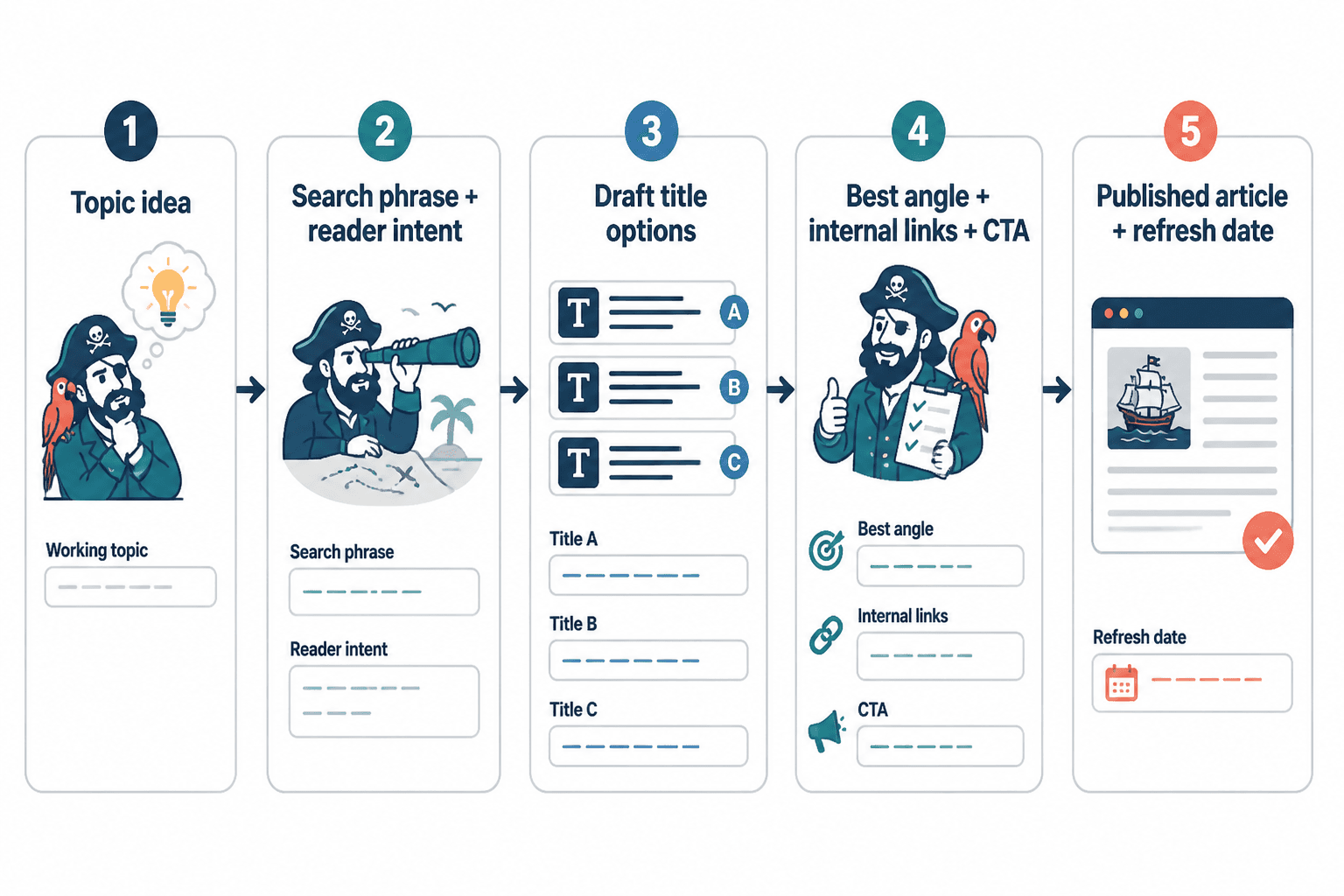
For solo creators, a simple planning structure usually works best:
- Column 1: Working topic
- Column 2: Search phrase
- Column 3: Reader intent
- Column 4: Draft title options
- Column 5: Best angle
- Column 6: Related internal links
- Column 7: CTA or next step
- Column 8: Refresh date
That one change alone can improve title quality because it forces the title to stay attached to strategy.
Where AI tools help and where they absolutely do not
AI can be useful for headline ideation. It can also produce a truly impressive amount of generic nonsense in under ten seconds.
Used well, AI tools help you:
- Generate multiple title versions fast
- Test different angles
- Rewrite flat headlines
- Turn one topic into several audience-specific title ideas
- Extract title opportunities from existing drafts or transcripts
Used badly, they give you:
- Formula spam
- Samey list-post titles
- Unnatural keyword stuffing
- Clickbait phrasing your audience will side-eye
- Titles that sound polished but say very little
The trick is to give AI enough context to do a decent job. That means audience, content goal, search phrase, angle, and what you want to avoid. If you just say “give me 20 SEO blog titles,” you are asking for oatmeal.
If you want a deeper look at that category, pair this piece with best AI tools for blog titles and headlines. AI is one useful layer in the process, not the whole process.
A practical workflow for better blog titles using tools without becoming weird about them
Here is a simple workflow that works well for creators, consultants, and small teams.
1. Start with the real topic, not the title
What are you actually helping the reader do? Compare tools? Improve CTR? Refresh old posts? Plan content around keyword themes? Start there.
2. Check search phrasing
Use keyword research to find how people phrase the problem. Pull variants, related terms, and questions.
3. Review SERP patterns
Look at what currently ranks. Not so you can copy it, but so you can understand the format readers seem to expect. List post? Tool roundup? Tutorial? Comparison? Process guide?
4. Draft 10 to 15 title options
Use a mix of manual writing and tool-assisted variations. Push different angles:
- Best tools
- Best tools for a specific audience
- Simple workflow
- Common mistakes
- Templates and tools
- Beginner vs advanced framing
- Refresh or repurposing angle
5. Run the best ones through a headline analyzer
Use the score as one signal, not the boss of your personality.
6. Choose based on clarity, intent, and usefulness
Ask:
- Would the right reader click this?
- Does it clearly match the article’s real payoff?
- Does it sound like a human wrote it?
- Is the search phrase present naturally?
- Is the angle distinct enough to earn attention?
7. Save alternates for future use
Good title ideas should not die in drafts. Store alternate versions for refreshes, social promotion, repurposed posts, or related articles.
How to choose the right tool stack for your situation
You do not need every category at full strength. You need the mix that solves your actual bottleneck.
If you are a solo creator
- Use one keyword research tool
- Use one simple headline analyzer
- Use a spreadsheet or lightweight planning board
- Add AI only if it saves time without flattening your voice
If you publish regularly for SEO
- Use a stronger keyword tool with topic clusters
- Use a title testing process for drafts
- Track internal links and content gaps
- Audit older titles quarterly
If you run a content team
- Standardize title fields in your planning system
- Keep a headline pattern library
- Create rules for search intent by content type
- Store approved title rewrites and refresh logs
The best stack is the one that helps you ship sharper titles consistently. Not the one with the prettiest dashboard or the most aggressively cheerful onboarding emails.
Common mistakes people make with headline and content planning tools
- Chasing scores instead of clicks from the right readers. A “great” score means nothing if the headline is bland.
- Confusing search volume with fit. Bigger keyword does not always mean better article.
- Using AI before thinking. If your input is mush, your output will be expensive mush.
- Planning too much and publishing too little. A flawless content map nobody executes is just decorative admin.
- Writing titles before deciding the angle. Same topic, different angle, very different performance.
- Ignoring older posts. Some of your best title wins come from refreshing content you already have.
That last one gets overlooked a lot. If you already have a back catalog, title improvement is often a faster win than constantly creating from scratch. A weaker old article can become a much stronger asset with a better promise, cleaner structure, and clearer search fit.
That is also why it helps to connect your planning process with refresh-focused resources like how to turn old content into better blog titles and headlines.
What better title planning looks like in practice
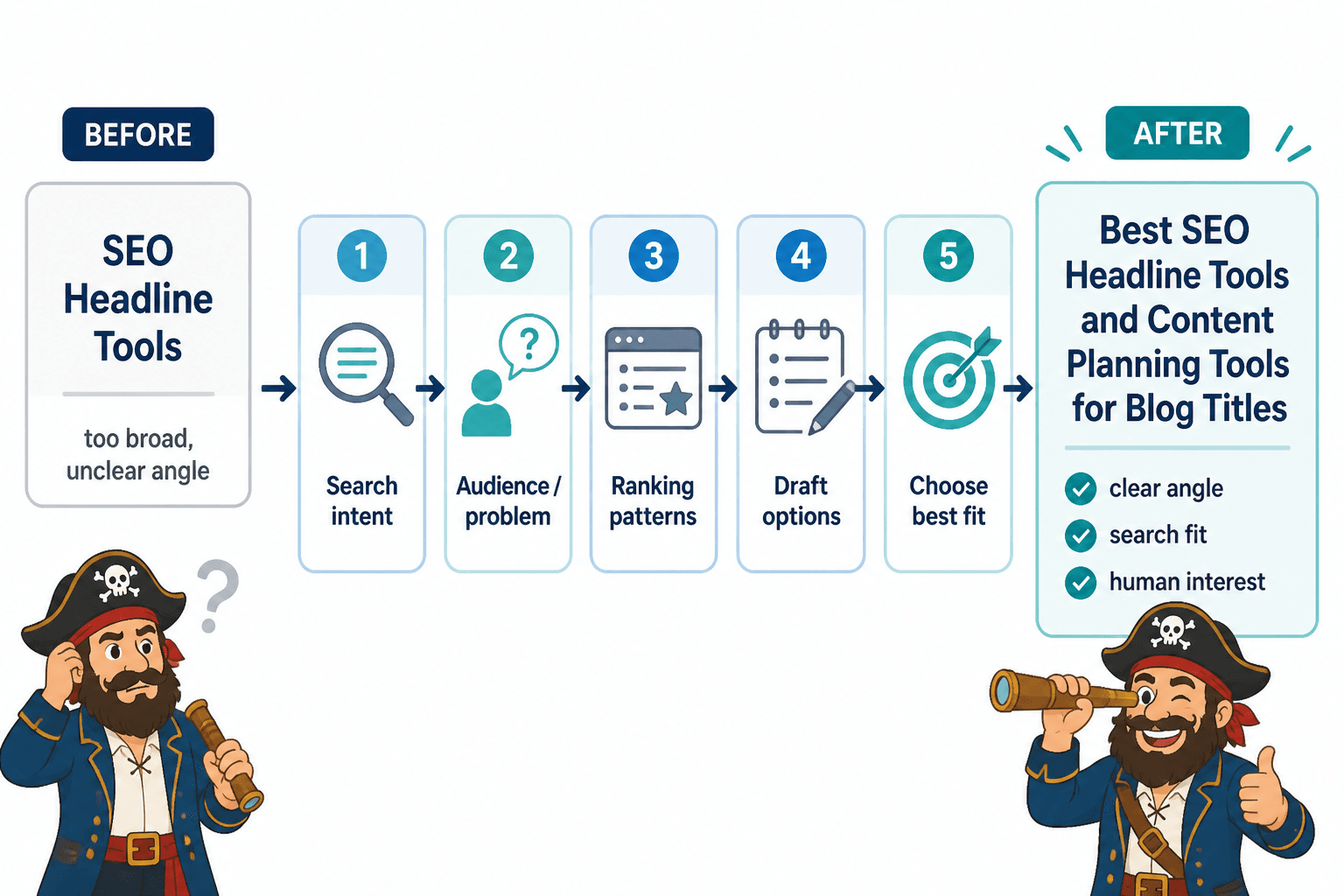
Let’s say your rough topic is: tools for blog titles.
Here is how weak planning usually goes:
- Open AI tool
- Ask for title ideas
- Pick one that sounds acceptable
- Publish article that half-matches the headline
Here is the better version:
- Define reader intent: are they looking for tools, templates, workflow, or analysis?
- Check keyword variants: headline tools, SEO title tools, blog title generators, content planning tools
- Review current ranking formats
- Choose a clear angle: best tools plus how to use them
- Draft multiple title options
- Select the one that best balances search fit and human interest
- Link it to related supporting articles in your cluster
That process produces better titles because it treats the title as strategy, not decoration.
And if you want a simpler, faster angle on headline creation, it also helps to pair this with simple blog titles and headlines click-worthy SEO titles templates for busy creators and best templates and tools for blog titles and headlines.
Simple criteria for picking the best SEO headline tools and content planning tools for blog titles and headlines
If you are comparing options, use this checklist.
- Does it help with the part you actually struggle with? Research, ideation, planning, or rewriting?
- Can you use it quickly? If every headline takes 40 minutes, the tool is not helping.
- Does it support better decisions, not just more output?
- Can it fit into your existing workflow?
- Will it help you keep title ideas organized over time?
- Does it improve clarity and relevance without making your titles sound synthetic?
That last one matters more than people think. Plenty of titles are technically optimized and still completely forgettable. A useful tool should help you sharpen the angle, not bleach the personality out of it.
If a tool helps you find clearer wording, stronger intent match, and better organization, it is doing its job. If it only helps you generate fifty mediocre options faster, it is just speeding up the wrong part of the process.