
Most blog titles are not bad because the writer lacks talent. They are bad because they were written in a rush, padded with vague words, or built to sound “professional” instead of worth clicking.
Busy creators do this all the time. You finish the article, your brain is fried, and then you slap on something like “Tips for Better Content Strategy” and call it a day. Which is a bit like cooking a solid meal and serving it on a paper towel.
If you want simple blog title and headline templates for busy creators, the goal is not to sound clever. It is to make the right person think, “Yep, that’s for me,” and click without needing a TED Talk from your headline.
This article will help you write titles faster, make them clearer, improve your odds of ranking and getting clicked, and avoid the headline habits that quietly ruin good articles. You’ll get practical templates, examples, and a simple process you can reuse without turning title writing into a dramatic event.
For the main guide behind this topic, visit the parent guide.
What a good blog title actually needs to do
A strong blog title has a job. Usually three jobs, really:
- Tell the reader what they’ll get
- Signal relevance fast
- Earn the click without sounding like a scam in loafers
That means your title needs some mix of clarity, specificity, usefulness, and tension. Not fake drama. Just enough contrast or promise that the reader sees a reason to care.
SEO matters too, obviously. But “SEO-friendly” does not mean stuffing every keyword variation into one poor headline until it wheezes. Search-friendly titles work best when they match real intent. If someone is searching for help with blog headlines, they probably want templates, examples, formulas, rewrites, or mistakes to avoid. Give them that plainly.
The best titles are not mysterious. They are specific enough to earn attention and simple enough to understand in one glance.
The easiest way to write better titles faster
If you are busy, do not start from scratch every time. Start with a title type.
That one shift saves a ridiculous amount of time. Instead of staring at a blank field hoping inspiration shows up in business-casual sneakers, you pick a structure based on the article’s real purpose.
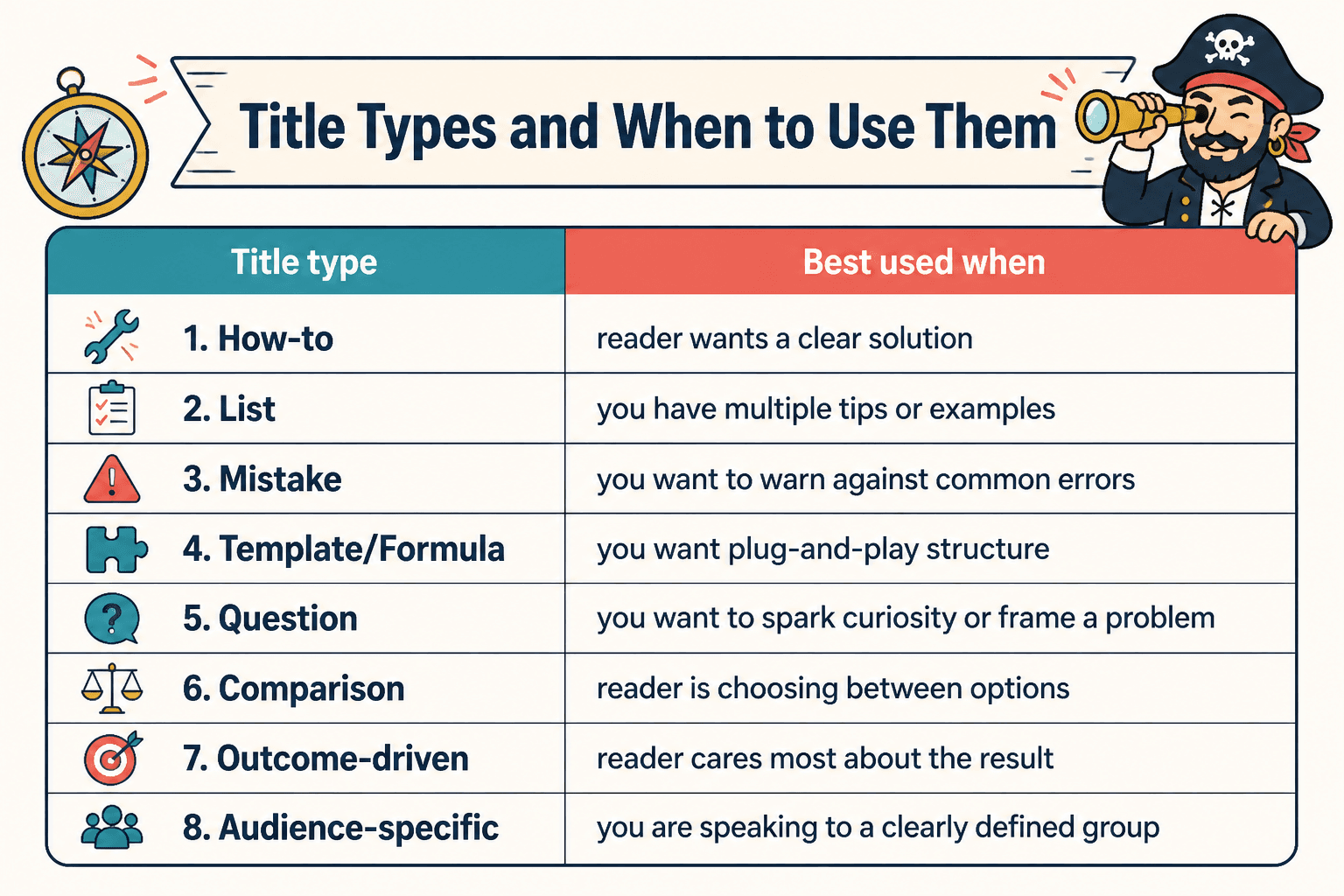
Most useful blog titles fall into one of these buckets:
- How-to titles
- List titles
- Mistake titles
- Template or formula titles
- Question titles
- Comparison titles
- Outcome-driven titles
- Audience-specific titles
Once you know which bucket fits, title writing gets much less annoying.
Simple blog title and headline templates for busy creators
These templates are meant to be used, not admired. Steal the structure, swap in your topic, and tighten the wording until it sounds like something a sane person would actually click.
1. The straightforward how-to title
Best when the reader wants a clear solution and already knows the problem.
- How to [get result] without [annoying obstacle]
- How to [do task] that actually [desired outcome]
- How to [do specific thing] for [specific audience]
- How to [improve thing] in [timeframe or context]
Examples
- How to Write Blog Titles That Actually Get Clicked
- How to Plan a Content Calendar Without Making It a Full-Time Job
- How to Write Better Homepage Copy for Coaches
- How to Create a Lead Magnet That Does Not Feel Like Filler
This format works because it is honest. The reader sees the topic, the benefit, and sometimes the pain point in one line. No interpretive dance required.
2. The list title that does not feel lazy
List titles work well when the article genuinely contains distinct examples, ideas, templates, or tools. They fail when the number is there to create fake authority.
- [Number] [type of thing] for [specific audience or use case]
- [Number] ways to [get result]
- [Number] [topic] examples that are actually useful
- [Number] [topic] mistakes to stop making
Examples
- 21 Blog Title Templates for Coaches and Consultants
- 9 Ways to Make Your Headlines Less Generic
- 15 Homepage Headline Examples That Actually Sound Human
- 7 Blog Title Mistakes That Hurt Clicks
If you use a number, make sure the content earns it. “37 headline ideas” sounds impressive until half of them are the same sentence wearing a fake mustache.
3. The mistake-based title
Great for articles where the reader is doing something wrong and does not fully realize it yet.
- [Number] mistakes ruining your [thing]
- Why your [thing] is not working
- The [topic] mistakes that hurt [result]
- What most people get wrong about [topic]
Examples
- Why Your Blog Titles Are Getting Ignored
- 5 Headline Mistakes That Make Good Articles Look Boring
- What Most Creators Get Wrong About SEO Titles
- The Blog Title Mistakes That Hurt Traffic and Clicks
This format works because readers are often more motivated to fix a problem than chase a vague improvement. It creates tension naturally, as long as the article actually explains the fix.
4. The template or formula title
Perfect when people want plug-and-play help. Busy readers love usable structure.
- [Number] templates for [specific task]
- The best [topic] formulas for [audience]
- Simple [topic] templates you can use today
- Fill-in-the-blank [topic] formulas for [result]
Examples
- 10 Simple Blog Title Templates You Can Use in Minutes
- The Best Headline Formulas for Personal Brand Articles
- Fill-in-the-Blank Title Templates for SEO Blog Posts
- Simple Blog Headline Templates for Busy Creators
If your audience is short on time, “templates” and “formulas” can be stronger than “tips” because they promise something more immediate and usable.
5. The audience-specific title
Useful when the same topic means different things to different readers. Narrowing the audience can improve clicks because the right people feel seen.
- [Topic] for [specific audience]
- The best [thing] for [specific type of business]
- How [audience] can [get result]
- [Number] [topic] examples for [audience]
Examples
- Blog Title Ideas for Coaches, Consultants, and Solo Founders
- How Personal Brands Can Write Better SEO Headlines
- Headline Templates for Freelancers Who Hate Clickbait
- Blog Title Examples for Small Service Businesses
The downside is reach can get narrower. The upside is the traffic gets better. Usually a fair trade.
6. The outcome-driven title
This one leads with the result people want.
- Write [thing] that gets [result]
- Create [thing] that helps you [result]
- [Topic] that drives [specific benefit]
- How to get more [result] from your [content type]
Examples
- Write Blog Titles That Get More Clicks Without Sounding Cheap
- Create Better Headlines That Help Your Articles Rank and Convert
- How to Get More Traffic from the Titles You Already Have
- Blog Headline Formulas That Improve Search Click-Through
This format can work well, but keep it grounded. “Explode your traffic overnight” is not a title. It is a trust leak.
What makes a title click-worthy without turning into clickbait
A click-worthy title creates enough interest to earn the click, then accurately represents the content. That second part matters. A lot. If your title overpromises, people bounce, trust drops, and your article starts life with a credibility problem.
Good titles usually include at least two of these:
- A clear topic
- A specific audience
- A useful outcome
- A concrete format like templates, examples, mistakes, or steps
- A bit of tension, contrast, or curiosity
For example, compare these:
| Weak title | Better title |
|---|---|
| Better Blog Writing Tips | How to Write Blog Titles That Are Clear, Searchable, and Worth Clicking |
| Content Headline Ideas | 15 Blog Headline Templates for Busy Creators |
| Improve Your SEO | Simple SEO Title Formulas for Blog Posts That Need More Clicks |
| Writing Headlines That Work | Why Your Blog Headlines Are Getting Ignored and How to Fix Them |
The better versions are not wildly creative. They are just more useful. That is usually the move.
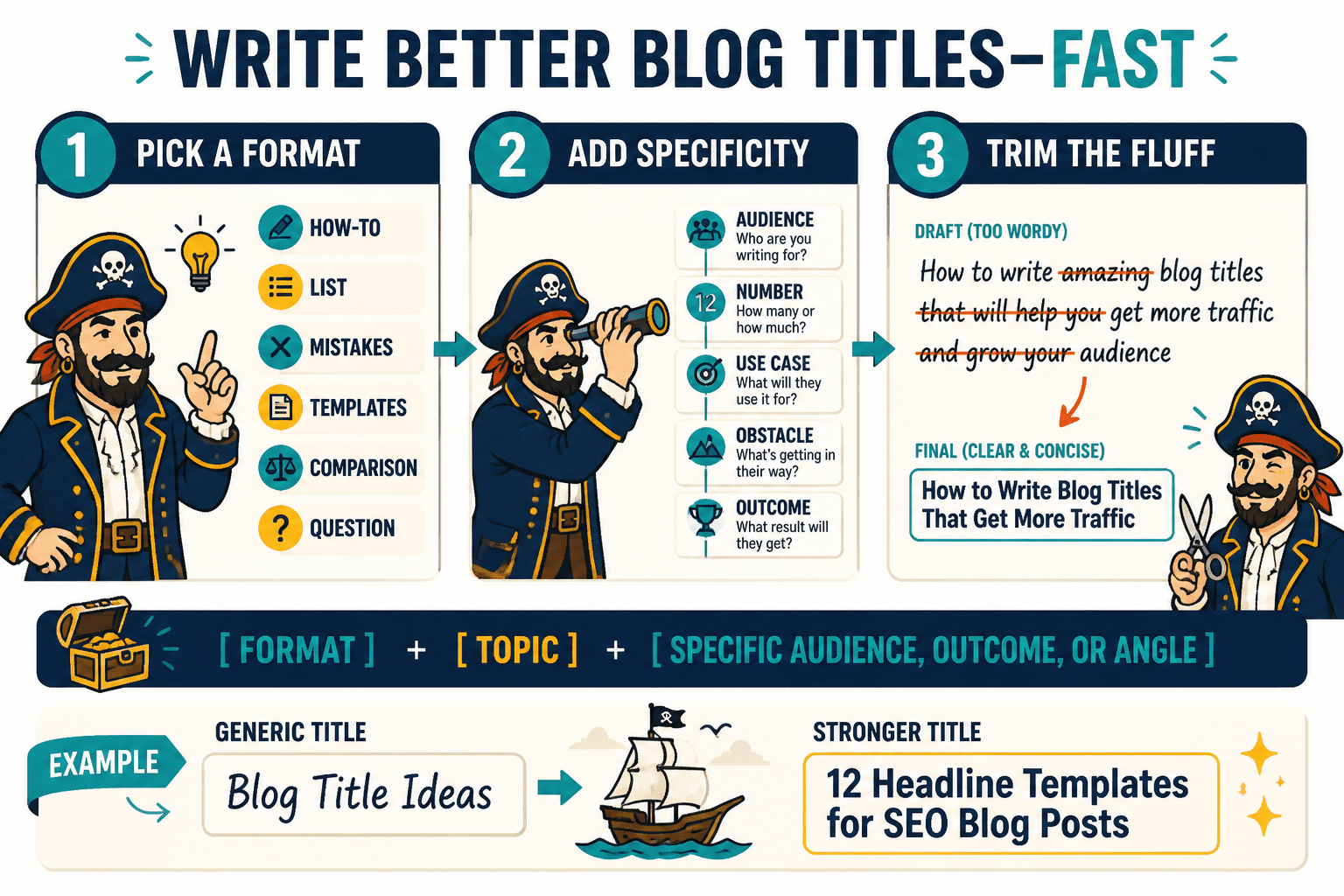
A simple formula for writing blog titles in under five minutes
Here is the quick process.
- Name the real topic. What is the article actually about?
- Name the result. What does the reader get from reading it?
- Pick a format. How-to, list, mistakes, templates, examples, comparison, question.
- Add specificity. Audience, number, use case, obstacle, or outcome.
- Trim the fluff. Remove vague filler words and stacked adjectives.
That gives you this simple framework:
[Format] + [Topic] + [Specific audience, outcome, or angle]
Examples:
- How to Write Blog Titles for Service Businesses
- 12 Headline Templates for SEO Blog Posts
- Why Your Article Titles Are Too Vague to Click
- Simple Blog Headline Formulas for Busy Creators
Not glamorous. Very effective.
The words that usually improve a title
Some words signal usefulness better than others. Not because they are magical, but because they match what people are looking for.
Useful title words:
- How to
- Templates
- Examples
- Mistakes
- Best
- Simple
- Easy
- Proven
- Step-by-step
- For beginners
- For coaches
- For consultants
- That actually works
- Without
Words that often weaken titles:
- Amazing
- Ultimate
- Revolutionary
- Powerful
- Insane
- Must-have
- Secrets
- Shocking
- Mind-blowing
Sometimes one of those can work in the right brand voice. Usually, though, they make the title sound inflated. And if your audience is creators, consultants, or people with functioning pattern recognition, inflated headlines tend to repel more than persuade.
SEO title tips that busy creators actually need
You do not need a doctoral thesis on keyword placement. You need a few rules that stop you from making obvious mistakes.
Put the main phrase in naturally
If the article is about blog title templates, say blog title templates. Do not get cute and call them “attention architecture systems for content assets.” Nobody searched that. Nobody wants to.
Lead with clarity, not branding
Your brand name almost never belongs at the front of the article title. Put the useful phrase first. Readers care about themselves before they care about your logo. Fair enough, really.
Do not cram multiple keyword versions awkwardly
“Simple Blog Titles and Headlines Click-worthy SEO Titles Templates for Busy Creators” is a fine row label for a spreadsheet, not a title a human would choose. Your public headline should sound normal.
Match the article to the search intent
If the title promises templates, give templates. If it promises examples, include real examples. If it promises mistakes, do not spend 1,400 words talking about mindset and then toss in two vague errors at the end.
Keep it tight enough to scan
You do not need one perfect character count, but shorter tends to be cleaner if you can keep the meaning. If the title is long, make sure every word earns its place.
If you want more support building a repeatable system around titles, the broader blog SEO writing section and the blog article systems hub are good next stops. For a deeper look at the topic specifically, this blog titles and headlines guide connects the strategy pieces well.
Before-and-after title rewrites
Sometimes the easiest way to improve your titles is to see a plain bad one become less bad.
| Before | After | Why it works better |
|---|---|---|
| Content Marketing Ideas | 12 Content Marketing Ideas for Small Service Businesses | More specific topic and audience |
| How to Grow Online | How Coaches Can Grow Online with Search-Friendly Blog Content | Clearer result and audience |
| Why Headlines Matter | Why Weak Headlines Are Costing Your Blog Clicks | Adds stakes and relevance |
| Tips for Better Blog Posts | Simple Blog Title Templates for Busy Creators | Sharper promise, more useful angle |
| Writing Good Titles | How to Write Blog Titles That Are Clear, Useful, and Search-Friendly | Specific benefit instead of vague quality |
If you want a deeper breakdown of this process, read How to Rewrite Boring Blog Titles and Headlines. It pairs nicely with this article because coming up with titles is one skill and repairing weak ones is another.
Title mistakes busy creators keep making
These are the repeat offenders.
Being too broad
“Marketing Tips” could be about absolutely anything. Broad titles usually feel safer, but they are harder to rank, harder to click, and easier to ignore.
Trying too hard to sound smart
Fancy wording is not authority. It is often just friction. If a simpler title says the same thing faster, use the simpler title.
Writing for search engines instead of readers
A title stuffed with awkward keyword variations might technically include the phrase, but if it reads like a malfunctioning plugin, people will skip it.
Writing for readers instead of search entirely
The opposite problem also happens. Writers get clever, poetic, or cryptic, then wonder why the article gets no search traffic. If nobody can tell what the article is about, that is not intrigue. That is just hiding the ball.
Promising too much
If your article offers basic title advice, do not title it “The Ultimate Psychology System for Viral Headlines.” Calm down. Earn trust first.
Using the same title pattern every time
If every post starts with “How to,” your content starts to blur together. Some variety helps. Not for the sake of art, just for readability and range.
For more of the avoid-this list, see Blog Titles and Headlines Title Templates Mistakes That Hurt Performance. Yes, mistakes deserve their own page. People are very committed to repeating them.
A practical workflow for creators who do not want to overthink headlines
Here is a simple workflow you can reuse every time you publish.
- Draft 5 title options, not 1.
- Make at least 2 of them straightforward and search-friendly.
- Make 1 option more curiosity-driven, but still clear.
- Read them out loud. If one sounds like LinkedIn trying to write a novel, cut it.
- Ask: would the right reader instantly know what this article helps with?
- Pick the clearest title with the strongest payoff.
That last line matters. Clarity with payoff usually beats cleverness with haze.
If you publish often, keep a swipe file of title structures by category. Templates for how-to posts. Templates for example posts. Templates for comparison posts. That way, you are not reinventing the wheel every week like it personally offended you.
And if you want done-for-you inspiration, Blog Titles and Headlines Examples for Coaches, Consultants, and Personal Brands gives you plenty of stronger patterns to adapt. If you are also choosing tools or title generators, best templates and tools for blog titles and headlines is the natural next article.
Templates are most useful when they help you move faster without flattening the point. That is the balance worth protecting.