
Most weak blog titles are not weak because you had nothing to say. They are weak because the title got written like an afterthought, usually five minutes before publishing, with the energy of someone labeling a tax folder.
For the broader learning path, visit our parent guide.
That is why old content is such a useful headline source. The thinking is already there. The proof is already there. The specifics are already there. You are not trying to invent a better idea from scratch. You are trying to spot the stronger angle that was hiding inside the piece the whole time.
If you want to know how to turn old content into better blog titles and headlines, the short version is this: stop summarizing the topic and start extracting the sharpest promise, tension, mistake, result, question, or contrast from what you have already written.
Done well, this gives you titles that are clearer, more clickable, more searchable, and a lot less beige. It also makes your old content more reusable, which is nice, because squeezing more value out of work you already did is one of the few genuinely smart content shortcuts.
Why old content is one of the best headline sources you have
Writers often try to create titles before the real idea is fully cooked. That is how you end up with headlines like “A Guide to Content Strategy” or “Tips for Better Blogging.” Accurate? Technically. Memorable? Not even slightly.
Old content gives you something better than brainstorming from a blank page. It gives you evidence. You can look at what you already wrote and ask better questions:
- What point was actually strongest?
- What section had the most tension?
- What line sounded like a real opinion instead of a generic topic label?
- What problem did this piece solve clearly?
- What phrase would make the right reader think, “Yes, that is exactly my issue”?
That is the shift. A weak title describes the subject. A better title frames the value.
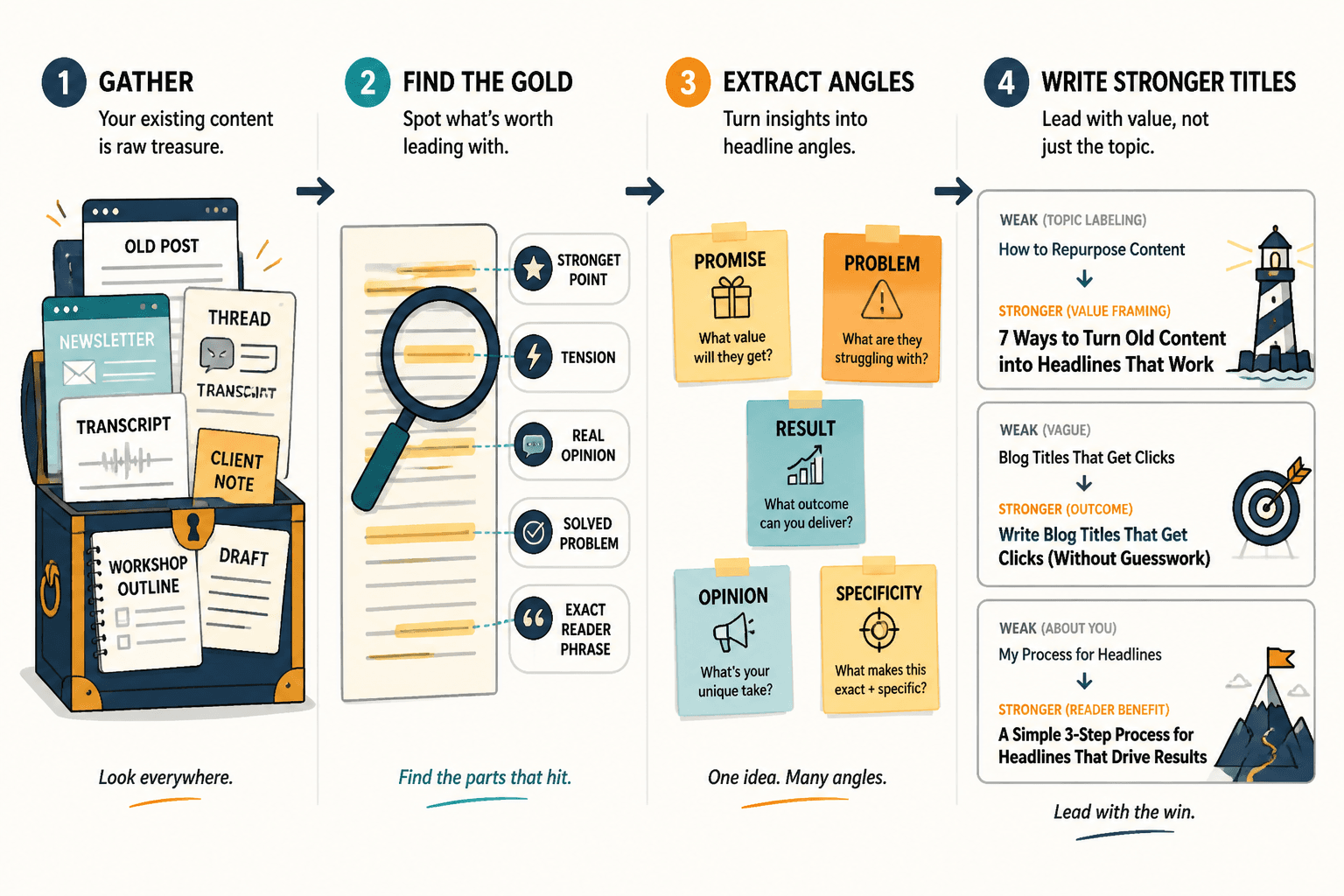
If your old post, newsletter, thread, transcript, client note, workshop outline, or half-forgotten draft has one useful idea buried in it, you already have title material. You just need to mine it properly instead of slapping “ultimate guide” on top and calling it a day.
What makes a blog title better, not just different
Before rewriting anything, it helps to define what “better” means. Because longer is not always better. Smarter-sounding is definitely not always better. And stuffing in keywords until the title reads like it was assembled by a malfunctioning SEO plugin is not better either.
A better blog title usually does a few things well:
- It makes a clear promise
- It names a specific problem, result, or angle
- It sounds relevant to a real person, not a content machine
- It gives enough detail to earn interest
- It still reads naturally
- It matches what the article actually delivers
That last part matters more than people like to admit. A flashy title that oversells the article is not a win. It might earn a click once. It will not build trust. And trust is doing a lot more work than one temporary spike in traffic.
A strong headline is not a costume for weak content. It is a clearer front door for content that already has something worth opening.
How to turn old content into better blog titles and headlines: the practical process
Here is the process. It is simple, but it works because it forces you to extract the actual value from the content instead of naming the general topic and hoping for the best.
1. Find the real point, not the official topic
Start by ignoring the current title completely. Read the piece and ask: what is this really about?
Not the category. Not the broad subject. The real point.
For example:
- Not “email marketing”
- But “why welcome emails underperform when they try to sell too early”
- Not “content repurposing”
- But “how one strong article can become five better assets without becoming repetitive sludge”
- Not “personal branding”
- But “why vague authority language makes smart people sound forgettable”
If you cannot finish the sentence “This piece is really about…” in a sharp way, the title problem is not solved yet. Keep digging.
2. Pull out the most title-worthy lines
Now skim the piece and highlight anything that has natural pull. Look for lines that contain:
- A bold opinion
- A useful contrast
- A common mistake
- A concrete outcome
- A surprising truth
- A sharp phrase the audience would recognize
These lines often show up in subheads, examples, topic sentences, callouts, and little mini-rants where the writing suddenly wakes up.
If a sentence in the body feels more alive than the current headline, congratulations: your title has been outperformed by paragraph three.
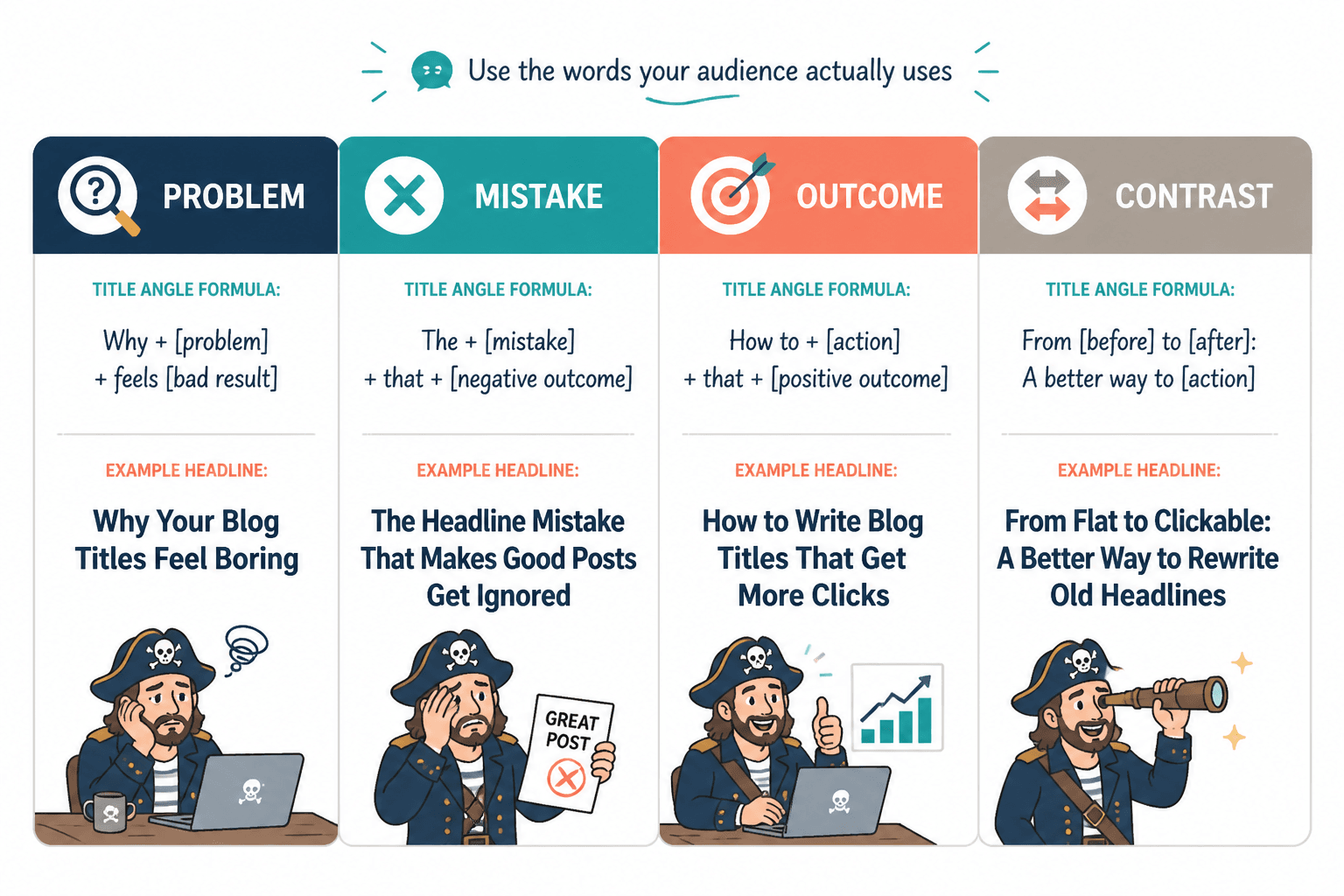
3. Identify the angle type
Most strong blog titles come from a small set of useful angle types. Once you know which one fits the piece, writing gets easier.
| Angle type | What it does | Example shape |
|---|---|---|
| Problem | Names the pain directly | Why Your Blog Titles Keep Getting Ignored |
| Mistake | Calls out what people do wrong | The Blog Title Mistake That Makes Good Content Look Boring |
| How-to | Promises a practical outcome | How to Turn Old Content Into Better Blog Titles and Headlines |
| Question | Matches search intent or reader curiosity | What Makes a Blog Title Actually Worth Clicking? |
| Contrast | Creates tension between bad and good | From Generic to Specific: Fixing Weak Blog Headlines |
| Outcome | Leads with the result | Better Blog Titles That Earn Clicks Without Sounding Cheap |
| List | Packages multiple examples or options | 9 Ways to Find Better Headlines Inside Old Content |
Not every article needs a number. Not every title should lead with “how to.” Sometimes a sharper mistake-based title beats a bland how-to by a mile. The right angle depends on the content and search intent, not on whichever template is currently clogging your notes app.
4. Turn insights into headline candidates
Once you have the point and the angle, draft several title versions. Not one. Several.
You are not looking for endless creativity here. You are testing emphasis.
Say your old content is about updating old blog posts. Here is how one core idea can produce multiple headline options:
- How to Update Old Blog Posts Without Rewriting Everything
- The Smarter Way to Refresh Old Blog Content for Better Traffic
- Why Most Blog Updates Waste Time and What to Fix Instead
- 7 Simple Fixes That Make Old Blog Posts More Useful and Searchable
- How to Get More Value From Old Blog Content You Already Wrote
Same general topic. Different title promises. Different reader pull. Different fit depending on what the article actually delivers.
5. Keep the keyword, lose the stiffness
If you care about search, yes, the phrase matters. But “contains keyword” is not the same thing as “reads like a sentence a sane person would click.”
For this article, the phrase “How to Turn Old Content Into Better Blog Titles and Headlines” belongs in the title naturally because it matches the intent. Great. Use it. But if your draft title sounds awkward, robotic, or bloated, the keyword is not helping enough to justify the damage.
SEO-aware titles should still sound human. That is not a cute preference. It affects clicks, trust, and whether your content looks credible at all.
7 reliable ways to pull stronger titles from old content
If you want a faster system, these are the seven title sources I would check first inside any existing piece.
1. Use the strongest subheading
Sometimes the best title is already sitting inside the article as an H2 or H3, because that is where the writer finally got specific.
Example:
- Old title: Content Planning Basics
- Better angle from subheading: Why Most Content Plans Collapse by Week Three
That second one has tension. It hints at a real problem. It also sounds like it came from someone who has seen this happen, which is a nice change from generic tutorial wallpaper.
2. Pull the line that names the mistake
Mistake-driven titles work well because readers are often trying to diagnose underperformance. They do not just want “tips.” They want to know what is quietly sabotaging the thing.
- Old title: Writing Better Newsletter Content
- Better title: The Newsletter Mistake That Makes Useful Writing Feel Skippable
This works especially well when your old content contains critique, myth-busting, audits, or before-and-after examples.
3. Extract the most concrete outcome
If the content helps someone achieve something specific, say that more clearly.
- Old title: Better Content Workflow
- Better title: How to Build a Content Workflow That Cuts Drafting Time and Keeps Quality Intact
Notice the difference. The first title names a bucket. The second names a result. Buckets are organized. Results are compelling.
4. Turn a buried question into the headline
Good articles often answer a specific question somewhere in the intro or body, but the title never uses that question directly.
- Old title: Repurposing Written Content
- Better title: What Should You Repurpose First When You Have Too Much Old Content?
This can work well for search intent, especially when the question is phrased the way a real person would actually ask it.
5. Use contrast to create pull
Contrast is useful because it instantly implies change, improvement, or correction.
- Old title: Blog Headline Tips
- Better title: From Flat to Clickable: How to Fix Blog Headlines That Say Too Little
Just do not get too theatrical with it. You are writing a title, not auditioning for a productivity cult.
6. Promote the proof element
If the old content includes examples, case breakdowns, rewrites, templates, data points, or a practical process, let the title reflect that. Proof makes a title more credible.
- Old title: Better Blog Titles
- Better title: How to Write Better Blog Titles Using Old Drafts, Examples, and Rewrites
Specifics calm skepticism. That matters.
7. Use the language your audience already uses
Old content often contains stronger wording in the parts where you were speaking more naturally. Client questions, comments, workshop notes, sales calls, email replies, and rough drafts are especially useful for this.
People rarely say, “I need holistic headline optimization.” They say, “My titles are boring,” or “Nobody clicks these,” or “I know the content is good, but the headline feels dead.”
Use the language people actually use. It tends to perform better because it sounds less processed and more relevant.
Before-and-after title rewrites from old content
Let’s make this less abstract. Here are a few examples of turning stale titles into stronger ones using material that was likely already inside the content.
| Weak title | What is wrong with it | Stronger rewrite |
|---|---|---|
| Content Marketing Ideas | Too broad, says nothing new | 12 Content Marketing Ideas to Use When Your Audience Is Paying Attention but Not Buying |
| Improving Your Website Copy | Generic and low-tension | How to Improve Website Copy That Sounds Fine but Converts Poorly |
| Blogging Tips for Beginners | Overdone, vague audience, weak promise | Blogging Tips That Actually Help When You Have Ideas but No Traffic Yet |
| Building a Personal Brand | Too broad and forgettable | How to Build a Personal Brand Without Sounding Like Everyone Else on LinkedIn |
| Email Strategy Guide | Flat and unearned | A Smarter Email Strategy for Creators Who Want Sales Without Constant Pitching |
Notice what improved:
- The audience got clearer
- The problem got more specific
- The tension increased
- The title hinted at a real payoff
- The language got less generic
If you want more title rewrite help, these related pieces will help: How to Rewrite Boring Blog Titles and Headlines and Better Blog Titles and Headlines: Weak Title Fixes for Personal Brands.
A simple headline extraction framework you can reuse
Here is a clean little framework for turning old content into title options without overcomplicating the process.
The source-to-headline method
- Open an old article, draft, transcript, thread, or newsletter.
- Highlight the best three lines or sections.
- Label each one as a problem, mistake, outcome, question, or contrast.
- Write 3 to 5 title options from those angles.
- Keep the version that is clearest, strongest, and truest to the content.
That is enough for most situations.
If you want to add one more filter, ask this: would the right reader instantly understand why this is for them?
If not, the title probably still needs more specificity.
Common mistakes when repurposing old content into new headlines
This is the part people usually botch.
Keeping the title too close to the category name
Category labels are useful for organizing content. They are not automatically good headlines.
- “SEO Tips”
- “Writing Advice”
- “Business Growth Strategies”
These are shelves, not titles.
Forcing clickbait drama onto decent content
There is a difference between adding tension and acting like your blog post contains classified state secrets.
- “The Shocking Truth About Headlines…”
- “Nobody Wants You to Know This…”
- “This Changes Everything…”
Please do not.
If the content is solid, it does not need tabloid makeup.
Using the keyword but killing the readability
Yes, search matters. No, “Best Blog Titles Headlines Better SEO Content Guide” is not a sentence.
Clarity first. Natural phrasing second. SEO support alongside both. That is the order.
Writing titles that promise more than the article delivers
If your old content is a short perspective piece, do not title it like a complete masterclass. Match the scope honestly. Readers can smell overpromising pretty quickly, and they tend not to thank you for it.
Only writing one title
One title is usually the first draft of your thinking, not the best version of it. Give yourself options. Three is usually enough. Five is plenty. Twenty is a sign you may be procrastinating under the disguise of optimization.
How to decide which repurposed title is best
Once you have a few candidates, choose based on these questions:
- Is it clear in one read?
- Does it sound like something a real person would click?
- Does it match the article honestly?
- Does it include the main phrase naturally if search matters?
- Does it emphasize a useful problem, result, or angle?
- Would it stand out next to generic competing titles?
If two options are both strong, pick the one with cleaner clarity over the one trying too hard to sound clever. Cleverness ages badly. Useful clarity tends to keep working.
Using old content to build title banks, not just one-off fixes
The bigger opportunity here is not just rescuing one weak title. It is building a repeatable headline system from your existing content library.
If you publish often, your archive is probably full of overlooked headline assets:
- Strong subheads
- Contrarian lines
- Useful questions
- Client objections
- Case study outcomes
- Common mistakes
- Framework names
- Before-and-after rewrites
That is what makes old content so useful for headline work. A good archive gives you tested raw material. The job is to reshape it into titles that feel clearer, sharper, and more timely than the first version.