
Weak product and service descriptions are rarely weak because the offer itself is bad. They are weak because the copy makes people work too hard to figure out what is being sold, who it is for, and why they should care. That is a framing problem, not a poetry problem. You do not need to make the description “sound better” first. You need to make it easier to understand.
The useful standard is blunt: a good description should help the right reader answer three questions fast – what is this, is it for me, and why should I trust it enough to act? Once that is clear, the nice writing has somewhere to land instead of drifting around looking decorative.
If you want the broader system this article sits inside, see the parent guide to product and service descriptions.
What a good product or service description actually needs to do
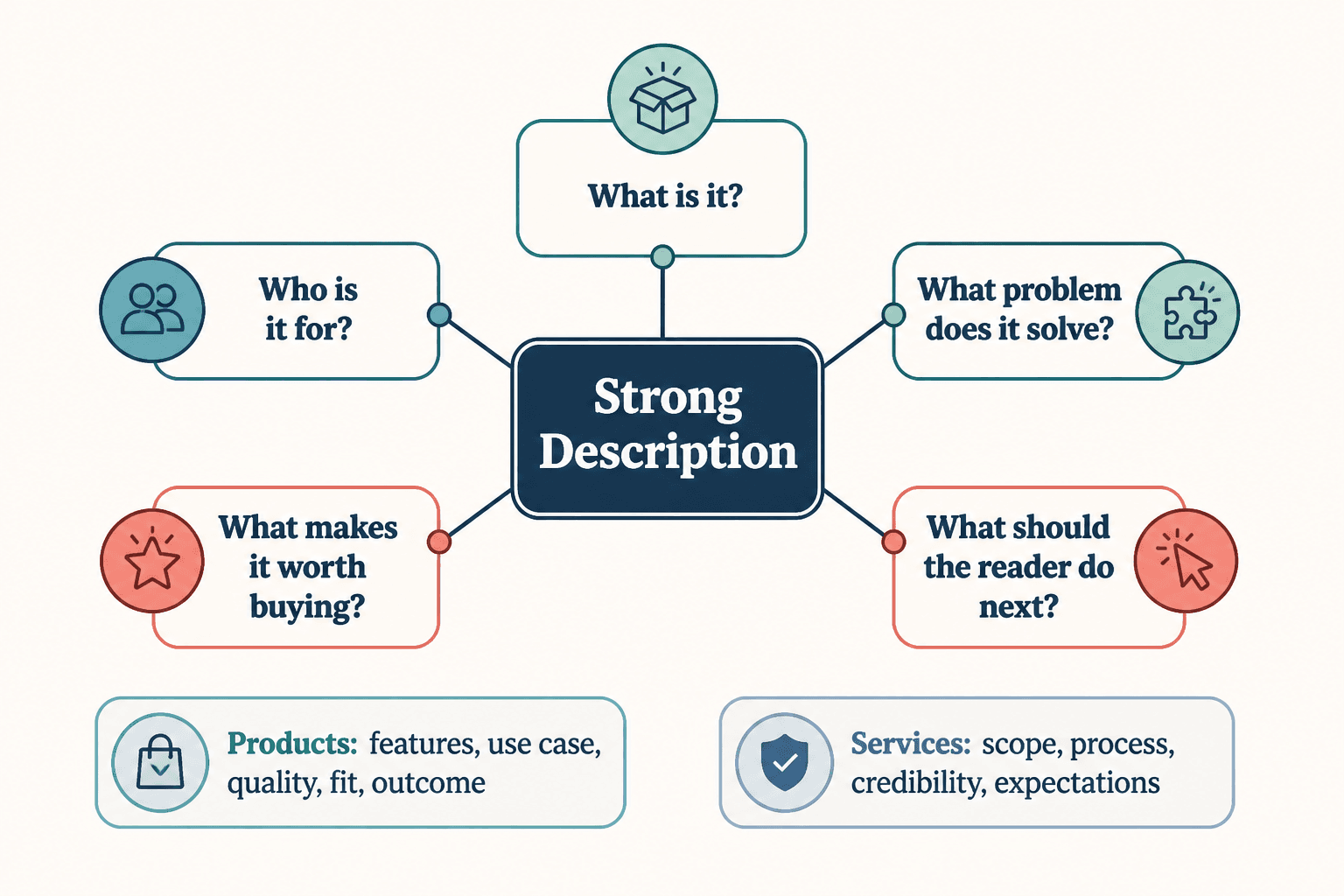
A strong description is not just a block of promotional copy. It is a tiny decision-making tool. It has to do a few jobs at once without sounding like it swallowed a brochure.
- Clarify the offer. The reader should know what it is without decoding jargon.
- Show who it is for. Good descriptions filter as well as attract.
- Explain the result. People buy outcomes, not category labels.
- Reduce doubt. A description should answer the obvious “yes, but…” questions.
- Make the next step obvious. If the reader is interested, the handoff should be easy.
That is true whether the thing being sold is a physical product, a digital product, a service, or a hybrid offer with a few too many moving parts. The shape changes, but the job stays annoyingly similar.
Why creators struggle with product and service descriptions
Most bad descriptions do not start as bad descriptions. They start as notes, assumptions, or internal shorthand that never gets translated into buyer language.
Common failure points:
- Generic wording. “High-quality,” “custom,” “tailored,” and “results-driven” are not explanations. They are wallpaper.
- Feature dumps. Listing everything included can still leave the reader unsure why it matters.
- Hidden audience. If the copy never says who it is for, the reader has to self-qualify by guesswork.
- Mushy framing. The offer is named, but the problem and outcome stay vague.
- Trying to sound premium by becoming abstract. This is the classic move. It rarely helps. The copy gets fancier and less useful at the same time.
Clarity usually beats cleverness because buyers are not grading your tone. They are trying to decide whether the thing in front of them is relevant.
The simple structure that makes descriptions easier to write
The easiest way to write a useful description is to stop improvising from the top down and build it from a few core parts:
- Audience. Who is this for?
- Problem. What are they trying to fix, avoid, or improve?
- Outcome. What changes when this works?
- Mechanism or contents. What is included, and how does it work?
- Proof. What makes this believable?
- Call to action. What should the reader do next?
That sequence keeps the reader oriented. It also keeps the writer from starting with the most boring part first, which is an occupational hazard with product pages and service pages.
A basic template
Use this as a starting point, then adapt it to the offer:
[Offer name] helps [audience] do [specific outcome] without [common frustration or obstacle].
It includes [core components or deliverables] so they can [secondary benefit or business result].
[Proof or credibility detail]
[CTA]
For a product, “includes” may mean ingredients, features, materials, formats, or what comes in the box. For a service, it may mean deliverables, process steps, support, or scope. The structure stays steady; only the nouns get swapped.
How to start product and service descriptions without a weak opening
Bad openings usually fail in one of three ways: they lead with the category label, they start with throat-clearing, or they reach for a vague benefit that could describe half the internet.
Better openings tend to do something much less dramatic:
- name the actual point of the offer,
- put the reader’s problem or goal near the front,
- replace broad adjectives with specifics.
So instead of opening with “premium solutions for modern brands,” the copy might begin with the outcome or friction point the buyer already recognizes. That is not flashy. It is useful, which is usually the better trade.
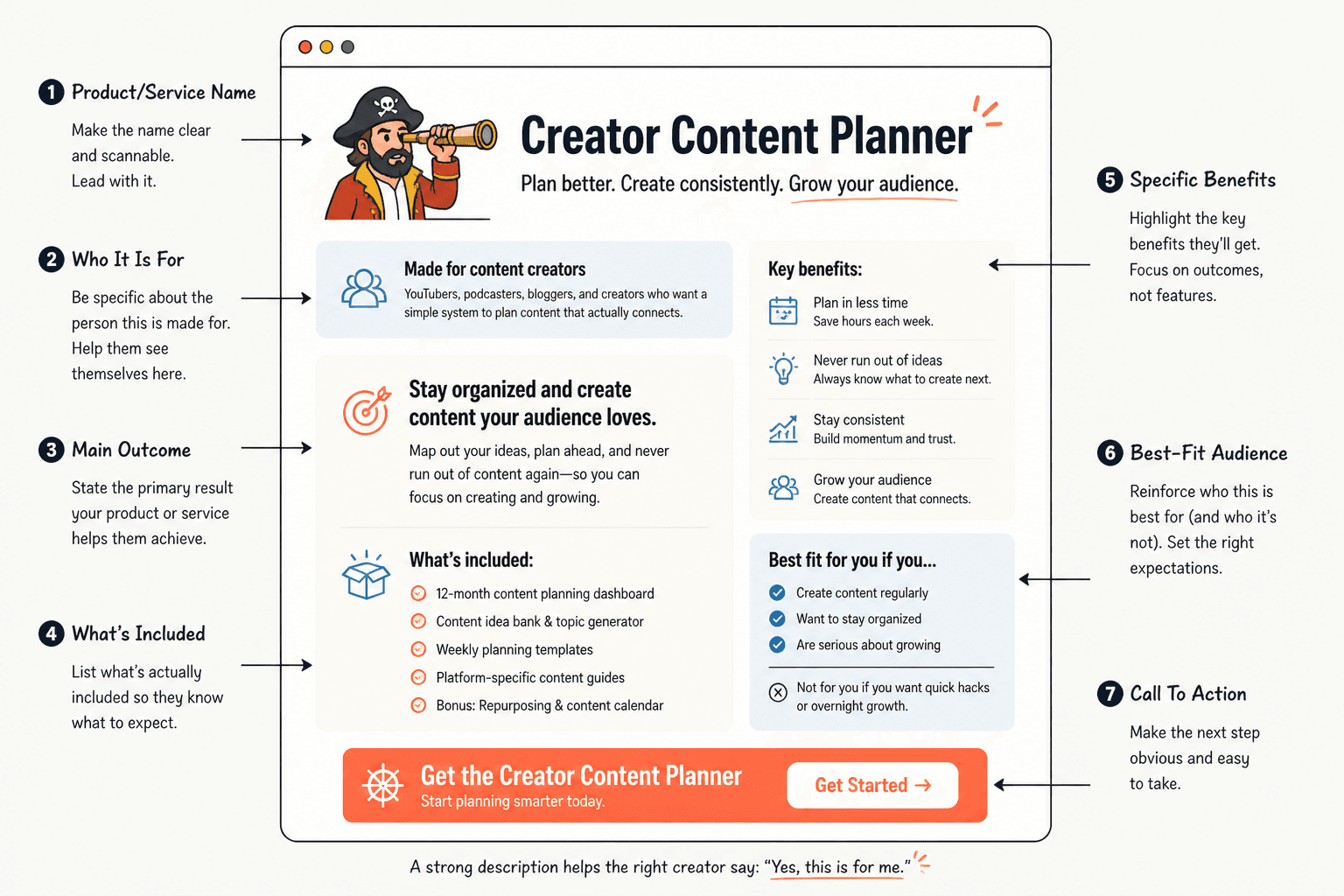
Example: weak version vs stronger version
Weak version:
Our signature brand strategy service is designed to elevate your presence with tailored support, premium insights, and a collaborative approach that helps you grow.
Stronger version:
Our brand strategy service helps small businesses clarify what they sell, who it is for, and how to explain it without vague marketing language. You get a focused messaging framework, positioning guidance, and a practical next-step plan you can actually use.
What changed?
- The stronger version says who it is for.
- It names the real problem instead of hiding behind “elevate” and “premium.”
- It explains the result in plain English.
- It describes the mechanism without overexplaining the process.
That is the pattern worth stealing. Not the specific wording. The structure.
How to improve service framing in product and service descriptions
Service descriptions often go vague in a very specific way: they describe the category before they describe the buyer’s actual problem. That creates mush. The fix is to frame the service around the change the buyer wants.
Try these adjustments:
Start with the real problem, not the category label
“Content strategy consulting” is a label. It is not yet a reason to care. Start with the issue the service solves: inconsistent publishing, unclear messaging, content that gets attention but not action, and so on.
Frame the outcome in plain language
Spell out the result as it would be described in conversation. Not “optimized audience engagement architecture.” More like “clearer messaging that helps the right readers take the next step.”
Explain your mechanism, not just your deliverables
Deliverables matter, but so does the logic behind them. What makes the service effective? What is the method, process, or approach that makes the deliverables useful?
Make the fit clear
The best service descriptions quietly qualify the buyer. They make it obvious who gets the most value, and who probably does not need the offer right now.
Show the stakes of inaction
What happens if the reader keeps doing what they are doing now? Confusion lingers, leads stay soft, traffic leaks away, and the offer remains more admirable than actionable.
How long should product and service descriptions be?
There is no magic word count. A description should be as long as it needs to be to answer the reader’s real questions – and not a word longer.
Length depends on a few things:
- Price and perceived risk. Higher-stakes offers usually need more explanation.
- Familiarity. If the audience already understands the category, you can be shorter.
- Buyer awareness. Less aware readers often need more context.
- Complexity of the outcome. Complicated results need more structure.
- Amount of proof needed. If trust is fragile, the description has to work harder.
A low-friction, familiar product can often be described in a tighter block. A high-consideration service usually needs more room to explain scope, process, fit, and proof. That is not bloat. That is the cost of being understood.
Common mistakes that hurt clarity
These are the usual offenders:
- Leading with vague benefits instead of the actual offer. “Grow your business” is not enough on its own.
- Using broad words that could mean almost anything. If the sentence could sit on 50 other pages, it is probably too soft.
- Describing the process before the buyer understands the value. People need the “why” before the blow-by-blow.
- Writing for yourself instead of the buyer. Internal terminology is efficient for teams and terrible for strangers.
- Hiding the audience. If everyone is the audience, no one is.
- Trying to sound premium by becoming abstract. This one deserves a small trophy for persistence and a large one for bad results.
When a description feels off, the problem is often not that it needs more flourish. It needs fewer layers of fog.
How to rewrite an existing description
If you already have copy, do not start by staring into the blank page and waiting for inspiration to become a business process. Rework what exists.
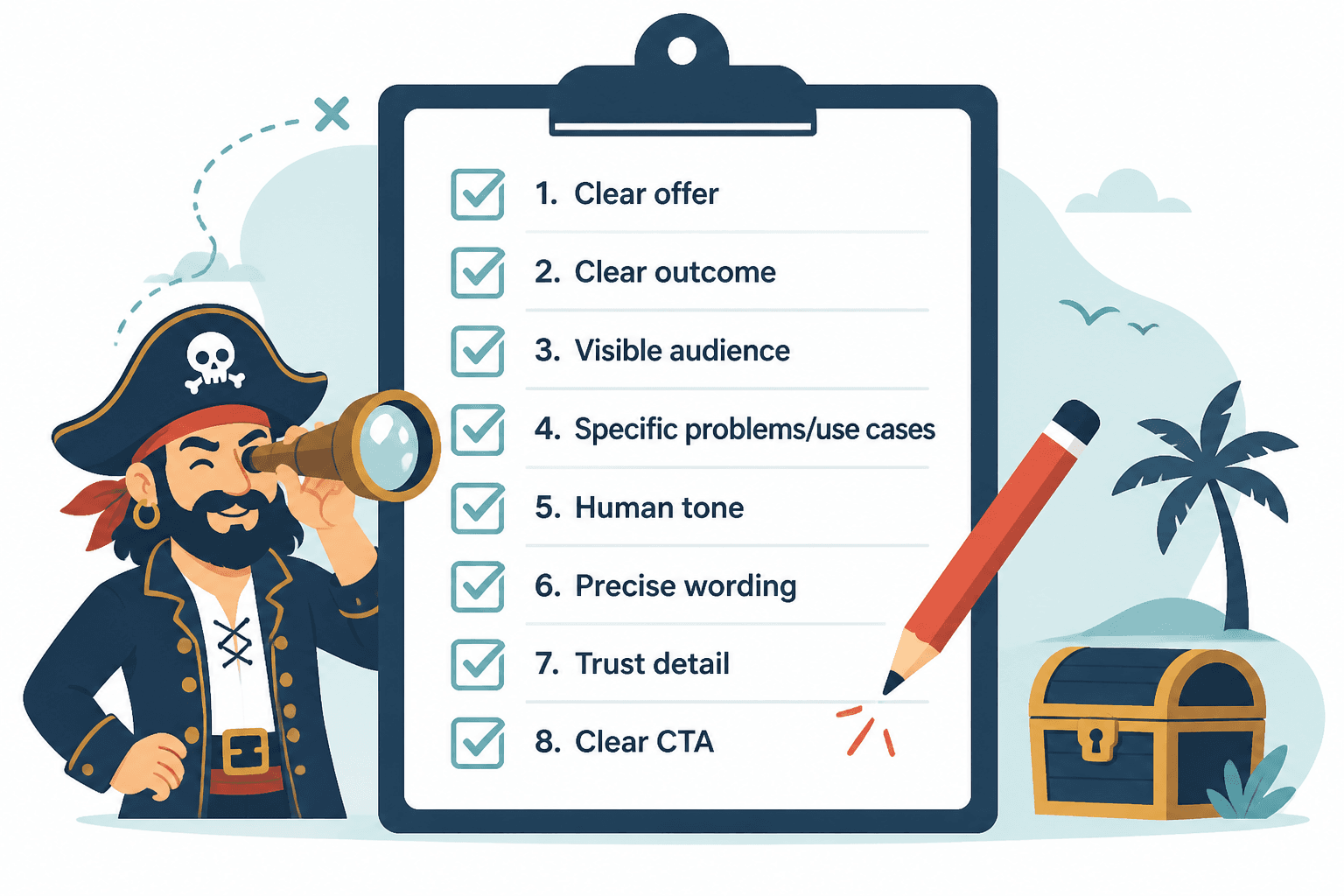
- Identify the offer in one sentence. What is actually being sold?
- Pull out buyer language. Look for phrases that reflect how customers describe their own problem.
- Remove category-first phrasing. Move from label to use.
- Reorder the content. Lead with the point, then the details, then the proof.
- Cut anything that repeats the same idea in fancier clothing.
- Add one believable proof point. Evidence beats self-congratulation.
- End with a clear next step.
If you need a quick gut check, read the description aloud and note where you start improvising. That is usually where the copy stopped being specific.
When short descriptions beat long ones
Short descriptions work best when the offer is already familiar, the page provides context elsewhere, and the decision is low to medium friction. In those cases, less copy can move faster because the reader does not need a guided tour.
Short can also win when the offer has one clear outcome and the audience is scanning rather than studying. Some pages need a clean paragraph, not a small novella with ambition issues.
Longer descriptions are better when the offer is unfamiliar, the decision carries more risk, or the reader needs help understanding fit, process, and proof. The point is not brevity. The point is giving the reader enough clarity to act.
Use the right amount of detail, not the maximum amount
The best product and service descriptions are not the most elaborate ones. They are the ones that let the buyer understand the offer quickly and confidently. That means using enough detail to make the value obvious, enough structure to keep the page moving, and enough restraint to avoid turning the whole thing into a self-important paragraph farm.
If you want to keep refining the system, the parent guide to product and service descriptions is the right place to branch out from here.
For pages that need help at the opening line, see the companion guide on starting product and service descriptions without a weak opening once it is available in this cluster’s structure. Until then, keep the focus on clarity, fit, and a next step the reader can actually see.