
Most creator email sequences are too long for what they are actually trying to do.
That is the uncomfortable bit. People build a 9-email welcome sequence, a 12-email nurture sequence, and a 7-email pitch sequence because longer feels more strategic. More complete. More “serious business.” But in practice, a lot of those emails are just extra laps around the same point.
When short creator email sequences beat long ones, it is usually not because short is magically better. It is because the sequence has a clear job, a clear reader, and enough restraint to stop before it becomes background noise.
If you are a creator, coach, consultant, or solo business owner trying to turn subscribers into readers, readers into leads, or leads into buyers, this matters more than people admit. A shorter sequence can get more replies, more clicks, and more action simply because it respects attention and gets to the point.
Here’s how to tell when short wins, when long still makes sense, and how to build a tighter sequence that does not feel thin or rushed.
If you want the bigger picture, start with the parent guide.
Why short email sequences often work better for creators
Creators are not enterprise software companies with six buying committees and a whitepaper addiction. Most creator businesses sell trust, clarity, expertise, personality, and a reasonably direct next step.
That changes the sequence math.
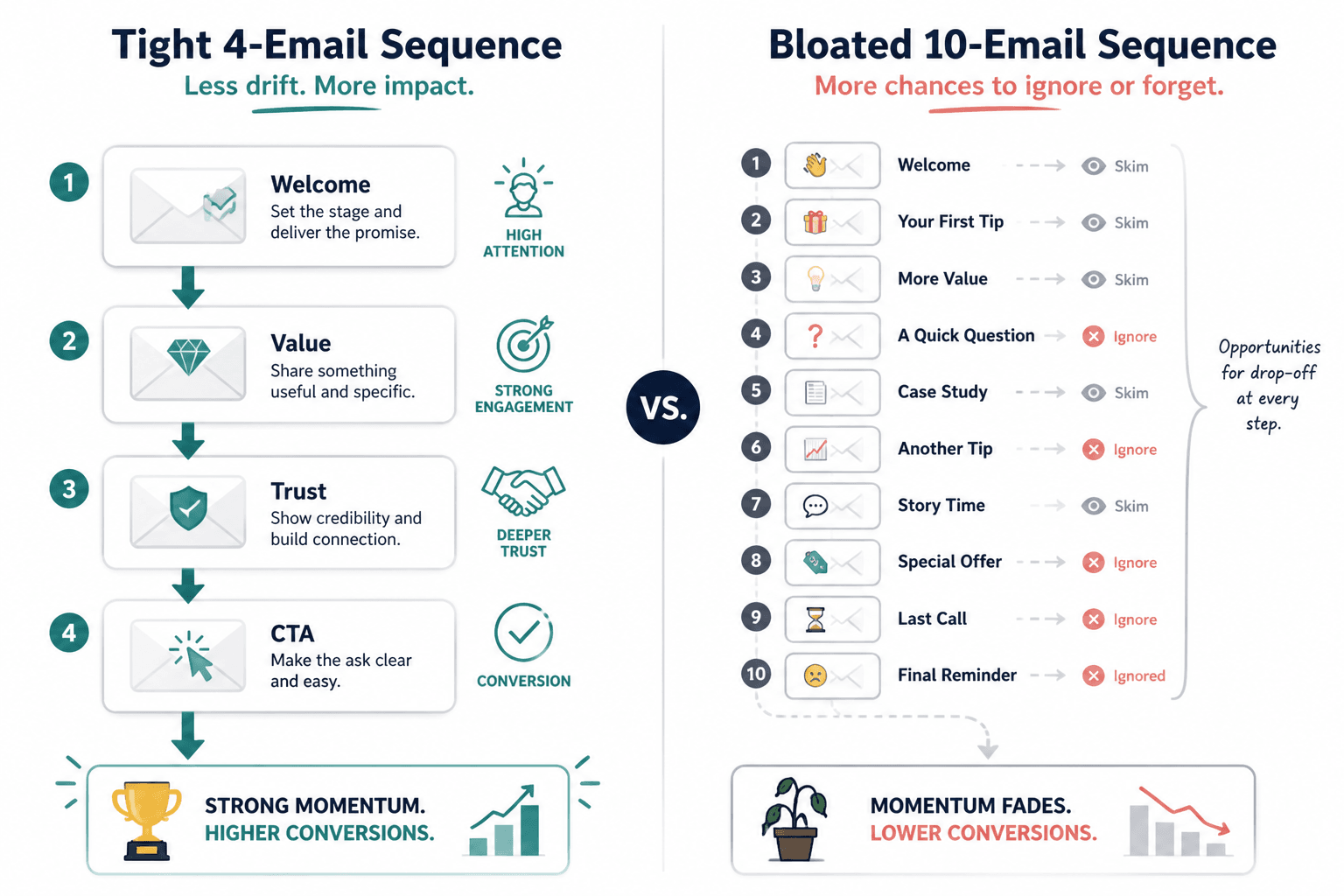
A shorter email sequence often works better because the subscriber does not need a semester-long orientation program. They need to understand who you help, what you help with, why they should trust you, and what to do next. If you can do that in three to five strong emails, seven more probably will not improve things. They might just dilute the good parts.
There is also a simple reality here: inbox patience is not exactly thriving. The more emails you send in a sequence, the more chances you create for people to ignore, skim, forget, or mentally file you under “probably useful, but not now.” That folder is where momentum goes to die.
Short sequences create tighter momentum. One idea leads to the next. The reader can feel the shape of it. There’s less drift, less filler, and fewer “why am I still getting this?” moments.
When short creator email sequences beat long ones
Short does not win all the time. But it wins a lot when the goal is simple and the offer does not need a dramatic courtroom defense.
1. When the sequence has one clear job
The shorter the objective, the shorter the sequence can be.
If the job is:
- welcome a new subscriber
- deliver a lead magnet
- introduce your positioning
- get people to book a call
- move readers to one core offer
- restart engagement with quiet subscribers
…you often do not need a sprawling sequence. You need a crisp one.
A lot of weak sequences are not too short. They are too confused. They are trying to welcome, teach, nurture, sell, tell a life story, prove authority, and become your best friend by email four. Pick a lane.
2. When the offer is simple and the trust gap is small
If you are selling a low-friction offer, a paid template pack, a strategy session, a workshop, a small productized service, or a clear next step, a shorter sequence often performs better because the reader does not need endless warming up.
They need enough confidence to act. Not eight extra emails pretending to be nurture when they are really just stalling.
This is especially true when your audience already came in warm. Maybe they found you through content, a podcast guest spot, a referral, or a social platform where they have already been reading your work. In that case, the sequence should continue the conversation, not restart from the invention of email.
3. When subscriber intent is high
Intent changes everything.
If someone opts in for something specific like:
- a pricing guide
- a workshop waitlist
- a free consultation
- a mini training on one exact problem
- a tool comparison
…they are not asking for a long scenic route. They want the useful thing, some clarity, maybe a bit of proof, and a next action that makes sense.
High-intent subscribers are often poorly served by long sequences because long sequences delay the outcome they were already leaning toward.
4. When your longer sequence is padded with “nice” emails
You know the ones.
- The inspirational email with no point
- The “just checking in” email that checks in on nothing
- The story email that never lands anywhere useful
- The lesson email that says something mildly true in 700 words
- The pitch email disguised as a casual note
If removing three emails improves your sequence, those emails were not building trust. They were clogging the pipe.
This is one reason short creator email sequences beat long ones so often. They force editorial discipline. You cannot hide weak thinking inside a short sequence. Every email has to earn its place.
5. When you want replies, not just opens
Shorter sequences often drive more replies because they ask less of the reader before making a human ask. You are not dragging them through a grand automated tunnel first. You are saying something useful, relevant, and timely, then giving them an easy way to respond.
For creators selling expertise, replies are gold. They reveal objections, language, pain points, and buying signals. A short sequence can get to that conversation faster.
Signs your long sequence should probably be shorter
If you are not sure whether your sequence is too long, do not start by asking how many emails it has. Start by asking what each email is doing.
- Several emails repeat the same core argument with slightly different wallpaper
- The offer does not appear until very late for no good reason
- Open rates fall off sharply after the first few emails and never recover
- Click rates are concentrated in the first half
- The later emails feel “supportive” but not necessary
- You would struggle to explain why email 8 exists
- The sequence reads like content repurposing with no actual sequence logic
That last one gets people a lot. A sequence is not just a pile of decent emails standing near each other. It needs progression. If one email could vanish and nothing changes, that email is furniture.
What a strong short sequence usually includes
A short sequence still needs range. “Short” does not mean abrupt, robotic, or weirdly undercooked. It means focused.
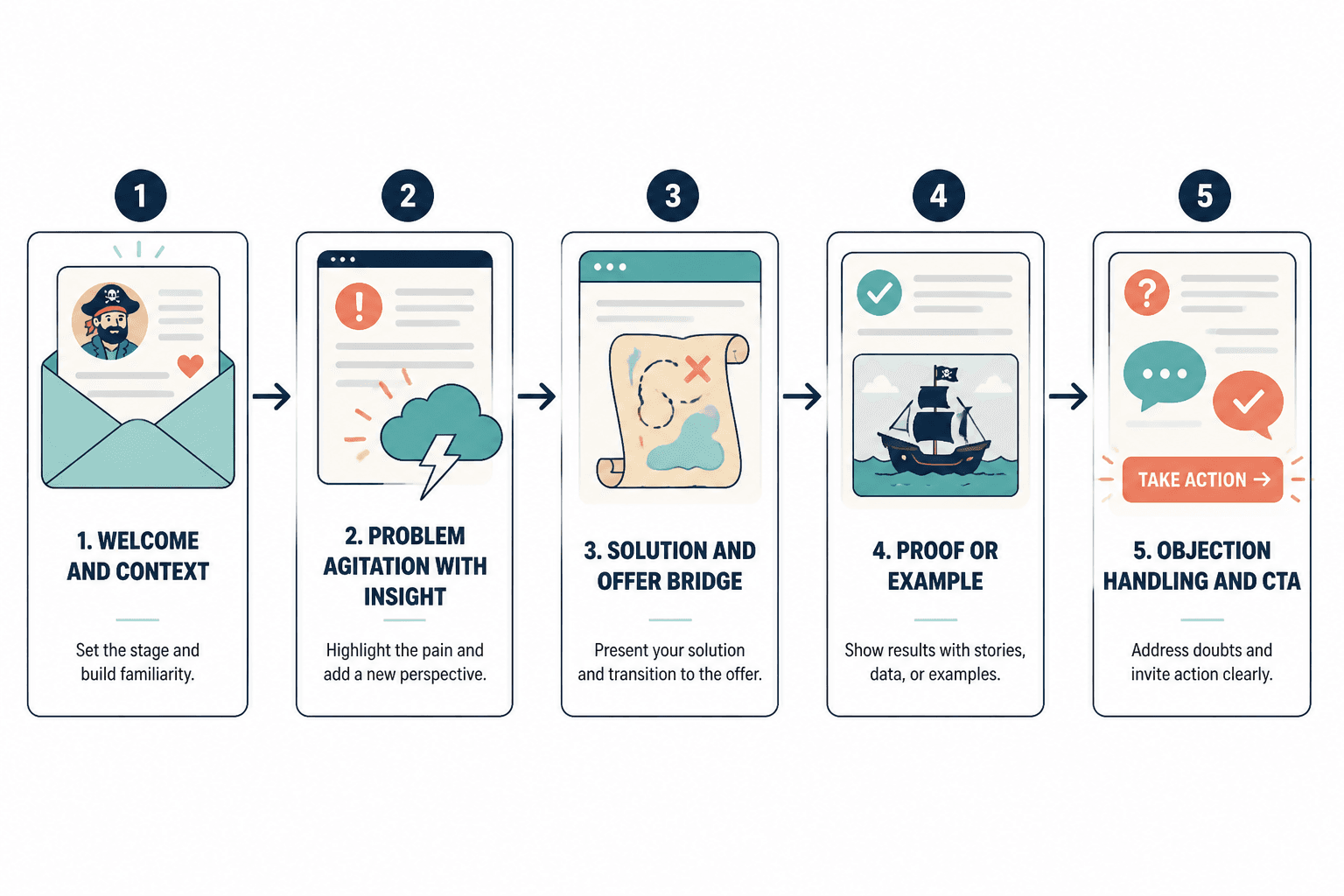
For many creators, a solid short sequence has 3 to 5 emails with distinct roles.
| Job | What it might include | |
|---|---|---|
| 1 | Deliver and orient | The promised resource, what to expect, one clear benefit, soft next step |
| 2 | Build relevance | Common mistake, sharper framing, why the problem happens |
| 3 | Build trust | Case study, proof, useful example, client pattern, small win |
| 4 | Present the next step | Offer, consultation, resource, reply prompt, clear CTA |
| 5 | Handle hesitation | Objection answer, contrast, who it is for, final invitation |
Not every sequence needs all five. Some only need three. But each email should advance the reader, not just keep the automation busy so it feels loved.
Short does not mean shallow
This is where people get twitchy. They hear “short sequence” and assume it means less trust-building, less teaching, and fewer chances to convert. Sometimes the opposite is true.
A short sequence can feel deeper because it is denser. Instead of spreading one useful insight across three polite emails, you put the sharp point where the reader can actually see it. Instead of teasing your offer for a week and a half, you connect the problem to the solution while the problem still feels alive.
Good short sequences are not thin. They are compressed. That is different. Compression keeps the useful parts and cuts the email equivalent of packing peanuts.
If your sequence gets shorter, each email has to get better. That is the trade. Fewer sends. More precision.
When long sequences still make sense
Not every long sequence is bloated. Some are genuinely earned.
Longer creator email sequences can work well when:
- the offer is expensive or high-consideration
- the audience is cold and needs more context
- the buying decision involves stronger objections
- you are teaching a layered concept over time
- the sequence is segmented based on behavior
- you are mixing authority-building with multiple proof points
For example, if you sell a premium coaching program, a strategic service package, or a substantial B2B offer, a longer sequence may be warranted. But even then, longer should come from complexity, not habit.
If every extra email adds a new and necessary job, fine. If it just says the same thing in a friendlier cardigan, not fine.
How to shorten a creator email sequence without hurting performance
If you have a long sequence already, you do not need to burn it down and start narrating your business into a blank document. Trim it with a little structure.
1. List every email and its actual job
Use one line per email. Be blunt.
- Delivers freebie
- Explains my angle
- Shows client example
- Pitches consultation
- Answers “do I need this?”
If you cannot identify the job quickly, the email probably does not have one.
2. Merge overlapping emails
If two emails both build trust, combine them. If three emails all teach slight variations of the same point, keep the strongest one. If one email exists only to “warm people up,” ask what specific doubt or action it addresses. Vibes are not a sequence strategy.
3. Cut throat-clearing
A lot of email bloat lives inside the emails, not just in the count.
Cut lines like:
- “I hope you’re having a great week”
- “I just wanted to pop into your inbox”
- “You may or may not know”
- “I thought I’d share a few thoughts”
Start closer to the point. Readers do not need a warm-up jog every time.
4. Bring the CTA forward if the reader is ready earlier
This is a common creator mistake: hiding the actual next step until the end because you are trying not to be “salesy.” Fine in theory. Expensive in practice.
If your subscriber has enough context by email two or three, give them a real CTA there. You can still follow up for the slower readers. But do not make ready people wait because you are managing your own discomfort.
5. Keep the strongest proof, not all the proof
One sharp case study beats four soft testimonials stacked like decorative pillows. Choose proof that reduces risk and increases clarity. Then move on.
A simple short sequence template for creators
Here is a practical 4-email structure that works well for many creator businesses.
Email 1: Deliver the thing and frame the problem
Send the resource. Tell them what it helps with. Point at the real issue underneath it.
You grabbed this because you want better leads from your content. Fair. But the bigger issue usually is not volume. It is that your content attracts attention without creating a clear next step.
Email 2: Teach one useful idea that changes how they see the problem
Not five ideas. One. Give them a better lens.
Most nurture content fails because it tries to be likable before it becomes relevant. Relevance first. Personality can ride shotgun.
Email 3: Show proof or a concrete example
Use a client pattern, mini case study, before/after, or specific mistake you see often.
One consultant cut her welcome sequence from 8 emails to 4, moved the booking CTA to email 3, and got more replies because the sequence stopped circling and started directing.
Email 4: Make the next step obvious
Ask for the reply, click, booking, application, or sale. Say who it is for. Say why now makes sense. Keep it clean.
If you want help tightening your content-to-email path, you can book a strategy call here. If the freebie helped but you are still not sure what to fix first, just reply with “sequence” and I’ll point you in the right direction.
Before and after: long sequence logic versus short sequence logic
Here is what this often looks like in the wild.
| Long sequence version | Shorter, stronger version |
|---|---|
| Email 1: welcome | Email 1: welcome + resource + framing |
| Email 2: my story | Email 2: useful reframe on the problem |
| Email 3: mindset lesson | Email 3: proof + example + CTA |
| Email 4: another story | Email 4: objection handling + final invitation |
| Email 5: tip roundup | |
| Email 6: case study | |
| Email 7: soft pitch | |
| Email 8: direct pitch |
The shorter version does not lose the important parts. It removes delay.
How to decide the right sequence length for your business
The bigger point is simple: clearer structure and clearer writing make the piece more useful. That is usually what makes the ending land better too.
Email sequences work better when each message has one clear role and the progression feels natural. Better sequencing usually beats more aggressive copy.