
Most homepage value propositions are not bad because the person lacks talent. They are bad because they are trying to sound professional instead of trying to be clear.
That is how you end up with homepage copy like “Helping visionary entrepreneurs elevate their brand through authentic storytelling and strategic growth.” Which sounds polished right up until you realize it could belong to 40,000 other websites and says almost nothing.
If you need Simple Homepage Copy Value Props Templates for Busy Creators, the goal is not to find a fancier sentence. It is to build a clear promise fast: who you help, what you help them do, and why they should care enough to keep reading.
This article will help you write a homepage value proposition that is simple, specific, and usable without needing a three-hour brand workshop, a mood board, or a copy deck full of beige fog. You will get practical templates, examples, rewrite patterns, and a few rules for not sounding like a generic internet professional.
For the full path around this topic, head to the parent guide.
What a homepage value proposition actually needs to do
Your homepage value proposition is not there to impress people with your vocabulary. It has a much less glamorous job.
It needs to answer, quickly:
- Who is this for?
- What do you help with?
- What outcome can I expect?
- Why should I believe you or keep reading?
That is it. Not your full life story. Not every service. Not a TED Talk in sentence form.
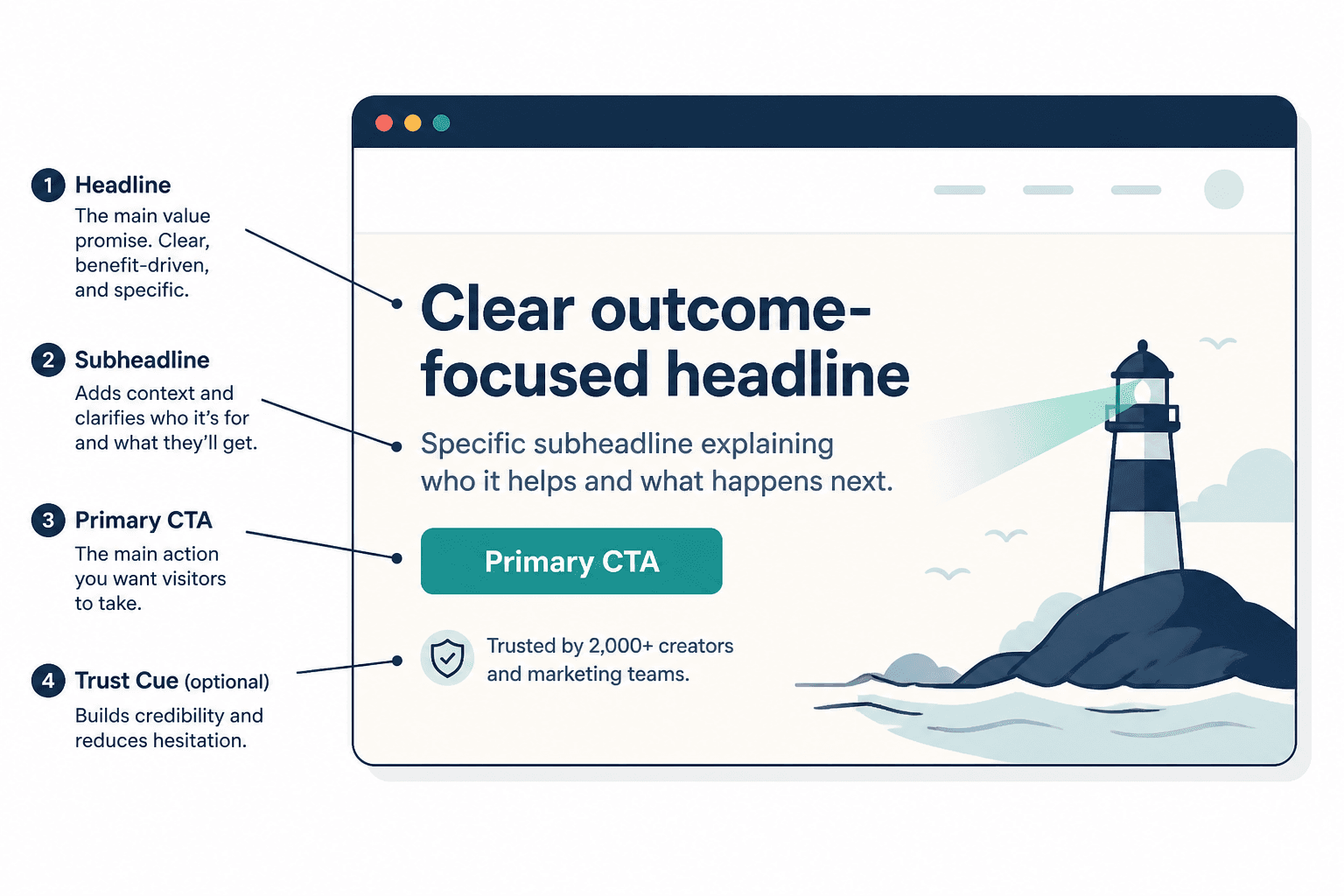
For busy creators, consultants, coaches, freelancers, and solo founders, a strong value proposition usually sits in the hero section and does the heavy lifting before anyone scrolls. If the top of the page is vague, the rest of the page has to work way too hard.
If you want a broader walkthrough on how the whole page fits together, read this homepage copy guide for creators who want better results. For now, we are focusing on the sentence or short set of lines that makes the homepage make sense fast.
Why most value propositions fail
Before the templates, it helps to know what usually goes wrong.
- They are too vague. “Grow your business with confidence” could mean anything.
- They lead with the creator, not the reader. People care about themselves first. Reasonable, honestly.
- They try to sound premium instead of useful. Fancy words often hide weak positioning.
- They stack too many audiences together. If you help creators, startups, nonprofits, executives, and wellness brands, your copy gets muddy fast.
- They promise process, not outcome. “Through strategic coaching and personalized systems” is not the part your reader wants first.
The fix is not to become robotic and formulaic. The fix is to become clearer and more specific. A simple value proposition can still have personality. It just should not make people do interpretive dance to figure out what you mean.
The simple structure that works for most creators
If you are busy and want something functional, start here:
I help [specific audience] do/get [specific result] without [pain, friction, or common bad alternative].
That structure works because it forces clarity. It does not let you hide behind “transformative solutions.” Tragic, I know.
You do not have to use that exact wording on your homepage, but it is a strong drafting tool. Once you have the core promise, you can make it sound more natural.
A quick example
Weak version:
I help purpose-driven brands show up online with authenticity and impact.
Better version:
Homepage copy for creators and service businesses who need clearer messaging, stronger trust, and more inquiries without sounding fake.
The second one gives us an audience, a service area, a result, and a tone fit. Much easier to work with.
Simple Homepage Value Proposition Templates for Busy Creators
Here are the templates. These are meant to be adapted, not copied word for word unless your dream is to sound suspiciously like everyone else using templates.
1. The direct outcome template
Helping [audience] get [result] with [service/product/category].
Best for: simple offers, fast clarity, practical service businesses.
Examples:
- Helping coaches turn messy expertise into clear homepage copy that gets more consult requests.
- Helping creators build simple websites that explain what they do and convert curious visitors into leads.
- Helping freelancers package their services so prospects understand the value fast.
2. The “for people who are tired of the usual mess” template
[Service/category] for [audience] who want [result] without [annoying problem/common bad approach].
Best for: crowded markets where you need contrast.
Examples:
- Homepage copy for creators who want more leads without sounding like a webinar funnel from 2018.
- Brand messaging for consultants who need sharper positioning without hiring a full agency.
- Website strategy for solo founders who want clarity without a six-week brand therapy process.
3. The audience + promise template
[Result] for [specific audience].
Best for: punchy headlines paired with a supporting subheadline.
Examples:
- Clearer homepage copy for busy creators.
- Better website messaging for service-based founders.
- Stronger positioning for coaches with too many ideas and one homepage.
This one is short, but it usually needs a subheadline underneath it to do the real explanatory work.
4. The problem-to-outcome template
Turn [current frustrating state] into [better outcome].
Best for: clear before-and-after positioning.
- Turn confusing homepage copy into clear messaging that earns trust fast.
- Turn scattered expertise into a website people actually understand.
- Turn polite traffic into qualified inquiries with sharper homepage messaging.
5. The credibility-led template
[What you do] for [audience], backed by [proof, experience, or credibility marker].
Best for: people with meaningful proof who should use it.
- Conversion copy for online experts, backed by years of client messaging strategy and real-world testing.
- Homepage audits for creators, built from reviewing hundreds of service-based websites.
- Brand messaging for consultants, shaped by launch, sales, and client-conversion experience.
Use proof carefully. “Trusted by visionary leaders” is not proof. It is filler wearing a blazer.
6. The simple claim + clarifier template
[Short claim headline]
[One-sentence clarifier with audience, outcome, and service]
Best for: cleaner hero sections.
Example:
Make your homepage make sense.
Clear homepage copy and messaging templates for creators, coaches, and solo businesses that need more trust and better conversion.
How to choose the right template
Do not pick the template that sounds smartest. Pick the one that matches what your reader needs to understand first.
| If your offer has this problem | Use this template style |
|---|---|
| People do not understand what you do | Direct outcome template |
| Your market is crowded and samey | “Without the usual mess” template |
| You want a cleaner headline | Audience + promise or simple claim + clarifier |
| Your value is transformation | Problem-to-outcome template |
| You have useful proof | Credibility-led template |
If your homepage already has a strong visual design but weak words, the issue is usually not layout. It is that the copy is too broad. That is where these templates help. They narrow the claim so the visitor can orient themselves quickly.
If you need more hero-specific examples, this collection of homepage copy hero section examples creators can adapt fast will help.
A fast fill-in method for writing your own
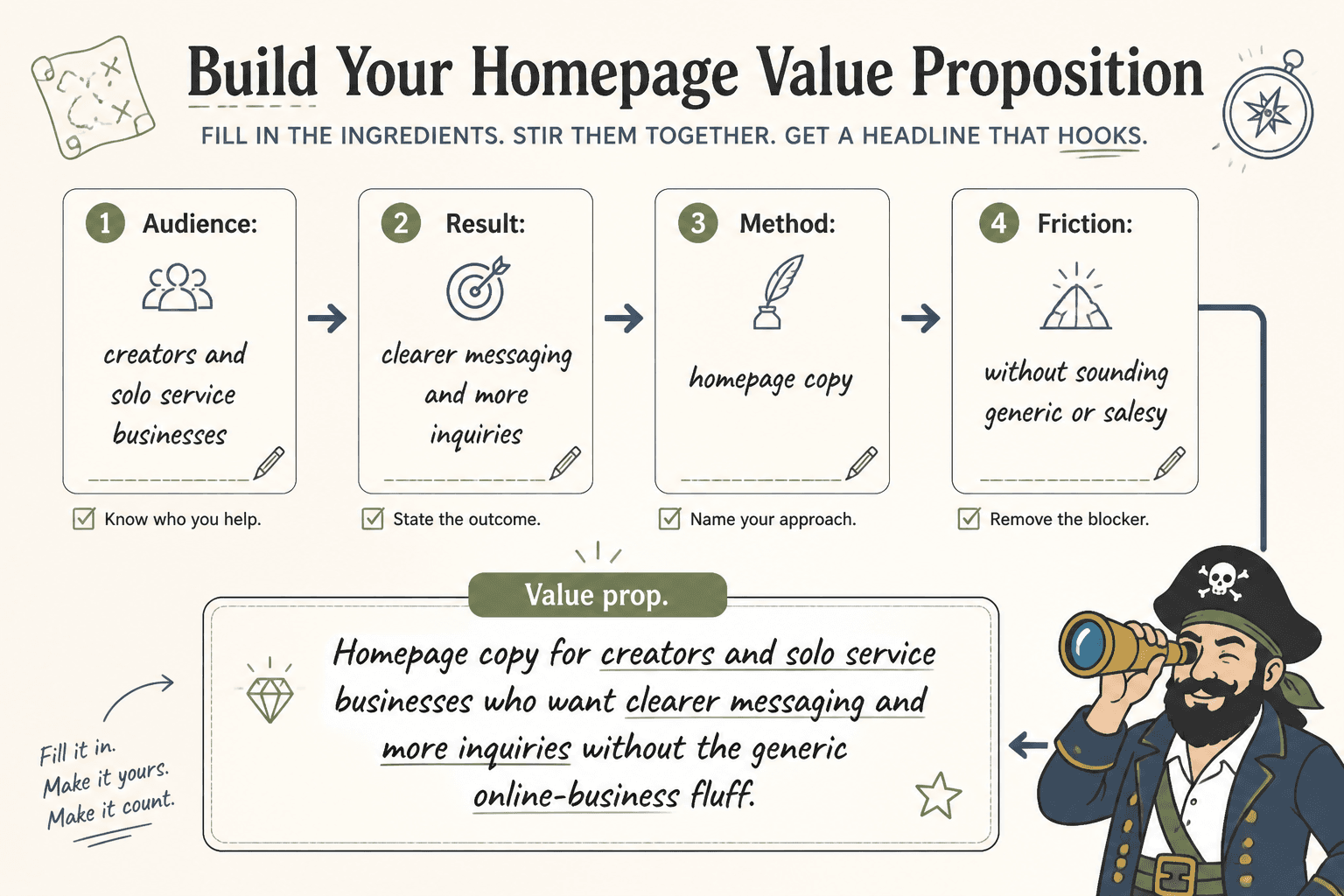
If templates still feel weirdly abstract, use this 5-part drafting method.
- Name the audience. Not “business owners.” More like “coaches,” “creators,” “consultants,” or “service-based founders.”
- Name the main result. More leads, clearer messaging, stronger trust, better conversion, faster understanding.
- Name the method or category. Homepage copy, messaging strategy, website audits, positioning, design, templates.
- Name the friction or bad alternative. Without sounding fake, without overcomplicating it, without a full rebrand, without vague messaging.
- Cut anything that sounds inflated. If you would never say it to a smart client on a Zoom call, probably cut it.
Here is what that can look like in practice.
Draft ingredients:
- Audience: creators and solo service businesses
- Result: clearer messaging and more inquiries
- Method: homepage copy
- Friction: without sounding generic or salesy
Turned into a value prop:
Homepage copy for creators and solo service businesses who want clearer messaging and more inquiries without the generic online-business fluff.
That is already usable. Not poetic. Not trying to win a literary prize. Just clear, helpful, and on the right job.
Before-and-after rewrites
Sometimes it is easier to see the shift than to talk about it. Here are a few common homepage lines and cleaner rewrites.
Rewrite 1: vague empowerment language
Before: I help ambitious entrepreneurs unlock their brand potential through authentic messaging.
After: Brand messaging for coaches and creators who need clearer positioning, better website copy, and a brand people understand faster.
Why it works: less fog, more function.
Rewrite 2: polished but empty
Before: Strategic storytelling solutions for purpose-driven businesses ready to scale.
After: Homepage and messaging support for service businesses that want to explain their value clearly and turn more visitors into leads.
Why it works: “strategic storytelling solutions” tells us almost nothing. The rewrite tells us the offer category and the actual outcome.
Rewrite 3: trying too hard to sound premium
Before: Elevated digital experiences for visionary founders.
After: Clear website messaging and conversion-focused copy for founders who are tired of beautiful sites that still confuse people.
Why it works: tension, clarity, relevance.
What to add under your value proposition
A homepage value prop rarely works best alone. Usually it needs support right under it. Think of the value prop as the headline idea, and the supporting line as the explanation that helps the right person say, “Yes, this is probably for me.”
Good support lines often include one or two of these:
- Who specifically you work with
- What kind of problem you solve
- What the process leads to
- A trust marker or proof point
- A simple next step
Example hero stack:
Clear homepage copy for busy creators.
Templates, strategy, and conversion-focused messaging for creators, coaches, and solo businesses that need their website to explain the value faster and earn more trust.
CTA: See examples / Work with me
The bigger point is simple: clearer structure and clearer writing make the piece more useful. That is usually what makes the ending land better too.