
Most lead magnets do not fail because the information is bad.
They fail because they sound like they were assembled by a funnel intern, a copy template from 2019, and a chatbot trained entirely on webinar landing pages. The result is technically “professional,” but nobody wants to read it. It feels pushy before it has earned trust, polished in the wrong places, and weirdly detached from how real people actually talk.
If you want to know how to write lead magnets without sounding salesy or robotic, the fix is not to make them less strategic. It is to make them more human, more specific, and more useful. A good lead magnet should feel like a smart shortcut, not a bait-and-switch in a nicer font.
Here’s how to write lead magnets people actually want, how to make them persuasive without getting needy, and how to avoid the stiff “marketing voice” that makes even good ideas feel slightly suspicious.
For the main guide behind this topic, visit the parent guide.
Why so many lead magnets sound fake in the first place
Because people write them backward.
They start with the opt-in goal, then the pitch, then the positioning, and only vaguely remember that a human being is supposed to download the thing. So the copy ends up stuffed with phrases like “unlock,” “transform,” “discover,” and “secrets” while saying almost nothing concrete.
That is how you get lead magnets called things like The Ultimate Success Blueprint for Explosive Growth. Which sounds important right up until you realize it could be about literally anything.
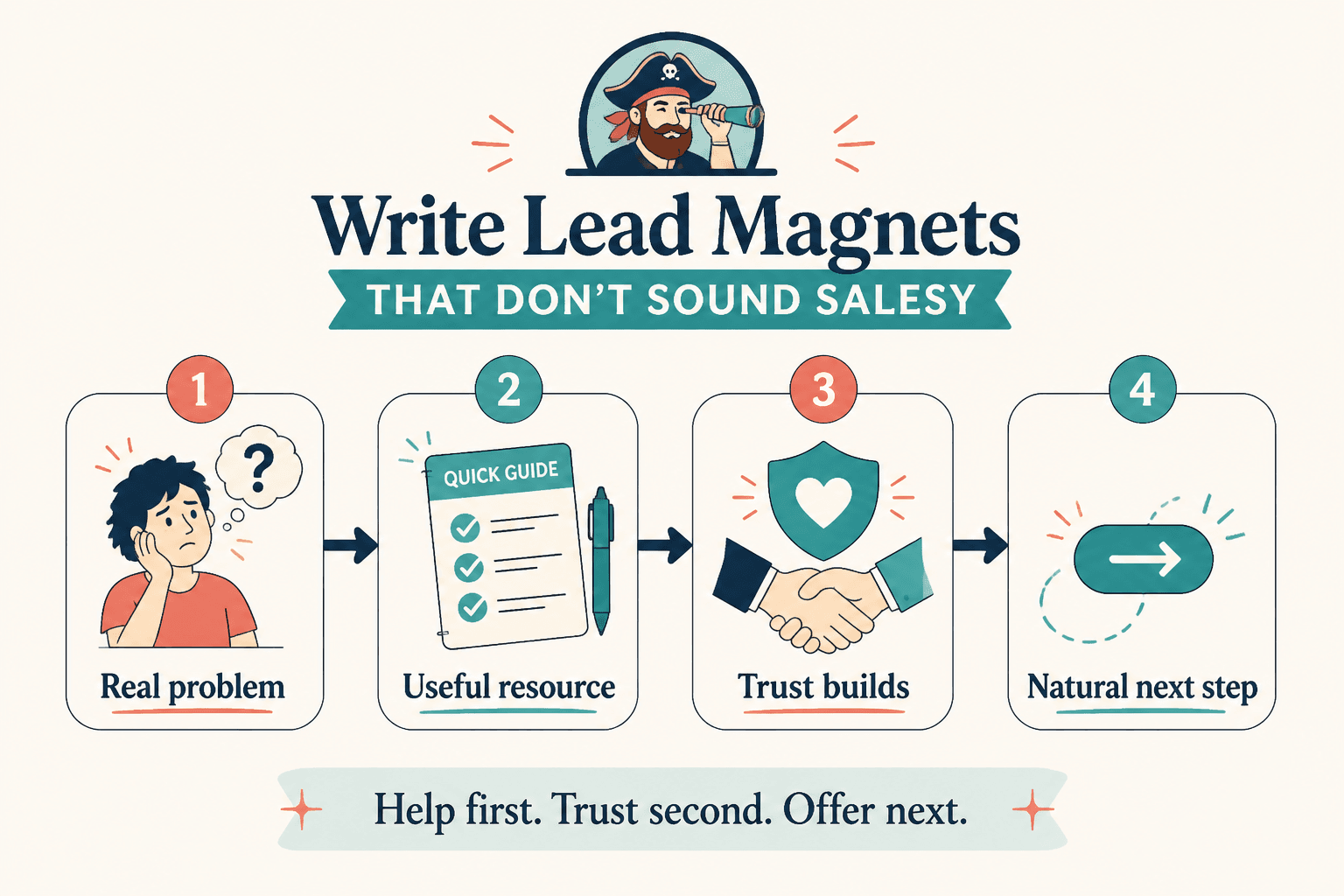
The better approach is simpler:
- Start with a real problem your audience wants solved
- Offer a genuinely useful next step
- Describe it in plain English
- Make the value obvious fast
- Leave the heavy sales energy for later, if it is earned
A lead magnet is not your whole funnel in miniature. It is the first proof that your stuff is worth paying attention to.
What a non-salesy lead magnet actually does
A strong lead magnet does three jobs at once without making a big theatrical scene about it.
- It solves a narrow, relevant problem
- It shows how you think
- It makes the next step feel natural
That middle part matters more than people think. Your lead magnet is not just information. It is positioning. It teaches the reader something useful, sure, but it also quietly tells them what kind of expert you are. Practical. Clear. Strategic. Sharp. Or, unfortunately in some cases, vague and addicted to filler.
The goal is not to cram your entire worldview into a PDF. The goal is to create enough value and clarity that the reader thinks, “Okay, this person gets the problem and is not wasting my time.” That reaction is a lot more useful than “Wow, this sure contains many pages.”
How to write lead magnets without sounding salesy or robotic: the core rules
1. Pick one specific problem, not a whole category of suffering
The fastest route to robotic copy is trying to sound broadly relevant to everyone. Broad lead magnets force broad language. Broad language gets vague. Vague gets sterile.
Bad: “A complete guide to growing your business online”
Better: “A 10-point homepage checklist for consultants who get traffic but too few inquiries”
One is a fog bank. The other is a thing.
If you want your lead magnet to sound human, define the reader, the problem, and the outcome tightly enough that the copy can be concrete. Specificity does a lot of the trust-building work for you.
2. Write like you are helping, not performing expertise
A lot of lead magnet copy sounds robotic because it is trying very hard to appear authoritative. So instead of saying what the thing helps with, it starts speaking in inflated consultant dialect.
For example:
- “Optimize your messaging ecosystem”
- “Leverage strategic alignment”
- “Implement high-converting frameworks”
No one talks like this unless they are trying to keep you from asking follow-up questions.
Write like a capable person explaining something useful to another capable person. That usually means:
- Shorter words
- Clearer outcomes
- Fewer claims
- More direct phrasing
- Actual examples
Instead of “a proven framework to optimize audience engagement,” say “a simple post structure that makes more people read past line one.” It is plainer, sharper, and less allergic to reality.
3. Promise a useful win, not a life transformation
The more dramatic your promise, the more careful readers get. Fair enough. They have seen things.
A lead magnet should usually offer a practical improvement, shortcut, or decision-making tool. Not total reinvention. Save the giant promises for people who enjoy refund requests.
Stronger promise angles:
- Save time
- Avoid a mistake
- Make a hard task simpler
- Get faster clarity
- Improve one result
- See examples before doing it alone
That kind of promise feels grounded. Which is another way of saying believable.
4. Use real language in the title and description
Your lead magnet title is where robotic writing often strolls in wearing expensive shoes. If the title sounds like a keynote slide, the reader expects fluff.
Compare these:
- Weak: The Visibility Accelerator Method
- Better: 25 LinkedIn post ideas for consultants who have run out of things to say
- Weak: Client Attraction Blueprint
- Better: The 7-page guide to turning profile views into qualified discovery calls
- Weak: Magnetic Messaging Framework
- Better: A messaging worksheet to help you explain what you do without sounding vague
The better titles tell the reader what the thing is, who it is for, and what it helps them do. Very little mystery. That is fine. Lead magnets are not movie trailers.
5. Show the contents so people do not have to guess
One of the easiest ways to make a lead magnet feel trustworthy is to stop being coy about what is inside it.
Instead of saying:
Get instant access to my exclusive framework.
Say:
You’ll get a 5-part worksheet that helps you tighten your positioning, write a clearer bio, and fix the two lines on your homepage that are probably doing nothing.
Specific contents lower friction. They also make your lead magnet feel more substantial without you needing to yell about its value.
People are much more likely to opt in when they know what they are opting in for.
6. Stop stuffing every line with persuasion tricks
Urgency. Curiosity. authority. exclusivity. scarcity. social proof. emotional contrast. “No fluff.” “No BS.” “Finally.” “At last.” “Revealed.”
Used lightly, some of that can help. Used all at once, it feels like the copy is trying to pick your pocket.
If your lead magnet needs six persuasion levers just to sound appealing, the offer probably is not clear enough yet.
Usually, this works better:
- Name the problem clearly
- Describe the resource plainly
- Show the result honestly
- Give a low-friction next step
Good copy does persuade. It just does not look desperate while doing it.
A simple structure for lead magnets that feel human
If you tend to either undersell or over-polish, use this structure. It keeps things useful without turning weirdly corporate.
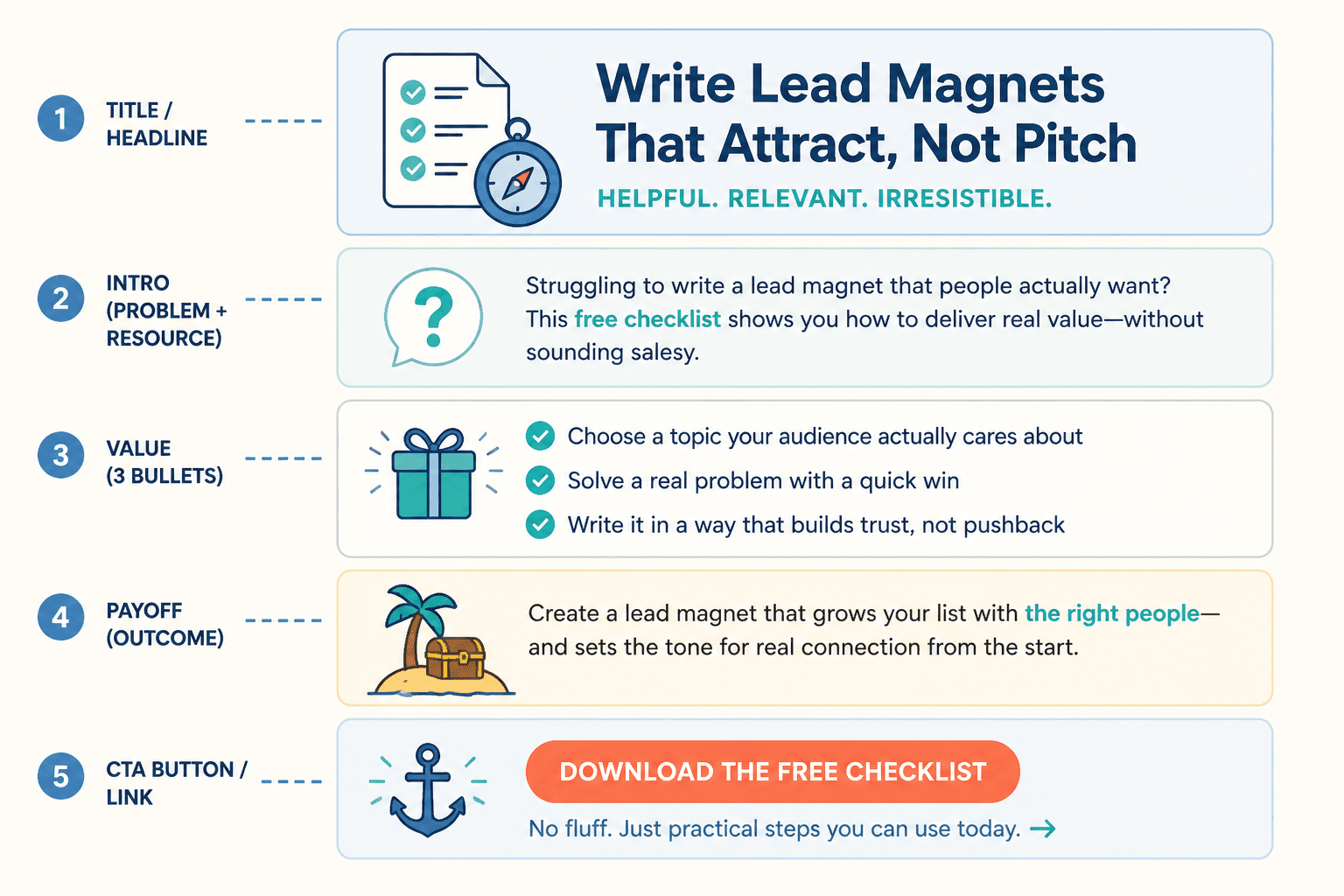
The 5-part structure
- Name the specific problem
What is frustrating, messy, slow, or confusing right now? - Offer a clear resource
Checklist, template, guide, cheat sheet, mini-training, swipe file, worksheet, calculator, audit, examples. - Describe what is inside
Not vaguely. Actually say what they get. - Explain the payoff
What becomes easier, clearer, faster, or better? - Give a calm CTA
No hard shove. Just tell them what to do next.
That is enough for most lead magnet landing pages, popups, profile links, pinned posts, or promo captions.
Here is a stripped-down template:
If you are struggling with [specific problem], this [resource type] will help you [practical outcome]. Inside, you’ll get [specific contents]. It is designed to help you [benefit] without [common frustration]. [CTA]
And here is a better filled-in version:
If your lead magnet signups are fine but barely any of those people turn into conversations, this short worksheet will help you fix the handoff. Inside, you’ll get a simple offer-alignment check, three nurture email prompts, and a fast way to spot where your next step feels too abrupt. It is designed to help you turn interest into action without making your funnel feel like a sales trap. Download it here.
Notice what it is not doing. No inflated promises. No fake mystery. No “revolutionary method.” Just a relevant problem, a clear resource, and a believable result.
How to make your lead magnet sound less robotic line by line
This is where the mechanical feeling usually creeps in: not just in the offer, but in the sentences themselves.
If your draft feels stiff, check for these problems.
Problem: everything sounds polished, but nothing sounds said
AI-flavored copy and over-edited marketing copy often share the same problem: every sentence is technically clean, but none of it feels like a human would naturally say it.
Fix it by reading the draft out loud. Any line that makes you sound like you are auditioning to narrate a software demo probably needs work.
For example:
- Robotic: This comprehensive resource is designed to empower entrepreneurs to maximize content performance.
- Human: This guide helps you figure out why your content is getting attention but not many actual leads.
Problem: the copy keeps talking about value without showing any
Words like valuable, actionable, high-impact, and powerful are usually filler unless you back them up fast.
Instead of saying the lead magnet is useful, prove it by naming:
- What is in it
- How long it is
- What task it helps with
- What kind of person it is for
- What happens after they use it
Useful beats “valuable” every single time.
Problem: the CTA sounds like a pushy webinar ad
You do not need to scream for the click.
Weak CTA examples:
- Get instant access now before it is gone
- Claim your free copy today
- Unlock the framework
Better CTA examples:
- Download the checklist
- Get the worksheet
- Send me the guide
- Grab the template
- Read the examples
Calmer CTAs feel more trustworthy, especially when the offer itself is specific. You do not need verbal fireworks when the thing is clearly useful.
Before-and-after rewrites
Sometimes the fastest way to spot the problem is to see the rewrite.
Example 1: vague and salesy
Before: Download my exclusive blueprint to unlock the secrets to attracting high-ticket clients with ease.
After: Download the 6-step lead flow I use to turn content readers into qualified inquiries without pitching in every post.
Why it works better: it drops the hype, names the mechanism, and gives a believable outcome.
Example 2: too corporate
Before: This guide equips personal brands with a strategic framework for optimizing audience conversion pathways.
After: This guide shows personal brands how to move people from “nice post” to email signup or inquiry without making the content feel like a constant pitch.
Why it works better: same idea, far less nonsense.
Example 3: generic value language
Before: Get actionable tips, expert insights, and proven methods for better content creation.
After: Get 15 lead magnet ideas, 5 opt-in page rewrites, and a simple way to choose the one your audience is most likely to care about.
Why it works better: the reader can picture the actual resource.
If you want more rewrite help, this guide on how to rewrite boring lead magnets goes deeper on tightening weak copy.
What to include so the lead magnet earns trust
Trust does not come from sounding polished. It comes from reducing uncertainty.
These details help:
- A clear audience: who this is for
- A narrow use case: what problem it helps solve
- Specific contents: what is inside, how to use it, and what result the reader should expect.
That last point matters because vague promises create skeptical readers. The more concrete the resource feels, the easier it is for someone to trust that the download is worth their email address.
If the lead magnet sounds specific, useful, and genuinely connected to the problem the article just discussed, it will usually convert better than something louder but blurrier.