
Most people do not have a landing page problem. They have a content recycling problem.
They’ve already written posts, emails, threads, webinars, sales call notes, FAQs, case studies, and client messages full of useful language. Then they sit down to write a landing page and somehow produce corporate soup. Vague headline. Puffy subhead. Generic benefits. A CTA that sounds like it was approved by a committee that hates clarity.
If you want to know How to Turn Old Content Into Better Landing Pages, the answer is not “copy and paste your best post into a page builder and hope for the best.” It’s smarter than that. You need to mine old content for proof, language, objections, hooks, and buying triggers, then shape it into a page that helps someone say yes.
That’s what this article will help you do. You’ll learn what old content is actually worth reusing, what to pull from it, how to structure it into a landing page, and how to avoid the classic mess where a page is technically “clear” but still feels flat, bloated, or weirdly generic.
For the full path around this topic, head to the parent guide.
Why old content is usually better raw material than a blank page
A blank page makes people perform. Old content shows how they actually talk when they are trying to explain, persuade, answer, reassure, or sell.
That matters because the best landing pages rarely come from “creative copywriting mode.” They come from finding the language that already worked in a useful context, then tightening it for conversion.
Your old content often contains things your landing page badly needs:
- Clear explanations of the problem
- Specific outcomes people care about
- Better phrases than your polished brand copy
- Real objections and questions
- Stories that make the offer feel concrete
- Proof that the thing works
- Natural CTAs that do not sound painfully overwritten
In other words, your archive is not just content. It is source material for conversion copy.
What old content to mine first
Not all old content deserves a second life. Some of it should stay buried. You want the pieces that reveal what your audience wants, what they resist, and what made them pay attention in the first place.
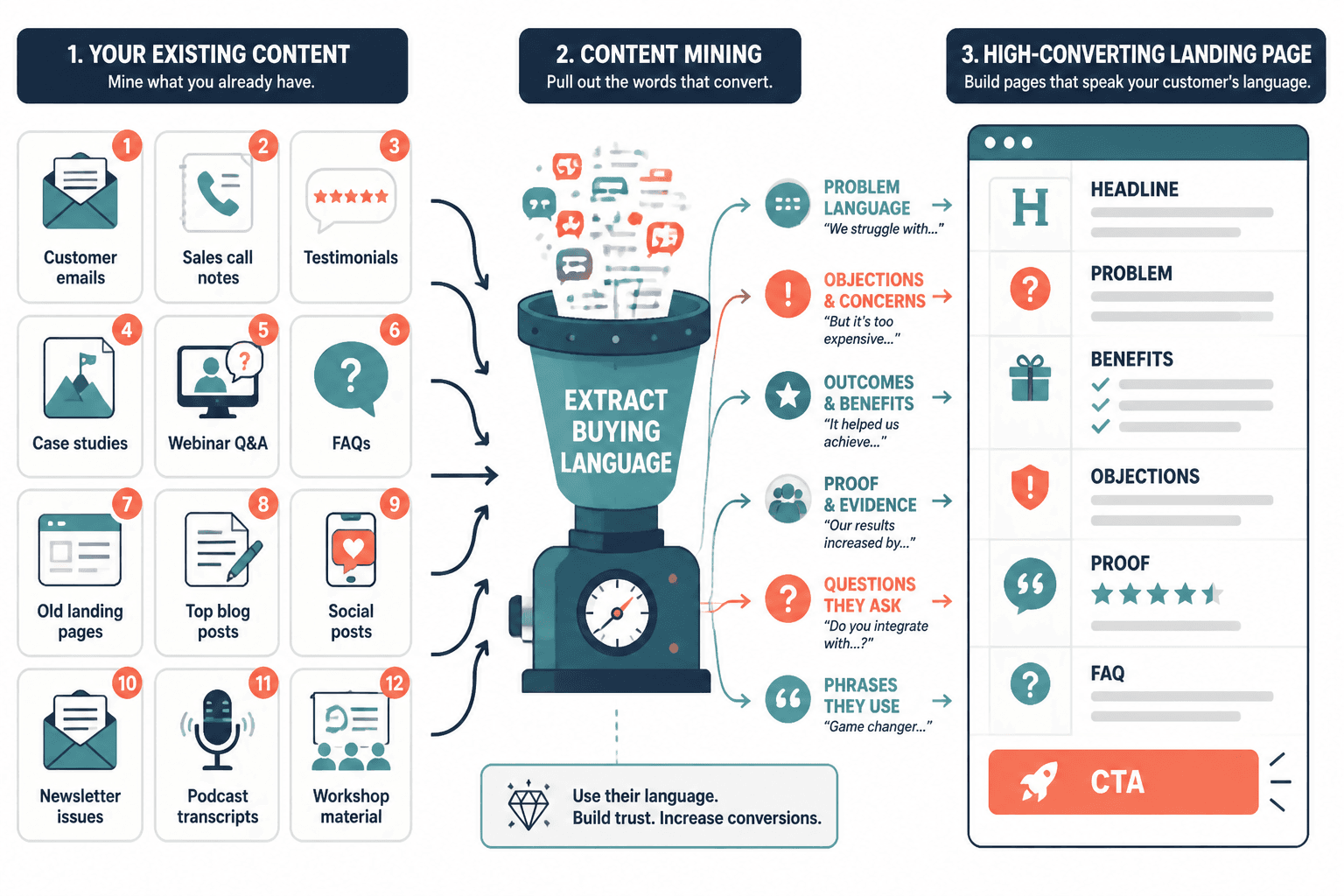
Start with content closest to a buying decision
If the goal is a better landing page, start with content that sits near trust, action, or sales. That usually gives you stronger material than broad awareness content.
- Email replies from prospects
- Sales call notes or discovery call transcripts
- DM conversations
- Testimonials
- Case studies
- Webinar Q&A sections
- Product or service FAQs
- Past landing pages that converted at least decently
Then pull from strong audience content
- Top-performing blog posts
- High-save social posts
- Threads that got thoughtful replies
- Newsletter issues that drove clicks or replies
- Podcast notes or interview transcripts
- Workshop teaching material
The key is not “most popular” by vanity metrics alone. A post with decent reach but strong replies can be more useful than a viral one full of empty agreement.
Good landing pages need buying language, not applause.
What to extract from old content
Do not just reuse content by topic. Reuse it by function.
When reviewing old content, pull out these five things.
1. Problem language
How do people describe the frustration before they buy? What words do they use when they are stuck, annoyed, overwhelmed, or losing time or money?
This helps you write a headline and opening section that sounds connected to real life, not “brand voice exercises.”
Weak: Build a powerful personal brand with strategic content systems
Stronger: Posting regularly but still not turning attention into leads? Your content probably is not the problem. Your landing page is.
2. Desired outcomes
What result do people actually want? Not your nice abstract promise. The real one.
Maybe they do not want “better messaging.” Maybe they want more booked calls from existing traffic. Maybe they want a page that stops sounding vague and finally explains why someone should hire them.
3. Objections and hesitations
Old content is often where people quietly tell you why they are not buying yet.
- “I’m not sure this is right for my stage”
- “I do not want to sound too salesy”
- “I already have a website, I just do not think it’s working”
- “I’m worried this only works if you have a big audience”
That material belongs on the page. Not as defensive rambling, but as smart reassurance.
4. Proof points
Look for screenshots, client outcomes, before-and-afters, testimonials, mini case studies, or even repeated audience responses. A landing page without proof is mostly wishful formatting.
5. Phrases with natural pull
Sometimes old content hands you a line that should absolutely become a subhead, CTA, or section hook. If readers kept replying to one phrase, highlighting one point, or clicking one email angle, pay attention.
Those lines usually work because they are specific and clean. Not because they are “clever.”
How to Turn Old Content Into Better Landing Pages without making a stitched-together mess
This is where people go wrong. They collect old material, then dump all of it onto the page like a digital yard sale.
A better landing page has a job. It should guide someone from attention to understanding to trust to action. Your old content supports that journey. It should not hijack it.
Use this process.
Step 1: Match content to page sections
Before rewriting anything, sort your old material into the sections it can support.
| Landing page section | Best old content source |
|---|---|
| Headline | Top-performing hooks, email subject lines, strong post openings |
| Problem section | Prospect questions, comments, call transcripts, pain-focused posts |
| Solution section | Teaching content, frameworks, workshop material, explainer posts |
| Benefits | Testimonials, client outcomes, audience replies, case studies |
| Objection handling | FAQs, sales objections, hesitation in DMs or calls |
| CTA | Email CTAs, webinar offers, high-click post endings |
This simple step keeps you from recycling content randomly. You’re building with purpose, not shoving old bricks into new wallpaper.
Step 2: Find the strongest angle
Most old content gives you multiple angles. Do not use all of them.
Pick the one that best fits the page goal.
- If the page is for booked calls, lead with clarity and credibility
- If the page is for a product, lead with outcome and simplicity
- If the page is for a lead magnet, lead with speed and usefulness
- If the page is for a high-trust service, lead with understanding and proof
A landing page gets stronger when it commits. Trying to include every possible benefit usually weakens the whole thing.
Step 3: Rewrite for decision-making, not content consumption
A good post can entertain, teach, or provoke. A good landing page has to help someone decide.
That means your recycled material often needs to become:
- Shorter
- Clearer
- More specific
- More structured
- Closer to the action you want
For example, a strong LinkedIn post might open loops and build curiosity. A landing page headline usually should not play hard to get. You need enough intrigue to pull people in, but enough clarity that the right person knows they are in the right place.
Old post angle: Why most personal brands are leaking leads
Landing page rewrite: Fix the landing page gaps that make your content work harder than it should
Step 4: Cut anything that only worked because of platform context
Some content performs because of timing, personality, platform behavior, or conversation context. That does not mean it belongs on your page.
Cut things like:
- Platform-specific jokes or references
- Comment-bait questions
- Long setup stories with weak payoff
- Opinionated tangents that distract from the offer
- Lines that sounded good in a post but do nothing on a page
Your landing page is not a scrapbook. It’s a decision environment.
A practical framework for rebuilding a landing page from old content
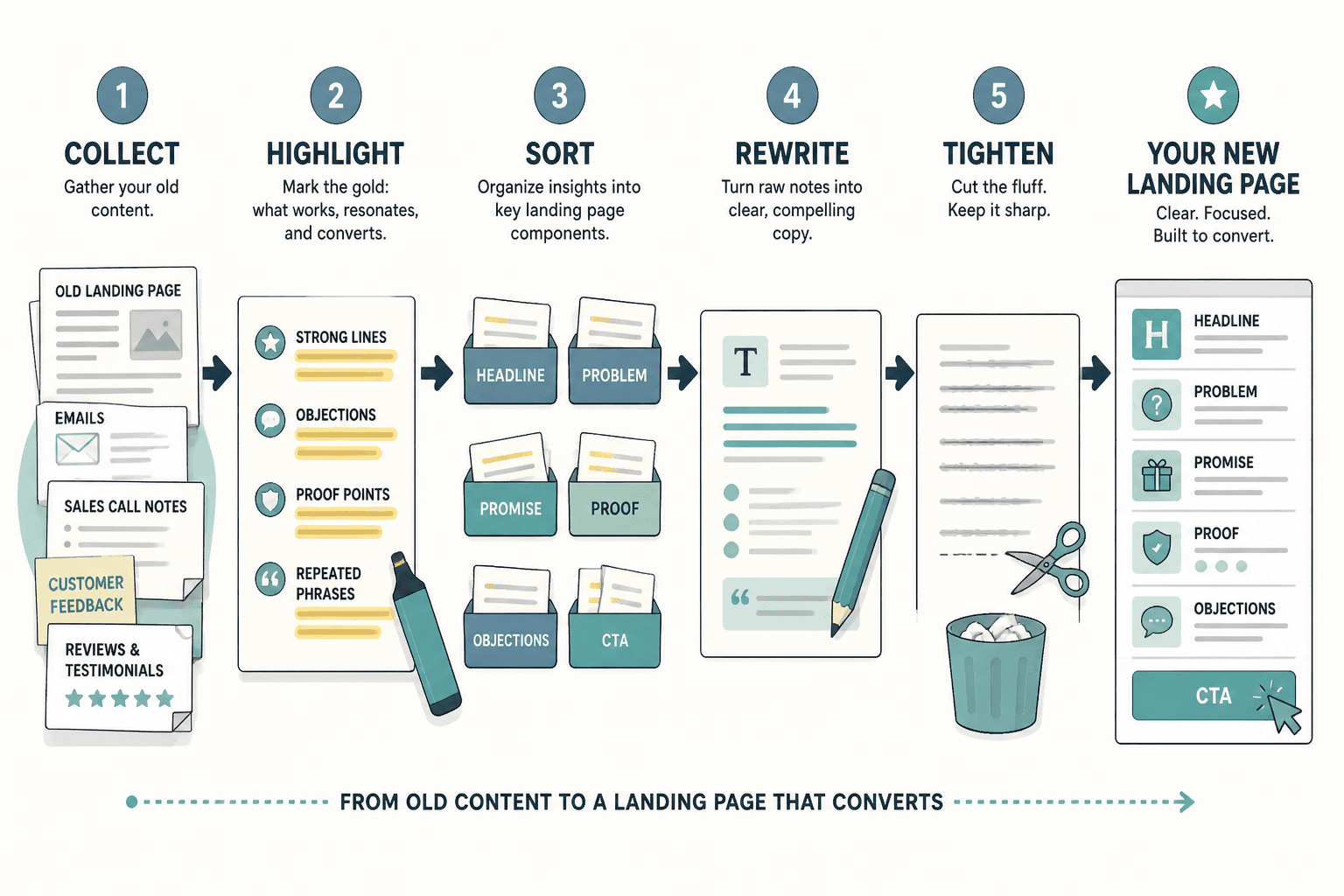
If you want a repeatable workflow, use this five-part rebuild.
- Collect: Gather old content related to the offer, audience, and result.
- Highlight: Mark strong lines, objections, proof, and repeated phrases.
- Sort: Place them into headline, problem, promise, proof, objections, and CTA sections.
- Rewrite: Adapt each piece for clarity and conversion.
- Tighten: Remove repetition, fluff, and any line that sounds impressive but says very little.
That last part matters more than people think. Old content gives you volume. Good landing pages need selection.
Before-and-after examples
Here’s what this can look like in practice.
Example 1: Turning a useful post into a stronger headline section
Old post line: A lot of creators do not need more content ideas. They need a better path from attention to action.
Weak landing page version: Strategic systems for audience growth and lead generation
Better landing page version: Turn attention into action with a landing page that actually explains, proves, and sells your offer
Why it works better: it keeps the original idea but makes the value concrete. “Strategic systems” is wallpaper. “Explains, proves, and sells” gives the page a job.
Example 2: Turning FAQ content into objection handling
Old FAQ answer: No, you do not need a full website rewrite. In most cases we can improve results by fixing message clarity, structure, proof, and CTA flow on the page people already visit.
Landing page section: You probably do not need to rewrite your whole website. You may just need one page that stops confusing people and starts guiding them.
That’s cleaner, sharper, and closer to the buying hesitation.
Example 3: Turning client praise into benefits that do not sound fake
Old testimonial line: You took what I’d been trying to say for months and made it obvious why people should work with me.
Weak benefit: Improved brand clarity and messaging alignment
Better benefit: Explain your value in a way that makes the right people think, “Finally. This is what I need.”
Same idea. Less beige.
What to keep, what to compress, and what to throw out
When you reuse old content, do not assume more is better. A landing page is not trying to preserve your thoughts for academic study. It is trying to help a person make a choice with confidence.
Keep
- Specific audience language
- Clear explanations
- Real-world examples
- Objections
- Proof
- Simple phrases that get repeated for a reason
Compress
- Stories that take too long
- Teaching sections with too much nuance
- Long process explanations
- Background context the reader does not need yet
Throw out
- Performative thought leadership lines
- Anything vague enough to fit any offer
- Repeated points that add length but not trust
- Platform-native filler like “curious if anyone else feels this”
- Old positioning that no longer matches your offer
This is the part where discipline matters. Reusing old content is not about honoring everything you wrote. It’s about finding the strongest pieces and making them pull their weight.
Common mistakes when repurposing old content into landing pages
The bigger point is simple: clearer structure and clearer writing make the piece more useful. That is usually what makes the ending land better too.
The bigger point is simple: clearer structure and clearer writing make the piece more useful. That is usually what makes the ending land better too.