Most product and service descriptions are not underperforming because they are too short or too long. They are underperforming because they make the reader work too hard to figure out what is being sold, who it is for, and why they should care.
That is the real question behind How Long Should Product and Service Descriptions Be in 2026? Not “what word count wins,” but “how much copy does this offer need to create clarity, trust, and action without wandering off into a swamp of filler?”
Because yes, short descriptions can convert. Long descriptions can convert too. Both can also fail spectacularly when they are vague, bloated, or trying to sound expensive instead of useful.
This piece will help you figure out the right length for your product or service descriptions based on what you are selling, how much trust the buyer needs, where the description lives, and how aware your audience already is. In other words: less guessing, fewer limp paragraphs, better conversion copy.
To see how this fits into the wider strategy, open the parent guide.
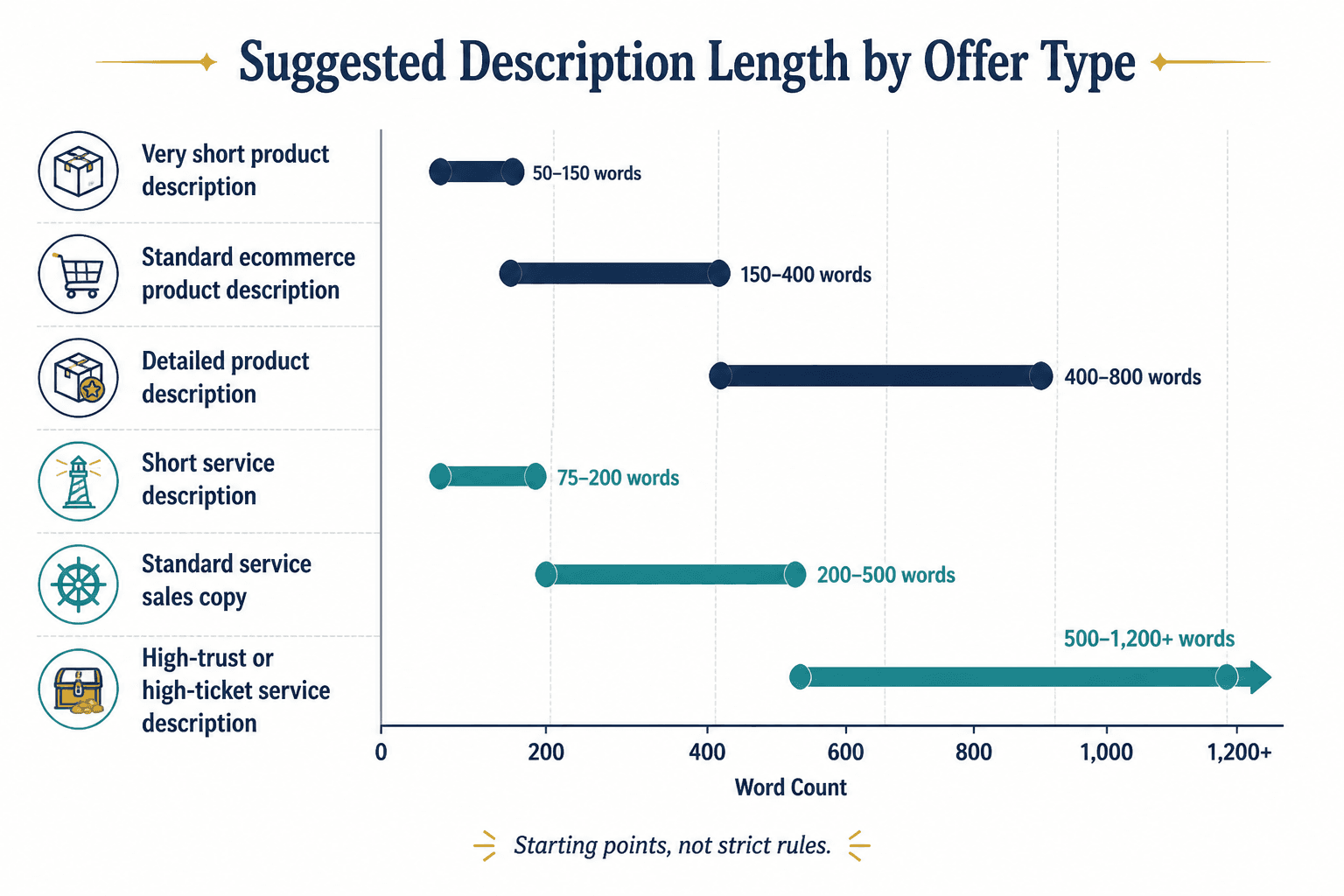
There is no magic word count, but there are clear ranges
If you came here hoping for one neat number, bad news. Copy does not work like airline baggage rules.
Still, practical ranges help. So here is the useful version.
| Offer type | Typical effective length | Best use case |
|---|---|---|
| Simple product description | 50–150 words | Low-cost, familiar, low-risk items |
| Feature-rich product description | 150–300 words | Products needing more detail, comparison, or reassurance |
| Short service description | 75–200 words | Service overview pages, directories, packages with low friction |
| Standard service sales copy | 200–500 words | Most creator, consultant, coach, and freelancer offers |
| High-trust or high-ticket service description | 500–1,200+ words | Complex, custom, expensive, or skeptical-buyer offers |
Those are not laws. They are starting points. A $19 template pack usually does not need a novella. A $5,000 consulting package usually needs more than three smug sentences and a “book now” button.
The right length is the shortest version that still answers the buyer’s real questions. That is the standard. Not elegance. Not minimalism. Not your personal devotion to “clean design.”
What actually determines description length in 2026
If you want to decide description length properly, stop looking for averages and start looking at buying friction.
The more resistance, confusion, skepticism, cost, or complexity involved, the more copy you usually need. Not because long copy is magical, but because unanswered questions kill action.
1. Price and perceived risk
Higher prices usually need more explanation. That is not revolutionary. But perceived risk matters just as much as the actual number.
A $49 digital product can still need decent copy if the buyer worries it will be generic junk. A $500 service can convert with relatively short copy if the audience already knows, trusts, and wants you.
Ask this: what feels risky to the buyer here? Money, time, embarrassment, complexity, team buy-in, implementation, wasting effort? Your description should reduce that friction directly.
2. Familiarity of the offer
If people already understand what the thing is, you can usually write less.
If they need context just to understand the category, you need more room. “Website copy audit” is fairly clear. “Asynchronous authority positioning sprint” sounds like something a consultant made up after two coffees and a rebrand.
Unfamiliar offers need more explanation. Weird naming also needs more explanation. Usually both.
3. Buyer awareness
Warm buyers need less copy than cold buyers.
- If someone clicked from your newsletter and already knows your approach, a shorter description may be enough.
- If they found you through search and have never heard of you, they probably need more clarity, proof, and structure.
- If they are comparison shopping, your description must help them decide fast.
This is one reason homepage service blurbs and full sales pages should not be treated as the same job. They are not.
4. Complexity of the outcome
Simple outcome, less copy. Complex transformation, more copy.
“Get a clean headshot in 30 minutes” is straightforward. “Clarify your positioning, rewrite your service messaging, and improve conversion across your site” needs more room because the buyer needs to understand scope, process, and payoff.
5. How much proof the reader needs
Proof takes space. If your offer depends on trust, expertise, or results, your description may need room for specifics: examples, outcomes, mini case-study language, objections, or what makes your process different.
This is especially true for services. People are not just buying deliverables. They are buying judgment.
How long should product descriptions be in 2026?
For most products, 50 to 300 words is enough. But “enough” depends on how many questions the buyer needs answered before they can act.
Use shorter product descriptions when:
- The product is inexpensive
- The category is familiar
- The benefit is obvious
- The buyer does not need much reassurance
- The page already includes supporting visuals, reviews, specs, or FAQs
Think: simple physical products, low-ticket digital resources, straightforward templates, or products where the image and title already do a lot of explanatory work.
Use longer product descriptions when:
- The product solves a nuanced problem
- The buyer may compare several options
- The product has features that need translating into benefits
- The price is high enough to trigger hesitation
- The offer is digital and intangible, so people need help visualizing what they get
Digital products often need more copy than people assume. Not because they are more complex, but because there is nothing physical to inspect. You are selling the outcome, the contents, the usefulness, and the confidence that this thing is not just another folder of PDFs no one will open.
A short product description works when the product is already understood. A longer one works when the buyer still needs convincing, context, or clarity.
How long should service descriptions be in 2026?
Service descriptions usually need more space than product descriptions. That is because services are less tangible, more trust-dependent, and often more expensive.
For most creators, consultants, coaches, freelancers, and agencies, a strong service description will land somewhere between 200 and 800 words. For high-ticket or custom services, it can be longer if the copy keeps earning its place.
The mistake is not writing long service descriptions. The mistake is writing long service descriptions that still somehow never explain what the client actually gets.
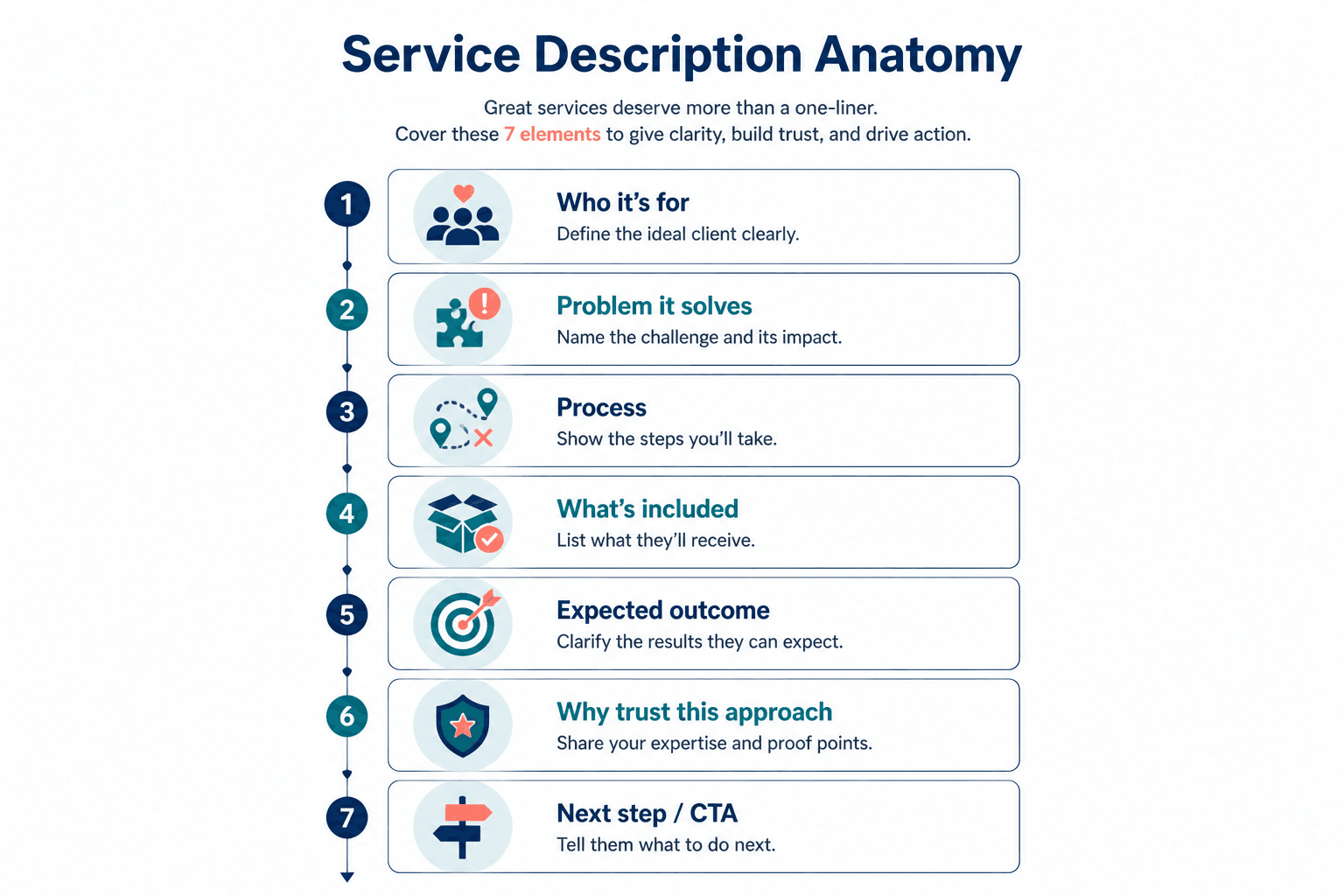
A solid service description usually needs to cover:
- Who the service is for
- What problem it solves
- What the process looks like
- What is included
- What outcome or result the client can expect
- Why your approach is worth trusting
- What to do next
That is hard to do in 60 words unless the reader already knows you well. Which is why so many ultra-minimal service pages look nice and convert like damp cardboard.
If you want more guidance on structuring this kind of page, the broader product and service descriptions guide for creators who want better results is a useful next stop.
The better question: how much copy does this buyer need before they can say yes?
This is the test worth using in 2026.
Not “can I make it shorter?” Not “what are top brands doing?” Not “will people read all this?” People will read what helps them decide. They regularly read restaurant menus, product reviews, pricing pages, Reddit threads, comparison pages, and user comments when they care. The issue is not length. It is relevance.
Good copy earns attention line by line. Bad copy wastes it line by line. That is the whole ugly truth.
A practical way to choose the right description length
If you are staring at a blank page and wondering how long the description should be, use this simple process.
Step 1: Identify the page’s job
Is this description supposed to get the click, support the sale, qualify the lead, or answer objections?
- Collection page card: very short
- Product page: moderate detail
- Service overview page: concise but clear
- Dedicated sales page: longer and more persuasive
One reason descriptions get weird is that people expect one paragraph to do the work of an entire funnel.
Step 2: List the buyer’s real questions
Before you write, list the questions someone would ask right before buying.
- What exactly is this?
- Is it for someone like me?
- What do I get?
- How does it work?
- Why is it worth the price?
- What makes this different?
- What happens next?
Your ideal length is usually whatever it takes to answer those well, without repeating yourself like a nervous intern presenting to the board.
Step 3: Cut anything that does not reduce friction
This is where most copy improves fast.
Cut vague praise of your own offer. Cut inflated adjectives. Cut broad claims that could describe literally anything. Cut throat-clearing intros that spend 80 words warming up before saying the useful part.
If a sentence does not clarify, differentiate, reassure, or move the buyer closer to action, it is probably decorative fog.
Step 4: Add missing specificity before adding more length
Sometimes a description does not need to be longer. It needs to be less vague.
Compare these:
Weak: A comprehensive service designed to elevate your brand messaging.
Better: A messaging strategy service for coaches and consultants who know their work is good but cannot explain it clearly on their site, profile, or sales pages.
The second version is not dramatically longer. It is just doing actual work.
When short descriptions beat long ones
Short descriptions win when they remove friction instead of creating it.
If the buyer already understands the offer, trusts the source, and just needs a clean explanation, short is often stronger. Sharp copy feels confident. It respects attention. It does not perform intelligence by using three paragraphs to say “this template helps you write faster.”
Examples where shorter often works better:
- Simple digital downloads
- Low-ticket products
- Menu-style service summaries
- Comparison cards
- Returning-customer pages
- Highly visual products
If that is your situation, this related piece on when short product and service descriptions beat long ones can help you avoid over-writing the page.
When longer descriptions are the smarter move
Longer descriptions make sense when buyers need help understanding, trusting, or justifying the decision.
- High-ticket services
- Custom offers
- Products with nuanced use cases
- Transformation-based services
- Offers with skeptical buyers
- New or unusual categories
But longer only works if the structure stays clean. Use subheads. Break up sections. Lead with the core value. Answer objections in the order a real buyer would have them. Do not bury the point in a swamp of “premium,” “tailored,” “bespoke,” and other words that usually mean “we forgot to explain the offer.”
What 2026 changes, and what it does not
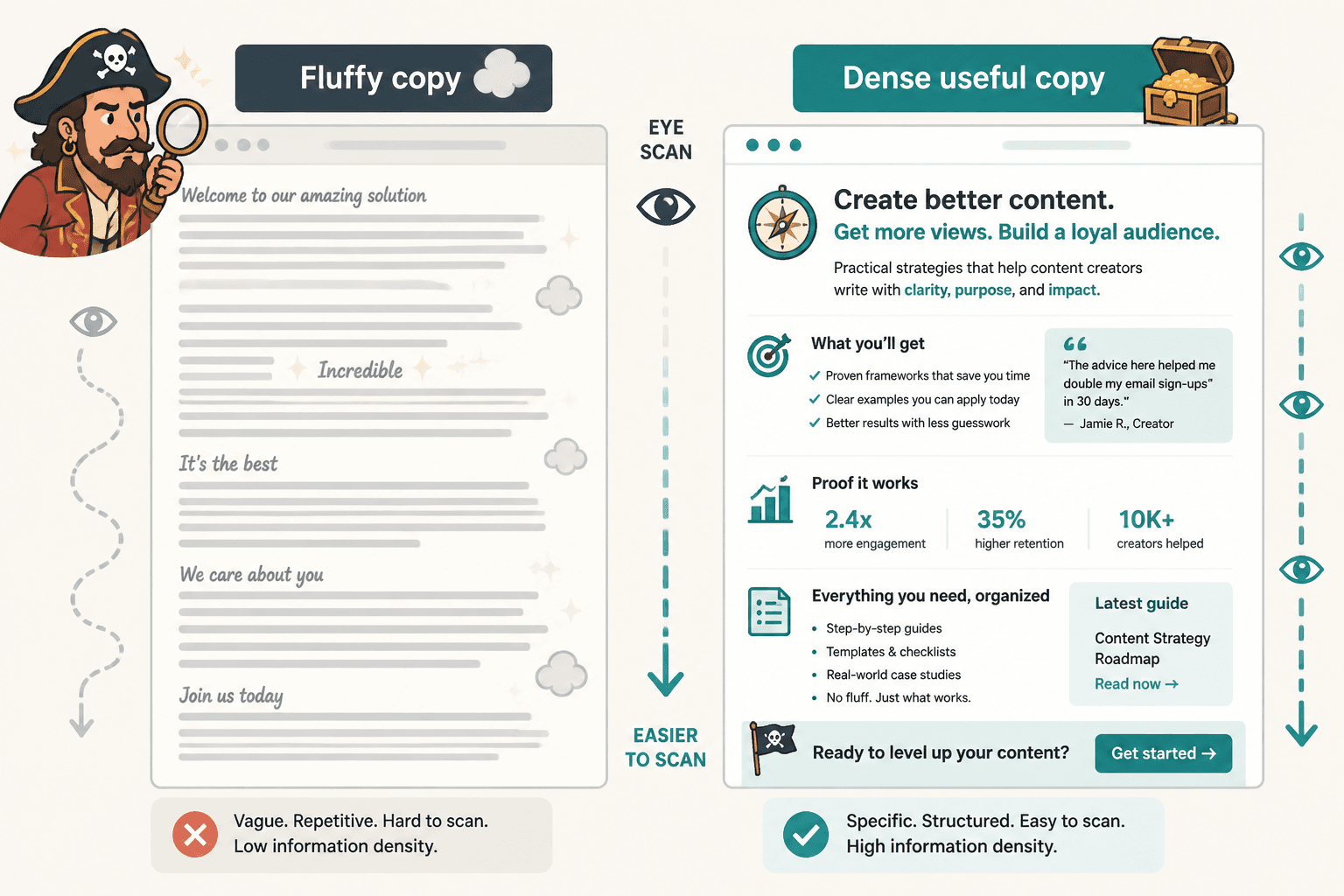
By 2026, readers are even more used to skimming, comparing, and using AI-assisted search summaries before they click. That does not mean all copy should be shorter. It means weak copy gets exposed faster.
People are quicker to scan for substance now. They want clear outcomes, specifics, proof, and easy structure. They are less patient with inflated filler and more alert to generic AI-polished mush.
So the trend is not “shorter descriptions.” The trend is “denser value.” Better structure. Faster clarity. More useful specifics per inch.
That is why the strongest descriptions in 2026 will often feel tighter even when they are fairly long. They are not meandering. They are efficient.
Common mistakes people make when deciding description length
- Copying ecommerce advice onto service pages. Services usually need more trust-building copy.
- Forcing minimalism because it looks premium. Looking premium is not the same as being clear.
- Writing long because SEO told them to. Search does not reward padding. Readers definitely do not.
- Explaining features without translating benefits. Details matter, but not if the reader cannot connect them to value.
- Skipping proof. If the buyer is hesitant, proof may matter more than another paragraph of explanation.
- Using one block of text for everything. Length is easier to handle when the structure is readable.
And yes, one more: writing descriptions that sound like they were generated by a committee of polished robots. If the copy sounds generic, the offer starts to feel generic too.
A simple description framework that works at almost any length
If you want a practical structure, use this:
- What it is: Name the thing plainly
- Who it is for: Make the audience clear
- What it helps them do: Focus on outcome
- What is included: Add specifics
- Why it is different or credible: Build trust
- What to do next: Give a clean CTA
That framework works for a 90-word description and for a 900-word page. The difference is depth, not structure.
If you need help tightening or expanding your own copy, how to write better product and service descriptions goes deeper on wording and structure, and best product and service descriptions ideas and examples for creators can help if you want stronger models.
The bigger point is simple: clearer structure and clearer writing make the piece more useful. That is usually what makes the ending land better too.