
Most affiliate articles do not lose trust because they use affiliate links.
They lose trust because the article reads like it was written by someone trying to earn a commission before earning credibility. The recommendations feel pre-decided. The downsides disappear. Every product is “great for creators.” The CTA starts sweating in the second paragraph.
Readers are not stupid. They can smell “this exists to sell me” from a mile away, even when the disclosure is technically there and the writing is polished. Especially when the writing is polished.
If you want to know how to monetize affiliate articles without wrecking trust, the answer is not to hide the monetization. It is to make the article genuinely useful, structurally honest, and clear about where your incentives sit. You can absolutely make money from affiliate content without turning your site, newsletter, or brand into a recommendation landfill.
This is about writing affiliate articles that still help the reader make a good decision, even if they do not click your link. That is the standard. And yes, it tends to convert better too.
To see how this fits into the wider strategy, open the parent guide.
What trust actually looks like in affiliate content
Trust in affiliate articles is not some soft, mystical branding thing. It is pretty concrete.
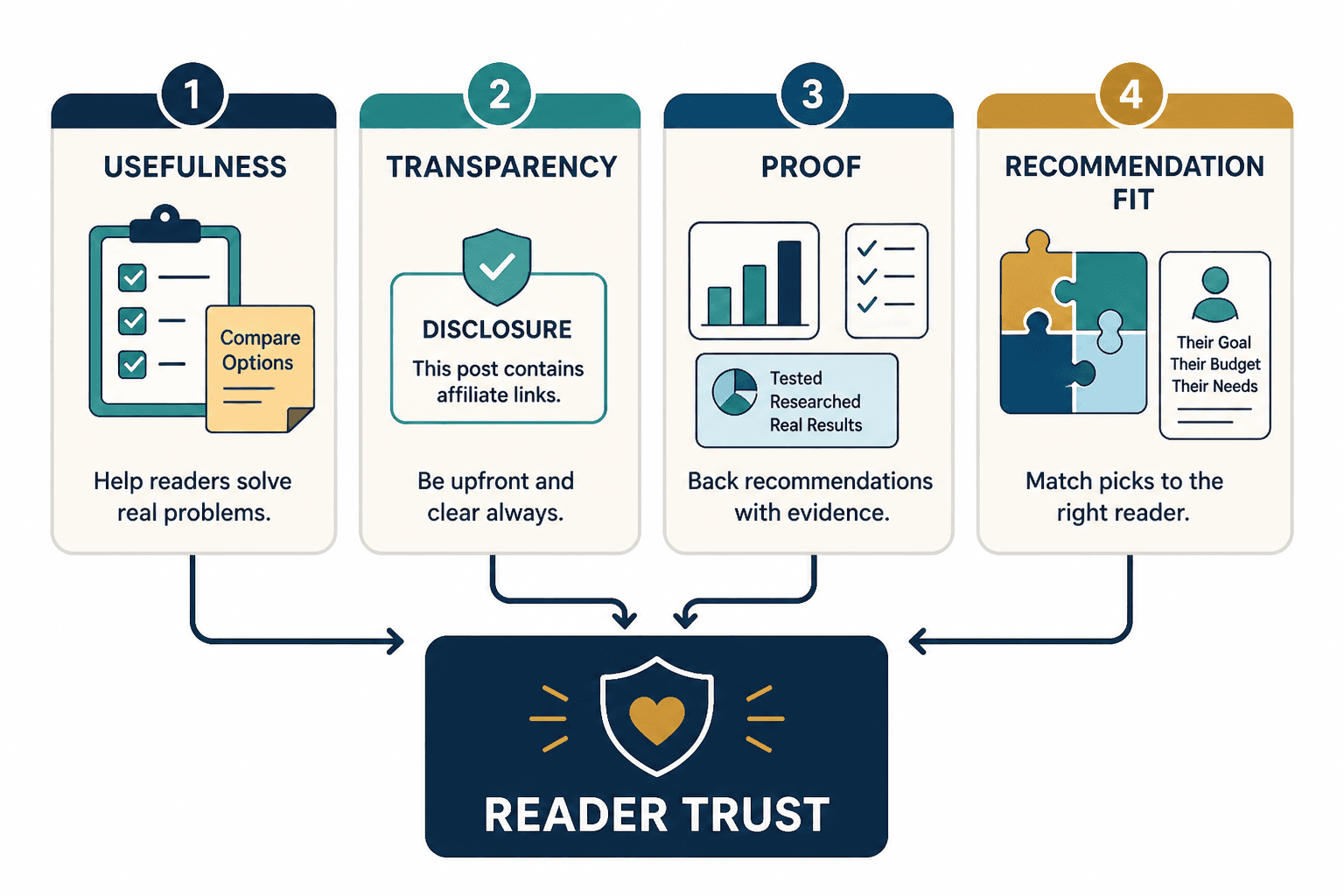
The reader trusts you when they believe three things:
- You are trying to help them make a good choice, not just a profitable one
- You understand the use case well enough to recommend with context
- You are not hiding tradeoffs, limitations, or incentives
That is it. If those three things are present, affiliate monetization feels fair. If they are missing, even a decent recommendation starts to feel slippery.
A lot of creators overcomplicate this. They think trust is built by sounding warm, adding a personal note, or tossing in a disclosure line and hoping that covers the rest. It does not. Trust is mostly built through how you structure the recommendation itself.
For a deeper look at the wider category, you can naturally connect this topic to the main affiliate articles hub and related guides under money content for monetization funnels.
Why affiliate articles go wrong so fast
Most bad affiliate articles fail in one of four ways.
1. The recommendation is too broad
“Best email tools for creators” sounds useful, but half the time it is just a pile of logos with recycled feature summaries. No audience segmentation. No buying context. No “this is best if you need X but not Y.”
Broad articles often convert worse because they dodge the real decision criteria. People do not buy a tool because it has “powerful automation.” They buy because they need something simple, cheap, scalable, collaborative, creator-friendly, or less annoying than what they have now.
2. The article is obviously written backwards
You can tell when the commission came first and the argument was built afterward. The examples are thin. The objections are missing. Every option sounds conveniently excellent.
Readers may not articulate that problem, but they feel it. The article does not sound like guidance. It sounds like inventory.
3. The downsides are vague or fake
If every “con” sounds like “so many features it can feel overwhelming,” congratulations, you have written the internet’s most suspicious review format.
Real tradeoffs build trust. Fake tradeoffs destroy it.
4. The CTA gets needy
When the article keeps shoving people toward the same link, the monetization becomes louder than the advice. You do not need five button moments and a fake urgency line to monetize an affiliate article. You need a strong match between the reader’s problem and the recommendation.
If your CTAs tend to sound stiff or interchangeable, read How to Improve Affiliate Articles’ Trust-Building CTAs Without Sounding Generic. It solves one of the fastest ways trust gets chipped away.
How to monetize affiliate articles without wrecking trust: the core principles
There is no trick here. Just a few principles that matter more than the little conversion hacks people keep stapling onto weak articles.
Lead with the decision, not the product
Start from the reader’s situation.
Not “Here are the top seven platforms for course creators.”
More like: “If you need something simple and fast, pick A. If you want more control and can tolerate setup friction, pick B. If your audience is small and you do not need enterprise nonsense, skip C entirely.”
That framing tells the reader you are helping them choose, not herding them.
Be specific about fit
“Good for creators” is lazy. Good for which creators?
- Solo consultants selling a high-ticket service?
- Coaches who want simple booking plus email capture?
- Writers monetizing with a newsletter and low-cost product?
- Founders who need team workflows?
Specific fit builds confidence. Vague fit sounds like affiliate wallpaper.
Include real tradeoffs
Every recommendation should carry some version of this sentence underneath it: Here is who this is best for, where it is strong, and where it may annoy you.
You do not need to roast the product. You do need to tell the truth. Sometimes the best converter in your stack is not the best option for beginners. Sometimes the cheap tool becomes expensive once you need one feature. Sometimes the clean interface comes with less flexibility. Say that.
Make the disclosure feel normal, not defensive
An affiliate disclosure should not feel like legal confetti tossed in to protect your conscience. It should feel plain, visible, and calm.
Something like this works:
Some links in this article are affiliate links, which means I may earn a commission if you buy through them. I only recommend tools that make sense for the use cases described here.
Clear. Honest. No dramatic throat-clearing. If you want to tighten that part of your articles, see Better Affiliate Articles: Affiliate Disclosures for Personal Brands.
Recommend fewer things when possible
One underrated trust move is simply not listing twelve options when three will do.
Long “best tools” posts often confuse readers because the article is optimized for search breadth instead of decision clarity. A smaller, better-filtered list feels more credible and is usually more useful. It also forces you to explain why each option belongs there.
Use article structures that make trust easier
Some affiliate article formats almost naturally support trust. Others make it easy to get sloppy.
Best-for articles
This format works well when each option clearly serves a different type of buyer.
Good example:
- Best email platform for solo creators who want simplicity
- Best for advanced automations
- Best budget option for small lists
- Best if you already sell digital products
Bad example:
- Seven excellent email tools with robust features and seamless integrations
That says nothing. Beige water.
Versus articles
“Tool A vs Tool B” can be great for trust because the comparison itself creates pressure to be fair. The key is to compare on criteria readers actually care about:
- Ease of setup
- Learning curve
- Pricing shape, not just starting price
- Best use case
- Flexibility
- Support and maintenance burden
Do not quietly prefer one tool in every category and then pretend you were objective. If one option wins for simplicity and the other wins for customization, say that plainly.
Use-case articles
These are often the strongest format for affiliate trust.
Instead of “Best CRMs,” write the article around an actual situation:
- Best CRMs for solo consultants who hate admin
- Best scheduling tools for coaches who want fewer back-and-forth emails
- Best writing tools for creators publishing weekly without a team
The narrower the problem, the easier it is to recommend honestly.
What to include in each recommendation block
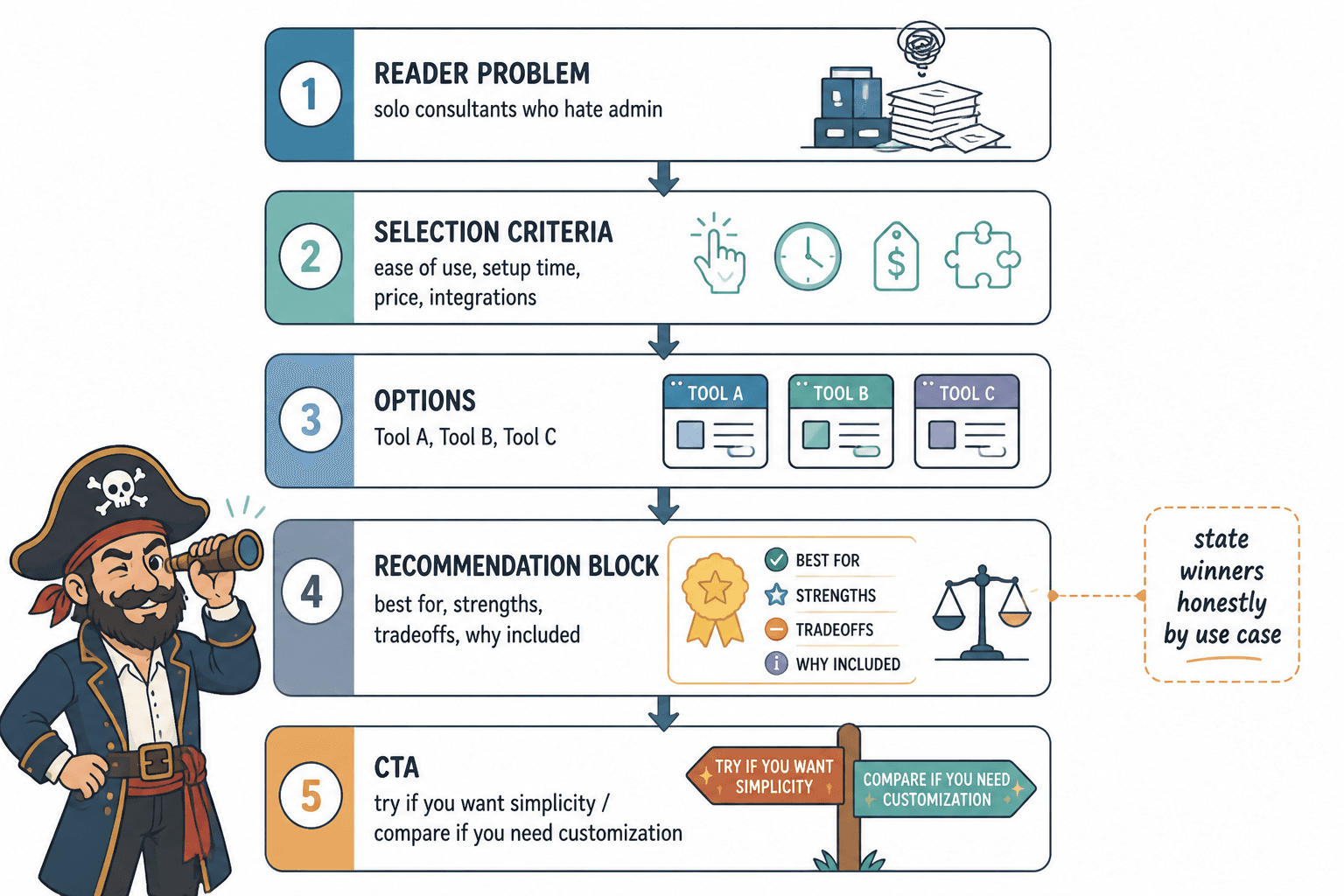
If you want affiliate content to feel trustworthy, each product section needs enough context to help a reader self-sort.
A clean recommendation block usually includes:
- Who it is for
- What it does well
- What to watch out for
- Why it made this list
- A CTA that matches the recommendation
Here is a simple structure:
Best for: solo coaches who want a simple landing page plus checkout setup
Why it stands out: fast to launch, clean interface, low setup friction
Worth knowing: not ideal if you need complex automations or deep customization
Why I’d pick it: strong option when speed and simplicity matter more than feature depth
CTA: If you want the fastest route to getting this live, check it out here.
That is enough to sound useful without turning every section into a white paper.
Write CTAs that sound like guidance, not commission breath
The affiliate CTA is where a lot of decent articles suddenly become embarrassing.
You do not need “Grab yours now” energy. You need a next step that feels aligned with the recommendation.
Here are a few weak CTA patterns:
- “Click here to get started today”
- “Don’t miss out”
- “Transform your business with…”
- “This powerful solution can help you scale”
These sound like someone borrowed a webinar funnel and forgot to return it.
Stronger affiliate CTAs usually do one of three things:
- Reinforce fit
- Clarify the next step
- Keep the tone calm and useful
Examples:
- If you want the simplest option on this list, this is the one I’d start with.
- If your main issue is managing leads without adding admin chaos, this is worth a look.
- If you need more flexibility and do not mind setup time, check this option out.
- If this sounds like the right fit for how you work, you can explore it here.
Notice the difference. The CTA is not shouting. It is helping the reader continue their decision.
For more examples, pair this article with How to Write Affiliate Articles Without Sounding Salesy or Robotic.
Do not fake objectivity. Earn credibility another way.
A weird mistake in affiliate writing is trying to sound perfectly neutral. It often backfires.
If you clearly have experience, preferences, or a point of view, use that. Just do not confuse opinion with fairness.
You are allowed to say:
- I prefer this tool for solo operators because the setup is less annoying
- I would not recommend this one if your business is still simple
- This option is powerful, but probably overkill for most personal brands
That kind of opinion can actually build trust because it sounds like a person making a judgment, not a content machine trying to keep every vendor happy.
What you cannot do is pretend your opinion is universal. Ground it in use case, tradeoffs, and context.
Use proof, but not the fake polished kind
You do not need inflated claims to make affiliate articles persuasive. In fact, they usually make things worse.
Better proof elements include:
- Specific use-case reasoning
- Implementation notes
- Honest limitations
- Comparison details
- Short observations about setup, workflow, pricing shape, or maintenance burden
For example, this is weak:
This all-in-one platform is perfect for serious entrepreneurs looking to scale with ease.
This is better:
This works best if you want landing pages, email, and checkout in one place and you do not want to duct-tape five tools together. If your setup is already more advanced, the simplicity may start to feel limiting.
That second version does not need fake hype because it actually helps someone decide.
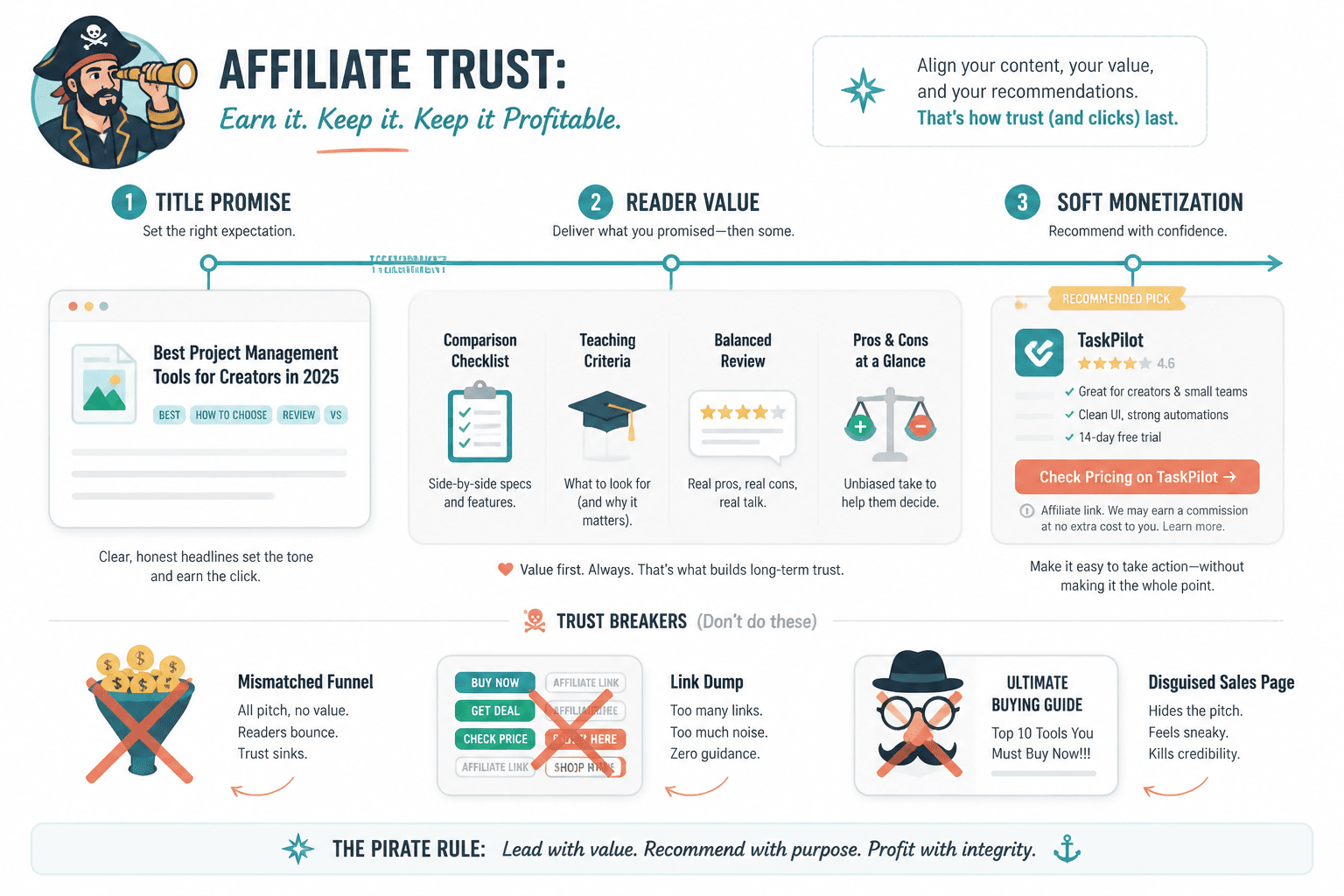
Keep monetization aligned with the article’s promise
One reason affiliate articles feel off is that the monetization does not match the reader’s intent.
If the article promises education but mostly pushes links, trust drops. If the article promises comparison but quietly funnels every path toward one preferred tool, trust drops. If the article acts like a tutorial but is really a buying guide in disguise, trust drops.
The fix is not complicated: make sure the article delivers the thing the headline implied.
If the title says “best,” compare. If it says “how to choose,” teach criteria. If it says “review,” go deep. If it says “vs,” be balanced. The monetization should ride inside the value, not replace it.
A simple workflow for trust-first affiliate articles
If you want something practical, use this process.
- Define the reader situation clearly. What are they actually trying to solve?
- Choose a narrow enough angle. Do not write for everyone with a wallet.
- Pick only recommendations you can explain honestly. If you cannot describe fit and tradeoffs, it does not belong.
- Set comparison criteria before writing. This helps stop the article from becoming a commission parade.
- Add a plain disclosure early.
- Write recommendation blocks with best-for, strengths, limitations, and why it is included.
- Use calm CTAs. Match the CTA to the reader’s likely next step.
- Cut any sentence that sounds like ad copy wandered into the article.
That last step matters more than people think. A surprising amount of mistrust comes from tone alone. If the article suddenly sounds slicker near the links, readers notice.
How this connects to leads and sales beyond the affiliate click
Affiliate articles do not have to work alone. In fact, they often perform better when they are part of a broader trust-based monetization path.
For example:
- Article to affiliate link for readers ready to choose now
- Article to newsletter for readers still researching
- Article to consultation if the reader needs help implementing the solution
- Article to related resource that helps them compare options more clearly
This matters because not every reader is click-ready. Some need more context. Some want your help, not just your link. Some trust your breakdown but still are not ready to buy. If your only monetization path is “click affiliate link immediately,” you are leaving both trust and revenue on the table.
If you want to expand that part, read How to Turn Affiliate Articles Into More Leads or Sales. It is the natural next step after getting the article itself right.
Common trust-killing moves to cut immediately
- Listing products you barely understand just to make the article look comprehensive
- Using identical recommendation language for every option
- Writing “pros and cons” where the cons are obviously fake
- Hiding disclosures where nobody will see them
- Stuffing links into every paragraph
- Using hypey CTA language that does not match your normal voice
- Recommending premium tools to beginners with tiny budgets just because the commission is nicer
- Copying vendor positioning instead of explaining actual fit
That last one is especially common. If your article sounds like the product’s homepage wearing a fake mustache, readers will feel it.
FAQ
Do affiliate disclosures reduce conversions?
Usually not in any meaningful long-term way. A clear disclosure can actually support trust, especially when the article itself feels fair and useful.
Should I only recommend products I personally use?
No, but you should understand the use case well enough to recommend responsibly. Personal use helps. Honest context matters more.
How many affiliate links should one article have?
As many as the article genuinely supports, and no more. More links do not automatically mean more revenue. Often they just make the article feel grabby.
Can affiliate articles still work for small personal brands?
Yes. In some cases they work better, because a smaller brand can feel more specific and more trusted when the recommendations are clearly aimed at the right audience.
The clean version of the strategy
If you want the short version of how to monetize affiliate articles without wrecking trust, here it is:
- Help the reader make a good decision
- Be obvious about fit and tradeoffs
- Use disclosures like an adult
- Keep the CTA calm
- Do not pretend the commission is not there, and do not let it run the article
That is the whole thing.
Trust does not break because money exists. It breaks when the reader realizes the article was more loyal to the payout than to the problem. Write on the right side of that line and your affiliate content can do both jobs: help people and make money without making your brand feel cheap.