
Most blog rewrites fail for one of two reasons: they are too light to matter, or so bloated they turn a decent update into a full-blown content identity crisis.
That is the real question behind How Long Should Blog Rewrites and Refreshes Be in 2026? Not “what word count is best?” Not “should every update be 2,000 words?” Just this: how much should you change for the post to become more useful, more current, and more competitive without wasting time rewriting the internet one article at a time?
Because no, there is not one magic number. Annoying, I know. But there are useful ranges, and there is a much better way to decide length than throwing another 800 words at a post and hoping Google feels something.
Here’s the practical version: the right rewrite length depends on what is broken, what the searcher needs now, what the post is trying to do, and how far the original draft is from being genuinely good. Sometimes a 200-word fix is enough. Sometimes the article needs surgery, not moisturizer.
For the main guide behind this topic, visit the parent guide.
Stop asking for a word count before you diagnose the problem
If you start with length, you are starting at the wrong end.
A blog refresh is not automatically “add more words.” A rewrite is not automatically “replace everything.” The right move depends on what kind of post you are dealing with.
- Some posts are structurally fine but stale on examples, dates, screenshots, or recommendations.
- Some posts have decent information but weak intros, vague subheads, and boring pacing.
- Some posts are targeting the wrong search intent entirely and need a full repositioning.
- Some posts were thin from day one and no amount of cosmetic editing will save them.
That is why asking “how long should the refresh be?” without checking intent, gaps, and performance first is like asking how much paint a collapsing wall needs. Probably not the first issue.
If you need a bigger-picture process for update decisions, this parent resource helps: blog rewrites and refreshes.
How long should blog rewrites and refreshes be in 2026? The useful answer
In 2026, most blog rewrites and refreshes should be as long as needed to meaningfully improve search intent fit, usefulness, clarity, freshness, and conversion—and not one fluffy paragraph longer.
That sounds obvious, but people still treat content updates like a volume contest. They assume “fresh” means “longer,” and “better” means “more complete,” even when the reader wanted a cleaner, faster answer.
Here are practical ranges that actually help.
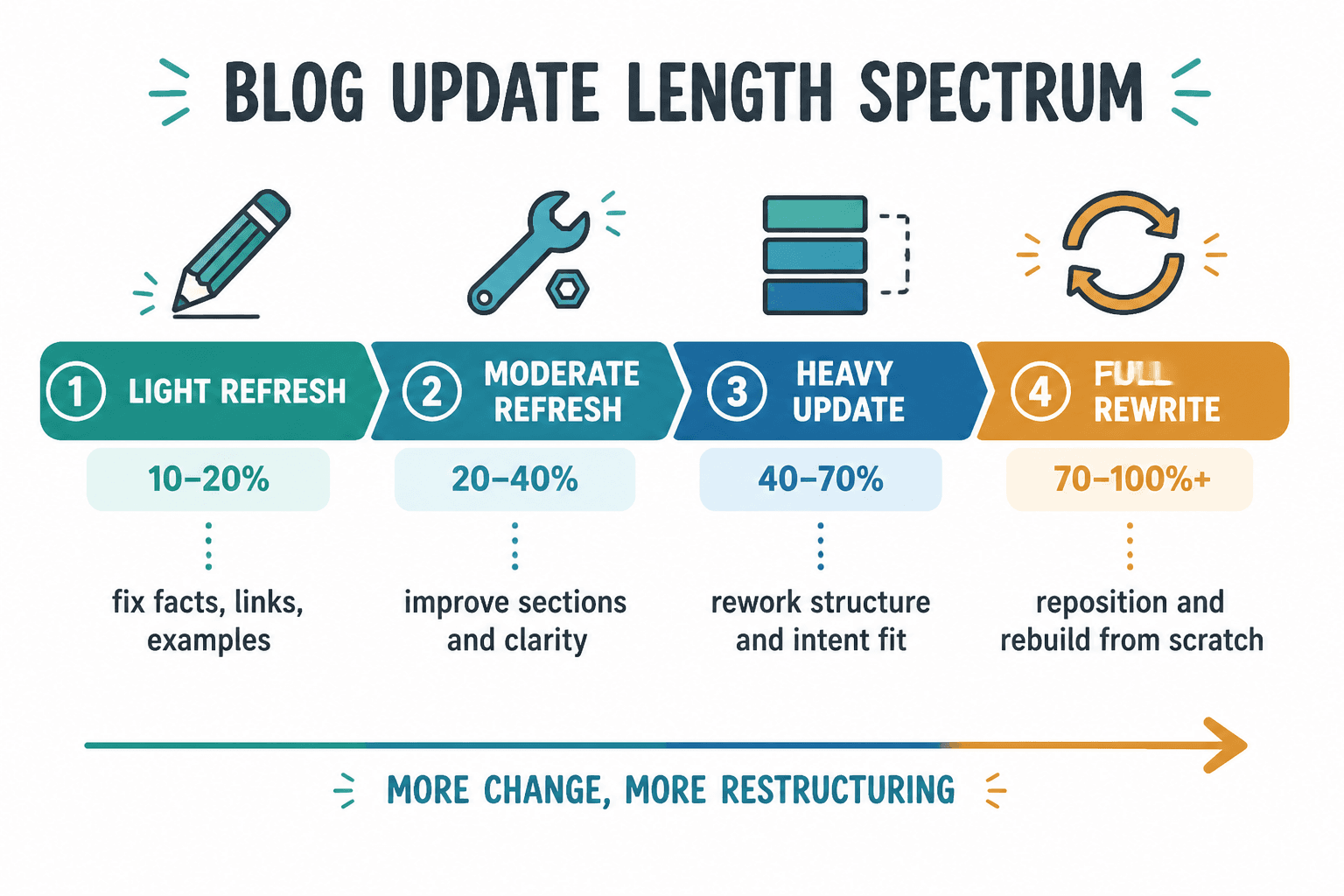
| Update type | Typical change size | When it makes sense |
|---|---|---|
| Light refresh | 5% to 15% of the article | Stats, dates, examples, links, screenshots, minor clarity fixes |
| Moderate refresh | 15% to 35% | Improved intro, tightened sections, stronger headings, added missing examples, intent alignment |
| Heavy rewrite | 35% to 70% | Outdated framing, weak structure, thin sections, poor SEO fit, weak conversion path |
| Near-total rebuild | 70%+ | Article is fundamentally off, thin, obsolete, or badly written |
Those are not laws. They are sanity-saving guidelines.
In word-count terms, that often looks something like this:
- A 1,200-word article might only need a 150-word freshness pass.
- A 1,500-word article with weak intent fit might need 500 to 900 words rewritten, removed, or replaced.
- A 2,000-word article that rambles may end up shorter after the rewrite, not longer.
- A 900-word thin post might need to become a tightly useful 1,400-word article.
Notice what matters there: not the final number, but the gap between what the article is now and what it needs to become.
What should determine rewrite length
If you want a smarter answer than “make it longer,” use these five factors.
1. Search intent gap
This is the big one. If people searching the topic want a quick tactical answer and your article currently opens with 400 words of historical throat-clearing, that content does not need extra length. It needs discipline.
On the other hand, if the query now rewards deeper comparisons, examples, templates, or clearer steps than your old post provides, you may need to expand it.
Length should follow intent. Not ego. Not habit. Not some tired content brief from 2022.
2. Topic complexity
Some topics deserve a short update. Others need room.
- A post on updating one setting, one tool, or one small tactic may only need a crisp fix.
- A post covering a strategic workflow, framework, or comparison may need substantial new material to stay useful.
If the topic has become more nuanced since the original post went live, your update may need more depth. Especially if readers now expect examples, edge cases, or practical implementation advice.
3. Original quality
A strong article can often be refreshed lightly. A weak article usually cannot.
If the original post already has:
- a clear structure
- solid reasoning
- relevant examples
- decent on-page formatting
- a useful CTA
then your refresh may be fairly compact.
But if the post is vague, generic, repetitive, or obviously padded, a tiny update will just preserve a bigger problem. That is when you stop “refreshing” and start rewriting.
4. Performance goal
What are you trying to improve?
- Traffic: You may need better intent alignment, stronger headings, richer examples, and sharper internal linking.
- Engagement: You may need pacing, formatting, and readability improvements.
- Conversions: You may need more trust signals, tighter copy, and better CTA placement.
- Authority: You may need more depth, proof, or original perspective.
Different goals create different rewrite lengths. A conversion-focused update may only require 300 strong words in the right places. A search recovery update may require a major structural overhaul.
5. Competitive gap
If competing articles are beating yours because they answer the question faster, cleaner, and with more relevant examples, then your rewrite needs to close that gap. That might mean more words. It might also mean fewer and better ones.
The internet has enough inflated articles already. You do not need to join the parade of 2,700-word posts that could have been a useful 900.
When a short refresh is enough
Not every post needs a dramatic rewrite montage. Sometimes the article is basically good and just needs to stop sounding dated.
A short refresh usually works when:
- the main structure still matches search intent
- the article already covers the topic well
- examples or screenshots are outdated
- a few headings need tightening
- the intro is a little slow but fixable
- the CTA needs updating
- internal links are missing or stale
In those cases, you might only update:
- the opening 100 to 200 words
- a few key examples
- one or two weak sections
- metadata and on-page formatting
- the conclusion and next step
This is especially useful for posts that are already ranking, already getting clicks, or already converting a bit. You do not always need to blow up a decent article. Sometimes you just need to make it less stale and more precise.
If that sounds like your situation, read when short blog rewrites and refreshes beat long ones.
When the article needs a heavy rewrite
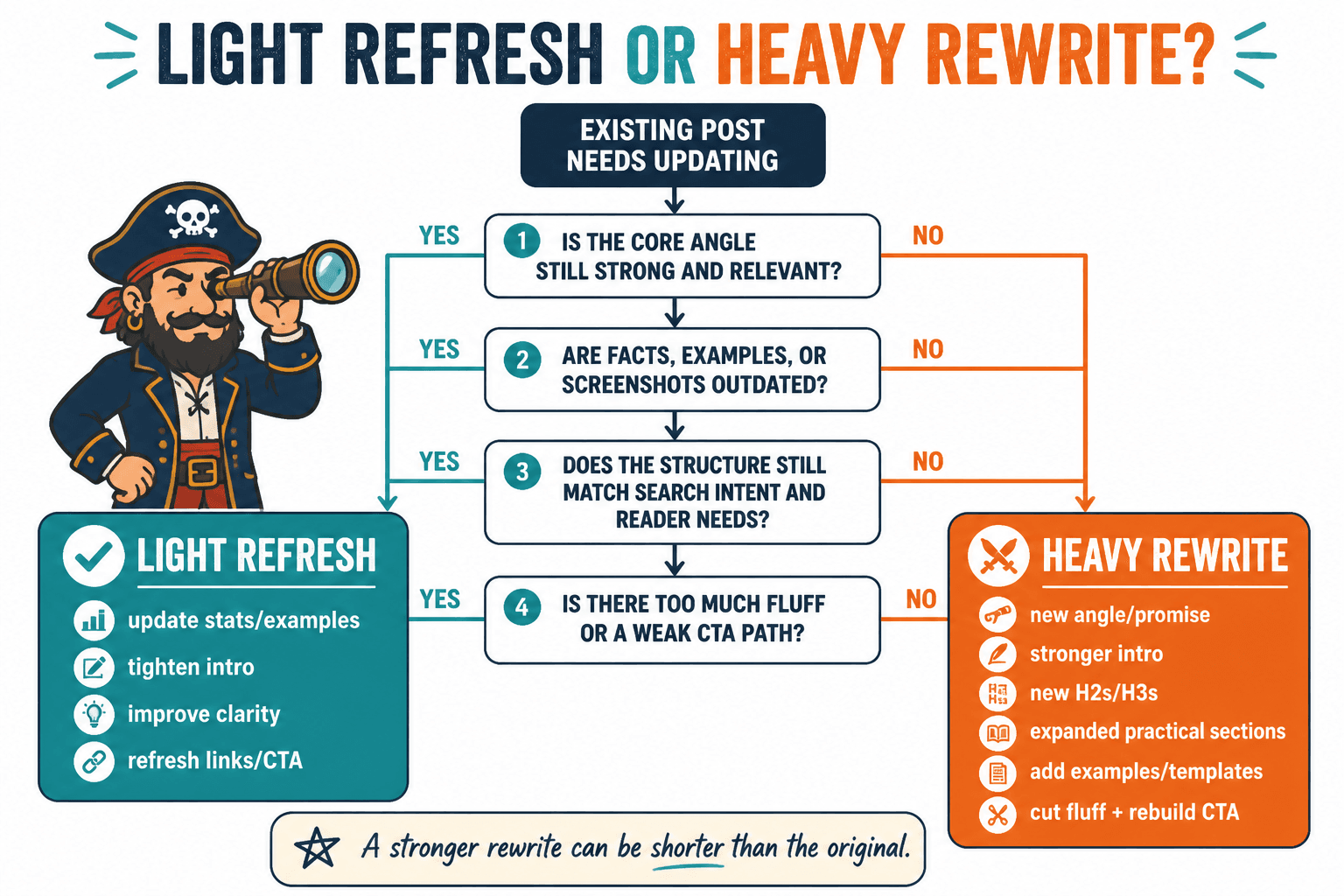
A heavy rewrite makes sense when the post is technically on-topic but not doing the job anymore.
That usually looks like this:
- The article targets a broad keyword but fails to answer the real question.
- The intro meanders and hides the payoff.
- The subheads are vague.
- The examples are generic or outdated.
- The structure feels like a list of notes, not a coherent article.
- The post sounds suspiciously like an AI intern fed oatmeal and optimism.
In these cases, the update may involve rewriting 40% to 70% of the piece. Not because longer is inherently better, but because too much of the current version is not pulling its weight.
A proper heavy rewrite might include:
- a new angle or promise
- a stronger intro
- new H2s and H3s
- expanded practical sections
- examples, templates, or mini-frameworks
- cuts to repetitive fluff
- a rebuilt CTA path
And yes, that can result in the final article being shorter than before. People really hate hearing that, but a bloated article can lose a thousand words and become much stronger.
For help tightening stale content without making it sound sterile, see how to improve blog rewrites and refreshes stale post fixes without sounding generic.
Good rewrite length by article type
Different kinds of posts age differently, so they do not all need the same update length.
| Article type | Usually needs | Typical refresh pattern |
|---|---|---|
| How-to guide | Accuracy, clearer steps, screenshots, examples | Moderate to heavy if the process changed |
| List post | Pruning weak items, better selection criteria, fresher examples | Moderate refresh or partial rebuild |
| Opinion/strategy piece | Sharper framing, updated market context, stronger proof | Light to moderate if the idea still holds |
| Tool comparison | Major factual updates, feature changes, new options | Heavy refresh often needed |
| Evergreen explainer | Better structure, current examples, intent fit | Light to moderate unless the original was thin |
| Case study | New outcomes, added commentary, clearer takeaways | Usually moderate, sometimes full rewrite for stronger story flow |
This is why blanket rules are mostly useless. “Every refresh should add 20% more content” is the kind of advice that sounds tidy and creates a lot of mediocre articles.
A simple framework for deciding rewrite length
If you want something fast and usable, score the article on these four areas before touching the draft.
- Intent fit: Does it answer what the reader likely wants now?
- Content quality: Is it clear, useful, specific, and well structured?
- Freshness: Are examples, tools, references, and terminology current?
- Conversion path: Does the post lead naturally to a next step?
Score each one from 1 to 5.
- 16 to 20 total: Light refresh
- 11 to 15 total: Moderate refresh
- 6 to 10 total: Heavy rewrite
- 4 to 5 total: Rebuild from scratch, frankly
This keeps you from over-editing solid posts and under-editing bad ones. Both happen constantly.
What to add first before adding length
If you are going to expand an article, add substance before size.
That means prioritizing:
- clearer explanations
- specific examples
- better subheads
- step-by-step guidance
- useful comparisons
- updated screenshots or process notes
- decision-making frameworks
- stronger transitions
- more relevant CTA language
Do not just add filler paragraphs that say the same thing three different ways in a nicer sweater. Readers can feel padding. Search engines are not exactly charmed by it either.
One of the best refresh moves, honestly, is replacing weak abstraction with concrete specifics. Not “content quality matters,” but “your intro buries the answer for six lines and your examples say nothing memorable.” That is the kind of clarity people can use.
If you are dealing with a bland, overpolite original draft, this should help: how to rewrite boring blog rewrites and refreshes.
Signs your refresh is getting too long
Yes, this happens. A lot.
Here are the warning signs:
- You are adding sections because competitors have them, not because your reader needs them.
- You keep repeating the same advice with slightly different wording.
- You are “rounding it out” with generic background information.
- The answer gets slower as the article gets longer.
- The new sections are informative-ish but not necessary.
- You are trying to make the post look more complete instead of making it more useful.
That last one is the killer. A lot of content teams are not improving articles. They are decorating them with respectable-looking extra paragraphs.
Very elegant waste of time.
Signs your refresh is too short
A tiny update is not efficient if it leaves the real problems untouched.
Your refresh is probably too short if:
- you updated the year in the title and not much else
- the intro still misses the core question
- the article is still thinner than the current search landscape
- the formatting improved but the substance did not
- the post still lacks examples, proof, or specificity
- the CTA is still weak or disconnected
This is where a lot of “content refreshes” quietly become fake maintenance. They look active in a spreadsheet. They do not actually make the article better.
How to refresh length without turning the post into sludge
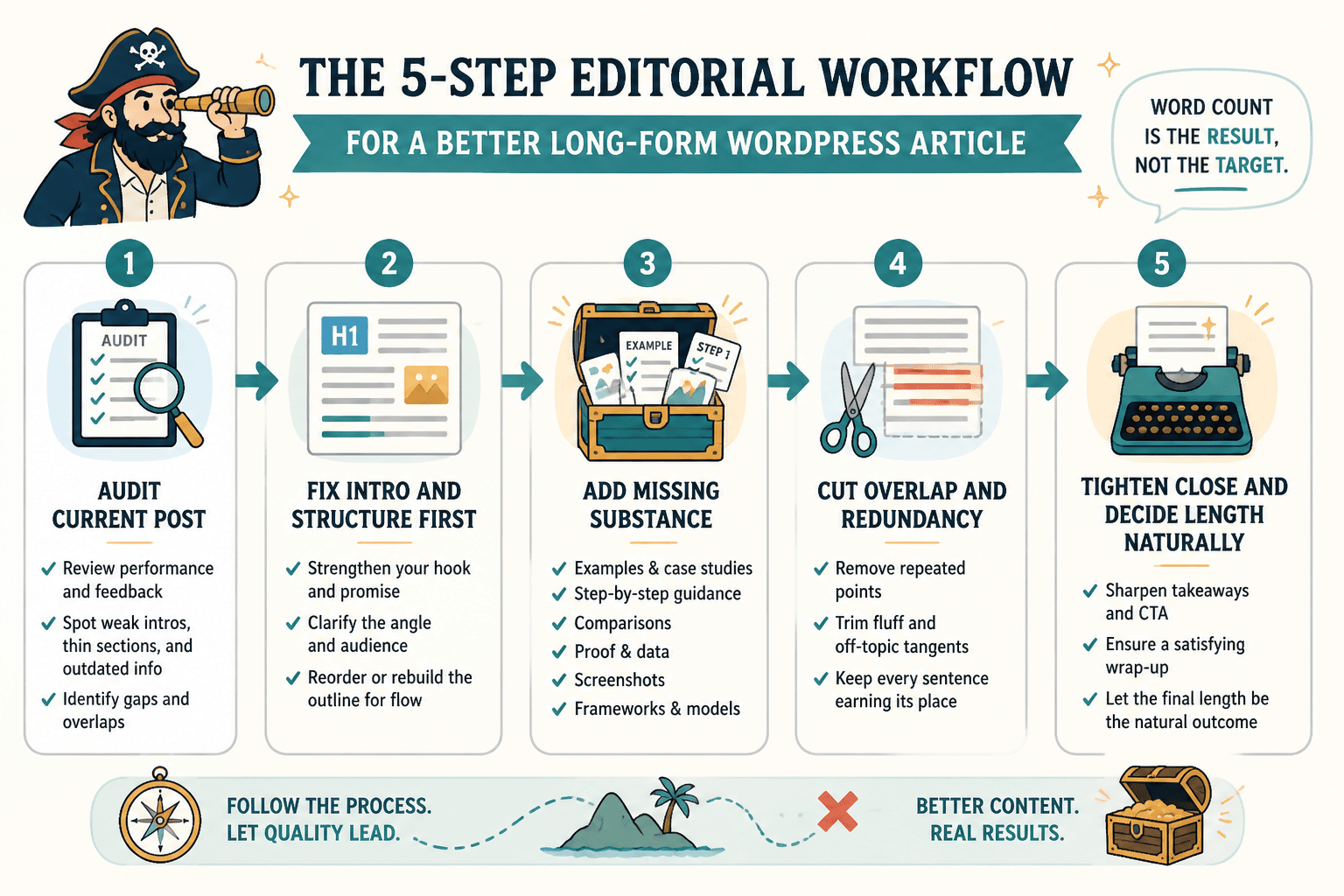
Here is a clean process that works well for most update projects.
- Audit the current article. Mark what is outdated, weak, repetitive, missing, and still solid.
- Check current search intent. What does the reader appear to want now?
- Preserve the good parts. Do not rewrite strong sections just to feel productive.
- Fix the intro and structure first. This changes the whole reading experience fast.
- Add missing substance. Examples, steps, comparisons, proof, screenshots, or frameworks.
- Cut overlap. If two sections do the same job, one goes.
- Tighten the close. A better CTA often matters more than another explanatory paragraph.
That process tends to produce the right length naturally. Which, inconveniently for people who love easy formulas, is usually the best way to get there.
And if you are building updates from older material rather than only editing in place, read how to turn old content into better blog rewrites and refreshes.
Internal linking and structural updates count too
One reason people misjudge rewrite length is they only count visible paragraphs. But a strong refresh often includes structural improvements that are not just “more text.”
- better internal links
- cleaner heading hierarchy
- table additions
- improved scannability
- tighter intros and conclusions
- better anchor phrasing
- stronger CTA placement
Those changes can materially improve performance without massively increasing the word count. Which is another reason word count alone is a pretty clumsy metric.
If you want to explore more systems around article structure and SEO writing, these may help:
Quick FAQ
Should a refreshed blog post always be longer?
No. It should be better. Sometimes that means expanding thin sections. Sometimes it means cutting fluff.
How much of a post should I rewrite before it counts as a rewrite, not a refresh?
Roughly speaking, once you are changing around 35% or more of the substance, structure, or angle, you are in rewrite territory.
The bigger point is simple: clearer structure and clearer writing make the piece more useful. That is usually what makes the ending land better too.