
Most small creators do not have a funnel problem. They have a fantasy problem.
They think they need a sprawling system with five email sequences, three lead magnets, a webinar nobody asked for, and a booking page that feels like it was assembled during a minor identity crisis. What they usually need is much simpler: a clear path from attention to trust to action.
That is the real job of Creator Funnels for Creators With Small Audiences. Not scale theater. Not complicated automation for an audience of 183 people. Just a useful, believable path that helps the right people move one step closer.
If your audience is small, your funnel needs to be sharper, not bigger. It should help people understand what you do, why it matters, and what to do next without making them feel like they have wandered into a dehydrated internet marketing labyrinth.
Here’s how to build a creator funnel that fits a small audience, respects trust, and can actually lead to inquiries, subscribers, buyers, and conversations instead of polite silence.
For the full path around this topic, head to the parent guide.
Why small creators need different funnels
Big creators can get away with sloppy funnels because volume covers a lot of sins. If enough people see the top of the funnel, some of them will eventually click something, join something, buy something, or accidentally fall into a nurture sequence.
Small creators do not have that luxury.
When your audience is small, every part of the funnel has to carry its weight. Your profile matters more. Your content has to make clearer promises. Your call to action cannot be vague. Your offer has to make sense for the level of trust you have actually earned.
This is also why copying giant creators usually goes badly. Their funnel often depends on scale, broad awareness, social proof, or a brand halo you do not have yet. If you try to mimic that with a small audience, you often end up with a funnel that looks professional but converts like a damp paper bag.
Small-audience funnels work best when they are:
- Simple enough to maintain
- Specific enough to attract the right people
- Trust-first instead of pitch-first
- Built around one clear next step
- Close to your actual offer, not a random freebie with no connection
If you want a broader overview of funnel structure before getting tactical, this related guide on creator funnels is a useful companion.
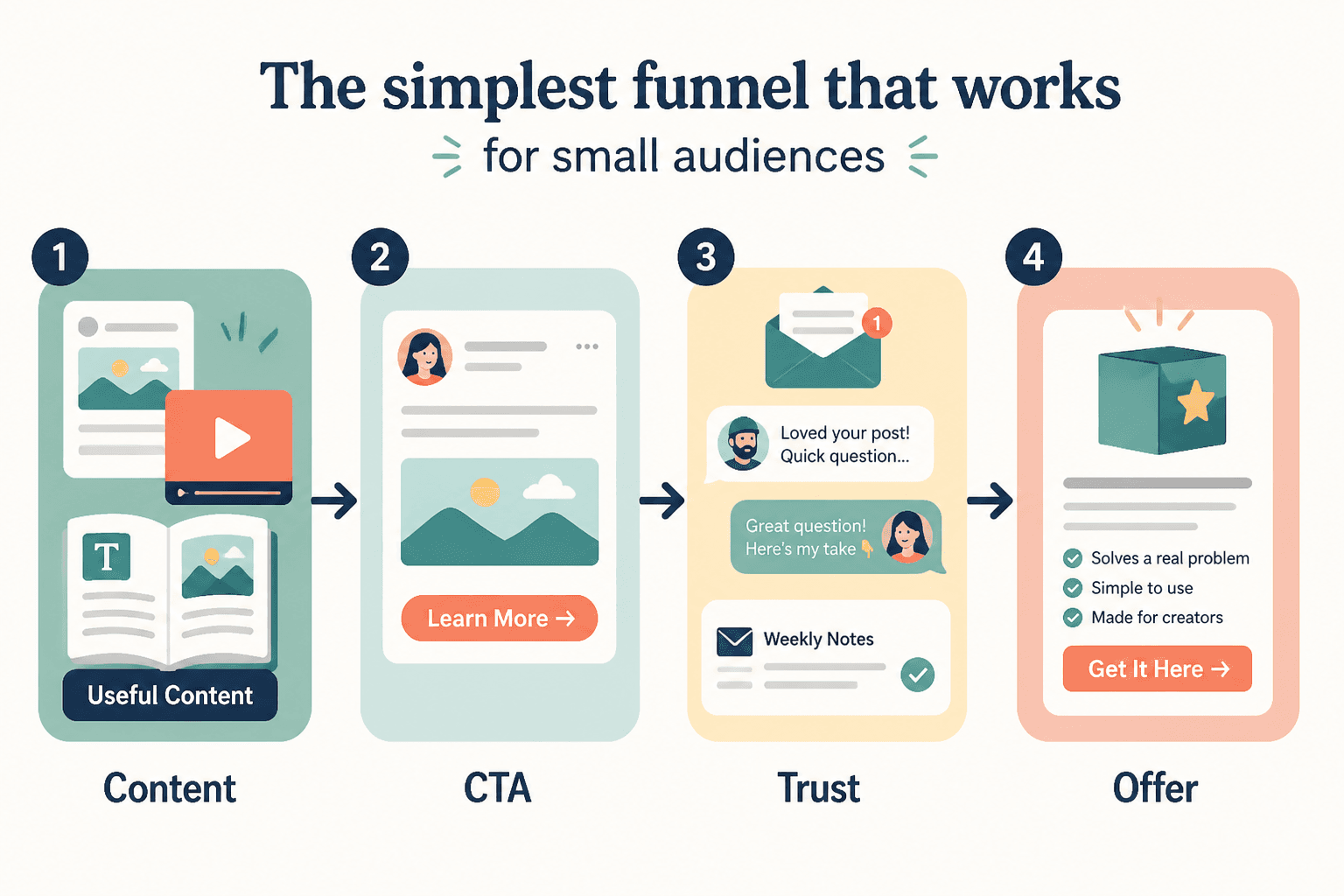
The simplest funnel that actually works
For most creators with small audiences, the best funnel is not complicated. It looks something like this:
- Useful content gets attention
- Profile or post CTA points to one relevant next step
- The next step builds trust or starts a conversation
- A simple offer invitation appears at the right moment
That is it. No need to cosplay as a software company.
The four pieces
- Top of funnel: Posts, threads, articles, videos, comments, guest appearances
- Bridge step: Profile CTA, lead magnet, newsletter signup, DM prompt, resource page
- Trust layer: Email sequence, useful resource, case study, welcome page, consultation qualifier
- Conversion step: Booking page, paid offer, product page, application, soft sales conversation
The point is not to create as many steps as possible. The point is to remove friction while keeping relevance high. A small audience does not need more moving parts. It needs fewer dead ends.
Start with the right goal, not a vague desire to “monetize content”
A lot of creator funnels fail before they start because the creator has not decided what the funnel is supposed to do. “Get leads” is too fuzzy. “Grow audience” is not a funnel goal. “Make money somehow” is just panic wearing a blazer.
Pick one primary outcome first. For a small audience, the cleanest options are usually:
- Book discovery or consulting calls
- Grow an email list of relevant subscribers
- Sell a low-ticket product
- Get qualified replies or DMs
- Move readers toward one signature service
Once you know the goal, you can build the path backward.
A simple backward-planning method
- What is the final action you want?
- What level of trust does that action require?
- What content would make that trust easier to build?
- What next step feels natural after that content?
Example:
- Final action: Book a strategy call
- Trust required: Reader must believe you understand their problem and can help
- Content needed: Posts with useful insights, examples, proof, mistakes, mini case studies
- Next step: Visit profile and download a relevant guide or read a case study page
That gives you a real funnel. Not just a pile of disconnected assets.
Best creator funnel types for small audiences
Not every creator needs the same funnel. The right one depends on your offer, trust level, and how people usually buy from you. Still, a few funnel types consistently work well when the audience is small.
1. Content to profile to booking page
This works well for consultants, coaches, service providers, and freelancers with a clear offer.
- Post useful content
- Use a profile that clearly says who you help and how
- Point interested people to a booking page or inquiry page
This is often enough when your offer is high-value and your content is specific. You do not always need a lead magnet in the middle. Sometimes adding one just slows down people who were already interested.
2. Content to lead magnet to email nurture to offer
This works well when your offer needs more education or your audience needs more warming up before buying.
- Post about a painful or expensive problem
- Offer a relevant free resource
- Send a short email sequence with useful guidance and proof
- Invite the reader to the next logical offer
The keyword here is relevant. A lead magnet should connect directly to what you sell. If you offer brand messaging services, your free resource should not be a random productivity checklist because you got bored and made one on a Tuesday.
3. Content to newsletter to soft sell
This is strong for writers, educators, niche experts, and creators building long-term trust.
- Use content to attract the right readers
- Invite them to a newsletter with a clear promise
- Deliver useful ideas consistently
- Introduce offers naturally through examples, stories, and direct invitations
This model is especially good for small audiences because it compounds. The list becomes your trust asset, not just your distribution channel.
4. Content to conversation to offer
This is underrated.
If your audience is small but relevant, you may not need to force everyone through a formal funnel. Sometimes the best path is content that starts good conversations, then moves naturally to DMs, comments, or email replies where you can qualify fit and make a tailored invitation.
This works especially well on platforms where discussion matters and for offers that benefit from context. It can be cleaner, faster, and more human than making everyone click through a mini obstacle course.
For more practical structures, you could pair this article with simple creator funnels, offer paths, and templates for busy creators and best funnel ideas to pair with creator funnels.
What small creators keep getting wrong
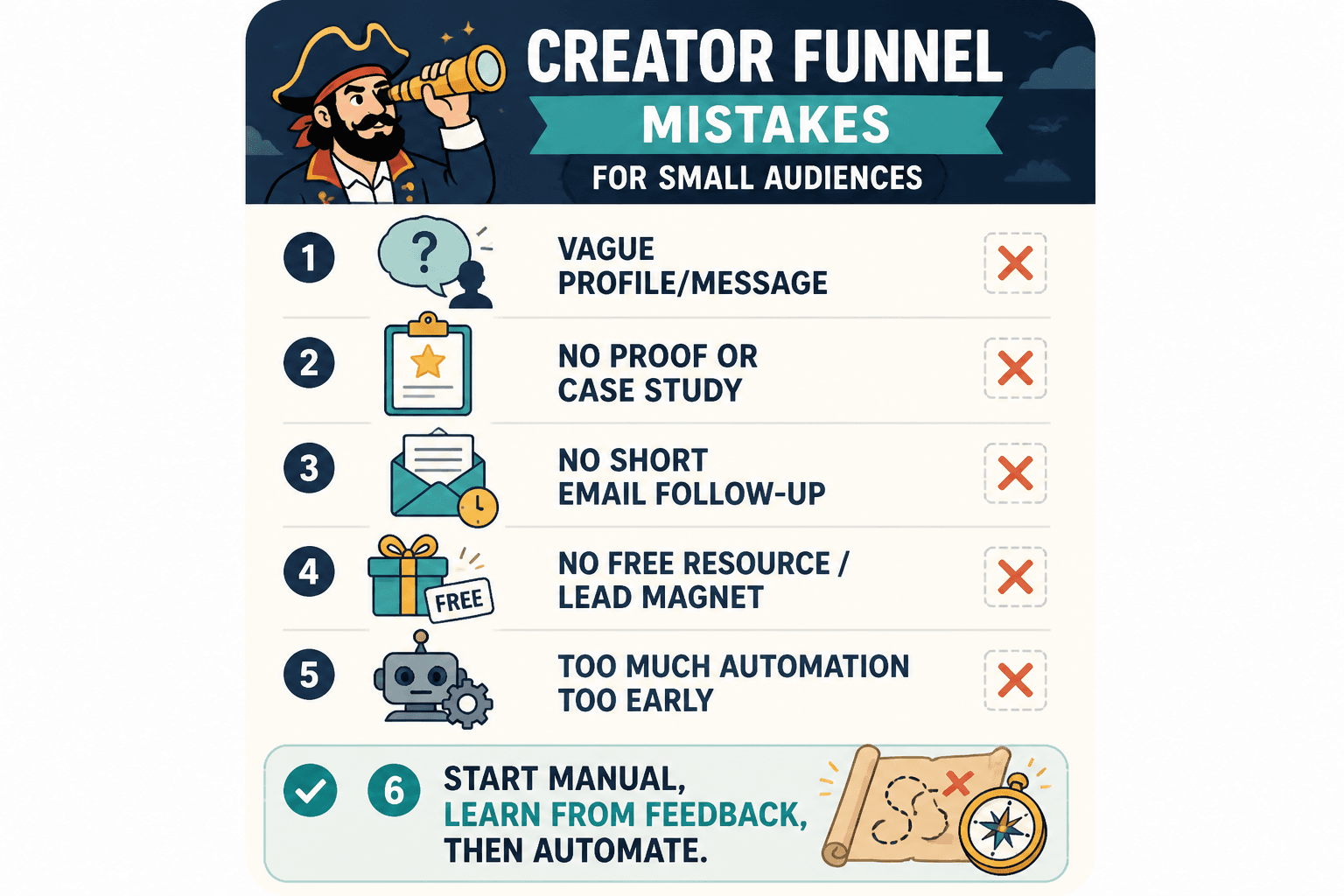
If your funnel is underperforming, there is a good chance the issue is not traffic. It is usually one of these:
Your content and offer do not match
If your posts attract people interested in broad inspiration, but your offer is a technical service for a niche buyer, your funnel will feel confusing from the start. The content needs to attract the kind of person who could plausibly want the offer.
Your CTA is too weak
“Let me know your thoughts” is not a funnel. Neither is “check the link in bio” if the link leads to a page with nine options and a vague mood.
A stronger CTA sounds more like:
- “If you want the full checklist, grab it here.”
- “If this is the bottleneck in your business, book a call.”
- “If you want more of this, the newsletter goes deeper.”
- “If you want help applying this, reply with ‘audit’ and I’ll send details.”
You are asking for too much trust too early
Cold readers usually do not want to jump straight from one decent post to a $3,000 offer. That does not mean your offer is too expensive. It means the bridge is missing.
Maybe they need:
- A better profile explanation
- A case study
- A short email sequence
- A free resource
- A lower-friction first conversation
You built for automation before you built for clarity
Automation is useful after the path works. Before that, it mostly helps you send confusion faster.
With a small audience, manual and semi-manual funnels are fine. Better than fine, actually. You get feedback faster. You can hear objections. You can see where people drop off. You can fix the real problem instead of staring at a dashboard like it insulted you personally.
How to build a small-audience funnel step by step
Step 1: Choose one audience slice
Do not build a funnel for “entrepreneurs” or “creators” if you can help it. Go narrower.
Examples:
- Coaches who need clearer LinkedIn positioning
- Freelance designers trying to get better inbound leads
- Consultants who want content that leads to calls
- Writers building a paid newsletter around a niche subject
The smaller your audience, the more useful specificity becomes.
Step 2: Pick one core problem
A good funnel usually converts around one painful, expensive, or annoying problem. Not all your expertise at once. Not your full range of talents. Pick the issue that your content can repeatedly address and your offer can clearly solve.
Step 3: Create one relevant next step
Your next step should match the audience and the offer.
| Offer type | Best next step |
|---|---|
| High-ticket service | Booking page, case study page, audit request |
| Coaching or consulting | Application, consult call, private message prompt |
| Low-ticket product | Direct sales page, email signup with product intro |
| Newsletter business | Email signup with a strong promise |
| Course or workshop | Waitlist, free lesson, mini guide |
If you need examples, these creator funnel ideas and examples can help you choose a structure that fits what you sell.
Step 4: Make your profile do actual work
For small creators, the profile is part of the funnel, not decoration.
Your profile should quickly answer:
- Who do you help?
- What do you help them do?
- Why should they trust you?
- What should they do next?
If someone likes a post and clicks your profile, they should not have to perform forensic analysis to figure out what happens next.
Step 5: Publish content that matches the funnel stage
This matters more than people think. Not all content should do the same job.
- Attention content: sharp opinions, useful tips, pattern recognition, mistakes, myths
- Trust content: examples, frameworks, case studies, behind-the-scenes process, proof
- Conversion content: offer explanation, objections, fit, outcomes, CTA-focused posts
If every post is trying to close the sale, people tune out. If every post is vague value with no next step, nothing moves.
Step 6: Add a small trust layer
This is where many small creators improve results fast. They do not need a giant funnel rebuild. They just need one trust-building asset between content and offer.
That trust layer could be:
- A 3-5 email welcome sequence
- A short guide with real substance
- A case study page
- A “start here” page
- A short FAQ page for your service
- A few strong testimonials placed where people can actually see them
Simple beats elaborate here. Give people enough confidence to keep moving.
Step 7: Measure useful signals
For small audiences, raw traffic numbers can be misleading. Better signals include:
- Profile visits from relevant people
- Email signups from the right audience
- Replies and conversations
- Qualified call bookings
- Lead magnet completion quality, not just downloads
- Sales conversations started
A small audience of the right people can outperform a larger audience of mildly curious spectators who will never buy anything but still somehow have opinions about your button color.
Three practical funnel examples for small creators
Example 1: Consultant selling strategy calls
- Content: LinkedIn posts about common growth mistakes and sharper strategy
- Profile CTA: Book a 30-minute strategy call
- Trust layer: Short case study page plus 3 testimonials
- Offer: Paid advisory session or retainer
Why it works: the path is direct, and the content pre-qualifies the reader by topic.
Example 2: Writer growing a niche newsletter
- Content: X threads and articles unpacking industry trends
- CTA: Subscribe for deeper weekly analysis
- Trust layer: Welcome email with best essays and what readers can expect
- Offer: Paid newsletter tier or sponsored consulting
Why it works: the free content proves taste and thinking, and the newsletter naturally extends the value.
Example 3: Coach with a small but relevant audience
- Content: Facebook and LinkedIn posts addressing a specific coaching problem
- CTA: Download a short framework or reply with a keyword
- Trust layer: Email sequence with examples, client wins, and common mistakes
- Offer: Discovery call or group program invitation
Why it works: the bridge step creates context before the offer, which matters when the audience is small and trust is still being built.
For a broader walkthrough, see this guide for creators who want better funnel results.
How to know if your funnel is too complicated
Ask these questions:
- Can I explain the path in one sentence?
- Does each step make the next one more likely?
- Does the free thing clearly connect to the paid thing?
- Would a real person understand what to do next in under ten seconds?
- Am I maintaining this system consistently, or just admiring its architecture?
If the answer to that last one is painful, good. That means we are getting somewhere.
A small-audience funnel should usually feel light enough to run without a team, clean enough to understand at a glance, and focused enough that each content piece points in roughly the same direction.
Creator funnels get better when the path feels simpler and the writing makes each next step obvious. A cleaner message usually fixes more than extra funnel complexity ever will.