
A draft About page has a funny habit of looking nearly done while still missing the actual point. The intro is warm but vague, the proof section reads like a résumé that got tired halfway through, and the CTA is sitting there like it forgot what job it applied for. That is exactly where examples help. They show the shape of the page before the polish goes on, so the copy stops drifting and starts doing something useful.
If you want the broader strategy behind the page, start with the About page copy guide. This article stays in the examples lane: openings, credibility blocks, and full-page patterns you can adapt without turning your About page into a small monument to yourself.
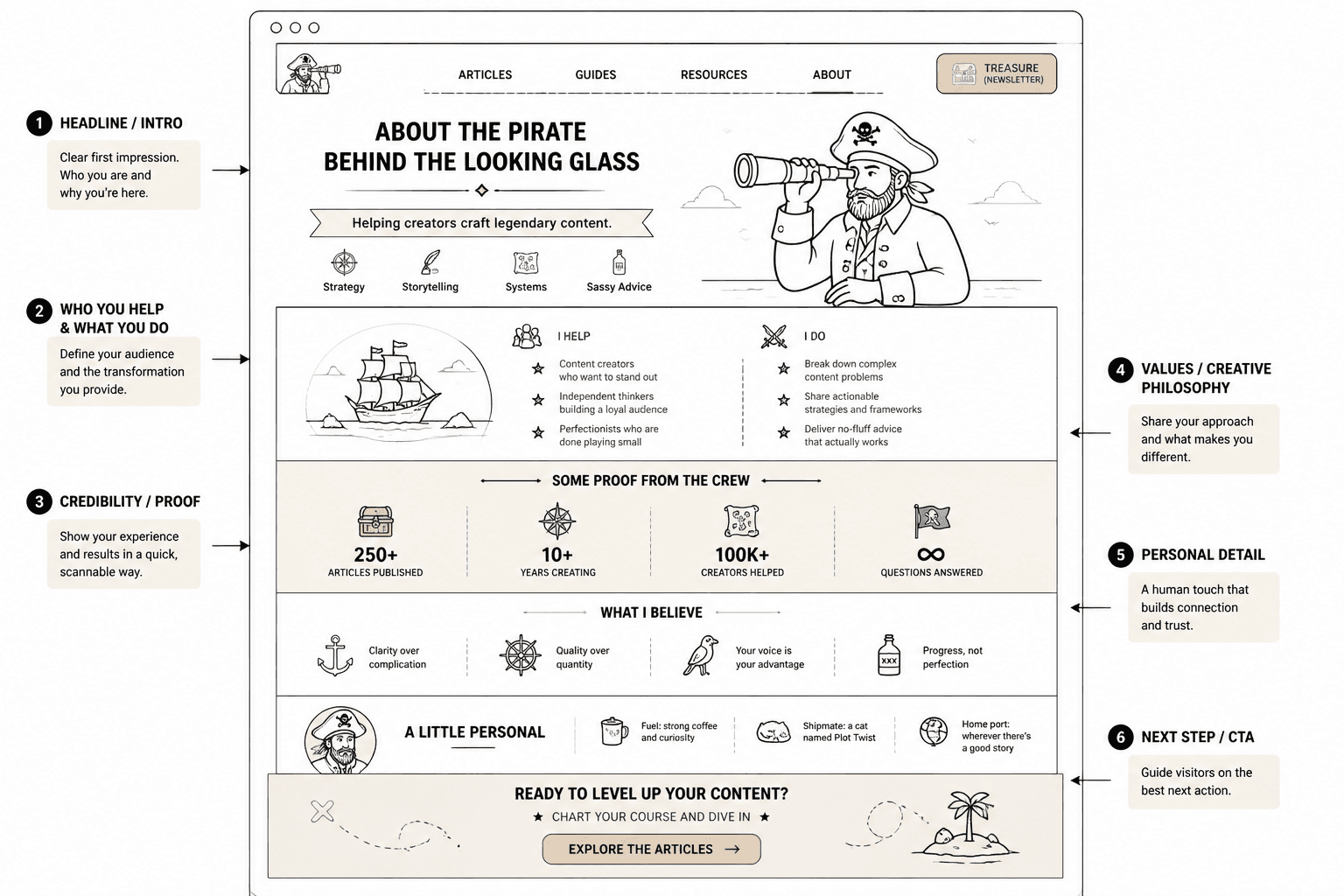
What good About page copy actually needs to do
A good About page is not there to host a biography in the decorative sense. It needs to help the right visitor answer a few fast questions:
- Who are you?
- Who do you help?
- Why should I trust you?
- What kind of person or business are you?
- What should I do next?
That is the whole game. The best examples do not try to sound impressive at every line. They make the page easy to understand, easy to trust, and easy to continue from.
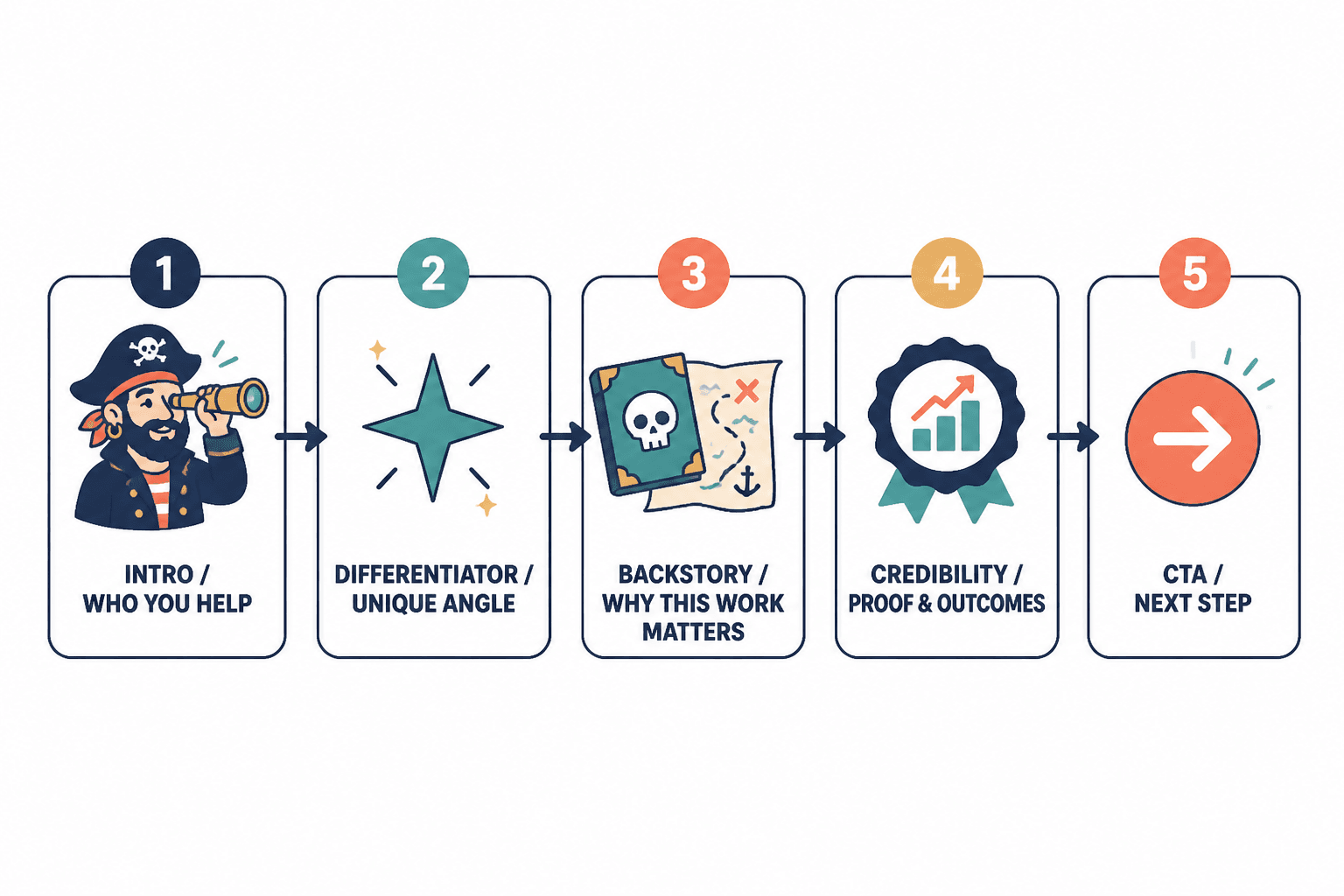
About page opening examples that do the job fast
Most openings fail for one simple reason: they spend too long warming up. You do not need five sentences to say what you do, who it is for, and why it matters. The opening has one job: orient the reader without making them work for it.
1. The clear positioning opening
Best for: creators, consultants, service providers, and anyone whose offer can be explained in plain English.
Template:
I help [audience] do [result] without [common frustration]. I do that through [service, content, or method], with a focus on [point of difference].
Example:
I help creative business owners write website copy that sounds like a real person and still sells. My work focuses on clear messaging, practical structure, and the kind of words people can actually use.
2. The audience-problem opening
Best for: pages that need to speak directly to a pain point or confusion.
Template:
If [audience] keeps running into [problem], the issue is usually not [wrong assumption]. It is often [real problem], and that is where I come in.
Example:
If your About page feels oddly hard to write, the problem is usually not that you lack a story. It is that the page is being asked to do too many jobs at once, so the message gets blurry before it gets useful.
3. The point-of-view opening
Best for: brands with a clear opinion, method, or philosophy.
Template:
I believe [principle]. That is why I [approach] instead of [common alternative].
Example:
I believe good website copy should sound human before it sounds clever. That is why I build pages around clarity, reader momentum, and proof that earns its place instead of eating the whole screen.
4. The credibility-first opening
Best for: creators who already have a strong background, niche experience, or a recognizable body of work.
Template:
For [timeframe], I have [done relevant work] for [type of client or audience]. Now I help [audience] with [specific result].
Example:
For years, I have worked on website messaging for creators and small brands that need their copy to do more than sound polished. Now I help them turn scattered ideas into pages that are easier to read, easier to trust, and easier to act on.
5. The story-lean opening
Best for: personal brands that need a little narrative without turning the page into a memoir.
Template:
It started when [brief origin point]. Since then, I have [what changed], and now I [current focus].
Example:
It started with a lot of drafts that sounded almost right and still missed the mark. Since then, the focus has been on writing copy that helps people understand an offer quickly, trust what they are seeing, and move forward without a scavenger hunt.
Notice what these openings have in common: they are specific, they are not trying too hard, and they tell the reader where they are. That is the real job.
Credibility block examples that do not turn into bragging
A lot of About pages either skip credibility entirely or dump too much of it in at once. The useful middle ground is a block that gives the reader enough proof to trust the page without forcing them through a full career summary.
Here are the credibility block types that tend to work best.
1. The specific experience block
Template:
I have spent [timeframe] helping [audience] with [kind of work], especially when [common challenge].
Example:
I have spent years helping creators and service providers shape website copy when the offer is solid but the message still needs tightening.
2. The audience-fit block
Template:
I work best with [audience] who [trait or situation], because [why that fit matters].
Example:
I work best with people who know their work matters but do not want their website to sound inflated, precious, or half-borrowed from a corporate brand deck.
3. The proof-by-results block
Template:
That usually means [result], [result], and [result].
Example:
That usually means clearer positioning, fewer vague filler lines, and a page that actually leads somewhere useful.
4. The recognisable proof block
Template:
My work has appeared in / supported / been used by [credible proof point].
Use this only if it is real.
Recognisable proof should be brief and plain. One solid signal is enough. A credibility block is not a trophy shelf.
5. The mini-testimonial block
Template:
[Short testimonial quote about the experience or result.]
Use this only if it is real.
Mini-testimonials work best when they sound specific, not theatrical. “Clear, easy to follow, and actually sounds like me” does more work than three paragraphs of applause.
If you want a deeper breakdown of how these proof sections work, the related article on Simple About Page Credibility Block Templates for Busy Creators is a useful companion page when it is live. Until then, keep the rule simple: one block, one job, no confetti cannon.
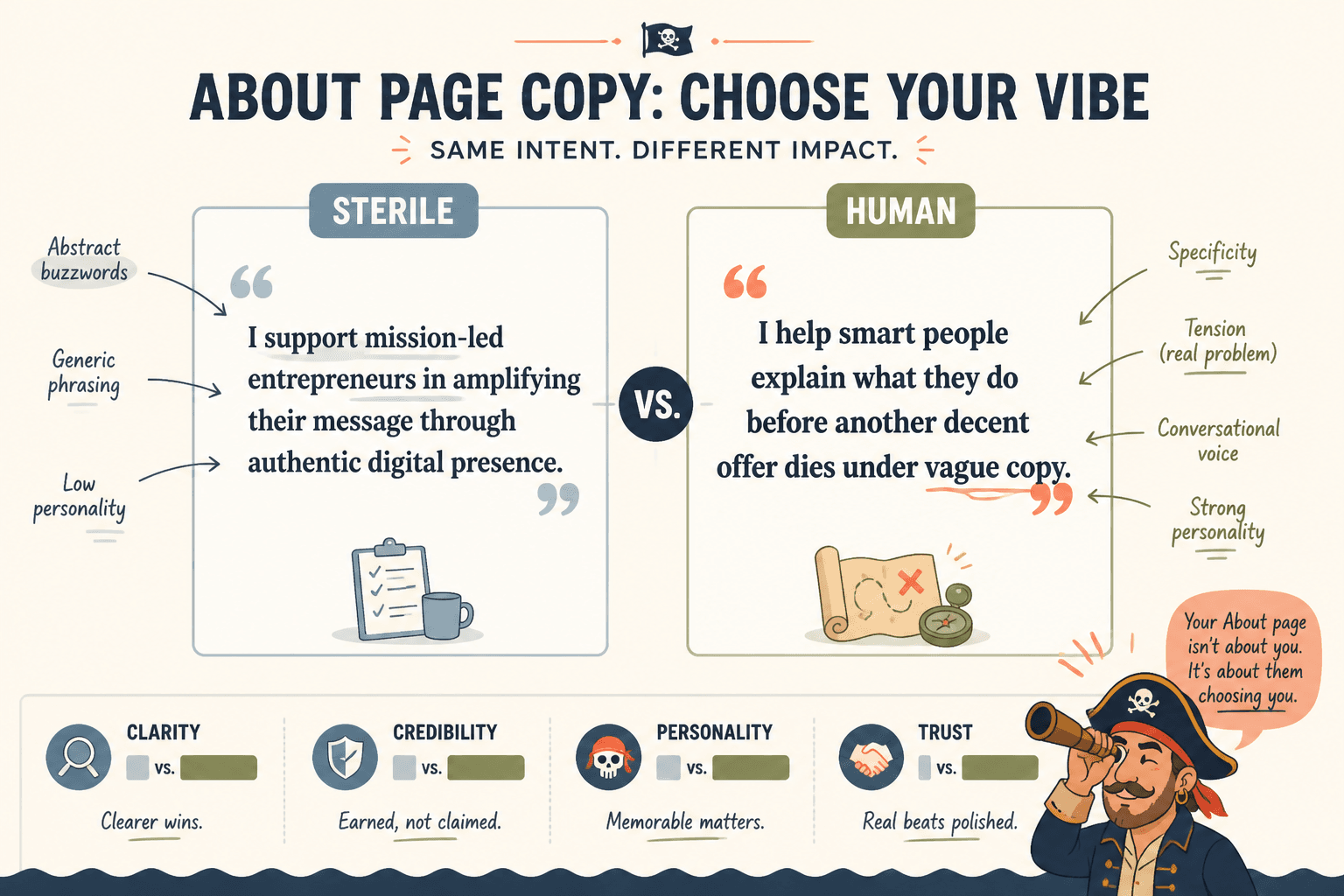
Full About page copy examples you can adapt
Openings and credibility blocks are useful, but full-page structure is where the About page starts to feel like a real page instead of a collection of nice-sounding fragments. Below are a few adaptable patterns.
Example 1: Simple creator About page
Structure:
- clear opening
- short background note
- what you help people do
- one proof point
- personality line
- call to action
Example copy:
I help creators turn unclear ideas into website copy that makes more sense to the people reading it. The work usually starts with a mess of notes, a half-finished bio, and a page that is trying to sound polished while saying almost nothing. My job is to fix that.
Over time, I have learned that strong About page copy is not really about self-description. It is about helping the right reader feel oriented, informed, and reassured enough to keep going.
If that is the part your page keeps missing, start with the guide to About page copy and build from there.
Example 2: Coach or consultant About page
Structure:
- positioning opening
- reader pain point
- how you work
- why your approach is different
- light credibility
- CTA
Example copy:
I work with service-based businesses that are ready to stop describing themselves in vague, nervous paragraphs. The goal is not to sound bigger than you are. The goal is to sound clear enough that the right people know they are in the right place.
My approach is simple: define the offer, sharpen the message, remove the dead weight, and leave enough personality intact that the page still feels human.
If your About page is doing a little too much explaining and not enough connecting, it may be time to simplify the structure.
Example 3: Personal brand About page
Structure:
- story-lean opening
- what changed
- what you now help with
- values or point of view
- next step
Example copy:
The work started with a lot of draft pages that had the right ingredients and the wrong energy. That led to a better question: how do you write About page copy that sounds thoughtful, not theatrical?
The answer usually involves fewer adjectives, more specifics, and a structure that helps the reader understand the offer without decoding it like a puzzle.
If you want a page that feels grounded and useful, the next step is usually not more personality. It is better sequencing.
Example 4: Service provider About page
Structure:
- what you do
- who it is for
- how you work
- proof or trust signal
- friendly CTA
Example copy:
I help small brands, founders, and creators write copy that sounds like a real person and still supports the business. That usually means turning rough notes into a cleaner message, then turning that message into pages people can actually read.
The copy does not need to be dramatic. It needs to be accurate, steady, and clear enough to move a visitor from curiosity to confidence.
If you want help with that, start with the page structure first. The words become much easier after that.
What weak About pages keep doing wrong
Examples are useful partly because they make the weak patterns obvious.
1. They open with fog
Bad:
Welcome to my corner of the internet, where I share my passion for creative transformation.
Why it fails: nothing here tells the reader who you help or why they should stay.
2. They talk about the writer for too long
Bad:
I have always loved storytelling, communication, and meaningful connections.
Why it fails: that may be true, but it is not yet useful.
3. They treat proof like a pile of receipts
Bad:
Here are twelve things I have done, followed by six awards, two certifications, and a paragraph that still does not say what changed for the reader.
Why it fails: proof should support the page, not bury it.
4. They never bridge back to the reader
Bad About pages can describe the founder beautifully and still forget the visitor exists. If the page cannot connect your story to the reader’s situation, it is decoration.
5. They end with a dead CTA
Bad:
Get in touch.
Better:
If you want copy that is clear, grounded, and built around your actual offer, start with the guide, then look at what your page needs most.
Not every CTA has to be dramatic. It just has to be helpful.
How to adapt About page examples without sounding copied
The safest way to use examples is to borrow structure, not phrasing. That means you keep the shape and swap in your own language.
- Replace generic labels with your real audience. “Creators” is fine. “Independent illustrators selling commissions and digital products” is better if that is the actual audience.
- Keep one clear proof point. More is not always better. One real signal beats five hazy ones.
- Say what the reader gets. The page should not only describe you; it should explain why your existence matters to them.
- Cut the filler lines. If a sentence exists only to sound polished, it is probably blocking the useful one.
- Make the CTA specific. Invite the next step, not a mystical life journey.
If you are building the page from scratch, the parent guide is the best place to start. If you already have a rough draft, these examples should help you see which parts are doing real work and which parts are just occupying space.
A simple About page formula you can use today
When the page feels scattered, this sequence usually helps:
- Who you help
- What problem you solve
- Why your approach is credible
- A little personality or point of view
- A useful next step
That formula is not fancy. It is also the point. Good About page copy does not need to perform gymnastics. It needs to give the visitor enough clarity to keep reading without needing a decoder ring.
Final takeaway
About page copy examples are most useful when they act like scaffolding. They show you where the opening should land, how much proof is enough, and how to tie your story back to the reader without sounding like you are auditioning for your own biography. Use the examples, steal the structure, then make the language yours.
That is usually the difference between a page that sounds assembled and a page that sounds intentional.