
Most audience-to-offer journeys do not fail because the offer is terrible. They fail because the opening feels vague, slow, needy, or instantly transactional.
You can feel it when it happens. A post starts with fluff, a landing page opens with empty “value,” an email meanders for three paragraphs, and by the time the actual point shows up, the reader has already mentally left the building.
If you want to know How to Start Audience-to-Offer Journeys Without a Weak Opening, the fix is not “be more persuasive.” It’s simpler than that. Start with a sharper entry point. Give the audience a reason to care before you ask them to click, opt in, reply, or buy.
This is about building momentum from the first line. The opening should create relevance, trust, and direction. It should make the next step feel natural, not like a sales funnel wearing a fake moustache.
For the full path around this topic, head to the parent guide.
What a weak opening actually does to your funnel
A weak opening does more damage than most creators think. It does not just lower engagement. It breaks the whole audience-to-offer sequence before it has a chance to work.
When the first touchpoint is boring, generic, or oddly pushy, people make a fast decision: this is not for me, this is not interesting, or this person wants something from me already. None of those reactions help conversion.
That matters because audience-to-offer journeys are built on micro-yeses. Read this. Agree with this. Trust this. Click this. Consider this. If the first step feels weak, every later step gets heavier.
- Weak openings create confusion: people do not know what the content is about or why it matters.
- Weak openings kill momentum: the reader has no reason to continue.
- Weak openings lower trust: vague language sounds like recycled marketing paste.
- Weak openings make the offer feel premature: if the setup is thin, the CTA feels like a grab.
So yes, your opening is part of your conversion system. Not the glamorous part. But definitely the part people keep messing up.
The job of the opening in an audience-to-offer journey
The opening is not there to impress people with your vocabulary, tease fake mystery, or perform a TED Talk version of “good morning.” It has a job.
A strong opening should do at least two of these four things right away:
- Signal who this is for
- Name a real problem or desire
- Create tension, contrast, or curiosity
- Point toward a useful next step
If it does all four, great. If it does none, you are probably writing throat-clearing copy and hoping the audience will politely hang around until you get to the point. They won’t.
The best openings are usually specific, fast, and grounded in something the reader already cares about. Not your brand mission. Not your process. Not your dream of “serving at scale.” Their problem. Their friction. Their stalled result.
That means the opening should feel like the start of a useful path, not a preamble. If you’re building a content funnel, a lead magnet funnel, an email sequence, or a soft-sell journey from posts to offers, this principle stays the same.
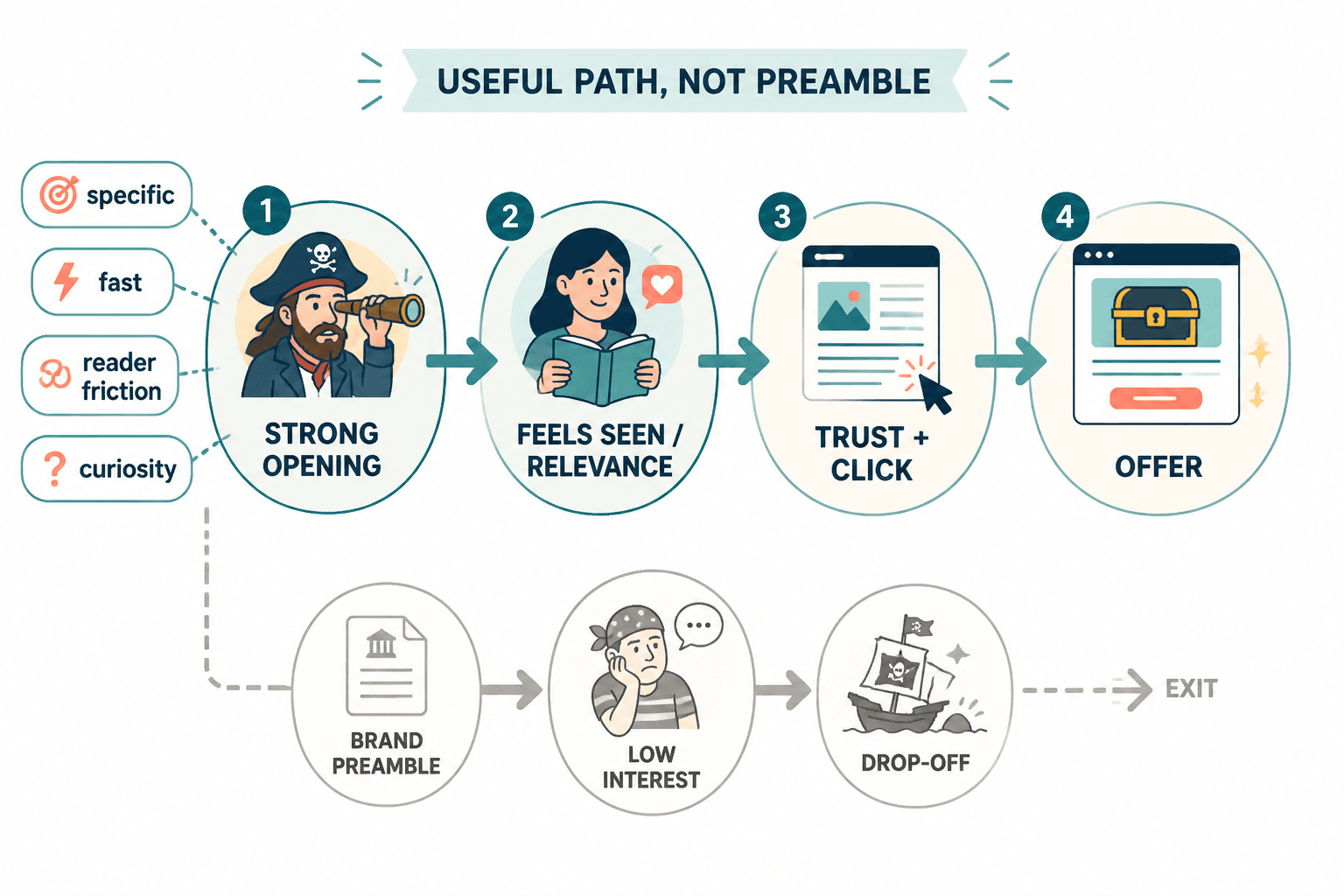
Start with the reader’s friction, not your offer
One of the easiest ways to weaken an opening is to begin with the offer itself.
That sounds backwards because the journey eventually leads to the offer. But if you start by talking about the product, program, service, or call before the reader feels seen, the whole thing lands like a premature sales ask.
Start with friction instead. Friction is what the audience is already feeling before they meet your offer.
- They’re posting but not converting
- They’re getting attention from the wrong people
- They have leads, but the leads stall
- They know their offer is decent, but the positioning is muddy
- They’re attracting readers, not buyers
A strong opening meets that friction directly. It tells the audience, in plain English, “Yes, this is about your actual problem.” That is how you earn the next line.
Weak vs stronger opening examples
Weak: I’m excited to share a new framework that helps entrepreneurs build a seamless audience journey toward their offers.
Stronger: If your content gets attention but rarely moves people closer to buying, the problem may start in your opening, not your offer.
Weak: Every business needs an effective funnel to nurture prospects and drive results.
Stronger: A lot of funnels lose people before the offer shows up because the first message says nothing worth caring about.
Weak: Here are some tips for connecting with your audience and increasing conversions.
Stronger: If your audience reads your content, nods politely, and still does absolutely nothing, your opening is probably too safe.
Use a clear entry point, not a broad theme
A broad theme sounds fine in your head and useless on the page.
Things like “visibility,” “growth,” “alignment,” “messaging,” or “client attraction” are not openings. They are topic clouds. They do not create urgency because they do not point to a specific tension the reader can recognize.
A clear entry point is narrower. It usually includes a problem, a moment, or a mismatch.
- “Your posts get saves, but almost no inquiries”
- “People join your list and never click again”
- “Your lead magnet gets downloads from freebie hunters, not buyers”
- “Your offer makes sense only after a 20-minute explanation”
That kind of opening works because it is legible. The reader can place themselves inside it immediately. That recognition matters more than sounding polished.
This is also why so many “nurture” sequences and funnel intros underperform. They are too broad to feel relevant, so the audience cannot tell if the next step is worth their time. Specificity fixes that faster than cleverness.
Four opening angles that work better than generic funnel copy
You do not need infinite creativity here. You need a handful of opening angles that reliably create movement.
1. The painful mismatch
This is where you point out the gap between effort and result.
Example: You’re publishing consistently, but your audience still has no clear path from “this is helpful” to “I want to work with you.”
This works because people hate wasted effort. It also sets up your offer journey as a missing bridge, not a random extra.
2. The wrong assumption
This opening challenges what the audience thinks is causing the problem.
Example: If your funnel feels weak, it may not be because you need more leads. It may be because your opening gives people no reason to continue.
Good when your audience is fixing the wrong thing over and over. Which, to be fair, happens a lot.
3. The costly symptom
This starts with a visible sign the reader already recognizes.
Example: When people engage with your content but ignore your CTA, the problem often starts much earlier than the call to action.
This works well because it takes a symptom and traces it back to the opening.
4. The sharp promise
This opening says what the reader will be able to do, but without floating into vague “better results” fluff.
Example: Here’s how to open your audience-to-offer journey so the next step feels relevant, not forced.
This one is simple, and sometimes simple wins. Especially if the promise is concrete and the audience already cares about the problem.
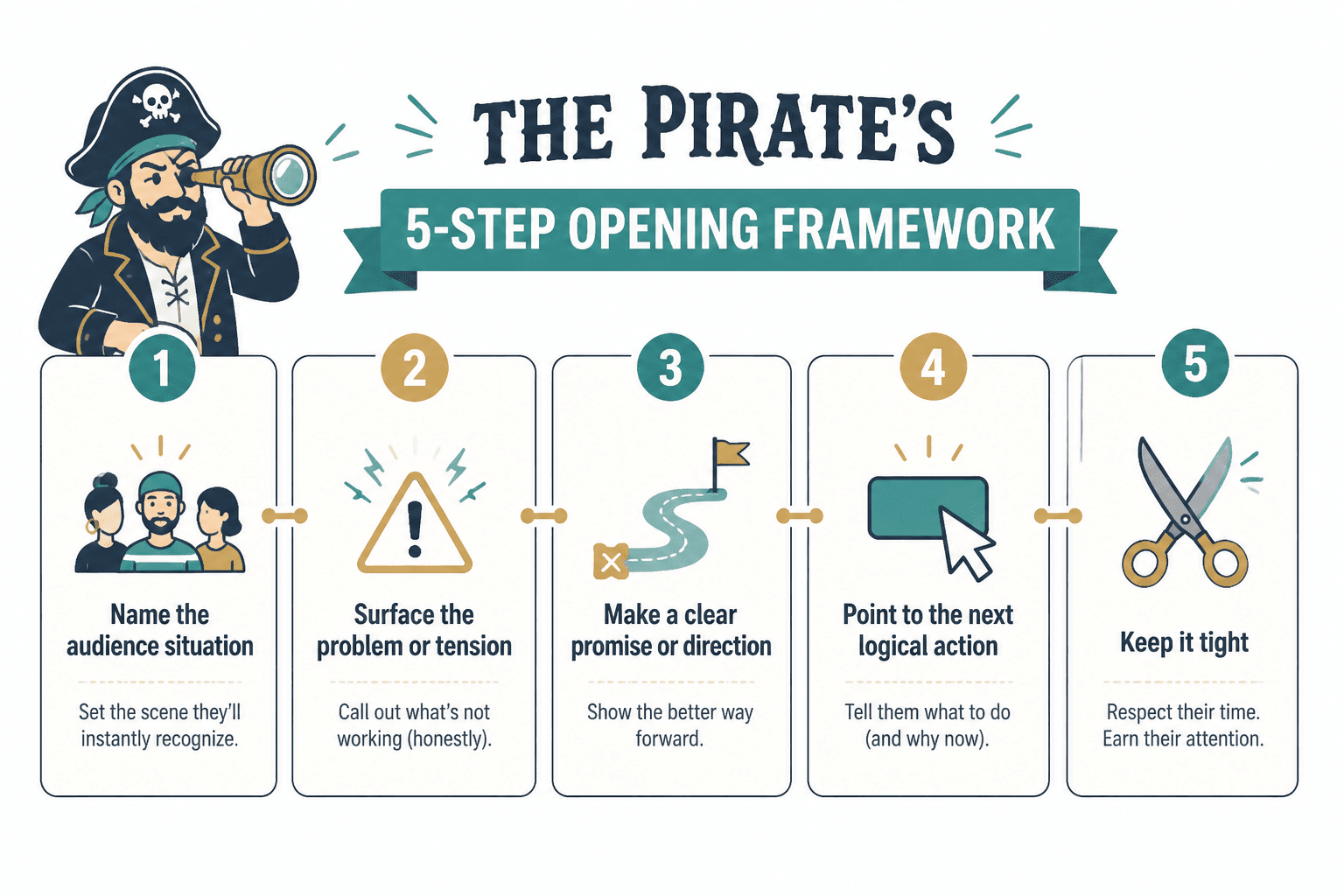
How to Start Audience-to-Offer Journeys Without a Weak Opening: a practical framework
If you want a repeatable way to build a stronger opening, use this five-part framework.
1. Name the current frustration
Start where the reader is stuck, not where your method begins.
Ask:
- What feels broken to them right now?
- What outcome are they not getting?
- What annoying pattern keeps repeating?
Example: Your content is doing its job on attention, but not on action.
2. Add a tension point
Do not stop at the problem. Show the friction inside it.
Example: People read, agree, and disappear. Which means the issue is not always reach. It is often transition.
Tension gives the opening energy. Without it, the copy just reports a fact and sits there.
3. Hint at the real cause
This is where you create forward motion. You do not need to explain everything yet. You just need to point toward a smarter diagnosis.
Example: The problem often starts in the opening, where the message sounds useful but gives no compelling reason to move closer.
4. Make the next step feel logical
The reader should feel like continuing is the obvious thing to do.
That could mean reading the rest of the post, downloading a guide, joining the list, replying to the email, or clicking toward the offer. But the path has to make sense.
Example: Fix the first few lines, and the rest of your funnel has a much better chance of working.
5. Keep it tight
The opening should not explain the whole system. It should create clarity and momentum.
Most weak openings are weak because they over-warm the room. They spend too long setting up a point that could have arrived in the first sentence.
Good openings get in, make contact, and move.
Before-and-after rewrites for audience-to-offer openings
Sometimes the fastest way to improve your writing is to watch bad copy get cleaned up.
Example 1: Social post into lead magnet
Before: Building an audience journey is important if you want to move your followers toward becoming customers over time.
After: If your posts get attention but your lead magnet gets ignored, your audience journey probably starts too blandly to create action.
Why it works: It names a specific symptom, points to the likely issue, and sets up the rest of the message.
Example 2: Email nurture intro
Before: Welcome. I’m so glad you’re here. Over the next few emails, I’ll be sharing value to support your growth and help you improve your marketing.
After: If you’ve been creating useful content that still doesn’t lead many people toward your offer, this email series will help you fix the handoff.
Why it works: It skips the generic welcome fluff and gets straight to relevance.
Example 3: Landing page hero section
Before: A proven framework to nurture your audience and maximize conversions with aligned messaging.
After: Turn engaged readers into qualified leads with an audience journey that makes the next step feel obvious.
Why it works: Cleaner promise, clearer outcome, fewer beige words pretending to be strategy.
Example 4: Sales page section opener
Before: Many entrepreneurs struggle with creating a seamless customer journey.
After: If people keep consuming your content without moving any closer to buying, you do not have an attention problem. You have a journey problem.
Why it works: Better tension, better diagnosis, better reason to keep reading.
Common opening mistakes that make the offer feel weaker
Even a solid offer can feel less valuable when the opening does one of these.
- Starting with broad claims: “Every business needs…” is usually a sign that no one specific is being addressed.
- Leading with your process: the audience cares about their problem first, your framework second.
- Overusing welcome language: nice is fine, but niceness is not a hook.
- Trying to sound profound: vague wisdom is not a substitute for relevance.
- Pushing the CTA too fast: if the opening has not earned attention, the ask will feel abrupt.
- Using AI-polished mush: if the copy sounds technically smooth but emotionally empty, people notice.
If this sounds familiar, you might want to tighten the writing itself before anything else. This related guide on how to rewrite boring audience-to-offer journeys is useful when the structure is fine but the copy has all the energy of a lukewarm webinar replay.
How the opening should connect to the next step
A good opening is not just a hook. It is the first piece of a chain.
If the opening highlights one problem, but the CTA points to something only loosely related, the journey feels crooked. The audience may still agree with the content and ignore the offer because the transition never quite lands.
Here is the clean version:
- Opening: names the friction
- Body: deepens the problem and reframes it
- Proof or example: shows credibility and real-world fit
- CTA: offers the logical next step
That “logical next step” part matters. A lot. If your opening is about weak transitions in content, the CTA should lead to something that helps solve that. Not a random booking link with no bridge.
If you want the handoff to feel smoother, read how to write audience-to-offer journeys without sounding salesy or robotic. It is the difference between a natural progression and a hard pivot into “buy now” energy.
Opening formulas you can actually use
Templates are not magic, but they are handy when your brain decides to produce mush.
Formula 1: symptom + hidden cause
Template: If [visible symptom], the problem may not be [assumed cause]. It may be [real cause].
Example: If your audience engages with your content but rarely clicks through, the problem may not be your CTA. It may be the weak opening that never built enough momentum.
Formula 2: effort + disappointing result
Template: You’re [doing effort], but still [missing result]. That usually means [problem in journey].
Example: You’re posting consistently, but still not getting many qualified leads. That usually means your audience journey starts too vaguely to move the right people forward.
Formula 3: misconception + correction
Template: Most people think [common belief]. In reality, [useful correction].
Example: Most people think conversions drop because the offer needs more polish. In reality, the opening often fails long before the offer gets a fair shot.
Formula 4: direct promise
Template: Here’s how to [practical result] so [better outcome].
Example: Here’s how to open your audience journey so readers actually want the next step.
Where this matters most in your funnel
The opening matters everywhere, but it matters even more in these spots:
- Top-of-funnel posts: this is where attention either starts moving or leaks away
- Lead magnet pages: weak hero copy kills opt-ins fast
- Welcome emails: generic intros train readers to ignore you
- Sales page section openings: momentum drops when copy gets fluffy
- DM or comment transitions: awkward opening lines make soft outreach feel weirdly hard
If your issue is not the opening itself but what comes after it, this guide on improving audience-to-offer journey offer timing without sounding generic will help. Sometimes the first line is decent, but the offer shows up too early, too late, or with all the grace of a surprise invoice.
And if your bigger goal is conversion, not just cleaner copy, read how to turn audience-to-offer journeys into more leads or sales. Good openings matter because they support the whole system, not because they win literary awards.
For broader context, you can also explore the main audience-to-offer journeys guide, the wider