
Most audience-to-offer journeys fail for a very boring reason: they ask people to buy before those people understand why they should care.
That usually shows up as content with decent advice, followed by a weird jump into “book a call,” “join my program,” or “grab my offer” like the reader has been emotionally fast-tracked through six missing steps. They have not. They are still standing at hello.
If you want to learn how to write better audience-to-offer journeys, the real job is not making your pitch prettier. It is building a path that makes sense. Your content should move people from attention to relevance, from relevance to trust, and from trust to a next step that feels earned instead of slapped on at the end.
That means better sequencing, sharper messaging, stronger transitions, and a lot less “I posted three tips, where are my clients?” energy. Here’s how to write journeys that actually help people move toward your offer without sounding pushy, robotic, or mildly desperate.
For the full path around this topic, head to the parent guide.
What an audience-to-offer journey actually is
An audience-to-offer journey is the path someone takes from discovering your content to taking a meaningful business action.
That action could be joining your email list, replying to a post, downloading a resource, booking a call, applying for your service, or buying a product. The exact action matters less than the logic behind it. Each step should answer the question the reader has before they are ready for the next one.
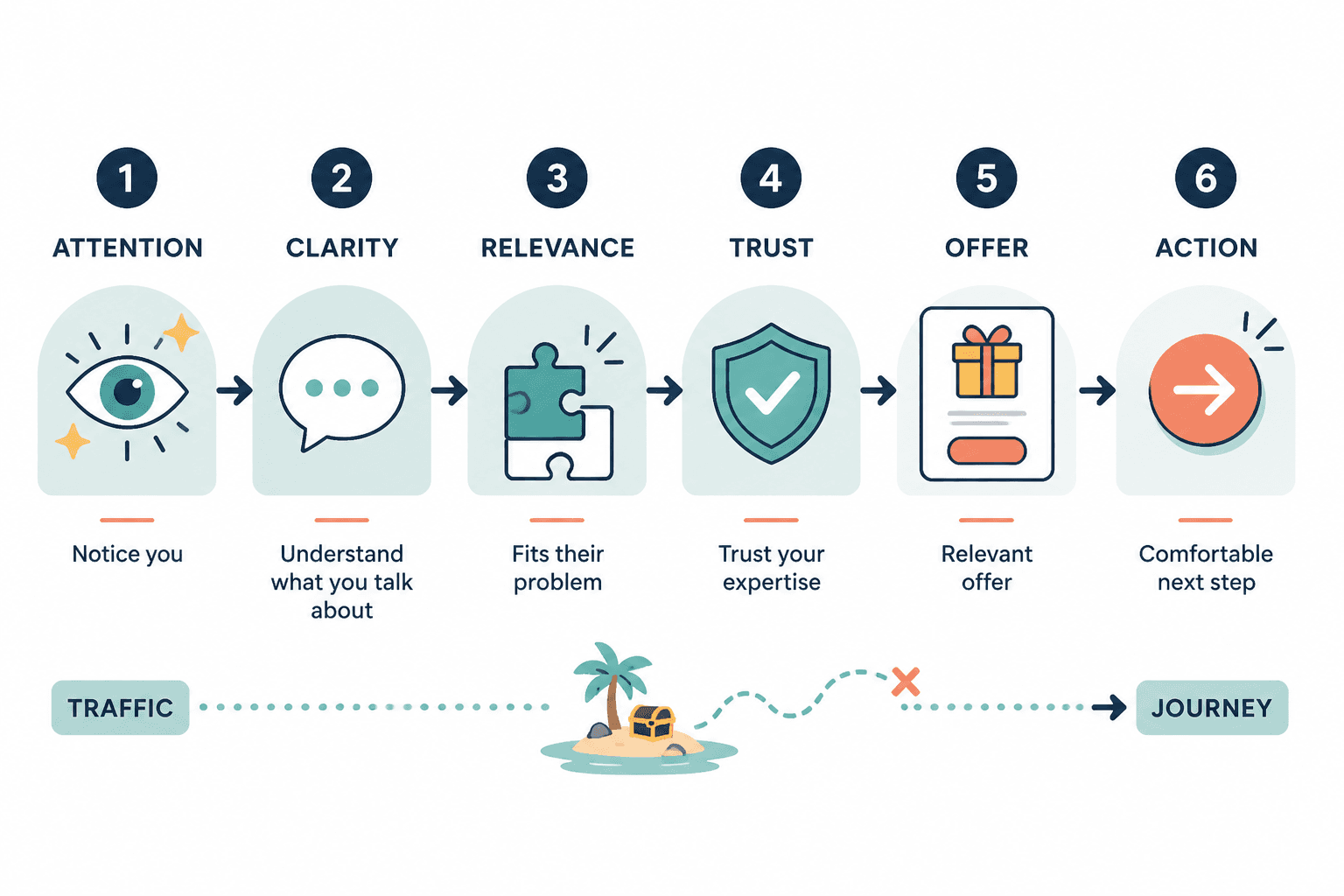
A simple version looks like this:
- They notice you
- They understand what you talk about
- They see that your advice fits their problem
- They trust that you know what you are doing
- They see that you have a relevant offer
- They feel comfortable taking the next step
Sounds obvious. Yet loads of creators skip half of it. They post random content, toss in a CTA every few days, then wonder why attention does not convert.
Attention alone is not a journey. It is traffic. Useful, yes. But still just traffic.
Why most audience-to-offer journeys feel clunky
Usually, the writing is not the only problem. The structure is.
Here are the common reasons journeys fall apart:
- The content is disconnected. Every post says something different, so there is no clear path toward your offer.
- The audience problem is too vague. If people cannot tell who your work is for, they will not self-select into the journey.
- The value is front-loaded but the relevance is weak. Advice can be useful and still fail to convert because it does not connect to the paid solution.
- The CTA arrives too early. You are asking for a decision before building enough trust or context.
- The offer appears out of nowhere. There is no transition from free insight to paid help.
- The messaging sounds templated. Which makes people feel marketed at, not understood.
If your journey feels stiff, salesy, or vague, that is usually not a copy problem in isolation. It means the reader is missing a bridge. Good writing builds that bridge sentence by sentence, post by post, page by page.
For a broader look at the category this sits in, it helps to explore the main monetization funnels content and the related audience-to-offer journeys hub.
Start with the right journey, not just more content
Before you write anything, get clear on the path you are trying to create. Most people think they need better posts. Often, they need a better sequence.
Define the starting point
Ask: what does the audience already know, believe, want, and misunderstand?
A cold audience needs different writing from a warm one. Someone who just found your post on LinkedIn is not in the same mental place as someone who has read five of your emails and checked your services page twice.
Write for the actual starting point, not the one that flatters your funnel diagram.
Define the end point
What specific action do you want the reader to take next?
- Read another article
- Join your list
- Reply to a post
- Download a resource
- Book a consult
- Buy a low-ticket product
Pick one. Not five. “Comment, subscribe, DM me, book a call, and check the link in bio” is not a strategy. It is a traffic accident.
Define the missing beliefs in between
This is where stronger journeys are built. What does your audience need to believe before your offer feels relevant?
For example, if you sell messaging strategy, they may need to believe:
- Their content problem is not inconsistency alone
- Poor positioning is reducing response
- Better messaging can improve leads without posting more
- You understand how to fix that problem
- Your offer is built for someone like them
Those beliefs do not appear by magic. Your writing has to create them.
Use a simple writing framework for better audience-to-offer journeys
You do not need an elaborate funnel opera. A simple structure works fine if the writing is doing its job.
Use this five-part framework:
- Attract with a sharp problem, opinion, observation, or result
- Orient by clarifying what the problem actually is
- Strengthen trust with proof, specificity, examples, or useful nuance
- Bridge from the free idea to the paid solution
- Invite a next step that fits the reader’s level of intent
That bridge step is where most journeys get ugly. People either skip it or turn it into hard-pivot copy. You have probably seen it:
Here are 4 mistakes in your messaging.
…
If you want help, my high-ticket program is now open. DM me “clarity.”
Technically a transition. Emotionally, a jump scare.
A better bridge sounds more like this:
If this sounds familiar, that is usually a positioning problem before it is a consistency problem. That is exactly the kind of issue I help clients fix in my messaging strategy work. If you want the framework, start with the guide here.
Now the offer feels connected to the problem. That matters more than sounding slick.
Write each stage for the reader’s actual intent
Different stages need different kinds of writing. If you use the same tone, same CTA, and same level of detail everywhere, the journey gets muddy fast.
Stage 1: Attention
Your job here is not to explain everything. It is to make the right people stop and think, “Oh. That is my problem.”
Good attention-stage writing usually includes:
- A specific pain point
- A sharp opinion
- A clear contrast
- A useful misbelief correction
- A concrete outcome people want
Weak example:
Growing your audience takes consistency and value.
Better:
If your content gets polite likes but no leads, the problem usually is not consistency. It is that your audience cannot see how your expertise connects to a paid solution.
Stage 2: Relevance
Once you have attention, show that you understand the problem beneath the obvious one.
This is where deeper explanation helps. A lot of creators stay too surface-level here because they are scared of “giving too much away.” In practice, underexplaining hurts more than overexplaining. If the reader cannot see the shape of the problem, they will not see the value of the solution either.
For example, if someone says they want more leads from content, they may think the issue is reach. But the real problem might be that their posts attract peers instead of buyers, or that their content is educational but disconnected from the service they sell. Good relevance-stage writing names that mismatch clearly. It gives the reader language for what is actually going wrong.
Stage 3: Trust
Trust is built through specificity, not chest-thumping.
That can include:
- A simple example
- A before-and-after rewrite
- A framework with real logic
- A short case-study style point
- A nuanced explanation that shows experience
You do not need to shout authority. Usually, the clearest person in the room already sounds credible.
Stage 4: Offer connection
This is where you explain why your offer exists in relation to the problem you just discussed.
Not every piece of content needs to sell. But if your business depends on content leading somewhere, some of your writing should clearly connect the free insight to the paid next step.
That connection can sound like:
- “This is the exact gap my audit is built to fix.”
- “That is why I created this template pack.”
- “This is the kind of problem I solve inside my consulting work.”
- “If you want help applying this to your business, here is the next step.”
Stage 5: Next action
Your CTA should match the level of trust and intent you have earned.
| Reader stage | Better next action |
|---|---|
| Cold audience | Read another article, follow, join newsletter, get free resource |
| Warm audience | Reply, DM, watch training, download guide, check case study |
| High-intent audience | Book a call, apply, buy product, request proposal |
If you want more on connecting that final step to actual results, read how to turn audience-to-offer journeys into more leads or sales.
How to make the transition to your offer feel natural
This is the part people usually overcook. A natural transition does not hide the offer. It earns it.
Use this sequence:
- Name the problem clearly
- Explain why it happens
- Show a useful angle or partial solution
- Point out where deeper help matters
- Invite the next step
Example:
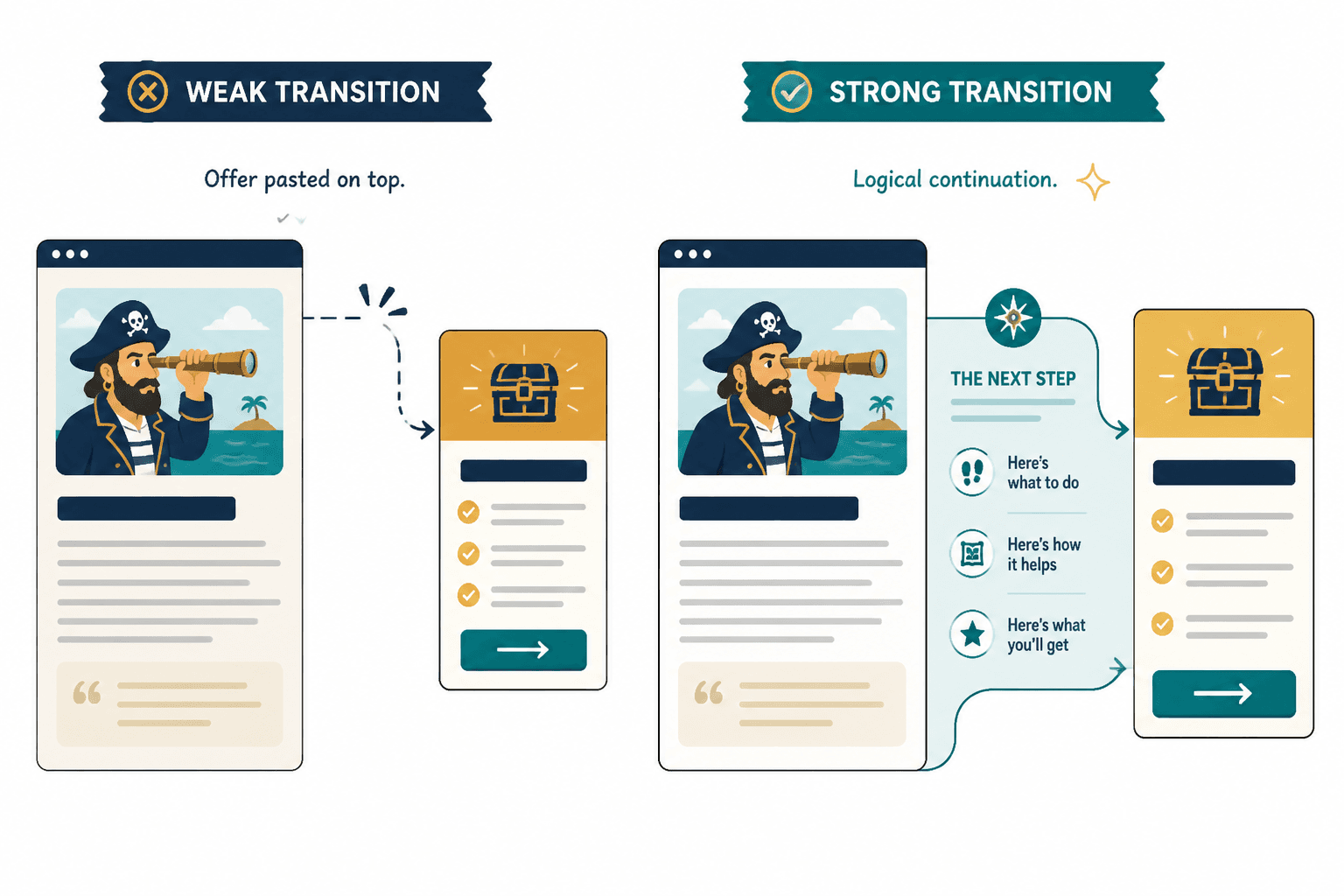
A lot of service providers think their content is not converting because they need better hooks. Sometimes that is true. But often the real issue is that the content teaches around the work instead of leading into it. If your posts are getting attention but not generating qualified interest, that is exactly what I help fix in my content strategy sessions. You can start with the breakdown here, or reach out if you want help applying it.
That works because the offer is not pasted on top. It is presented as a logical continuation.
And yes, tone matters. If your transition sounds like a funnel template wearing a fake smile, people will feel it. For more on that specifically, read how to write audience-to-offer journeys without sounding salesy or robotic.
Common writing mistakes that weaken conversion
1. Teaching without directing
Useful content is good. Useful content with no path is just free-floating value.
If the reader gets help from you but never understands what paid help looks like, the journey stalls. You do not need to pitch constantly, but your ecosystem should make the next step obvious.
2. Pitching before the problem feels expensive enough
People act when they understand the cost of staying stuck. If your writing jumps to the solution before the problem feels clear, the offer lands flat.
This does not mean using manipulative fear tactics. It means showing the real consequence of the issue. Lost leads. Confused positioning. Wasted traffic. Low-trust content. Missed sales. Real problems, not theater.
3. Using generic nurture language
Phrases like “I help you scale with ease” or “turn your expertise into impact” usually do not move anyone. They are broad enough to apply to half the internet and convincing enough to impress almost nobody.
Better writing names specific frictions and concrete outcomes.
4. Sending everyone to the same CTA
If every piece of content ends with “book a call,” you are treating cold readers like warm leads. That tends to go badly.
Use lower-friction actions for lower-intent readers. Save stronger asks for people who have enough context to care.
5. Writing in isolated pieces instead of connected journeys
A strong audience-to-offer journey is usually made of multiple assets working together:
- A social post that identifies the problem
- An article that explains it more deeply
- A profile or landing page that clarifies the offer
- A lead magnet or email sequence that nurtures trust
- A CTA that matches readiness
This is why old content can be valuable. You do not always need more content. Sometimes you need your existing content to connect better. On that note, see how to turn old content into better audience-to-offer journeys.
A practical template you can use
Here is a simple writing template for a post, article section, email, or landing page bridge.
The template
- Call out the visible problem
“A lot of [audience] are doing [common action] and still not getting [desired result].” - Name the deeper reason
“Usually, the issue is not [assumed cause]. It is [real cause].” - Explain the impact
“That leads to [specific friction or consequence].” - Offer a useful shift
“What works better is [principle, method, framework, or example].” - Bridge to the offer
“This is the kind of problem I help solve in [offer].” - Give a fitting CTA
“If you want [next step], start here.”
Filled-in example
A lot of consultants are posting useful content and still not getting serious inbound leads. Usually, the issue is not a lack of value. It is that the content educates without creating a clear path to the offer. That leads to attention without action, which is great for vanity metrics and not much else. What works better is writing content that identifies the problem, sharpens the consequence, and connects naturally to the paid solution. That is exactly what I help fix in my messaging and funnel strategy work. If you want a simpler way to turn content into qualified interest, start with the guide.
Not flashy. Just clear. Clear converts surprisingly well.
How to sequence content across the journey
If you are building a fuller system, think in sequence instead of isolated posts.
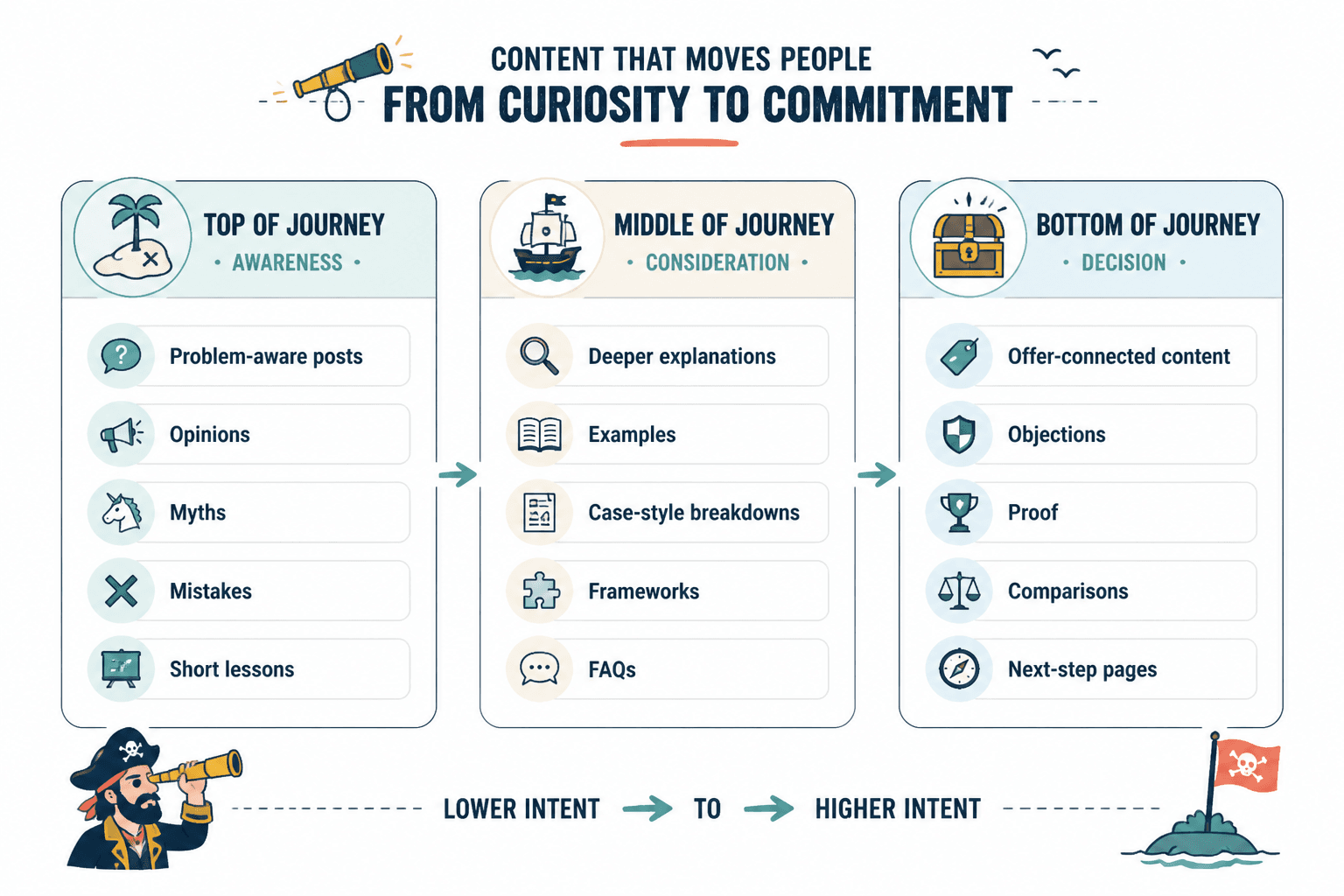
A simple sequence might look like this:
- Top of journey: Problem-aware posts, opinions, myths, mistakes, short lessons
- Middle of journey: Deeper explanations, examples, case-style breakdowns, frameworks, FAQs
- Bottom of journey: Offer-connected content, objections, proof, comparisons, next-step pages
This is where timing also matters. Not every offer mention should happen in the same place or with the same intensity. If that is your sticking point, read how to improve audience-to-offer journeys offer timing without sounding generic.
You can also explore the broader funnel-systems context through related funnel systems resources if you are mapping a larger journey.
A quick self-check before you publish
Before publishing a post, article, email, or page designed to move people toward an offer, check these:
- Does it name a specific problem clearly?
- Does it explain the deeper issue, not just the surface symptom?
- Does it show why the issue matters?
- Does it include proof, specificity, or a useful example?
- Does the offer feel like a logical next step?
- Is the CTA matched to the reader’s likely level of intent?
- Would this still sound human if read aloud?
If the answer to that last one is no, fix that first. Robotic writing rarely becomes persuasive just because it includes a stronger button.
FAQ
How long should an audience-to-offer journey be?
Long enough to build clarity and trust. Sometimes that is one strong post and a relevant landing page. Sometimes it is a longer sequence across content, email, and profile copy.
Should every piece of content lead to an offer?
No. But your overall content system should make the path to your offer clear. Some pieces attract. Some nurture. Some convert.
What is the best CTA for colder audiences?
Usually a lower-friction next step like reading a related article, joining your list, or downloading something useful.
How do I know if my journey is too salesy?
If the offer appears before enough context, relevance, or trust has been built, it will probably feel pushy. The fix is usually better sequencing, not softer words.
Write the path, not just the pitch
If you want to get better at how to write better audience-to-offer journeys, stop obsessing over the sales line in isolation. The best-performing journeys are rarely powered by one genius CTA. They work because every step earns the next one.
That means your writing should help readers move from “this is interesting” to “this is relevant” to “this could help me” with as little friction as possible. Clear problem. Clear insight. Clear connection. Clear next step.
Do that well, and your content stops acting like a polite side hobby and starts doing an actual job.
The bigger point is simple: clearer structure and clearer writing make the piece more useful. That is usually what makes the ending land better too.