Most creators do not need more tools. They need fewer bad decisions dressed up as software.
That is the real problem with picking the best funnel tools and website tools for Creator Funnels. People build a stack that looks impressive, then wonder why the funnel still feels clunky, slow, confusing, and oddly allergic to conversions.
A tool cannot rescue a weak offer, vague positioning, or a landing page that reads like it was assembled by three tabs and a caffeine crash. But the right tools can make your funnel easier to build, easier to maintain, and much more likely to turn attention into leads or sales without creating a tiny tech support job for yourself.
Here is how to choose the best funnel tools and website tools for Creator Funnels based on what actually matters: speed, clarity, ease of use, flexibility, and how well the thing supports trust instead of sabotaging it.
If you are still shaping your broader setup, it helps to understand where these tools fit inside a bigger monetization funnels strategy and how they support stronger funnel systems. And if you want the bigger picture specifically for this model, start with Creator Funnels.
For the main guide behind this topic, visit the parent guide.
What creator funnel tools actually need to do
Before naming categories, it helps to get brutally clear on the job.
A creator funnel tool is not just something that “collects leads” or “builds pages.” That is the brochure version. In practice, your tools need to help people move from mild curiosity to useful action with as little friction as possible.
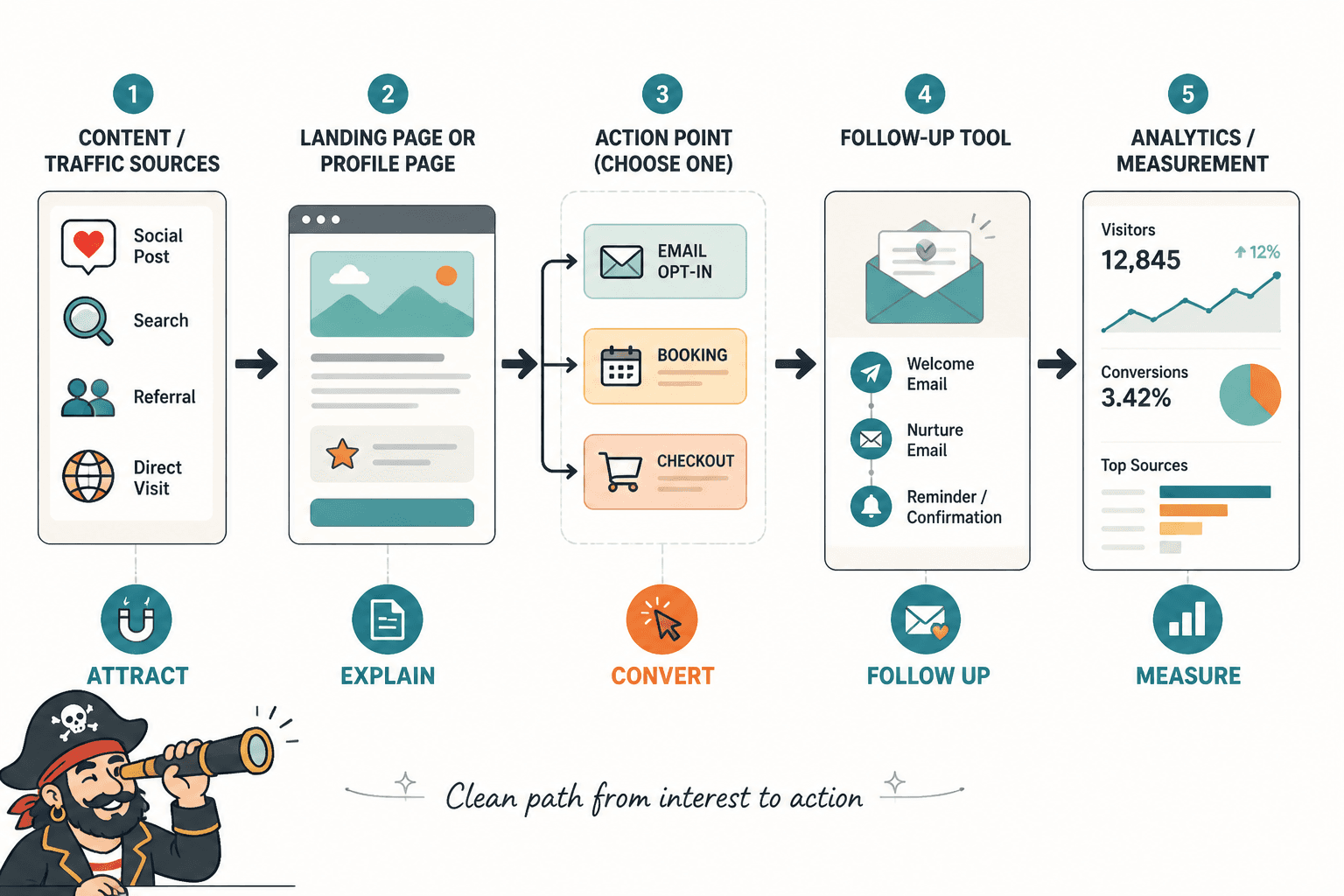
For most creators, coaches, consultants, freelancers, and personal brands, that means your stack should help you do five things well:
- Capture attention from content, profile visits, referrals, or direct traffic
- Explain the offer or next step clearly
- Collect the lead, booking, or sale without weird friction
- Follow up without becoming spam in human form
- Measure what is working so you can improve the actual weak point
That is it. Not seventeen dashboards. Not a stack that needs a full-time operations goblin. Just a clean path from interest to action.
The best funnel tools and website tools for Creator Funnels are usually simple
There is a very common mistake here: creators choose tools based on feature quantity instead of funnel fit.
They buy the platform with forty-two automations, seven pipeline views, and some dramatic promise about scaling while you sleep. Then they use maybe 12 percent of it and quietly hate logging in.
Simple wins more often than people want to admit.
A clean landing page builder, email tool, scheduling tool, checkout option, and basic analytics setup will outperform an overbuilt stack if the message is sharper and the path is easier. Fancy software does not create demand. It just gives your existing strategy somewhere to live.
So instead of asking, “What is the most advanced funnel platform?” ask better questions:
- Can I build and update this without wanting to throw my laptop into traffic?
- Can a visitor understand the next step in under ten seconds?
- Does the tool support my actual funnel type: lead magnet, booking funnel, email funnel, product funnel, or application funnel?
- Can I track the key conversion points?
- Will this still feel manageable in six months?
The core tool categories most creator funnels need
You do not need one all-in-one platform unless it is genuinely the best fit. A lot of creators do better with a small stack of tools that each do one job well.
1. Website or landing page builder
This is the front door. It is where traffic goes after someone clicks your bio, CTA, article, or post.
A good website or page builder for creator funnels should make it easy to create:
- Lead magnet pages
- Sales pages
- Waitlist pages
- Booking pages
- Simple thank-you pages
- Offer overview pages
What matters most is not design fireworks. It is clarity, mobile performance, editing ease, and enough flexibility to build a page that feels credible instead of templated into oblivion.
2. Email capture and email marketing tool
If your funnel starts with a free resource, newsletter, workshop, guide, or nurture sequence, this is non-negotiable.
Your email tool should handle:
- Forms and opt-ins
- Welcome sequences
- Basic segmentation
- Broadcast emails
- Simple automation
- Reasonable analytics
You probably do not need enterprise-level branching logic unless your funnel has become suspiciously complicated.
3. Scheduling or booking tool
If you sell coaching, consulting, strategy calls, audits, or discovery sessions, your funnel needs a smooth booking step.
The right scheduling tool cuts the awkward back-and-forth and lowers friction. It should let someone book fast, understand what happens next, and show up prepared.
4. Checkout or payment tool
For paid offers, digital products, memberships, services, or workshops, your checkout matters more than people think.
A clumsy payment process kills momentum. Someone just decided to give you money. This is not the moment to make them wrestle a confusing form that looks like it was built during the dial-up era.
5. CRM or lead tracking system
This does not need to be a giant corporate CRM. Sometimes a lightweight lead tracker is enough.
But if your funnel includes calls, applications, DMs, referrals, or sales conversations, you need some way to track who came in, where they came from, what they wanted, and what happened next. Otherwise you are basically managing revenue with vibes.
6. Analytics and behavior tracking
You do not need creepy surveillance theater. You do need enough signal to see where people drop off.
Basic funnel metrics usually matter more than deep reporting:
- Page visits
- Opt-in conversion rate
- Click-through rate
- Booking rate
- Sales conversion rate
- Email open and click trends
How to choose the right stack for your funnel type
The best funnel tools and website tools for Creator Funnels depend on what you are actually trying to move people toward. Different funnel models need different setups.
| Funnel type | What you need most | Tool priorities |
|---|---|---|
| Lead magnet funnel | Email capture and nurture | Landing pages, forms, email automation, thank-you pages |
| Booking funnel | Trust and scheduling speed | Offer page, proof, booking tool, reminders, intake form |
| Product funnel | Clear sales flow | Sales page, checkout, email follow-up, upsell or onboarding |
| Application funnel | Qualification and positioning | Application page, form logic, CRM, follow-up workflow |
| Newsletter funnel | Consistent content delivery | Opt-in pages, email platform, archive pages, simple segmentation |
If you are not sure which funnel model fits your business, these guides will help: creator funnel ideas and examples and funnel ideas to pair with creator funnels.
What to look for in website tools for creator funnels
A website tool does not need to be “powerful.” It needs to make your funnel easier to trust and easier to use.
Here is what actually matters.
Fast editing and publishing
If updating a headline takes fifteen minutes and three support articles, you will avoid improving the page. That means your funnel gets stale. Fast tools make better marketers because they make testing less annoying.
Clean mobile experience
A lot of creator traffic comes from social. A lot of social traffic is mobile. If your page looks elegant on desktop and ridiculous on a phone, the tool is not helping you.
Flexible page structure
You want enough layout freedom to build pages that match your funnel stage:
- Short opt-in pages for low-friction offers
- Longer sales pages for higher-ticket or more nuanced offers
- Application pages for selective services
- Simple resource hubs for lead magnet libraries
Easy integration with forms, email, and checkout
If your website tool does not play nicely with the rest of your stack, you get brittle workflows and weird gaps. A page builder is not useful if your form breaks, your email list misses signups, or your checkout sends people into the void.
Credibility support
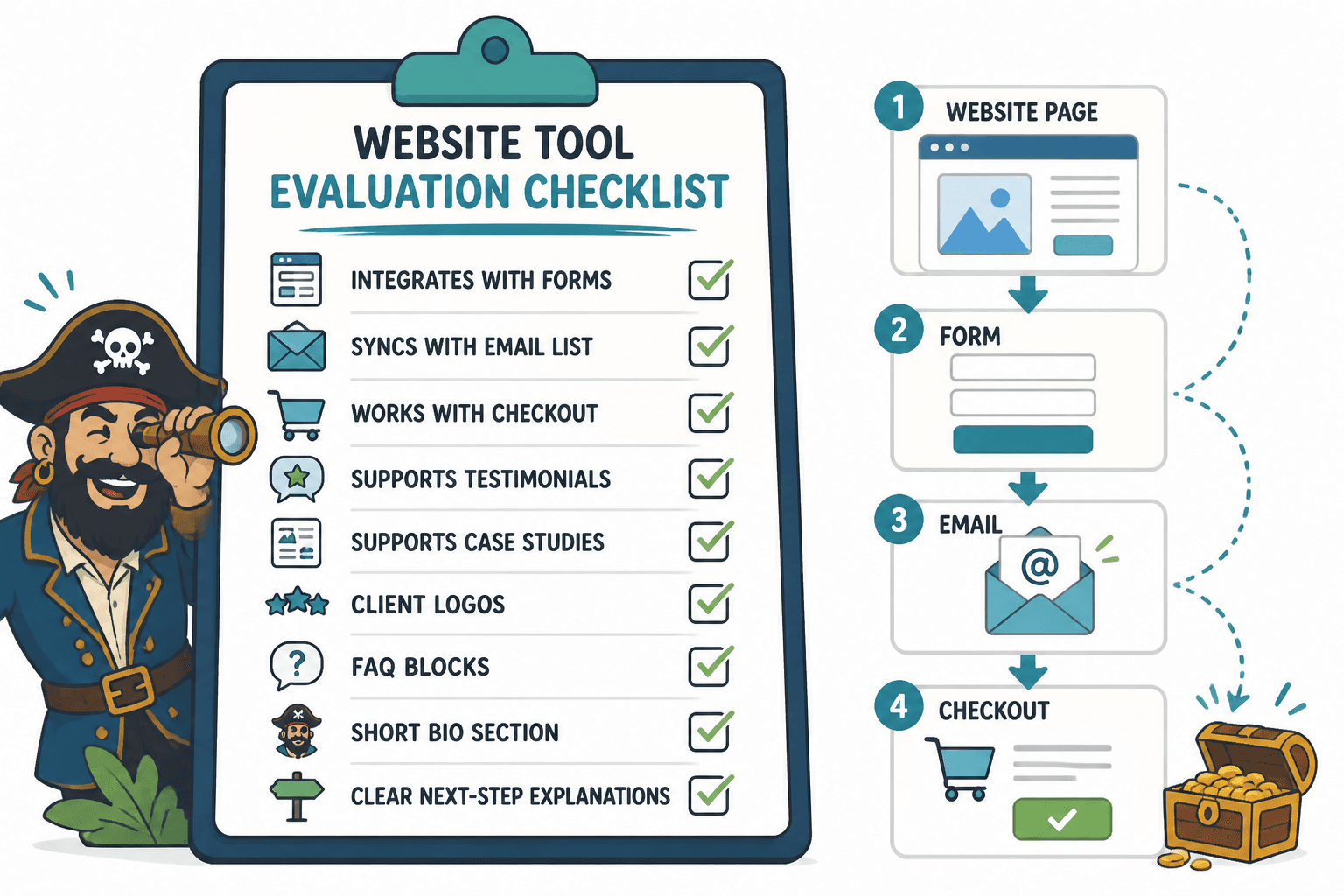
This one gets missed. Your site tool should make it easy to add trust signals:
- Testimonials
- Case studies
- Client logos if relevant
- FAQ blocks
- Short bios
- Clear next-step explanations
Funnels do not convert because they are clever. They convert because they feel clear and believable.
Tool categories that matter more than brand names
Since tools change, get acquired, overcomplicate themselves, or randomly decide they now have an “AI universe mode,” it is smarter to think in categories first.
Here are the categories worth comparing when building creator funnels.
- Website and landing page platforms: best for building opt-in pages, sales pages, link-in-bio hubs, resource pages, and simple offer sites
- Email platforms: best for welcome sequences, lead nurture, broadcasts, and selling through trust over time
- Form and application tools: best for intake, qualification, surveys, applications, and custom lead capture
- Booking tools: best for service creators, consultants, and coaches who sell through calls
- Checkout and course tools: best for digital products, programs, memberships, workshops, and paid resources
- CRM and pipeline tools: best for tracking leads, conversations, applications, and sales follow-up
- Analytics and testing tools: best for spotting drop-off points and improving funnel performance without guessing
If you want a broader stack beyond websites and funnels, you may also want templates and tools for creator funnels and AI tools for creator funnels. Just do not let AI write your entire sales page in that eerie polished tone that sounds like a chatbot trying to sell confidence supplements.
A practical way to build your creator funnel stack
If you are building from scratch, keep it boring and functional first. That is usually the smart move.
Here is a simple build order that works for a lot of creators.
Stage 1: Build the minimum viable funnel
- Create one clear page for one offer or one lead magnet
- Add one form or one booking step
- Connect it to one email sequence or confirmation flow
- Make sure the thank-you page tells people what happens next
- Test the entire thing on mobile
At this stage, the goal is not elegance. It is a working path.
Stage 2: Add trust and proof
- Testimonials
- Specific outcomes
- A sharper bio or credibility line
- Examples of your process
- A better FAQ
This is where a lot of funnels improve dramatically. Not because the software changed, but because the page finally answers the questions a reasonable person would have before clicking.
Stage 3: Add automation carefully
Now you can add reminders, segmentation, CRM updates, tagging, or simple branching. But only after the basic flow already works.
Automating a broken funnel just helps it fail with more efficiency.
Stage 4: Improve based on real behavior
Watch where people stall:
- Are they landing but not opting in?
- Are they opting in but not booking?
- Are they reading the sales page but not buying?
- Are they clicking your CTA from content at all?
Then fix that point. Not your logo. Not your button shade. The actual problem.
Mistakes people make when choosing funnel and website tools
Buying for scale before they have proof
You do not need a “high-volume sales machine” when you are still testing your first decent lead magnet or booking page.
Using too many disconnected tools
A stack with five cheap tools that barely talk to each other can cost more in time and errors than one solid central platform.
Choosing design over conversion clarity
A stunning page with vague copy is still a weak funnel. Pretty confusion is still confusion.
Ignoring maintenance
The best creator funnel tool is one you will actually update. If your stack is so annoying that every tiny change gets postponed for two months, it is too complicated.
Expecting tools to create strategy
This is the big one. Tools can support positioning, messaging, follow-up, and conversion. They cannot invent a compelling offer for you. They cannot decide who your funnel is for. They cannot manufacture trust from generic content and a beige headline.
That part is still your job. Slightly rude, I know.
A lean creator funnel stack for different business models
If you want this simpler, think in lean stacks.
| Business type | Lean stack | Main goal |
|---|---|---|
| Coach or consultant | Offer page + booking tool + email follow-up + simple CRM | Turn traffic into calls and qualified leads |
| Writer or personal brand | Website + newsletter platform + lead magnet page + archive | Grow trust and owned audience |
| Course or digital product creator | Sales page + checkout + email sequence + onboarding page | Convert audience into buyers |
| Service provider or freelancer | Service page + inquiry form + proof section + pipeline tracker | Generate and manage qualified inquiries |
| Membership or community builder | Landing page + email nurture + checkout + member onboarding | Drive recurring signups and retention |
Notice what is missing: random complexity.
How to know if your current funnel tools are working
You do not judge a stack by how many things it can technically do. You judge it by whether it helps the funnel move.
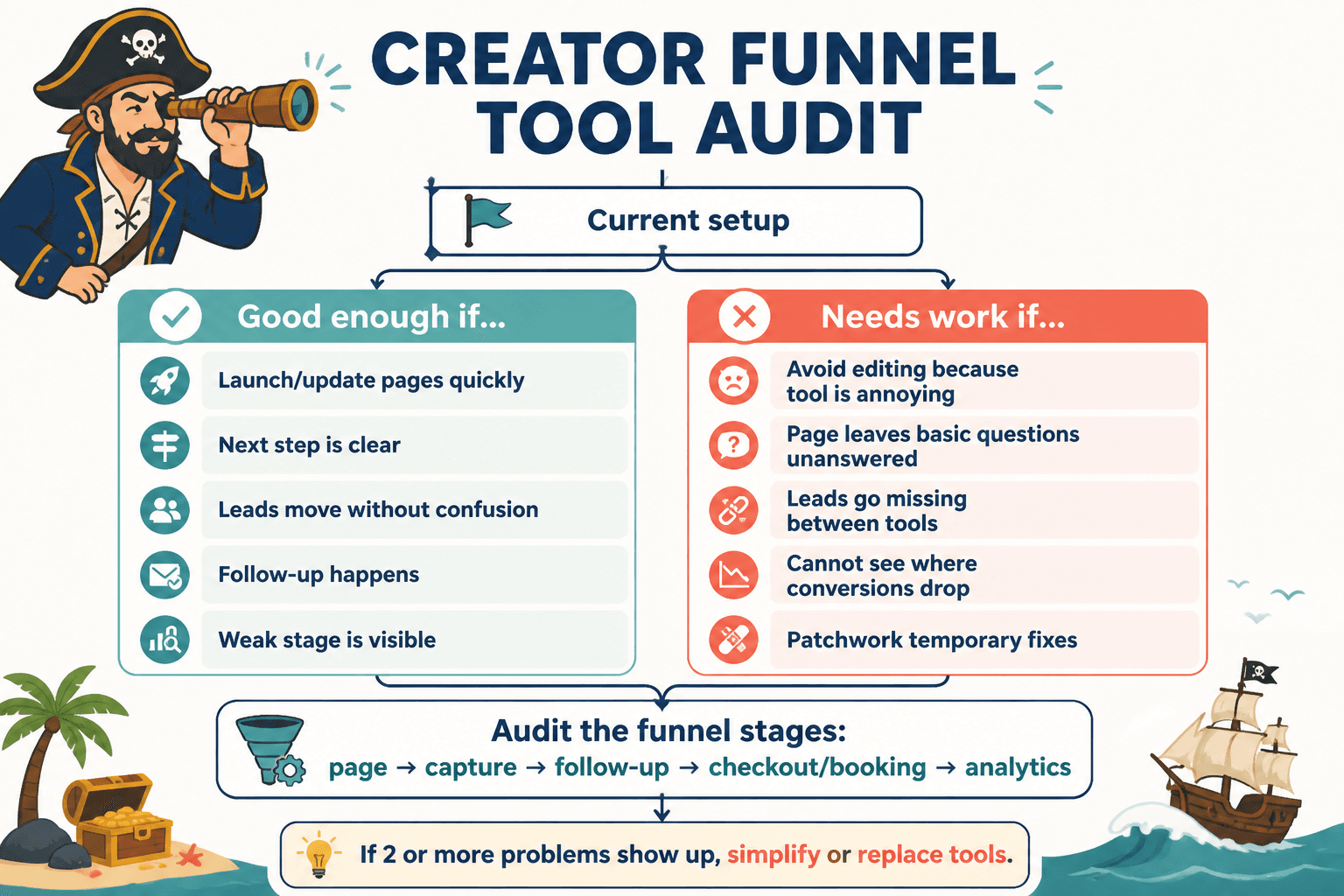
Your current setup is probably good enough if:
- You can launch or update pages quickly
- Visitors understand the next step fast
- Leads or buyers move through the funnel without confusion
- Your follow-up actually happens
- You can spot the weak stage and improve it
- The system feels manageable without heroic effort
Your current setup probably needs work if:
- You avoid editing the funnel because the tool is annoying
- People ask basic questions the page should have answered
- Leads go missing between tools
- You cannot tell where conversions are dying
- Your stack has become a patchwork of “temporary” fixes that never left
Quick tool selection checklist
- Does it support the exact funnel type I am building?
- Can I publish and update fast?
- Is the mobile experience solid?
- Does it integrate with the rest of my stack cleanly?
- Can I add proof, FAQs, and clear CTAs easily?
- Can I track the main conversion steps?
- Will I still want to use this after the setup buzz wears off?
FAQ
Do creators need an all-in-one funnel tool?
Not always. Many do better with a simple stack of page builder, email tool, booking or checkout tool, and basic analytics.
What is the most important website feature for creator funnels?
Clarity. If the visitor cannot tell what you offer, who it is for, and what to do next, the rest barely matters.
Should I build a full website before making a funnel?
No. One strong funnel page is often more useful than a five-page site with no clear conversion path.
Are free tools enough to start?
Often, yes. Especially for lead magnets, newsletters, and simple booking funnels. Upgrade when the limits create real friction, not because a pricing page made you insecure.
What if my funnel is getting traffic but not converting?
Check the message before blaming the software. Weak promise, vague audience fit, poor proof, and clumsy CTAs kill more funnels than tool limitations do.
Pick tools that make the funnel easier to trust
The best funnel tools and website tools for Creator Funnels are not the ones with the loudest marketing or the longest feature page. They are the ones that help you build a clear path from attention to action without making your business feel like a software hobby.
Start with the funnel. Then choose the tools that support it. Not the other way around.
If your pages are clear, your offer is relevant, your follow-up is solid, and your stack is easy to maintain, you are already ahead of a lot of creators who keep buying “solutions” instead of fixing the actual journey.
Build the simplest system that can do the job well. Then improve the message, the proof, and the friction points. That is usually where the money is hiding, not inside another shiny dashboard claiming to revolutionize your funnel life.