
Most creator funnels are not broken because they are missing some advanced automation trick.
They are boring because they sound like they were assembled from leftover webinar slides, nervous sales copy, and a half-remembered “value ladder” thread. Same promise. Same limp freebie. Same awkward jump from “helpful post” to “book a call.”
And that is usually the real problem. Not the software. Not the number of emails. Not the landing page builder. The funnel is boring because the messaging is generic, the transition is clunky, and the reader can feel the conversion machinery grinding away under the floorboards.
If you want to know how to rewrite boring creator funnels, start there. This is not about making your funnel louder. It is about making it sharper, clearer, more specific, and much easier to trust.
Here’s how to rewrite the weak parts, fix the stale language, and turn a beige funnel into something that actually fits your audience, your offer, and the way real humans decide to buy.
For the main guide behind this topic, visit the parent guide.
Why creator funnels get boring in the first place
Boring funnels usually come from one of three habits.
- You copied a funnel structure without adapting the message.
- You tried to sound “professional” and drained all the personality out of it.
- You wrote every step to convert, but forgot that people need clarity and trust before they need persuasion.
That is why so many funnels feel eerily similar.
Post about problem. Offer generic freebie. Send nurture emails. Pitch call. Repeat until everyone is tired.
The structure itself is not the villain. A simple creator funnel can work beautifully. The problem is when every part is written in vague, bloodless language that could belong to literally anyone.
A boring funnel usually has one or more of these issues:
- A broad promise with no clear outcome
- A lead magnet that sounds useful but not necessary
- Email copy that repeats the same idea in six slightly different outfits
- A sales page that sounds bigger than the offer really is
- A CTA that asks for too much too early
- No through-line between the content, profile, free resource, and paid offer
If your funnel feels flat, rewrite the message before you redesign the machine.
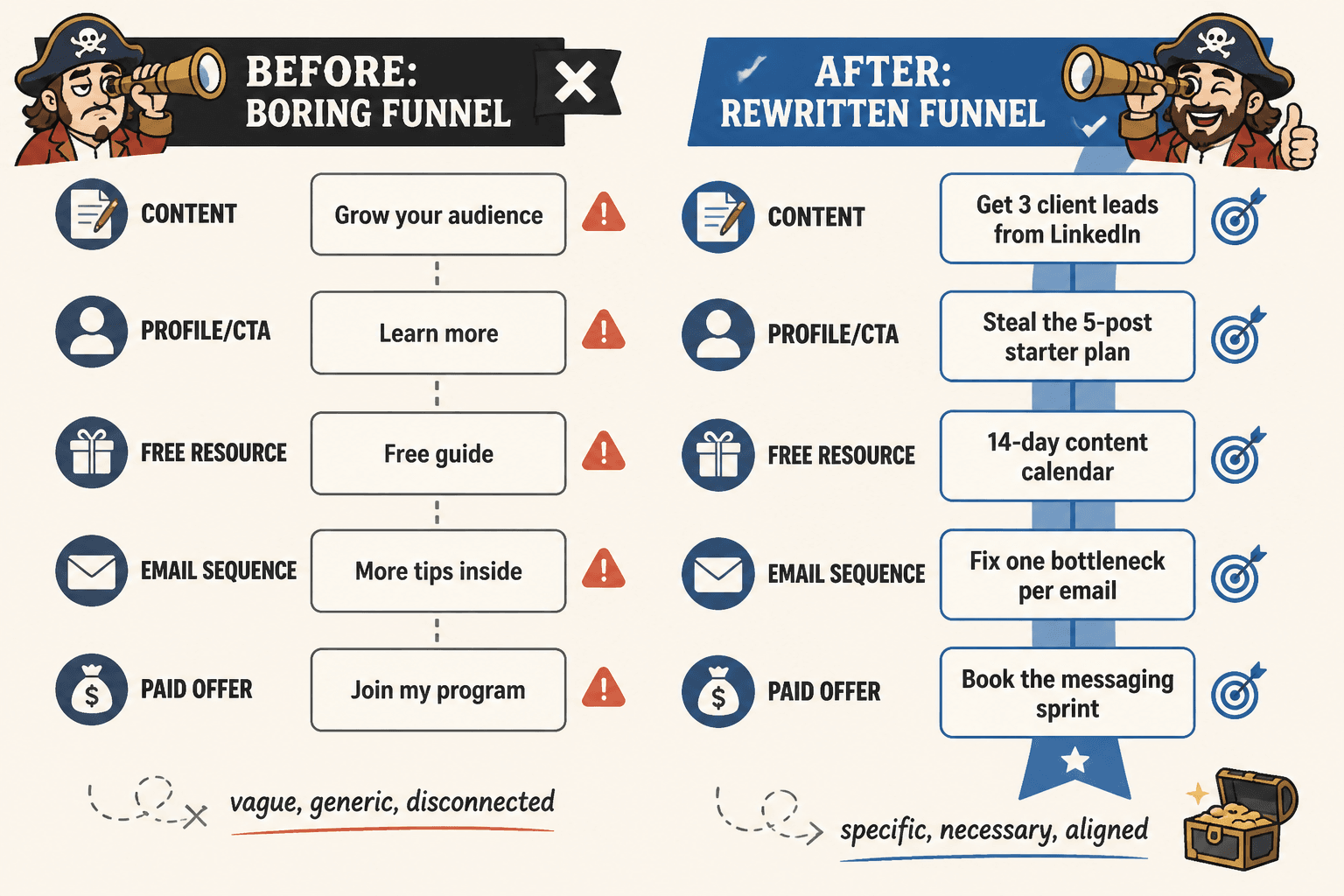
How to rewrite boring creator funnels without rebuilding everything
You do not need to burn the whole thing down every time your funnel underperforms. Usually, a few better decisions fix most of the problem.
The simplest way to rewrite a boring creator funnel is to move through it step by step and ask one question at each stage:
Does this sound like something a specific person would actually care about right now?
If the answer is “kind of,” you have work to do.
Step 1: Rewrite the promise so it sounds specific, not inflatable
Most funnel copy collapses at the promise level.
Creators write things like “grow your brand,” “get more leads,” or “scale your content strategy.” None of that is technically wrong. It is just too broad to create urgency. Broad promises make people nod politely and keep scrolling.
Your promise needs edges. It should point to a real result, for a real kind of person, in language they’d actually use.
| Boring promise | Stronger rewrite |
|---|---|
| Grow your personal brand | Turn your expertise into content people remember and inquiries you can actually use |
| Get more leads online | Build a simple content funnel that turns posts into email signups and sales calls without spamming people |
| Improve your messaging | Clarify what you do so your profile, posts, and offer stop sounding interchangeable |
Notice the difference. The stronger versions are still concise, but they give the reader a more concrete picture of what changes.
Step 2: Fix the handoff between content and funnel
This is where a lot of creators quietly ruin trust.
You post solid content. People like it. Then the CTA suddenly swerves into “grab my ultimate blueprint” or “book a high-impact strategy session.” That jump feels unnatural because it is unnatural.
A good funnel handoff feels like the next sensible step, not a trap door.
If your content is practical, your CTA should feel practical too. If your content is opinion-driven, your funnel can extend that argument. If your content helps people diagnose a problem, the next step should help them go a little deeper, not instantly marry you.
Here is a simple rewrite framework:
- Match the CTA to the post’s topic.
- Offer a next step that feels proportionate.
- Use language that sounds like a continuation, not a hard pivot.
Weak CTA: “DM me GROWTH for my free training and let’s discuss your business goals.”
Better CTA: “If you are trying to turn educational posts into actual leads, I put together a simple creator funnel breakdown you can steal from.”
Same basic function. Less cringe. More relevance.
Step 3: Rewrite your lead magnet so it solves one obvious problem
Many creator funnels die because the free resource is trying to be impressive instead of useful.
“The Ultimate Content Success Vault” is not a real reason to opt in. It sounds like digital attic clutter.
The best lead magnets are narrow, clear, and close to a painful problem. They help the right person make a small but meaningful improvement fast.
| Weak lead magnet | Stronger lead magnet |
|---|---|
| Personal Brand Master Guide | 10 profile rewrites that make your expertise easier to understand in 15 seconds |
| Content Growth Toolkit | 25 post-to-CTA transitions that turn useful content into soft lead generation |
| Sales Funnel Blueprint | A 1-page creator funnel map for consultants selling a low-ticket offer and a call-based service |
The rewrite test is simple: would the right person immediately know why this matters?
If they have to decode the title, admire the branding, and guess what is inside, it is probably too vague.
Rewrite each part of the funnel like it has a job
One reason funnels get bloated is that creators expect every step to do everything. The post should attract, persuade, explain, and convert. The freebie should educate, impress, and pre-sell. The emails should nurture, qualify, and close. Then they wonder why all of it feels heavy.
Each part should do its actual job. That’s it.
The post’s job
- Earn attention
- Show relevance
- Create curiosity or trust
- Point naturally to the next step
The landing page’s job
- Clarify what the resource is
- Explain why it matters
- Reduce friction
- Get the opt-in
The email sequence’s job
- Deliver the promised value
- Deepen the problem
- Build trust through useful insight or proof
- Introduce the offer without sounding like a hostage negotiation
The offer page or sales CTA’s job
- Show fit
- Clarify outcome
- Reduce uncertainty
- Make the next action feel sensible
When you rewrite with that lens, the copy gets cleaner. You stop overexplaining things too early and underexplaining them where it actually matters.
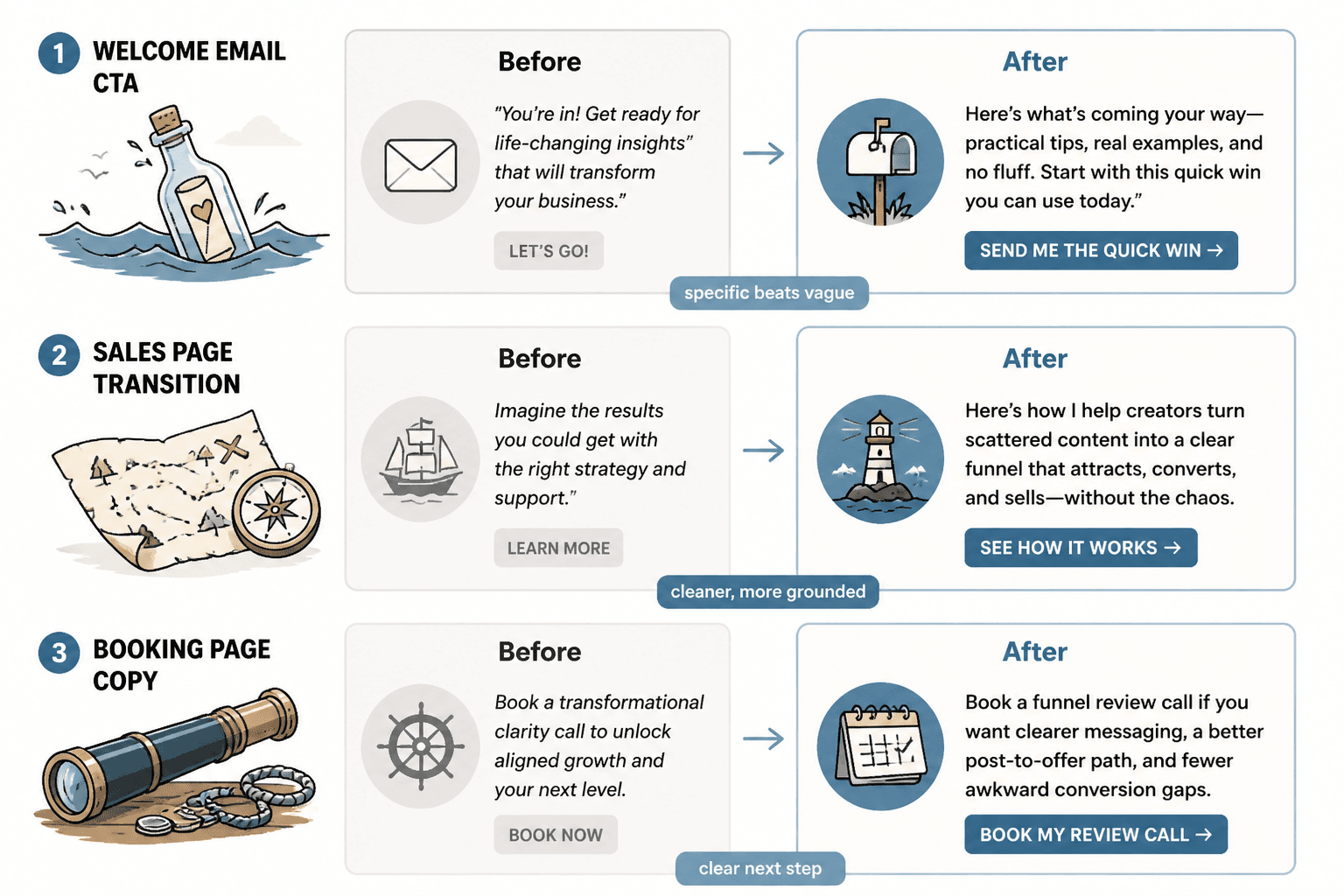
Before-and-after rewrites for common boring funnel copy
Here is where it gets practical.
Below are a few common examples of creator funnel copy that sounds bland, generic, or weirdly overcaffeinated, followed by sharper rewrites.
1. Top-of-funnel post CTA
Before: “If you want to scale your audience and create more impact, comment GUIDE and I’ll send over my free system.”
After: “If you are posting useful ideas but they are not leading anywhere, I made a simple creator funnel guide that shows how to connect content, profile, and offer without forcing it.”
Why it works better: it names the problem, sets expectation, and avoids empty “impact” language.
2. Landing page headline
Before: “Unlock explosive growth with our proven funnel framework.”
After: “Build a simple creator funnel that turns strong content into email signups, qualified leads, and cleaner sales conversations.”
Why it works better: people know what they are getting, and nobody has to survive the phrase “explosive growth.”
3. Email nurture opening
Before: “I’m so excited you’re here. You’re now part of an elite community of creators committed to success.”
After: “Glad you grabbed the guide. Most creator funnels do not fail because the tech is wrong. They fail because the message is vague and the next step feels off. So today I want to show you how to fix that first.”
Why it works better: it gets to the point. Fast.
4. Sales email transition
Before: “Now that you have consumed the value, if you are ready to take your business to the next level…”
After: “If this helped you spot where your funnel is losing people, the next step is fixing it with your own messaging, offer, and audience in mind. That is what I help with inside [offer].”
Why it works better: cleaner, more grounded, less infomercial residue.
5. Booking page copy
Before: “Book a transformational clarity call to unlock aligned growth.”
After: “Book a funnel review call if you want clearer messaging, a better post-to-offer path, and fewer awkward conversion gaps.”
Why it works better: specific beats mystical. Pretty much every time.
What to add when your funnel feels too flat
Sometimes a funnel is not boring because it is overly salesy. Sometimes it is boring because it is too safe.
If every page and email sounds neutral, polished, and generally acceptable, the whole thing becomes forgettable. Trust does not come from sounding sterile. It comes from sounding clear, credible, and real.
Here is what usually helps.
Add sharper opinion
Take a stand on what does not work. Call out the lazy approach. Explain what you do differently.
Not for drama. For positioning.
Example: “Most creators do not need more funnel steps. They need fewer vague ones.”
Add proof
Proof is not always a huge case study. It can be a pattern you have seen, a concrete example, a client result framed responsibly, or a clear breakdown of why something works.
Boring funnels often make claims without support. That is why they feel slippery.
Add audience fit
General messaging creates general interest. Which is another way of saying weak interest.
If you help coaches, say coaches. If you work with consultants selling expertise-based services, say that. If your funnel only really fits solo founders with a low-ticket digital product and a newsletter, write to them.
The more your reader feels seen, the less your funnel has to shout.
Add friction reduction
Sometimes the funnel is boring because it is confusing. People do not know what happens next, how long something is, what they will get, or whether it is for them.
Good rewrites often look less glamorous because they replace fluff with useful detail.
- Tell them what the resource includes
- Tell them who it is for
- Tell them what happens after they opt in
- Tell them what kind of offer comes later, if relevant
Clarity is underrated because it is less flashy than hype. It also tends to convert better.
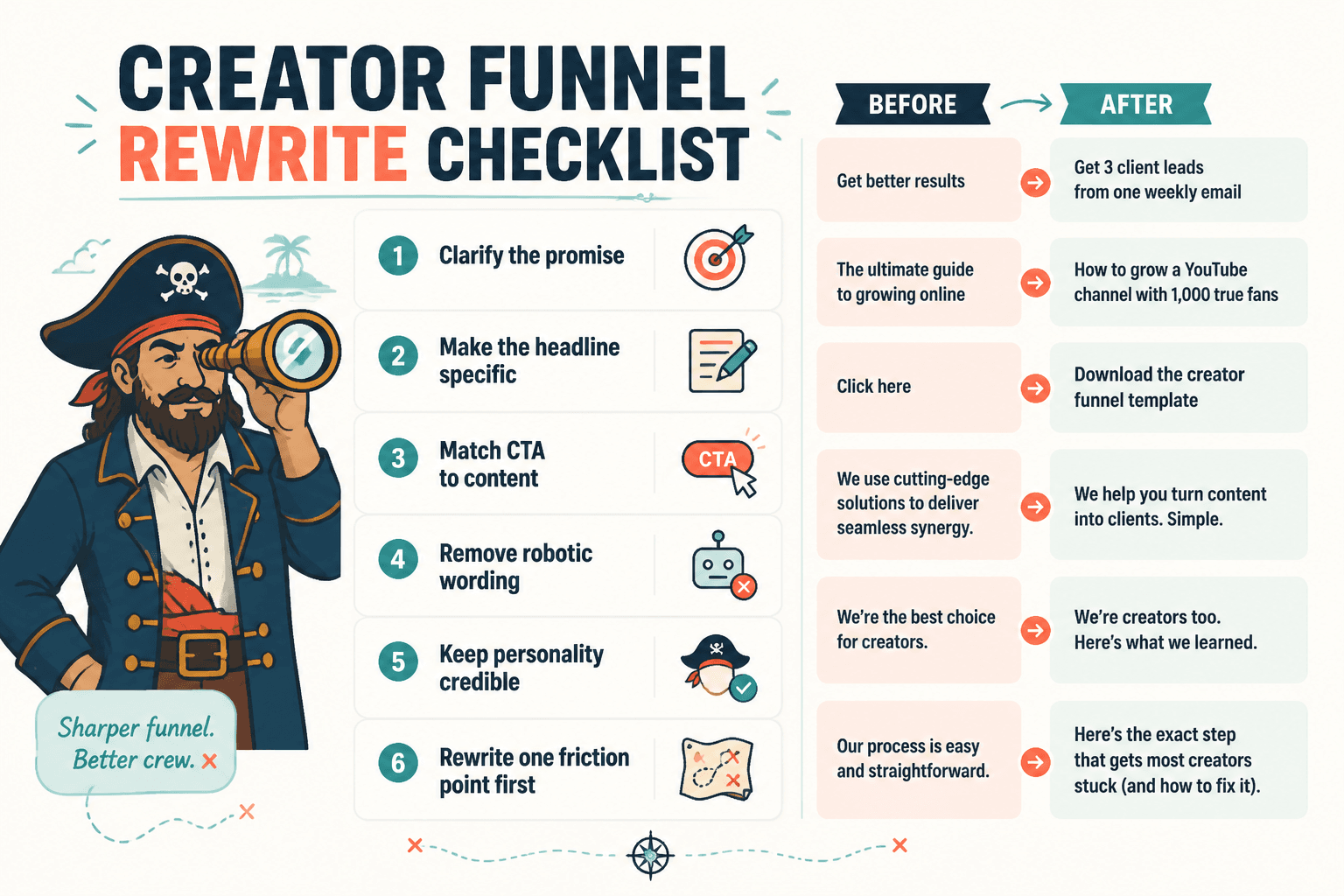
A practical rewrite checklist for boring creator funnels
If you want to tighten your funnel fast, use this checklist.
- Does the first promise describe a concrete result?
- Would the right audience instantly know this is for them?
- Does the CTA match the content that came before it?
- Is the lead magnet narrow enough to feel immediately useful?
- Does the landing page explain the resource without puffed-up language?
- Does the email sequence add insight instead of repeating generic encouragement?
- Does the pitch feel like a logical next step, not a sudden lunge?
- Have you removed jargon, filler, and AI-oatmeal phrases?
- Is there proof, specificity, or a real point of view somewhere in the funnel?
- Could a busy person understand the whole thing in under a minute?
If you answered “not really” to more than two of those, the rewrite is worth doing.
Simple creator funnel structures that are easier to rewrite
Some funnels are boring because they are overbuilt. Too many steps. Too many pages. Too many “nurture assets” floating around with no obvious role.
Simple structures are often easier to write well and easier to trust.
- Post → profile → free resource → email sequence → offer
- Article → relevant lead magnet → case study email → consultation CTA
- Thread → newsletter signup → weekly insights → product or service pitch
- Short-form content → booking page → audit or strategy call
If you need help thinking through those structures, the broader creator funnels guide is a useful starting point, and you can also explore related funnel system content through these monetization and funnel system resources.
And if your issue is not just boredom but generic positioning, read how to improve creator funnels without sounding generic. It pairs nicely with this rewrite process.
What not to do when rewriting your funnel
A quick warning, because this is where people overcorrect.
- Do not replace boring copy with louder copy.
- Do not add fake urgency to a weak offer.
- Do not make every sentence hyper-clever.
- Do not turn “personality” into chaos.
- Do not rewrite the funnel in a tone your audience would never trust.
The goal is not to sound more “creative.” The goal is to sound more relevant, more specific, and more believable.
If your current funnel sounds robotic, this guide on writing creator funnels without sounding salesy or robotic will help you clean up the tone without making the whole thing floppy.
And if the bigger issue is conversion, not just messaging, follow this with how to turn creator funnels into more leads or sales.
FAQ
How do I know if my creator funnel is boring?
Your messaging is probably too vague if people engage with the content but ignore the next step, or if your funnel sounds interchangeable with everyone else in your niche.
Should I rewrite my whole funnel at once?
No. Start with the biggest friction point: usually the promise, CTA, lead magnet title, or landing page headline.
What is the fastest funnel rewrite win?
Tighten the promise and make the CTA match the content more closely. That alone fixes a surprising amount.
Creator funnels get better when the path feels simpler and the writing makes each next step obvious. A cleaner message usually fixes more than extra funnel complexity ever will.