
Most lead magnets do not fail because the PDF was ugly or the headline was a little weak.
They fail because the thing itself was too vague, too big, too slow, or too easy to ignore.
Creators love the idea of a lead magnet. In practice, a lot of them make a mini-course nobody finishes, a guide nobody asked for, or a “free resource” that sounds like it was assembled by a committee that fears specificity.
If you want better leads, better email signups, and fewer dead downloads, your lead magnet needs to solve one small, relevant problem fast. That’s the whole game. This guide gives you lead magnet ideas creators can adapt fast, plus examples, structure, and a few ways to stop making freebies that politely collect dust.
If you want the broader strategy behind what makes these work, read Lead Magnets Guide for Creators Who Want Better Results. If you need the bigger funnel context, the lead magnets hub is a good place to keep open in another tab.
Want the broader roadmap? Start with the parent guide.
What makes a lead magnet worth downloading
Before we get into lead magnet ideas creators can adapt fast, it helps to strip this down.
A useful lead magnet usually does at least four things:
- Solves a specific problem
- Feels immediately usable
- Matches the paid thing you eventually sell
- Attracts the right person, not just any person with a pulse and an email address
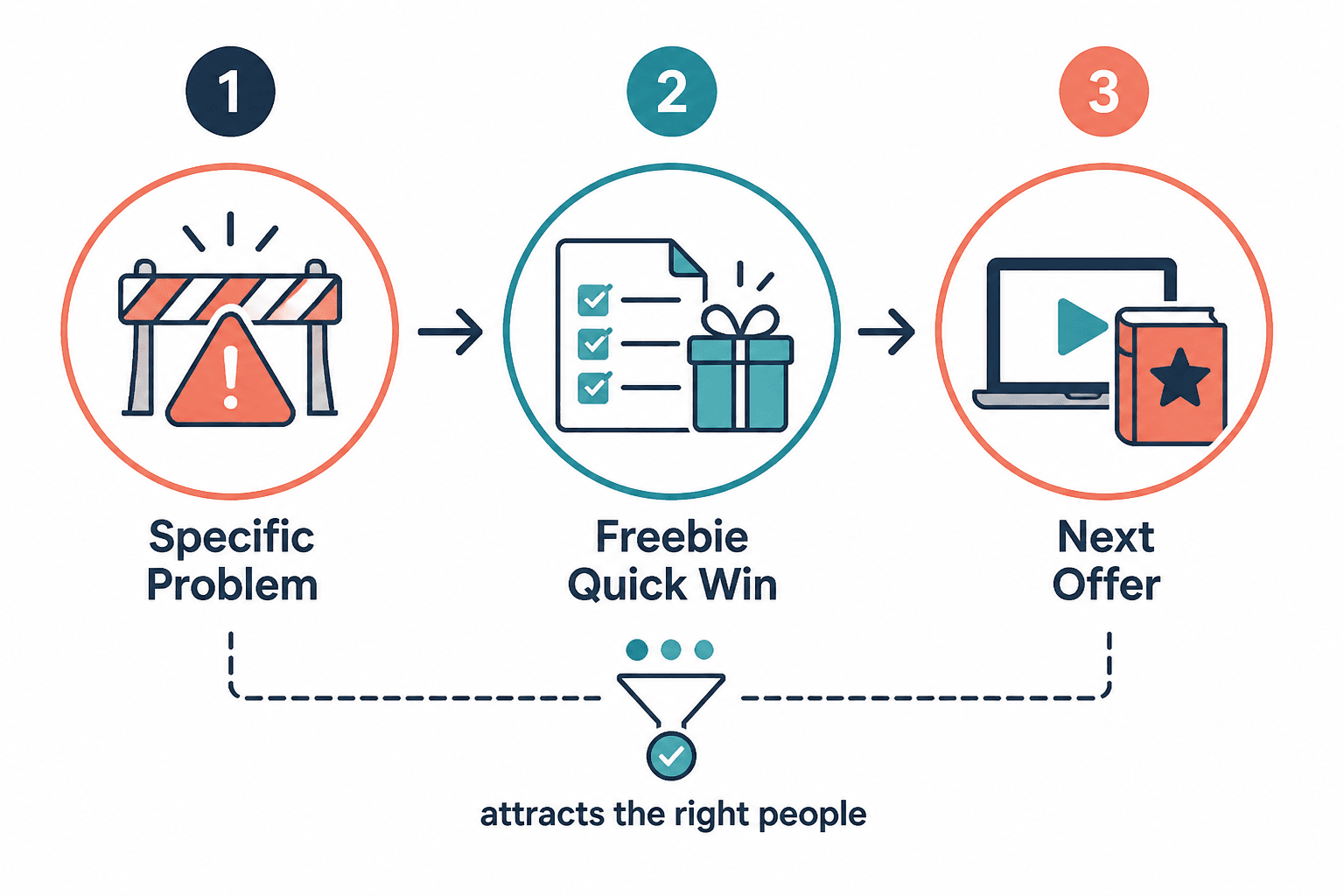
That last point matters more than people think. A lead magnet is not just bait for list growth. It is a filter. If your freebie attracts everyone, it often converts almost no one. Broad freebies make broad lists. Broad lists tend to click politely and buy absolutely nothing.
The better approach is simple: give people a quick win that naturally leads to your next offer.
A strong lead magnet should make the next step feel obvious, not random.
The fastest way to come up with a lead magnet idea
Do not start by asking, “What free thing should I make?” That question leads to bloat.
Start here instead:
- What is one problem your audience keeps running into?
- What is one step they get stuck on?
- What tiny tool, checklist, script, or example would help them move faster?
- What paid offer would logically help after that?
That sequence saves you from building another 37-page “ultimate guide” when what people really wanted was a checklist, prompt pack, mini template, or example bundle.
For more inspiration, you can also browse Best Lead Magnets Ideas and Examples for Creators. But first, here are the formats that tend to work especially well when speed matters.
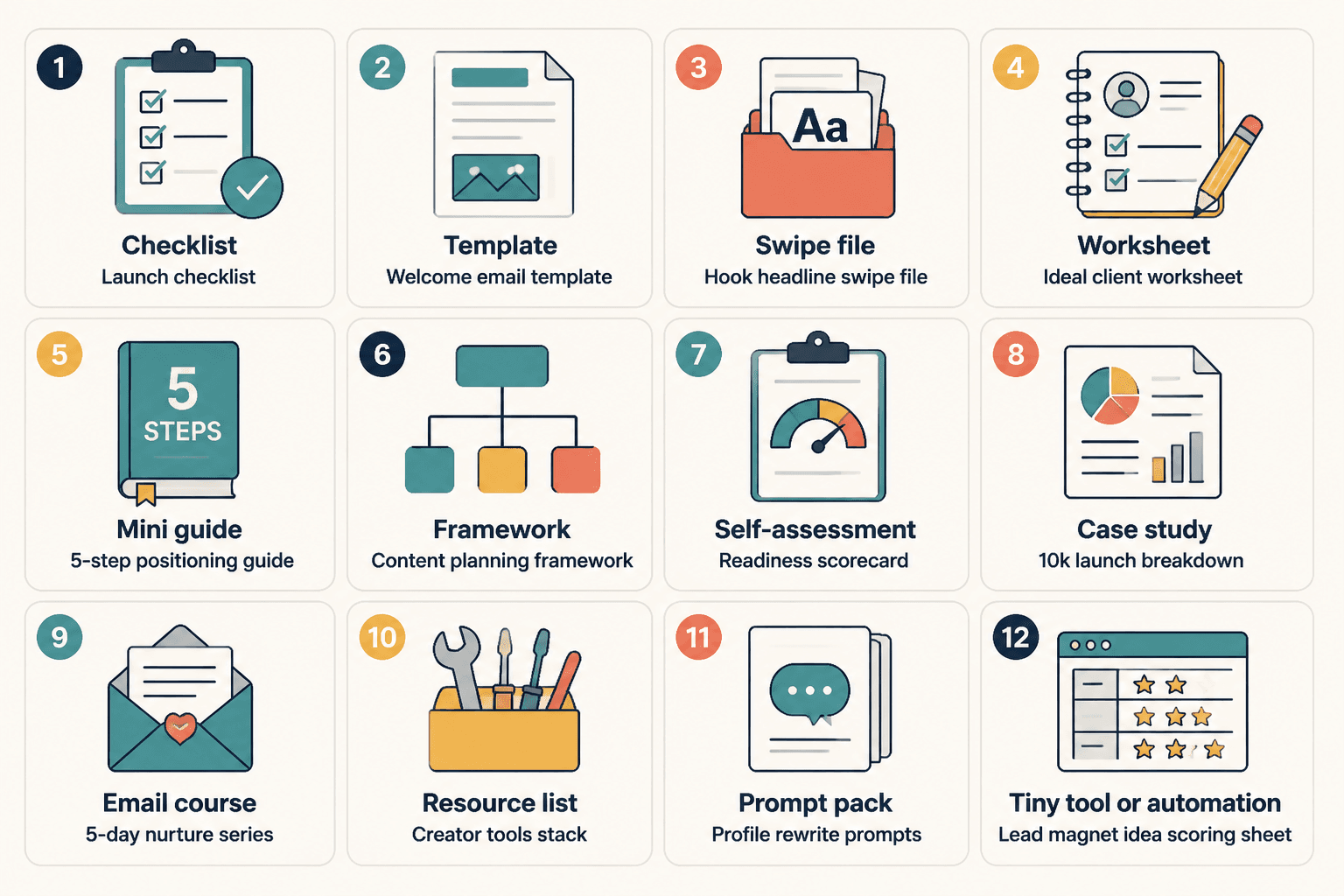
12 lead magnet ideas creators can adapt fast
1. Checklist
A checklist works when your audience needs clarity more than theory.
It is easy to create, easy to consume, and genuinely helpful when people are trying to avoid mistakes, prep something, review something, or publish something.
Works well for: coaches, consultants, copywriters, content creators, service providers
Examples:
- LinkedIn Post Checklist Before You Hit Publish
- 5-Minute Sales Page Review Checklist
- Client Onboarding Checklist for Freelancers
- Podcast Guest Prep Checklist for Personal Brands
Why it converts: it promises speed and certainty. People like not forgetting things.
2. Template pack
Templates are one of the best lead magnet formats because they reduce blank-page friction. Your audience does not just want advice. A lot of the time, they want a starting point.
Examples:
- 10 CTA Templates for Creator Posts
- Client Proposal Email Templates
- Newsletter Welcome Sequence Templates
- Content Repurposing Prompt Templates
The trick is to avoid generic fill-in-the-blank sludge. If your templates sound like they escaped from a stale webinar funnel, people will smell it instantly.
3. Swipe file
A swipe file is basically a curated example bank. Great for creators, writers, marketers, and anyone who learns faster by seeing what good looks like.
Examples:
- 25 High-Trust LinkedIn CTAs
- 50 Hook Examples for Thoughtful Non-Cringey Posts
- Sales Email Subject Line Swipe File
- Consultant Bio Examples That Do Not Sound Inflated
Swipe files work especially well if you already teach writing, positioning, messaging, or content strategy.
4. Mini audit or self-assessment
People love finding out what is wrong. More accurately, they love finding out what is wrong when the answer feels fixable.
A self-assessment helps prospects diagnose the gap between where they are and where they want to be. That makes it a strong bridge into consulting, coaching, services, or strategy offers.
Examples:
- Is Your LinkedIn Profile Losing Clients? 12-Point Audit
- Email Welcome Sequence Scorecard
- Creator Funnel Friction Finder
- Thought Leadership Content Self-Review Sheet
If you use this format, make the outcome actionable. Nobody needs another quiz that tells them they are “a visionary builder archetype.”
5. Short guide
Yes, guides can work. No, they should not be bloated ebooks pretending length equals value.
A short guide is useful when your audience needs a focused explanation with a few examples. Think 5 to 12 pages, not a heroic manuscript.
Examples:
- The Simple Creator Funnel for Selling One Offer
- How to Write a Lead Magnet Signup Hook That Gets Clicks
- A No-Fluff Guide to Better About Page Copy
If you need help with packaging, this pairs well with How to Improve Lead Magnets Signup Hooks Without Sounding Generic.
6. Prompt pack
Prompt packs are useful when your audience needs help generating ideas, making decisions, or speeding up a repeatable process.
They are especially effective for creators, coaches, strategists, and marketers because they turn vague “I should make content” energy into actual movement.
Examples:
- 30 Journal Prompts for Coaches Who Want Better Content Ideas
- 25 AI Prompt Starters for Repurposing Posts
- 20 Messaging Prompts to Clarify Your Offer
- 15 Story Prompt Angles for Facebook Posts
Just make sure the prompts are tied to an outcome. A random bag of prompts is not a lead magnet. It is stationery with ambition.
7. Resource list
Curated resources save people time. That alone can be enough to earn the opt-in.
This works best when your audience trusts your taste or wants a faster way to choose tools, references, or next steps.
Examples:
- My Favorite Creator Workflow Tools
- 15 Books That Actually Improve Messaging
- Recommended Software Stack for a One-Person Content Business
- Best Free Research Sources for Newsletter Writers
The best version is curated and opinionated, not a random warehouse list.
8. Script or framework
If your audience has to say something difficult, repetitive, or high-stakes, a script is gold.
Examples:
- Discovery Call Question Script
- Soft-Sell DM Script After Someone Engages Repeatedly
- Client Boundary Email Scripts
- Simple Framework for Writing Stronger Hook-Body-CTA Posts
This kind of lead magnet often converts well because it is tied closely to action. It also tees up paid offers nicely if you sell strategy, coaching, sales support, or copy.
9. Examples bundle
Sometimes people do not need more theory. They need to see what “good” looks like in context.
Examples:
- 7 Creator Bios Rewritten for Clarity
- 12 Before-and-After Hook Examples
- 10 Landing Page Hero Sections That Convert Better
- 5 Nurture Email Sequences Annotated
This format is especially strong for writers, brand strategists, conversion consultants, and content educators.
10. Calculator, estimator, or worksheet
Anything that helps people estimate time, pricing, volume, effort, ROI, or content output can be very compelling.
Examples:
- Freelance Rate Calculator
- Newsletter Growth Planning Worksheet
- Monthly Content Capacity Planner
- Offer Profit Margin Estimator for Solo Creators
Works well when your audience wants decisions, not inspiration.
11. Mini email course
This one takes more effort, but it can work beautifully if your topic benefits from sequencing.
Instead of dumping everything into one file, you teach one focused concept across 3 to 5 short emails.
Examples:
- 5 Days to Sharper LinkedIn Posts
- 3 Email Lessons to Clarify Your Offer Positioning
- 4-Day Mini Course on Building a Simple Lead Funnel
Use this when you want to build habit, trust, and momentum, not just collect opt-ins.
12. Tiny tool or automation
If you can turn your expertise into a simple spreadsheet, notion board, calculator, generator, or AI-assisted helper, people will often perceive it as more valuable than a PDF.
Examples:
- Content Calendar Generator
- Lead Magnet Idea Scoring Sheet
- Offer-to-Content Mapping Board
- Profile Rewrite Prompt Tool
Just do not overbuild it. The point is usefulness, not launching a small software company by accident.
How to choose the right lead magnet idea for your business
Not every lead magnet format fits every creator.
If you are a coach, a self-assessment, worksheet, or script may convert better than a swipe file. If you are a writer or strategist, examples and templates may outperform a broad guide. If you sell implementation-heavy services, a checklist or audit may be the cleanest bridge into the paid offer.
Here is a simple way to choose.
| If your audience needs… | Use this lead magnet type |
|---|---|
| Clarity on what to do | Checklist, guide, framework |
| A starting point | Template pack, script, prompt pack |
| Examples to model | Swipe file, examples bundle |
| Diagnosis or feedback | Audit, assessment, scorecard |
| Decision support | Worksheet, calculator, planner |
| Progress over time | Mini email course |
The easier test is this: what is the smallest useful thing that moves someone one step closer to buying from you?
That is usually your lead magnet.
3 fast examples creators can adapt right now
Example 1: For a content strategist
Audience: consultants trying to get leads from LinkedIn
Lead magnet: 21 LinkedIn Hook Templates for Experts Who Hate Sounding Cringe
Why it works: very specific audience, clear pain point, immediate usability, natural bridge into a paid content strategy offer
Next offer: LinkedIn messaging audit or content consulting package
Example 2: For a business coach
Audience: solo service providers with messy offers
Lead magnet: Offer Clarity Scorecard: 10 Questions to Find What Is Blocking Sales
Why it works: helps diagnose the problem, creates urgency without fake pressure, opens the door to a strategy session or coaching package
Next offer: offer positioning intensive
Example 3: For a freelance copywriter
Audience: founders writing their own landing pages
Lead magnet: Homepage Hero Section Rewrite Kit with 15 Before-and-After Examples
Why it works: concrete outcome, high relevance, strong proof of expertise, naturally leads to done-for-you copy or audits
Next offer: homepage review or website copy package
What creators keep doing wrong with lead magnets
A few mistakes show up constantly.
- Making it too broad. “The Ultimate Guide to Growing Your Brand” is not a lead magnet. It is a cry for editorial restraint.
- Teaching too much. The goal is one useful win, not a free substitute for your entire paid offer.
- Choosing the format before the problem. PDFs are not strategy.
- Attracting the wrong audience. More signups means very little if they are not future buyers.
- Weak signup hooks. Good resource, bland promise. That kills conversions fast.
- No next step. A lead magnet without a follow-up path is just free labor with branding.
If your signup page is underperforming, improve the promise before you rebuild the asset. The packaging often breaks before the content does. This is exactly where stronger signup hooks matter.
A simple lead magnet formula you can reuse
If you want a repeatable structure, use this:
Help [specific audience] achieve [small desirable outcome] with [specific format] in [short time or low effort].
Examples:
- Help consultants write better LinkedIn posts with 15 tested hook templates
- Help freelance designers onboard clients faster with a simple welcome packet checklist
- Help coaches clarify their offer with a 10-minute scorecard
- Help creators build a cleaner funnel with a one-page planning worksheet
That formula keeps your lead magnet grounded in utility instead of drifting into vague “value” language.
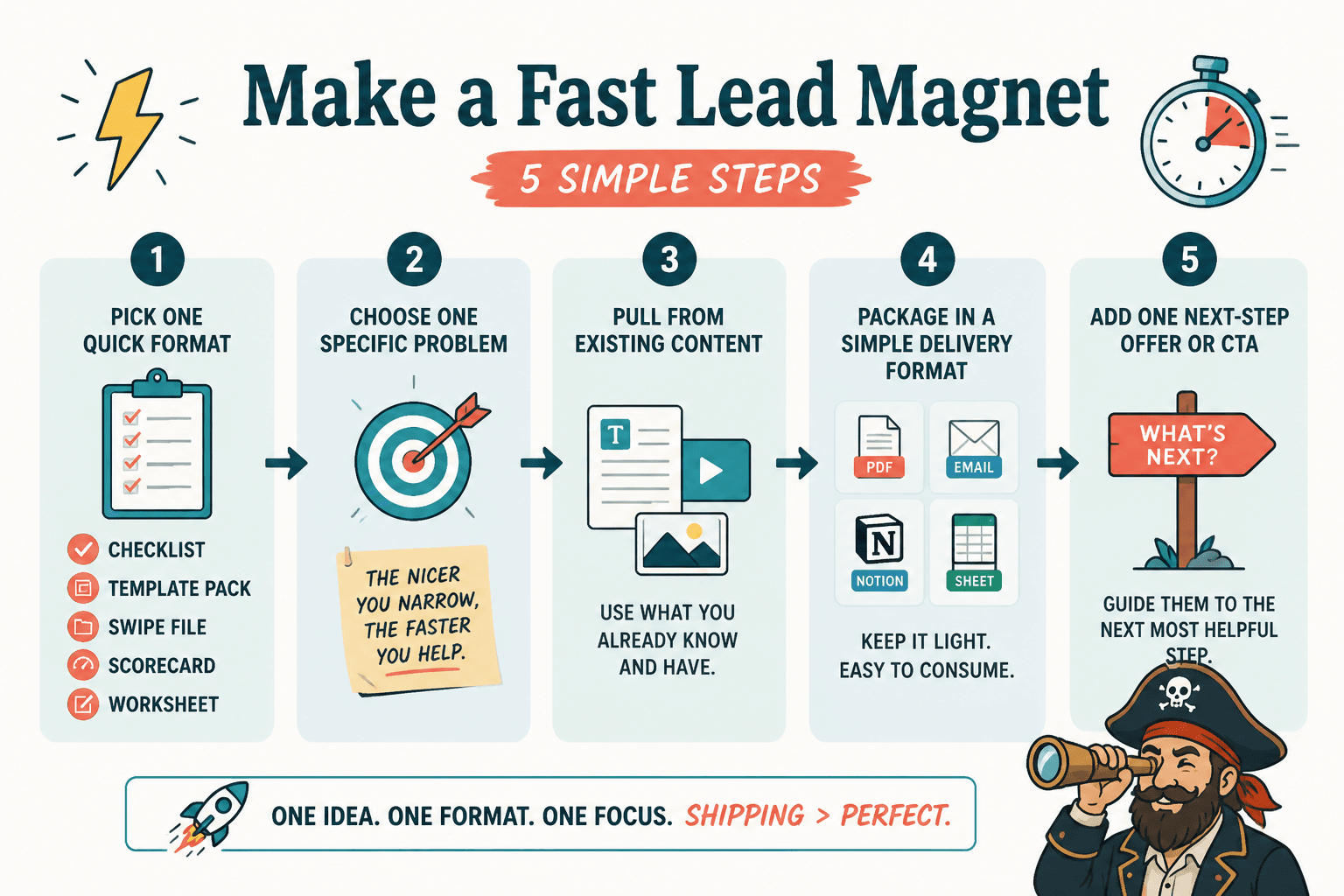
Best formats when you are busy and need something fast
If you need to ship quickly, start with one of these:
- Checklist
- Template pack
- Swipe file
- Scorecard
- Worksheet
These are usually faster to create, easier to consume, and easier to connect to a clear paid next step.
If you need help choosing the actual delivery format, see Simple Lead Magnets Delivery Formats Templates for Busy Creators. It will save you from spending three afternoons wondering if this should be a PDF, email series, Notion page, or spreadsheet.
How to connect your lead magnet to actual revenue
Lead magnets work best when they solve one real problem cleanly and make the next step feel natural. The clearer the bridge from free value to real offer, the stronger the whole system gets.
Lead magnets work best when they solve one real problem cleanly and make the next step feel natural. The clearer the bridge from free value to real offer, the stronger the whole system gets.