
Most lead magnet signup hooks are not failing because the freebie is bad. They are failing because the pitch sounds like every other freebie on the internet.
“Get the free guide.” “Download the checklist.” “Learn the secrets.” Fine. Technically clear. Also completely forgettable.
If your signup hook sounds like template sludge, people do what people always do with template sludge: ignore it, postpone it, or assume it is just another PDF they will never open. Harsh, yes. Also true.
Here’s how to improve lead magnet signup hooks without sounding generic: make the promise more specific, make the outcome more concrete, make the reader feel understood, and stop pretending “free” is enough to do all the work. A better hook does not need more hype. It needs more relevance.
This matters a lot if you are using content to drive leads. The path is usually simple: post, profile, signup page, lead magnet, follow-up. But when the hook is weak, the whole thing gets softer than it should. You can have a solid free resource and still lose conversions because the signup line sounds like it was assembled by a bored intern and a tired AI prompt.
If you are building out that system, it helps to understand the bigger picture around content monetization funnels, how money content works, and what makes lead magnets worth signing up for in the first place.
To see how this fits into the wider strategy, open the parent guide.
Why generic signup hooks get ignored
A signup hook has one job: make the right person think, “Yes, that is for me, and yes, I want it now.”
Generic hooks fail because they do not create that moment. They describe the format, not the value. They name the asset, not the shift. They tell people what they get, but not why they should care.
Compare these:
- Generic: Download my free content guide
- Better: Steal the 7-part content planning system I use to turn one idea into a week of posts
The first one tells me there is a guide. Great. The second one tells me what problem it solves, what kind of result I can expect, and why it might be useful right now.
People do not sign up because your lead magnet exists. They sign up because the hook makes the resource feel immediately relevant, usable, and worth the email trade.
If your signup hook could sit on 500 other landing pages without anyone noticing, it is too generic.
What a strong lead magnet signup hook actually does
When you want to improve lead magnet signup hooks without sounding generic, do not start by trying to sound clever. Start by making the hook do four practical things.
1. It names a real problem
Not a broad theme. A problem.
- Weak: Improve your marketing
- Better: Fix the five homepage mistakes quietly killing your inquiries
2. It implies a useful outcome
The person should be able to picture what changes after they read or use it.
- Weak: Get my outreach script
- Better: Use this outreach script to start warmer sales conversations without sounding like you copied a cold DM bro
3. It suggests speed, ease, or clarity honestly
You do not need ridiculous promises. But you should reduce friction.
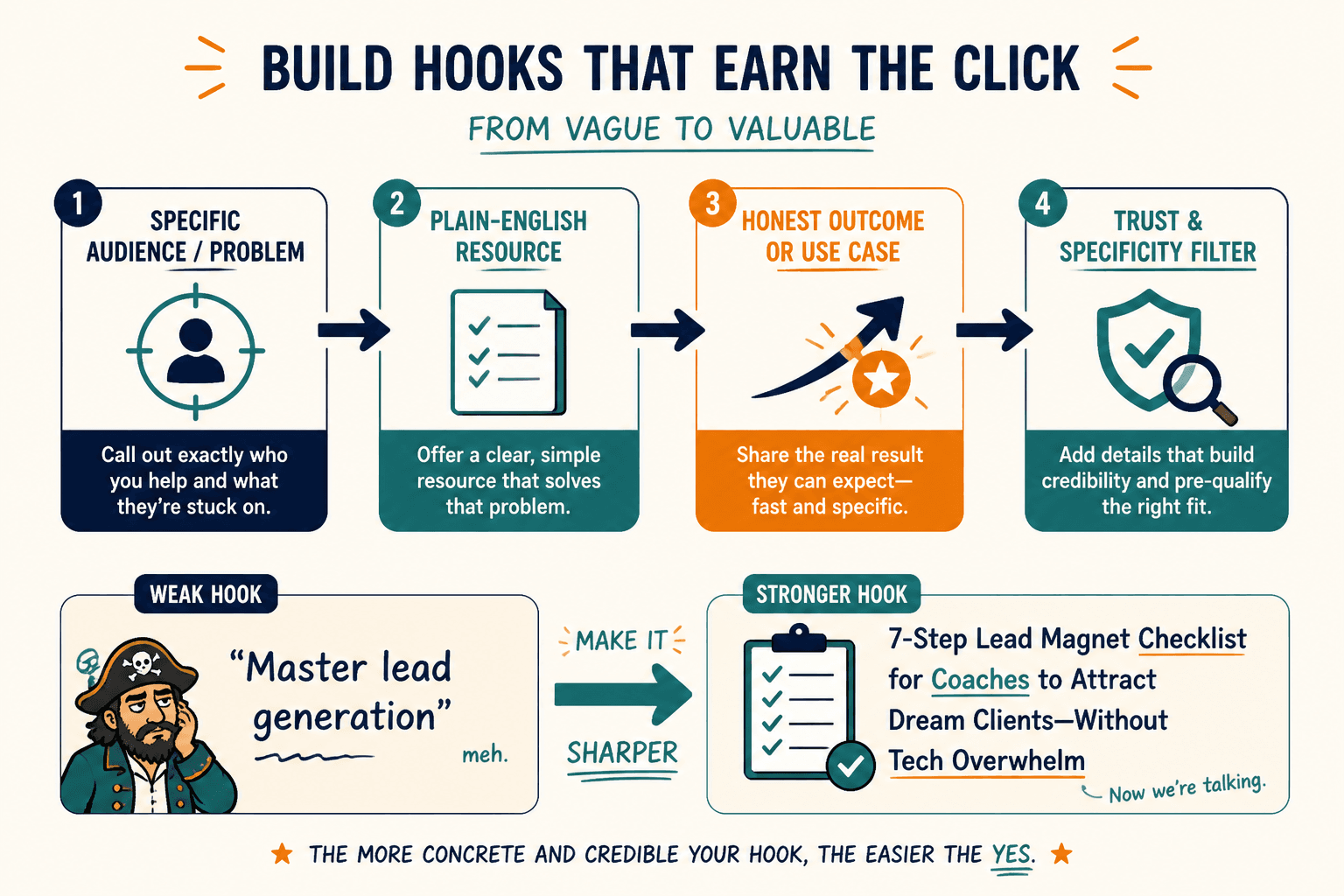
- Weak: Master lead generation
- Better: Get the one-page lead gen checklist I use before publishing any conversion-focused post
4. It sounds like it came from someone with a brain
That means no vague hype, no buzzword soup, and no “unlock” anything. Your hook should sound like a sharp human explaining why this is useful, not a landing page assembled from leftover webinar scraps.
The fastest way to make a generic hook better
Take your current hook and run it through this simple upgrade:
- Identify the actual audience
- Name the specific problem
- Describe the resource in plain English
- Add the result or use case
- Cut any filler words trying to sound important
Here is the formula:
Get/use/download + specific resource + for specific problem + with specific outcome
For example:
- Generic: Download my free lead magnet template
- Better: Download the lead magnet template I use to turn messy expertise into a clear opt-in people actually want
That is not poetry. It is not trying to win awards. It is just doing the job properly.
5 things to remove from your signup hooks immediately
If your hooks feel flat, these are usually the culprits.
Vague nouns
Words like success, growth, clarity, results, and freedom tend to sound impressive while saying almost nothing.
Swap them for actual context. Growth in what? Clarity about what? Results from which action?
Overused lead magnet labels
Guide. Blueprint. Roadmap. Secrets. Framework. System.
These words are not banned. They are just tired. If you use them, they need support from a much more specific promise.
Fake urgency
“Get instant access now before it is gone” does not magically improve a weak offer. Most of the time, it just adds sales-page cologne to a basic sentence.
Broad audience language
“For entrepreneurs, business owners, creators, founders, coaches, and freelancers” is not audience clarity. It is audience panic.
Choose the real buyer. Your hook gets stronger the second it stops trying to please every person with Wi-Fi.
Throat-clearing intros
“I created this free resource to help you…” is usually unnecessary. Start with the value, not your explanation of why the value exists.
Before-and-after rewrites for generic lead magnet signup hooks
This is where most people improve fastest. You see the bland version, then you see what changed.
| Before | After | Why it works better |
|---|---|---|
| Download my free guide to content marketing | Download the 10-post content guide I use when a week of ideas turns into a blank screen | Specific format, specific use case, stronger relatability |
| Get the checklist for growing your audience | Get the audience-growth checklist that helps small creators stop posting randomly and start building momentum | Targets a real pain point and audience stage |
| Free sales funnel template | Use this simple funnel template to turn one good post into subscribers, replies, and consultation leads | Shows how the template fits into the reader’s workflow |
| Download my personal branding workbook | Download the workbook that helps you describe what you do without sounding vague, inflated, or painfully corporate | Adds tension and makes the payoff clearer |
| Get my lead magnet ideas PDF | Get 25 lead magnet ideas for creators who know their offer is good but their opt-in is getting ignored | Connects ideas to a clear frustration |
The pattern is simple. The stronger version usually adds one or more of these:
- A more precise audience
- A more specific problem
- A more concrete outcome
- A stronger use case
- A clearer emotional tension
And importantly, it cuts anything that sounds like recycled lead-gen wallpaper.
Use specificity, not hype
People often try to improve weak hooks by making them louder. More exclamation points. Bigger adjectives. More intensity. More urgency. This usually makes the hook worse.
Specificity beats hype because it creates trust. “Steal my 3-email welcome sequence for warm leads” is stronger than “Discover the ultimate email strategy.” Not because it is sexier, but because it is believable.
Believable matters. Especially if your audience is coaches, consultants, founders, or creators who have seen enough internet nonsense to smell fluff from three tabs away.
A good signup hook does not sound huge. It sounds useful.
How to match the hook to the type of lead magnet
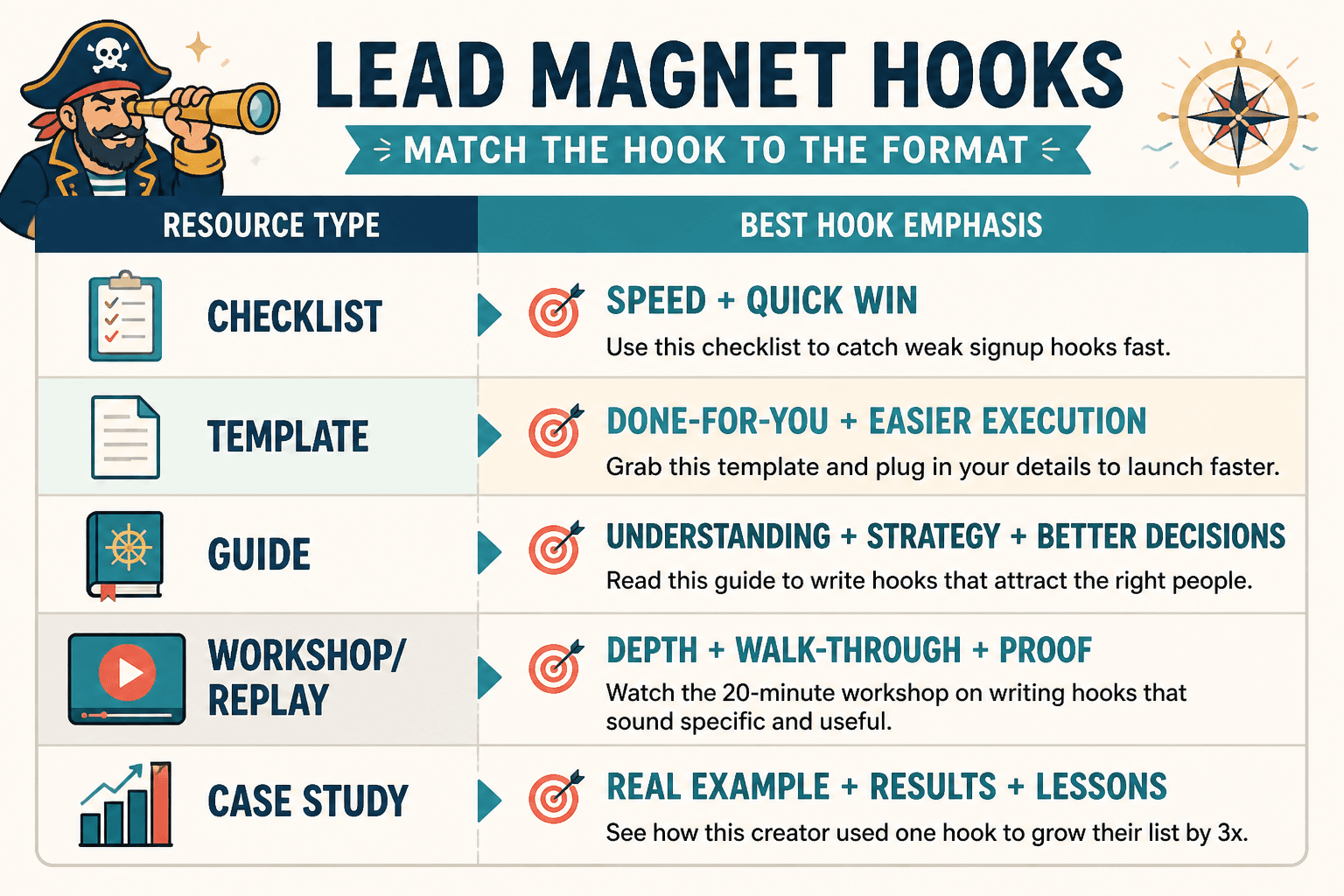
Different lead magnets need different hook styles. A template is not sold the same way as a case study. A checklist is not sold the same way as a workshop replay. Obvious, yes. Yet people still write every signup hook like it is just “free value” in a trench coat.
For checklists
Emphasize speed, simplicity, and mistake prevention.
- Example: Get the pre-publish checklist I use to catch weak hooks, soft CTAs, and vague promises before they cost me leads
For templates
Emphasize done-for-you structure and easier execution.
- Example: Use these 5 lead magnet landing page templates when you need a cleaner opt-in page without writing from scratch
For swipe files
Emphasize examples, inspiration, and faster ideation.
- Example: Get 30 signup hook examples you can adapt for newsletters, lead magnets, and low-friction opt-ins
For guides or mini-books
Emphasize understanding, strategy, and better decisions.
- Example: Download the short guide that shows why most lead magnets underperform before the follow-up sequence even starts
For workshops or replays
Emphasize depth, walk-through, and proof.
- Example: Watch the 20-minute workshop on writing lead magnet hooks that sound specific, useful, and worth the email
Matching the hook to the format makes the pitch feel more honest. It also helps the reader know what kind of effort the resource will require. That lowers friction. And lower friction usually beats louder persuasion.
A simple framework for writing better signup hooks
If you want a repeatable approach, use this:
Problem + resource + payoff + tone
Break it down like this:
- Problem: What frustration or stuck point is the person dealing with?
- Resource: What exactly are you giving them?
- Payoff: What gets easier, better, faster, or clearer after they use it?
- Tone: How can you phrase it in a way that sounds like your brand rather than generic funnel software?
Example:
- Problem: Their lead magnet sounds bland
- Resource: A signup hook swipe file
- Payoff: They can write sharper opt-ins faster
- Tone: Direct, useful, lightly sharp
Final hook:
Get the swipe file of signup hooks for lead magnets that need more curiosity, more clarity, and a lot less generic mush.
That works because it speaks like a person. Not a funnel chatbot trying to impress a spreadsheet.
Where most creators go wrong with lead magnet hooks
They focus on the asset instead of the decision.
The reader is not standing there thinking, “Hmm, I would love another PDF today.” They are deciding if this thing is worth attention, inbox space, and the mild annoyance of entering an email address. Your hook has to help them make that decision fast.
That means you should stop leading with format alone. “Free guide,” “free workbook,” and “free template” are not compelling by themselves anymore. They are just containers.
The thing that converts is the promise inside the container.
If you want to tighten the front end even more, it helps to pair this with a stronger opening on the page itself. This is exactly where better lead magnet openings matter. And if the lead magnet itself is weak once people get it, no hook in the world is going to save that for long, so make sure you also know how to write better lead magnets.
Templates you can adapt without sounding copy-pasted
These are not magic formulas. They are starting points. Use them to get sharper, then edit until they sound like you.
Template 1: For a practical quick win
Get the [resource] that helps you [specific result] without [specific frustration].
Example: Get the one-page content brief that helps you write faster without rambling your way into 14 unfinished drafts.
Template 2: For mistake prevention
Use this [resource] before you [important action] so you do not [costly mistake].
Example: Use this landing page checklist before you publish your opt-in so you do not waste traffic on a signup page that says almost nothing.
Template 3: For people stuck in a messy process
Download the [resource] I use to turn [messy situation] into [clear outcome].
Example: Download the planning template I use to turn scattered content ideas into a week of posts, emails, and lead magnet promos.
Template 4: For audience-specific tools
Get [resource] for [specific audience] who need to [specific goal] without [common objection or pain].
Example: Get 21 lead magnet hook ideas for coaches who need better email signups without making every post sound like a mini sales page.
Template 5: For stronger curiosity
Lead magnets work best when they solve one real problem cleanly and make the next step feel natural. The clearer the bridge from free value to real offer, the stronger the whole system gets.
Lead magnets work best when they solve one real problem cleanly and make the next step feel natural. The clearer the bridge from free value to real offer, the stronger the whole system gets.