
Most lead magnets do not fail because the PDF was ugly or the headline needed more “power words.” They fail because the thing itself was too broad, too weak, too easy to ignore, or too disconnected from the offer that comes next.
A lot of creators make lead magnets like they are handing out polite freebies at a conference table nobody wanted to walk past. “Free guide.” “Checklist.” “My top tips.” Fine. Also forgettable.
If you want better results, your lead magnet needs to do one job well: help the right person get a useful win that naturally makes them want the next step. Not random value. Relevant value. That difference matters more than most people want to admit.
This Lead Magnets Guide for Creators Who Want Better Results will show you how to choose the right type of lead magnet, make it more compelling, connect it to your content and offer, and avoid the usual mistakes that fill your list with freebie collectors who never buy a thing.
For the broader learning path, visit our parent guide.
What a lead magnet is actually supposed to do
A lead magnet is not just a free thing in exchange for an email address.
That is the mechanical definition. It is also not very useful.
A good lead magnet does three things:
- It attracts the right people
- It solves a small but meaningful problem
- It sets up the next step in your funnel without feeling like bait-and-switch nonsense
That means the best lead magnets are usually narrow, specific, and tied to a clear outcome. They are not mini-books trying to prove how smart you are. They are not giant resource dumps for everyone with a pulse. They are not “everything I know about content” stuffed into 37 pages nobody will finish.
If your lead magnet cannot be described in one clean sentence that makes the right person think, “Yes, I need that,” it probably needs work.
The goal is not to impress people with volume. The goal is to move the right person one step closer to trust, momentum, and action.
If you want a broader view of how lead magnets fit into creator monetization, this lead magnets hub is a useful next stop after this guide.
Why most creator lead magnets underperform
Before fixing lead magnets, it helps to name what keeps going wrong.
They are too broad
“A guide to growing your brand online” sounds generous. It also sounds like work. Broad lead magnets feel vague, heavy, and skippable.
Narrow is usually stronger. “12 profile fixes that make consultants easier to trust in 5 minutes” has an audience, a use case, and a specific payoff.
They solve the wrong problem
A creator may attract people with content about visibility, but then offer a generic “business mindset workbook.” Those are not close enough. You got attention for one need and offered a freebie for another.
Lead magnets work better when they match the problem that brought the person in. If the post was about weak LinkedIn hooks, the lead magnet should help with hooks, post structures, examples, or a related conversion problem. Not your morning routine. Not a planner. Not a workbook full of empty pages.
They give information instead of momentum
People do not need more information nearly as often as they need better direction. A lead magnet that says, “Here are 19 things to think about” is often less useful than one that says, “Use this 5-part template and rewrite your homepage CTA today.”
The right kind of freebie helps someone do something, decide something, fix something, or avoid something. It creates movement.
They attract the wrong subscribers
If your lead magnet is too generic, too broad, too trendy, or too disconnected from your paid work, you can absolutely grow your list. You can also grow a list full of people who like free stuff and disappear the second money enters the chat.
Bigger is not automatically better here. A smaller list of relevant subscribers is far more useful than a giant list of ghosts, coupon chasers, and people who vaguely remember downloading your checklist six months ago.
There is no clean next step
Even a strong lead magnet can stall if it ends with nothing. No follow-up path. No related offer. No welcome sequence. No CTA. Just “hope they keep liking me, I guess.”
Hope is not a funnel. It is a coping mechanism.
How to choose the right lead magnet for your business
The right lead magnet depends on what you sell, how your audience buys, and what kind of trust they need before they take the next step.
Here is the simple way to choose one: start with the paid offer, then work backward.
Ask these four questions first
- Who is this for? Be specific. “Creators” is often too broad. “Coaches selling 1:1 services on LinkedIn” is much better.
- What small problem can I solve fast? Not their entire business. One clear friction point.
- What result would make them trust me more? A useful win, not just more reading.
- What should they logically do next? Subscribe to your newsletter, book a call, use a paid template, buy a low-ticket product, or join a service funnel.
If the lead magnet does not naturally lead toward the offer, it will probably produce weak leads. Not no leads. Weak leads.
Match the lead magnet type to the buyer’s stage
| Buyer stage | What they need | Strong lead magnet types |
|---|---|---|
| Problem-aware | Clarity and diagnosis | Checklist, self-audit, scorecard, quick guide |
| Solution-aware | Direction and comparison | Template pack, workflow, framework, examples |
| Ready to act | Proof and implementation help | Mini training, case-study breakdown, swipe file, tool stack |
| Close to buying | Confidence and fit | FAQ resource, roadmap, onboarding preview, decision guide |
This is where many creators get messy. They give beginner-level freebies to people who are already shopping for help, or advanced resources to people who still do not understand the problem well enough to care. Better alignment usually means better conversions.
If you want more inspiration, this piece on best lead magnets ideas and examples for creators can help you pick a format that fits what you actually sell.
The best types of lead magnets for creators
You do not need to make an ebook just because the internet keeps acting like it is 2016. Some lead magnet formats work much better for creators, consultants, coaches, and personal brands because they are faster to use and more connected to buying intent.
Checklists
Great when your audience needs a quick diagnostic, review process, or quality control tool.
Works well for: bios, posts, landing pages, sales pages, profile audits, content reviews.
Example: “15 things to fix before publishing your LinkedIn article.”
Templates and swipe files
Excellent when the audience wants speed and structure. People love starting from something useful instead of a blank page and good intentions.
Works well for: hooks, CTAs, emails, DMs, offers, discovery call questions, thread structures.
Example: “25 non-cringey CTA templates for service-based creators.”
Mini guides
Useful when the problem needs a bit more explanation, but still needs to stay tight. A mini guide should feel focused, not like a blog post in witness protection.
Works well for: simple strategy shifts, positioning fixes, funnel mapping, lead magnet planning.
Example: “A 7-step profile rewrite guide for consultants who want more inbound leads.”
Audits and self-assessments
These can work very well because they turn vague dissatisfaction into a clearer problem. Diagnosis creates urgency better than generic education.
Works well for: messaging, brand clarity, content performance, funnel leaks, profile trust signals.
Example: “Score your creator bio in 5 minutes and see what is costing you trust.”
Short email courses or mini trainings
Best when the audience needs guided momentum over a few days, not just a static download. These can be stronger than PDFs because they keep people engaged after opt-in.
Works well for: education-heavy offers, higher-trust services, more nuanced transformations.
Example: “5 days to sharpen your content funnel and stop posting into the void.”
Resource stacks
This is where you gather tools, examples, prompts, or references in one place. Done well, these save time. Done badly, they become a junk drawer with a download button.
Works well for: tool-heavy workflows, content systems, creator operations.
Example: “My weekly content planning stack for solo experts.”
How to make a lead magnet people actually want
A stronger format helps, but the real difference is usually in the packaging and usefulness.
Start with a sharp promise
A vague title kills interest fast. The promise should tell people what they get, who it is for, and what result or relief it offers.
- Weak: Free Content Guide
- Better: 21 content prompts for consultants who want more discovery calls
- Weak: Personal Branding Checklist
- Better: The 10-point profile checklist that makes your expertise easier to trust
Focus on one useful outcome
One lead magnet should not try to solve five business problems. Choose one useful job and do it properly.
This is where creators often overbuild. They think more pages means more value. Usually it means more friction. The lead magnet should be easy to consume and easy to use. If someone downloads it and immediately knows what to do next, good. If they need a quiet weekend and a fresh notebook, maybe not.
Make it actionable fast
People are more likely to trust what helps them do something this week, not “someday when life calms down.”
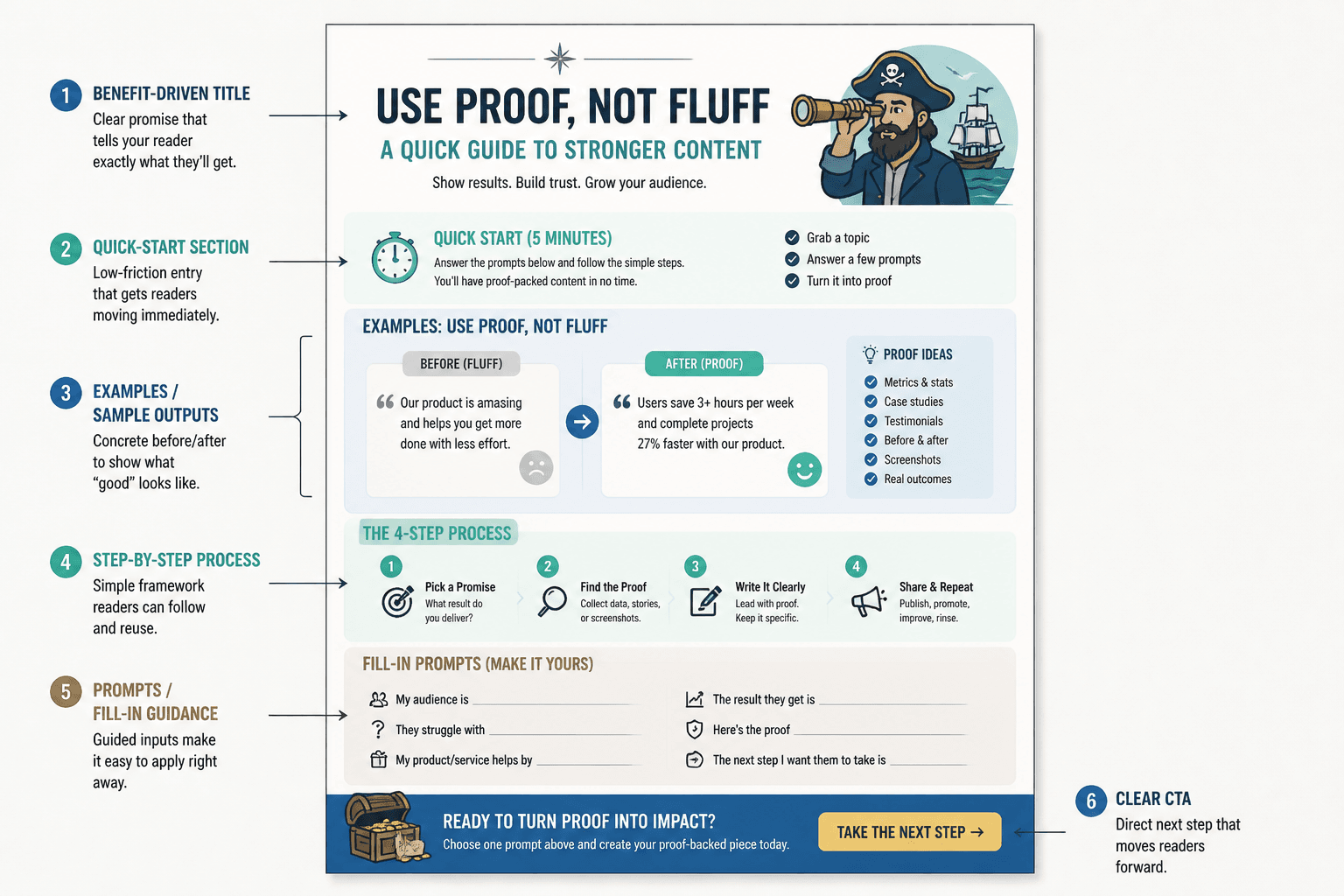
Good lead magnets often include:
- A quick-start section
- Examples or sample outputs
- A short process to follow
- Prompts or fill-in-the-blank guidance
- A clean CTA for the next logical step
Use proof, not fluff
If your lead magnet says it helps people write better bios, show examples. If it helps improve posts, include before-and-after rewrites. If it supports a funnel, map the flow clearly.
Abstractions make people feel informed. Examples make people feel capable.
If you are building or rewriting your freebie, how to write better lead magnets will help you tighten the thing instead of padding it with polite filler.
How to connect your lead magnet to content and offers
This is the part people skip, and then they wonder why opt-ins are fine but sales are weirdly absent.
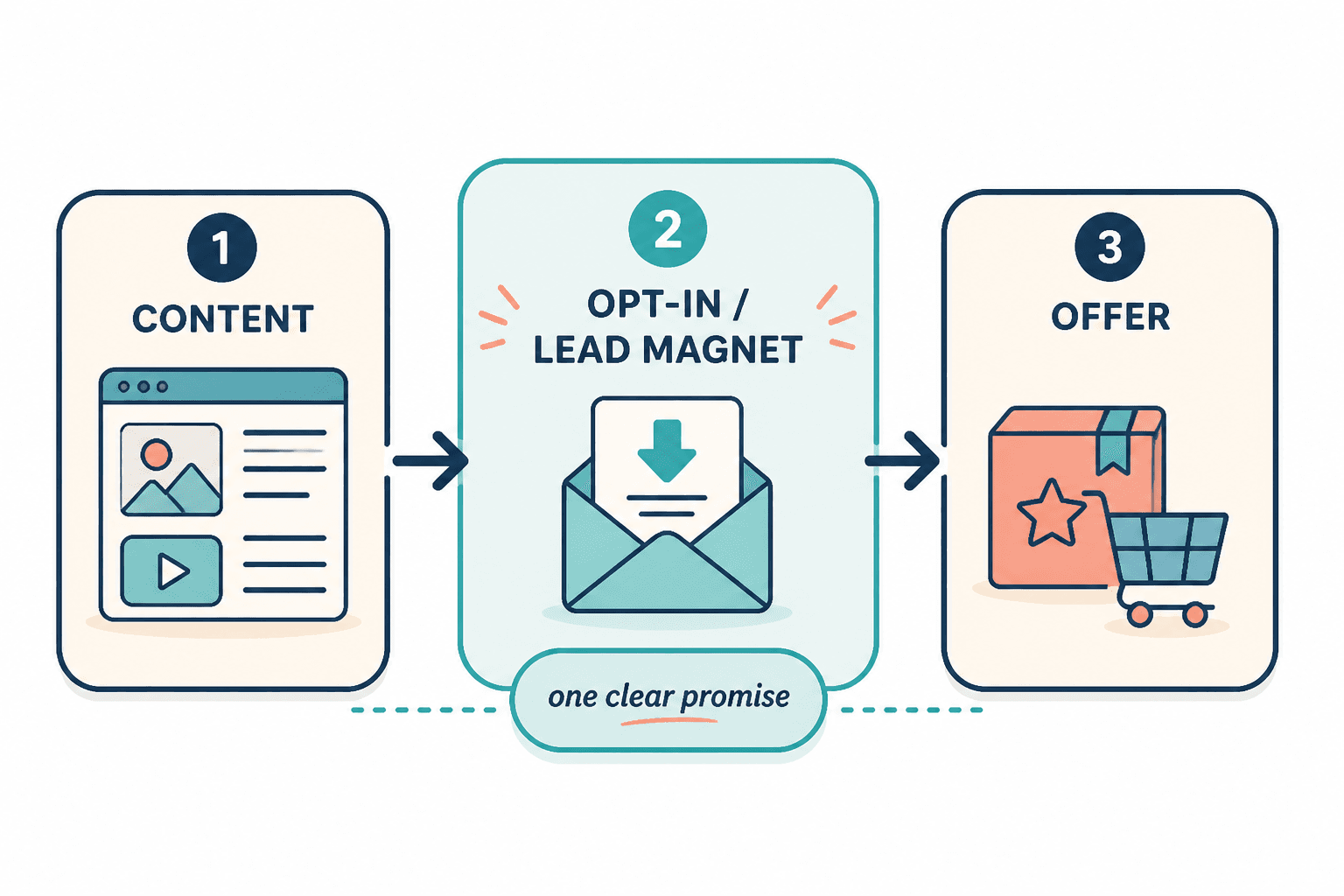
Your lead magnet should sit between a specific content topic and a specific next step. It is a bridge, not a side quest.
A simple creator funnel that works
- Post, article, thread, or video addresses a pain point
- Lead magnet offers a practical next step on that same topic
- Welcome sequence deepens trust and shows relevance
- CTA points to the next action: product, service, consultation, newsletter, or another conversion step
Example:
- Content topic: “Why your LinkedIn posts get polite silence”
- Lead magnet: “17 hook rewrites for experts who know their topic but cannot package it well”
- Follow-up emails: common hook mistakes, examples, mini case study
- Offer: messaging audit or content strategy service
That sequence makes sense. The person who wants the freebie is probably relevant to the offer. The freebie also proves you know what you are doing.
By contrast, if the post is about content hooks and the lead magnet is “my productivity planner,” you may still collect emails, but the buying intent gets fuzzy fast.
Use topic clusters, not random freebies
Creators get better results when they build a few strong lead magnets around core themes rather than inventing random downloads every time they have a new thought.
For example, you might build one cluster around:
- Positioning
- Profile copy
- Content conversion
- Offers and CTAs
That gives your funnel shape. It also makes your content easier to connect to useful opt-ins instead of treating every post like a scavenger hunt.
If you want a wider framework for monetization paths, this section on monetization funnels and money content connects the bigger picture.
Lead magnet mistakes creators keep making
Mistake 1: Making it too long
Longer does not mean better. It often means less likely to be used. If your 42-page guide could have been a 5-page checklist and 3 examples, your audience would probably prefer the shorter version and so would their attention span.
Mistake 2: Giving away random value
“Value” is one of those words people say right before handing you something generic. A useful lead magnet is not random good advice. It is strategically relevant help.
Mistake 3: Hiding the offer too much
You do not need to turn the freebie into a sales brochure. You also do not need to act like selling is morally suspicious. If the lead magnet helps with a problem your paid work solves more deeply, it is completely fine to say what the next step is.
Subtle is good. Invisible is not.
Mistake 4: No follow-up system
If someone opts in and then hears nothing useful from you, the opportunity fades quickly. Even a simple 3-to-5 email follow-up sequence can make a big difference because it keeps the topic alive and builds trust while the person still remembers why they signed up.
Mistake 5: Designing for everyone
General freebies get general results. If you want stronger subscribers, write for a smaller, clearer slice of people with a more obvious problem.
This matters even more if your audience is still small. A focused lead magnet can outperform a broad one because it attracts better-fit people and gives you cleaner feedback. If that is your situation, read lead magnets for creators with small audiences. It is a useful reality check.
A simple process to build a better lead magnet
If you want a cleaner workflow, use this.
- Pick one audience segment. Not all creators. One kind.
- Choose one friction point. Something annoying, costly, or blocking progress.
- Define one fast win. What can they improve quickly with your help?
- Choose the simplest useful format. Checklist, template, guide, training, audit, swipe file.
- Name it around the outcome. Clarity beats cleverness.
- Add examples. Show what good looks like.
- Include a next step. Newsletter, offer, booking page, service, product.
- Write a short follow-up sequence. Keep building trust after the download.
- Promote it with content tied to the same problem. Relevance does most of the heavy lifting.
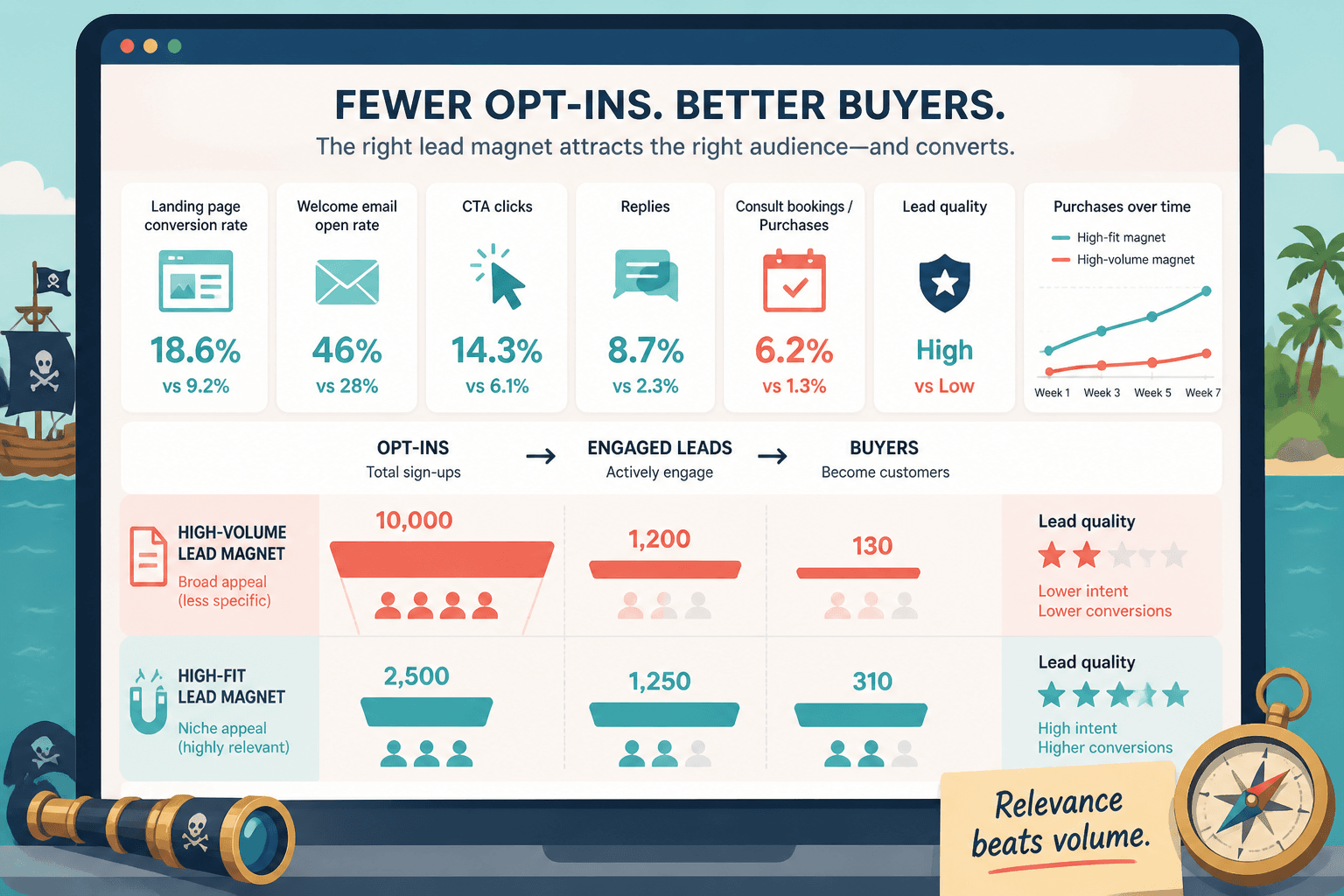
- Watch for quality, not just quantity. Opens, replies, clicks, consults, sales, and actual fit matter more than raw opt-ins.
That last point is worth sitting with for a second. It is very easy to obsess over opt-in conversion rates while ignoring what happens after. But if 500 people join and none of them care about your paid offer, congratulations on the beautifully organized disappointment.
What to measure if you want better results
A lead magnet is not performing well just because people download it. That is the first signal, not the full story.
Track metrics that tell you whether the lead magnet is attracting the right people and moving them forward.
- Landing page conversion rate
- Email open rate on the welcome sequence
- Clicks to the next CTA
- Replies or direct engagement
- Consult bookings or product purchases
- Lead quality by audience fit
- Which content topics generate the best opt-ins
Sometimes a lead magnet with fewer downloads produces better buyers. That is not a problem. That is called relevance. You want more of it.
And once people opt in, your follow-up CTA matters more than many creators think. If you need help tightening that step, better lead magnets follow-up CTAs for personal brands is worth reading next.
Quick examples of stronger lead magnet angles
Here are a few weak ideas and sharper alternatives.
| Weak version | Stronger version |
|---|---|
| Free branding guide | 7 messaging fixes that make your personal brand easier to understand in 10 minutes |
| Content planner | 30 post angles for coaches who need leads, not just likes |
| Business checklist | The pre-launch checklist for solo creators selling a new offer next month |
| Instagram tips PDF | 15 story prompts that turn warm followers into consult calls |
| LinkedIn ebook | 25 LinkedIn hook rewrites for experts tired of posting into polite silence |
Notice the pattern: clearer audience, clearer problem, clearer outcome, less fluff. Funny how often that works.
FAQ
How long should a lead magnet be?
Long enough to create a useful win, short enough to be used. For many creators, that means 1 to 10 pages, a short template pack, a checklist, or a brief email sequence.
What is the best lead magnet format?
There is no universal winner. Templates, checklists, mini guides, and swipe files often work well because they are practical and fast to use.
Should a lead magnet mention my paid offer?
Yes, lightly and clearly. The next step should feel natural, not hidden and not obnoxious.
Can I use one lead magnet for all my content?
You can, but topic-specific lead magnets usually convert better because they match the reason people paid attention in the first place.
Do small creators need a lead magnet?
Not always, but a focused lead magnet can help you turn attention into email subscribers and better leads long before your audience gets big.
Better lead magnets are more specific, more useful, and less desperate
If there is one thing to take from this Lead Magnets Guide for Creators Who Want Better Results, it is this: stop trying to make a freebie that vaguely “adds value” and start making one that solves a clear problem for the right person and leads somewhere sensible.
A good lead magnet is not a popularity trick. It is a trust tool. It should make your work easier to understand, your expertise easier to believe, and your next offer easier to say yes to.
So before you make another generic checklist with a Canva cover and a prayer, tighten the audience, sharpen the outcome, and connect it to a real next step. That is usually where better results begin.
Lead magnets work best when they solve one real problem cleanly and make the next step feel natural. The clearer the bridge from free value to real offer, the stronger the whole system gets.