
Good X threads can still burn time, attention, and trust if they never point anywhere useful. The result is expensive busywork: the post gets shared, the likes show up, and the leads stay politely elsewhere. A thread that earns attention but does not earn a next step is basically a very efficient way to look busy.
The fix is not to make every thread louder or more aggressive. It is to give the thread a conversion path that matches the level of trust the reader actually has. That usually means a cleaner offer, a better CTA, and less hoping that people will magically know what to do next.
If you want the bigger system behind thread structure and formatting, start with the X threads guide. For examples of stronger thread shapes, the X threads examples page is a useful companion. And if the bottleneck is production rather than strategy, the best AI tools for X threads roundup can help you move faster without making the work sound like it was assembled by committee.
Why most X threads do not convert well
Most weak conversions are not caused by bad ideas. They happen because the thread ends in a shrug. The reader gets value, but not direction. Or the direction is there, but it feels bolted on, so the reader treats it like roadside leafleting.
The common failure modes are predictable:
- The thread teaches something useful, then stops without a clear next step.
- The CTA is too early, too generic, or too salesy for the trust level.
- The offer is real, but the thread never earns the click.
- The profile bio, pinned post, and landing page do not support the same promise.
- The thread topic is broad, but the CTA asks for a specific buying decision.
That last one matters more than people admit. A thread about a broad problem can create awareness, but a thread that jumps straight to “book a call” is asking the reader to cross too much distance too fast. The conversion path should feel like the next sensible step, not the end of a sales relay race.
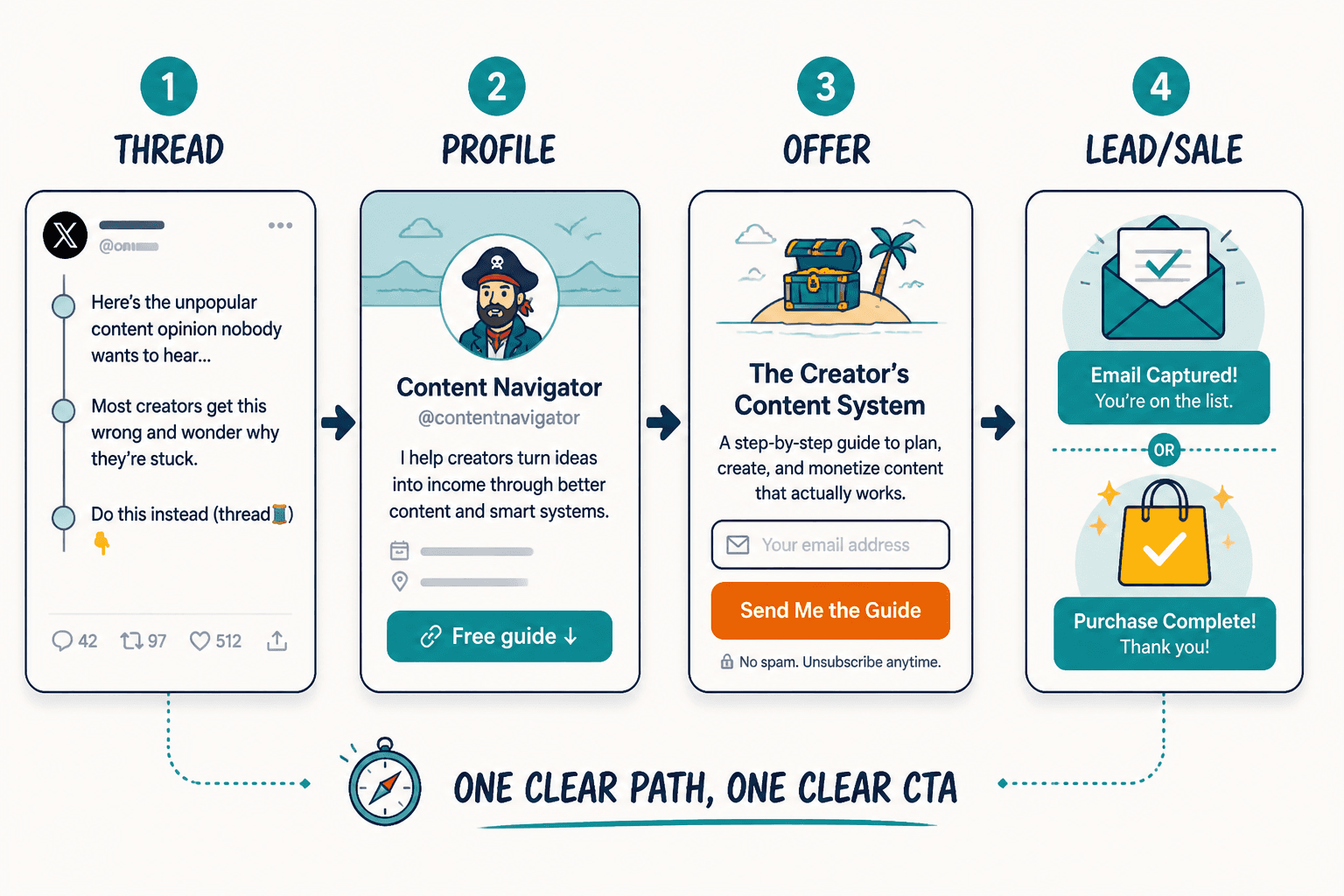
What a good conversion path actually does
A good thread conversion path does three jobs at once:
- It keeps the thread useful. The reader gets something concrete before anything is asked of them.
- It creates a believable next step. The CTA fits the trust the thread has built.
- It makes the rest of the funnel easier. The profile, offer, or follow-up page does not have to rescue a weak handoff.
In plain terms, the thread should not do all the selling. It should open the door and make the next step feel obvious. The profile, pinned offer, lead magnet, email sequence, or product page then does the heavier lifting.
That also keeps the thread from becoming a tiny hostage note written by marketing. Useful first. Commercial second. That order tends to age better.
Match the CTA to the trust level
Not every thread should push the same action. A reader who just discovered you is not in the same state as someone who has already been reading your posts for weeks. The CTA should reflect that difference.
| Trust level | Best CTA style | Example |
|---|---|---|
| Cold | Soft, low-friction | “Follow for more” or “Grab the free checklist” |
| Warm | Specific and practical | “Read the guide” or “See the template” |
| Hot | Direct and action-oriented | “Book a call” or “Start here” |
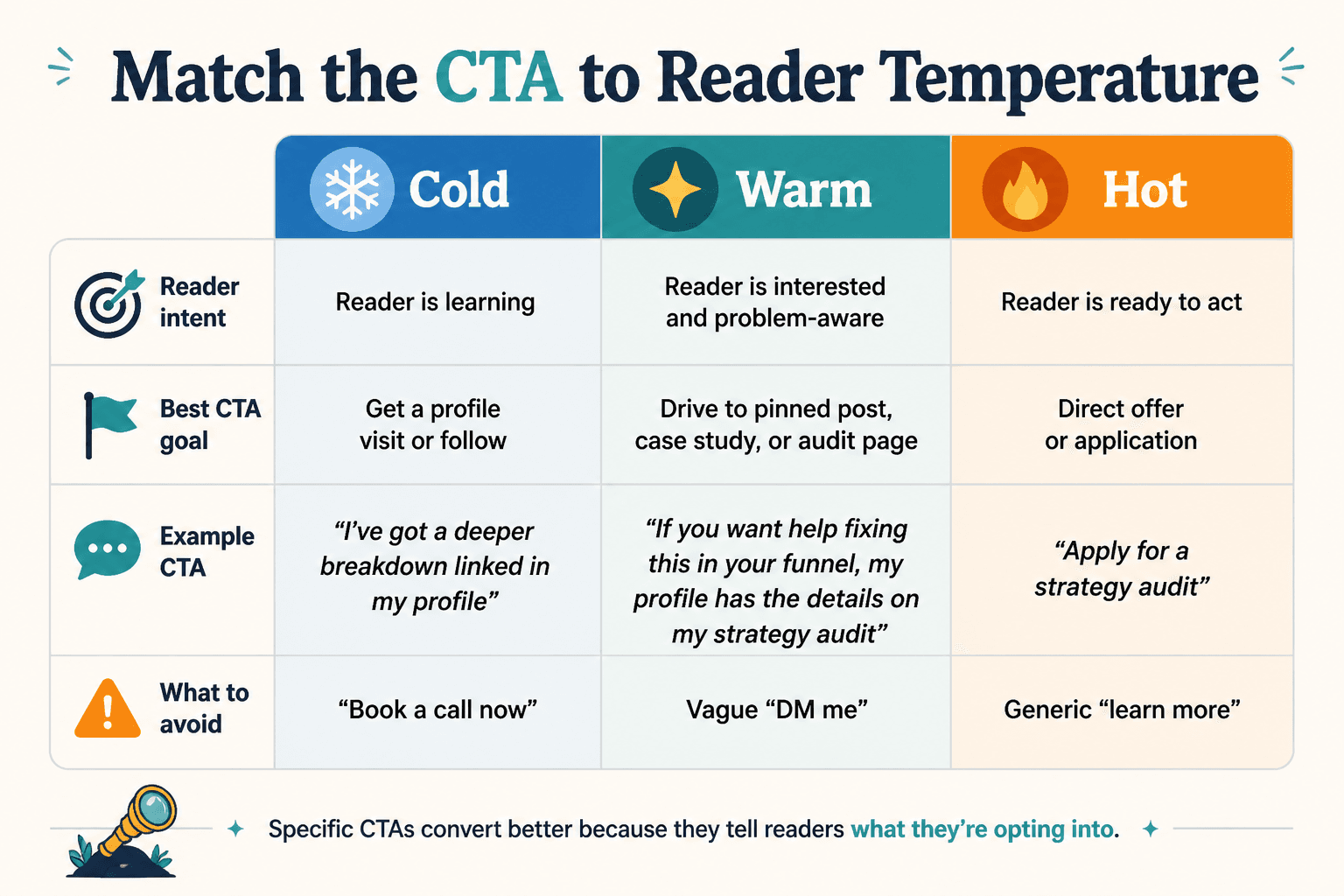
A useful rule: the colder the audience, the more the CTA should feel like an invitation, not a demand. The hotter the audience, the less you need to dress it up. Clarity beats theatrical persuasion most of the time.
Best funnel ideas to pair with X threads
Not every thread needs a giant funnel. Sometimes the best conversion path is just a clean handoff to the next logical step. The point is fit, not complexity.
1. Thread to lead magnet
This is a strong option when the thread teaches part of the problem and the lead magnet completes it. A thread about improving conversions, for example, can end by offering a checklist, swipe file, or template that makes implementation easier.
Use this when the reader would reasonably think, “Useful. Now give me the practical version.”
2. Thread to newsletter
This works well when the thread builds trust through perspective rather than a single tactical takeaway. The newsletter CTA should promise continued usefulness, not vague inspiration and weekly fog.
Good fit: educational threads, opinion threads, and recurring topic clusters. If the thread is part of a series, the newsletter can become the easiest place to continue the relationship.
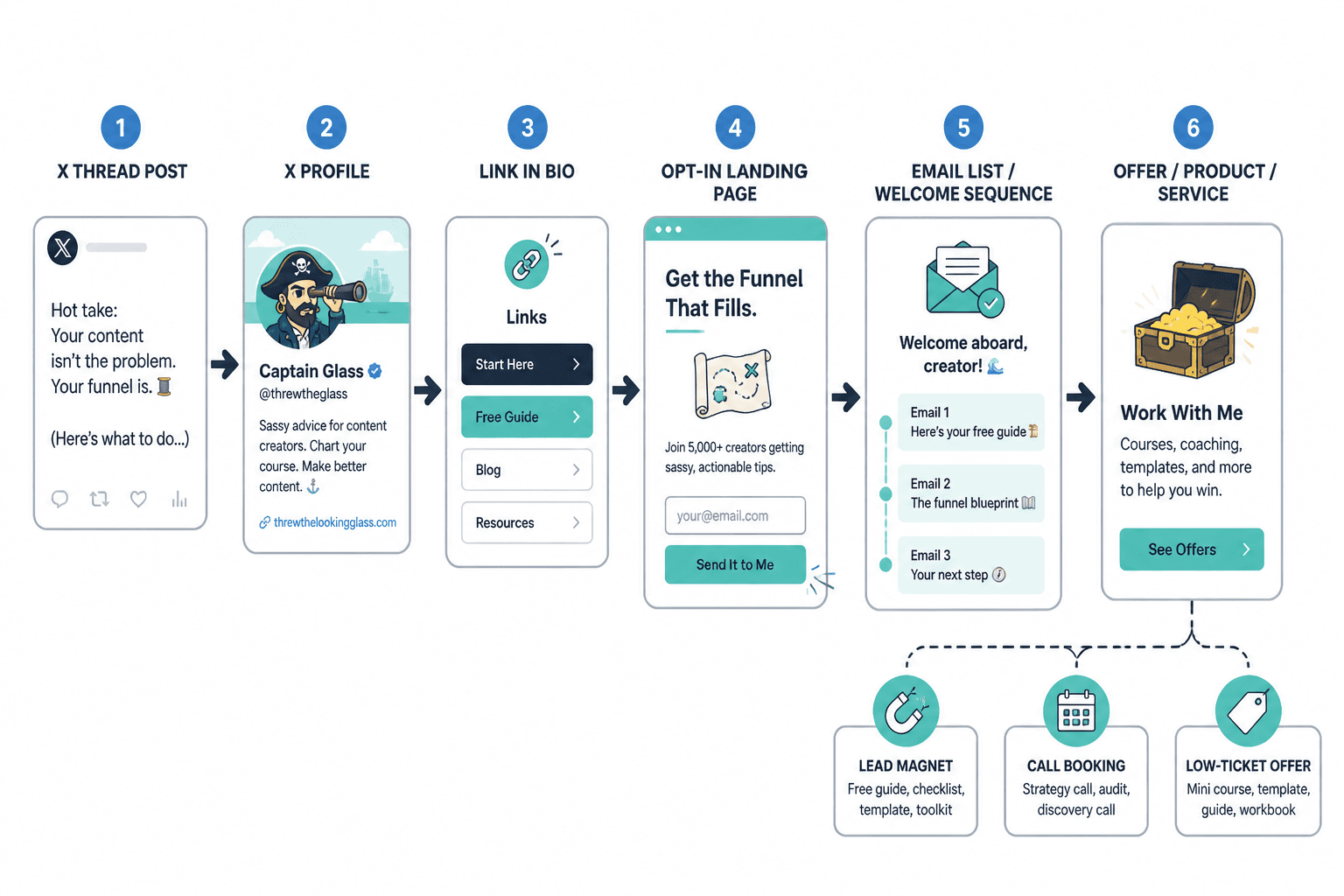
3. Thread to profile to pinned offer
This is the cleanest option when the thread is doing top-of-funnel work and the profile is already strong. The thread should make the reader curious enough to click, and the profile should make the offer immediately understandable.
For this to work, the profile has to earn its keep. The bio, pinned post, and header area need to say the same thing as the thread. If those elements disagree, the reader starts doing unpaid detective work.
For more help aligning thread structure with profile and offer logic, the X threads guide is the right place to anchor the broader setup.
4. Thread to free resource to nurture sequence
This is the safest path when the reader is interested but not ready for a direct sale. The thread points to a free resource, and the resource hands off to an email sequence that builds trust over time.
This is often the best move for higher-consideration services or offers that need a bit more explanation before anyone buys.
According to HubSpot’s benchmark reporting, email remains a reliable channel for nurturing and conversion when the follow-up is relevant and timely. That is not glamorous, but neither is revenue leakage.
5. Thread to low-ticket product
This works when the thread is specific enough to support an immediate, lower-risk purchase. Think practical templates, short playbooks, or tools that solve a narrow problem.
The product should feel like a natural extension of the thread, not a surprise exit from it. If the thread explains the problem and the product solves it in one move, the sales path feels earned.
A simple planning framework
Before you publish, answer these four questions:
- What is the thread trying to do? Teach, tease, diagnose, compare, or persuade?
- What is the next best step? Follow, click, opt in, reply, or buy?
- Does the CTA match the trust level? If not, reduce the ask.
- Does the rest of the funnel support the promise? Profile, landing page, and offer should not contradict the thread.
If any answer feels fuzzy, the thread is not ready. That is not a catastrophe. It just means the thread still needs shape before it needs distribution.
A practical way to think about it:
- One thread should usually have one primary goal.
- One CTA should usually be enough.
- One offer should be the obvious destination.
Trying to squeeze five goals into one thread tends to create the digital equivalent of a person giving directions while opening three other tabs.
Where the conversion breaks down
Even solid threads lose momentum when the handoff is sloppy. Watch for these quiet conversion killers:
- The CTA is vague. “Check it out” is not a strategy.
- The offer is too far away. Too many clicks, too much friction.
- The promise is too broad. The thread sounds useful, but the destination sounds unrelated.
- The proof is missing. Readers cannot tell why the offer is credible.
- The thread closes too hard. A blunt pitch can work, but only after enough trust has been built.
The easiest fix is usually not a cleverer hook. It is a clearer path. Make the next step obvious and the conversion rate tends to stop acting personally offended.
Outbound sources worth checking
If you want a few stable references behind the conversion logic, these are useful starting points:
- Mailchimp email marketing benchmarks for broad performance context.
- Nielsen Norman Group on CTA design for clarity and action cues.
- Google Analytics campaign tracking for measuring where clicks and conversions come from.
What to do next
If your thread is getting attention but not producing leads or sales, start by tightening the handoff. Make the CTA fit the trust level, align the profile and offer, and choose one clear next step.
For more on the broader system, use the parent X threads guide. For thread shape and execution, the examples page is the quickest way to see what stronger structure looks like in practice.
Attention is nice. Revenue is nicer. The trick is not to confuse the two.