
Most people do not ruin trust on Facebook because they sell. They ruin it because they turn one decent long-form post into a clumsy ambush.
You know the move. A strong story or opinion pulls people in, the post gets traction, and then the ending swerves into “DM me if you want to 10x your business” like a networking event badge became sentient. That is usually where the trust leak starts.
If you want to learn How to Monetize Facebook Long-Form & Rants Without Wrecking Trust, the answer is not “never sell.” It is to make the sales layer fit the post, the audience, and the relationship you have actually earned. Facebook rewards conversation and familiarity. That means your monetization has to feel like a natural next step, not a trap door.
Here’s how to make your Facebook long-form posts and rants pull in leads, conversations, and sales without turning your comment section into a polite ghost town.
For the full path around this topic, head to the parent guide.
First, stop treating every rant like a funnel entry point
This is the mistake underneath most bad monetization advice.
Not every rant should sell. Not every long-form Facebook post should lead to a booking page. Not every spicy opinion needs a CTA attached like a price tag hanging off a sweater.
Some posts are for reach. Some are for trust. Some are for positioning. Some are for conversation. A smaller number are for conversion.
When people flatten all content into “content should make money,” they usually start forcing offers into places they do not belong. That makes the writing feel manipulative, even if the offer itself is good.
A much smarter way to think about it is this:
- Some posts earn attention
- Some posts deepen trust
- Some posts create demand
- Some posts convert existing demand
Facebook long-form and rants are especially good at the middle two. They let people hear your thinking, feel your standards, and decide whether they trust how you see problems. That is valuable. Do not wreck that by trying to close every time you open your mouth.
If you need help with the structure side first, this guide on how to write better Facebook long-form and rants pairs well with everything here.
What trust-friendly monetization actually looks like
Trust-friendly monetization is simple to describe and annoyingly hard for people to practice:
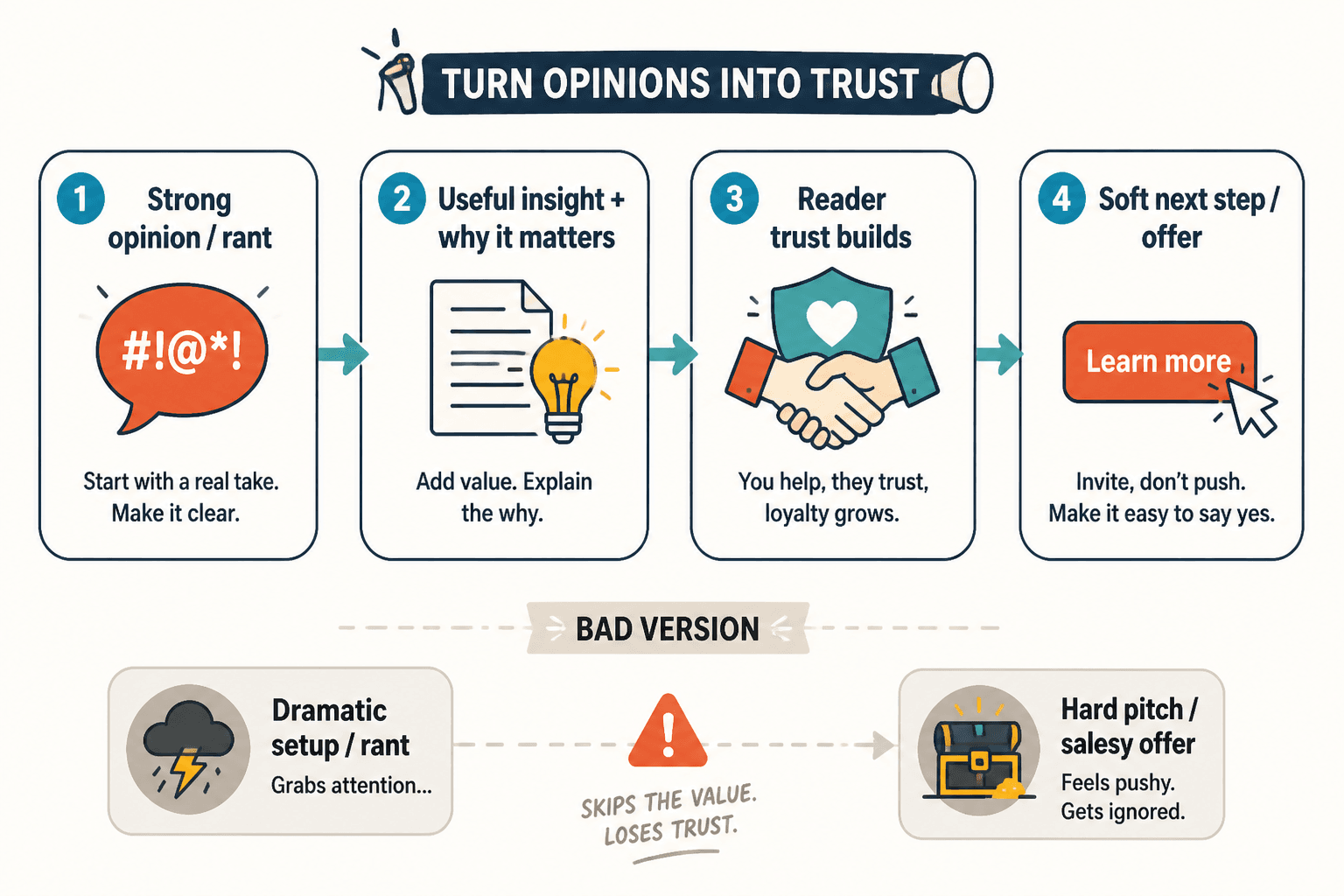
Give people a strong idea, a clear point of view, and a useful payoff. Then offer the next step to the people who already want more.
That means your post should still work if nobody buys anything that day.
The post needs to stand on its own as worth reading. If the whole thing is just a runway built for your pitch, readers can feel it. And Facebook readers are not exactly famous for giving the benefit of the doubt.
A good monetized rant says, “Here is what I believe, here is why it matters, here is what most people get wrong, and if you want help applying this, here is the next step.”
A bad monetized rant says, “I needed three dramatic paragraphs to warm you up for a link.”
That distinction matters more than people think.
Use the right monetization goal for the right kind of post
One reason monetization gets awkward is that people use the same CTA for wildly different posts. A personal story gets the same ending as a tactical breakdown. A spicy opinion gets the same pitch as a client lesson. No wonder it feels bolted on.
Match the CTA to the type of post you wrote.
| Post type | What it does best | Best monetization move |
|---|---|---|
| Opinionated rant | Positioning and attracting aligned people | Invite conversation, then soft-DM or point to profile CTA |
| Story-driven long-form post | Trust and relatability | Offer a relevant resource, newsletter, or low-friction next step |
| Tactical breakdown | Demonstrates expertise | Offer audit, consult, service, or deeper guide |
| Case-study style post | Builds proof and demand | Invite qualified inquiries or consultations |
| Contrarian educational post | Filters audience and sharpens positioning | Point readers to a related offer for people who agree with the premise |
If the post is mostly emotional or opinion-led, do not force a hard conversion CTA. If the post is highly practical and obviously relevant to your offer, a stronger sales step can feel natural.
The offer is not the problem. Mismatch is the problem.
The best monetization paths for Facebook long-form and rants
You do not need a 14-step funnel here. In fact, that usually makes this worse. Facebook works well when the path from post to next step feels human and low-friction.
1. Post to comments to soft DM
This is one of the cleanest options when your post sparks conversation.
You share a strong argument or useful rant. People comment with agreement, questions, or examples. You reply like a normal person. If someone is clearly a fit, you continue the conversation privately.
That works because the sale is not parachuted into the post. It emerges from relevance.
Use this when:
- Your service is nuanced or high-trust
- Your post is opinion-heavy rather than step-by-step tactical
- You want to qualify people through conversation first
What not to do: “Comment GUIDE and I’ll DM you” on every post like you are running a vending machine made of keyword bait.
2. Post to profile to clear offer
Sometimes the cleanest CTA is barely a CTA at all.
A good rant can make the right people curious enough to click your profile. If your profile clearly says who you help, how you help them, and what to do next, you do not need to hammer the offer inside every post.
This works especially well if your content has a strong point of view. The post does the attraction. The profile does the sorting.
That is one reason broad Facebook writing strategy matters. If useful, browse the wider social media writing and Facebook writing resources alongside the main Facebook long-form and rants hub.
3. Post to free resource
If your rant uncovers a common mistake or painful pattern, a relevant free resource can be a very natural next move.
Example:
“If this is the part you’re stuck on, I made a short checklist/template for it. Happy to send it if you want it.”
Notice the difference between that and the usual funnel sludge. One sounds like help. The other sounds like captivity with branding.
This route works best when the free resource is tightly connected to the exact problem in the post. Not adjacent. Not vaguely relevant. Directly connected.
4. Post to booking page
This is more direct, and it can work very well, but only under the right conditions.
Your post should usually have:
- A clear, business-relevant problem
- Visible expertise
- Some form of proof or credibility
- An audience likely to buy, not just clap
If your long-form post is basically a thoughtful teardown of a problem your service solves every week, then yes, inviting readers to book a consult can feel completely reasonable.
If your post is a broad emotional rant about authenticity and then you tack on “book a strategy call,” that is usually a weird left turn.
5. Post to newsletter or email list
This is the middle road a lot of creators should use more often.
Facebook is good for attention and relationship-building, but not everybody who likes your rant is ready to buy. A newsletter gives them a quieter, more durable place to keep hearing from you. That matters if your offer needs repeated exposure or deeper trust.
And unlike the average comment thread, your email list is not rented land with mood swings.
How to write a CTA that does not make the post feel cheap
Most Facebook CTAs fail because they sound imported from a funnel template, not because CTAs are bad.
A strong CTA should feel like the logical next sentence.
Here are the principles:
- Match the CTA to the post
- Keep the tone consistent
- Make the next step small and clear
- Do not over-explain the offer
- Avoid fake urgency and fake intimacy
Weak CTA examples
- “DM me if you’re ready to transform your business.”
- “If this resonated, I have 3 spots left.”
- “Comment YES and I’ll share how I can help.”
- “Book a call to learn my proven framework.”
These are not illegal. They are just bland, pushy, or suspiciously familiar.
Stronger CTA rewrites
- “If your content has this problem too, send me a message. I can usually spot the issue pretty fast.”
- “I help clients fix exactly this in their messaging. If you want another set of eyes on it, my inbox is open.”
- “If you want the checklist we use to tighten this up, ask and I’ll send it over.”
- “This is the kind of problem I solve with clients every week. If you need help with it, you can reach out.”
They work better because they are specific, lower-pressure, and connected to the actual post.
There is also a tone issue here. Facebook is usually less formal and more conversational than LinkedIn. If your CTA suddenly starts sounding like a webinar registration page from 2019, readers feel the gear shift immediately.
How to monetize a rant without turning it into a tantrum with a checkout button
A good Facebook rant is not random anger. It has shape. It has a point. It gives the reader a release at the end, not just your blood pressure readings.
If you want that kind of post to lead to business, the rant needs to do four things well.
1. Aim the rant at a real problem
Rants that monetize well usually attack a broken norm, bad advice, costly habit, or frustrating misunderstanding. They are not just emotional venting.
Good:
“Most people do not need more content ideas. They need to stop posting unclear ones.”
Less useful:
“I’m tired of fake people online.”
One creates demand for your thinking. The other just creates weather.
2. Back the opinion with reasoning
If your rant is going to lead to trust, readers need to see how your brain works. Show why you believe the thing, what pattern you keep seeing, what consequences it creates, and what a better approach looks like.
This is where long-form helps. You have room to move beyond hot takes and into actual thinking. That is where authority lives.
3. Give the reader a useful takeaway
Do not just rant at people. Help them do something with the point.
Even one or two practical takeaways can turn a rant from “that was entertaining” into “this person knows what they’re doing.”
4. Make the offer feel like support, not extraction
By the time you mention an offer, the reader should already understand why that offer exists. It should solve the exact problem you just unpacked.
If you need a stronger opening structure for those posts, read how to start Facebook long-form and rants without a weak opening. Bad openings make monetization harder because people never stay long enough to trust you in the first place.
A simple framework: Value, tension, proof, next step
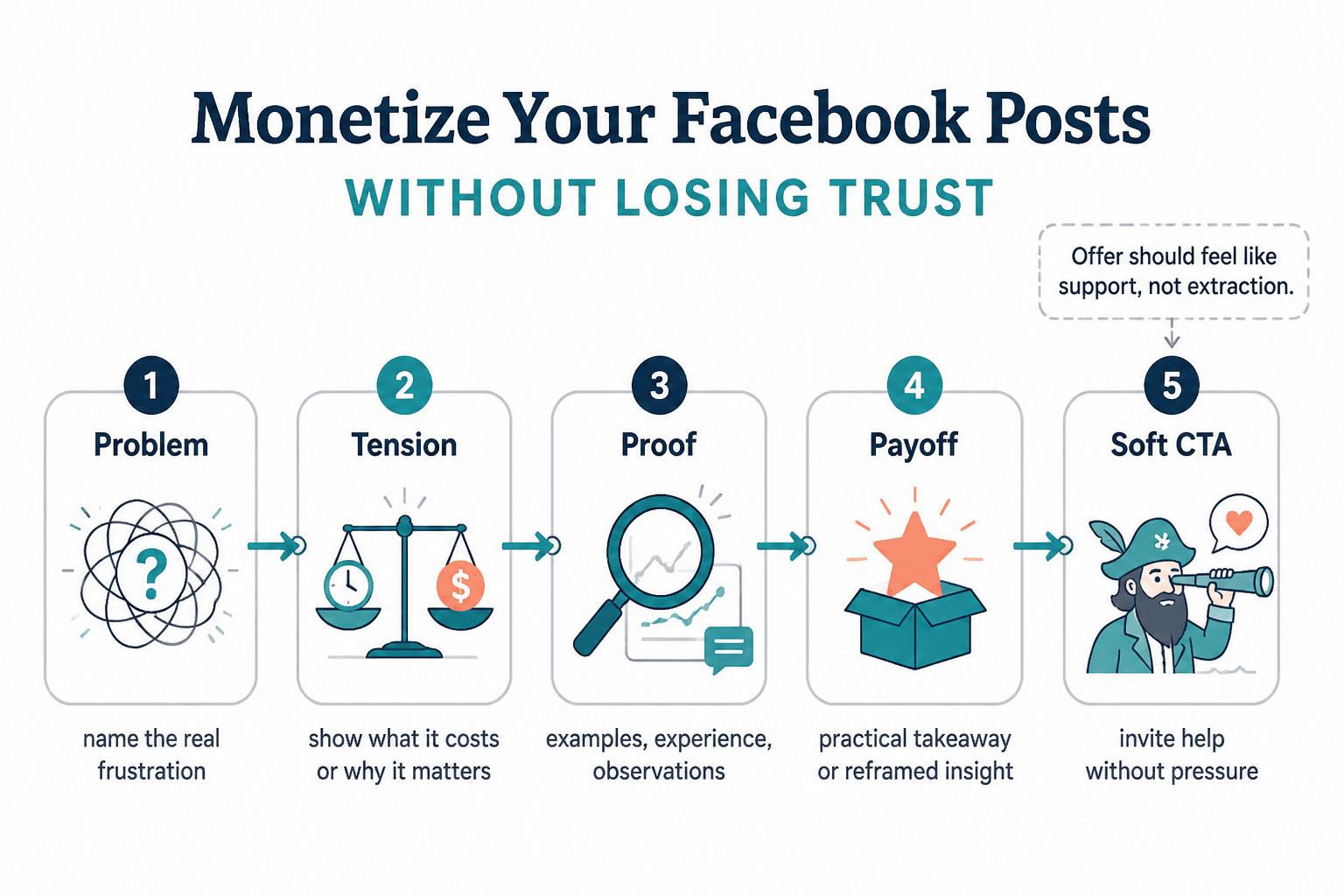
If you want a practical structure for monetized Facebook long-form posts, use this:
- Value: give a strong idea, insight, or argument
- Tension: show what people get wrong, what it costs, or why it matters
- Proof: include experience, examples, observations, or results
- Next step: offer a relevant action for people who want help
That keeps the post grounded in usefulness while still creating a path to business.
Example structure
Opening: “A lot of Facebook advice about ‘being authentic’ is just an excuse for posting unedited thoughts and calling it strategy.”
Tension: Explain how that leads to rambling posts, weak positioning, and lots of comments from people who will never buy.
Proof: Show what stronger posts do instead. Mention patterns you have seen in clients, projects, or your own analysis.
Takeaway: Give 3 quick fixes for making Facebook long-form clearer and more persuasive.
Next step: “If you want help tightening your Facebook content so it attracts buyers instead of just applause, message me.”
That works. No smoke machine required.
Common ways people wreck trust while trying to monetize
If your Facebook long-form posts are getting attention but not converting well, the issue may not be visibility. It may be one of these trust killers.
Turning every post into a pitch
If readers know every post ends in a sales move, they start reading defensively. You do not want defensive readers. You want receptive ones.
Sell often enough that people know you have offers. Not so often that every opinion sounds sponsored by your own desperation.
Using fake vulnerability to soften the pitch
This is one of the grimmest content genres on the internet.
The formula is always the same: painful confession, dramatic lesson, suspiciously tidy turnaround, invitation to buy. People have seen it. A lot.
If the story is real and relevant, fine. If the story exists mostly to make the pitch feel emotionally earned, readers can smell the staging.
Dropping an offer with no bridge
The post says one thing. The CTA sells another. This kills momentum.
If your rant is about weak messaging and your CTA points to leadership coaching, you had better build that bridge clearly. Otherwise it feels random or opportunistic.
Being louder than you are useful
Strong opinions help. Noise does not.
A rant can attract attention fast, but if the post is all heat and no substance, the trust collapses as soon as someone asks, “Okay, but what should I do instead?”
Making the CTA bigger than the point
If the longest, clearest, most specific part of the post is the pitch, your priorities are showing.
The post should do the heavy lifting. The CTA should just open the door.
How to know when a post has earned the right to sell
This is the real judgment call.
Before adding a monetization layer, ask:
- Does the post have a clear point?
- Did I give people something useful even if they do not buy?
- Is the offer directly related to the problem in the post?
- Would the CTA feel natural to a skeptical reader?
- Am I inviting the next step, or cornering people into it?
If the answer is no to more than one of those, the post probably needs work before it needs a CTA.
And yes, sometimes the smartest monetization move is to leave the CTA out completely and let the post build trust. That is still part of the sales process. Boring answer, useful answer.
The bigger point is simple: clearer structure and clearer writing make the piece more useful. That is usually what makes the ending land better too.