
Most Facebook long-form posts do not fail in the middle. They fail in the first three lines.
That is the part where people warm up, explain the context, apologize for the length, vaguely gesture at a topic, and basically hand the reader a perfect excuse to keep scrolling.
If you want to know how to start Facebook long-form & rants without a weak opening, the fix is not “be more dramatic.” It is to stop clearing your throat on the page. A strong opening creates tension fast. It tells the reader what the post is really about. It gives them a reason to stay before they have to do any work.
And on Facebook, that matters even more than people admit. Long-form can work beautifully there, especially when it feels human, specific, and alive. But nobody owes your post patience. You have to earn it early.
This is where we’ll focus: how to open Facebook long-form posts and rants so they feel sharp, readable, and worth sticking with. Not fake-outragey. Not overproduced. Not “I wasn’t going to share this, but…” nonsense. Just stronger starts that actually pull people in.
To see how this fits into the wider strategy, open the parent guide.
Why weak openings kill good Facebook posts
A lot of smart people bury their best point under six lines of setup.
They think they are creating context. Usually they are creating drag.
Facebook is a conversational platform, but that does not mean you get to meander into the point whenever inspiration finally shows up. A good long-form post still needs momentum. A good rant still needs shape. If your opening feels soft, generic, or delayed, readers assume the rest of the post will be the same.
That is the real issue. Weak openings do not just lower curiosity. They quietly signal weak thinking, even when the actual idea is solid.
If you want better Facebook long-form writing overall, it helps to understand the broader format too. This guide pairs well with how to write better Facebook long-form and rants and the broader Facebook long-form and rants topic hub.
What a strong opening actually needs to do
Your opening does not need to do everything. It just needs to do enough.
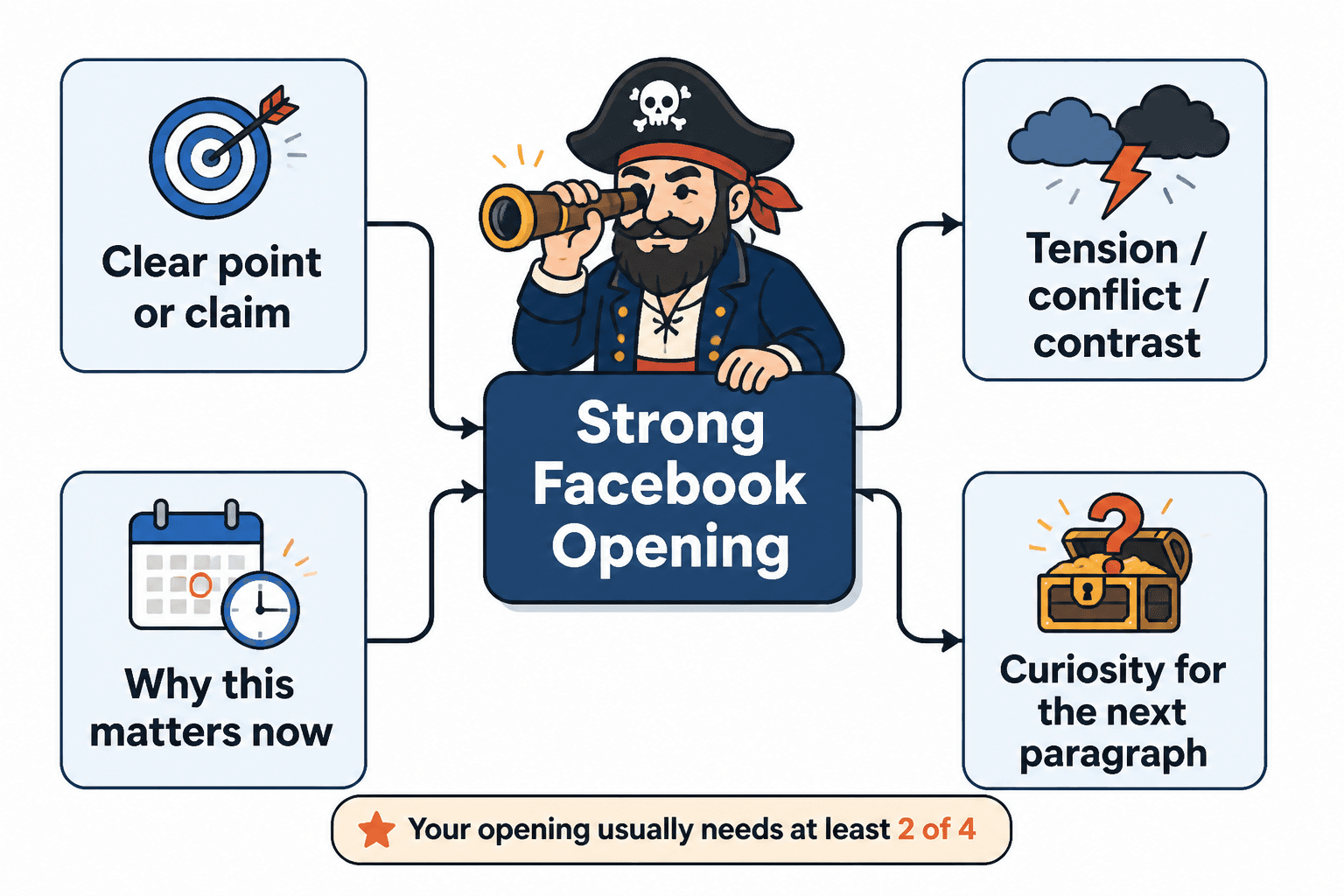
In most cases, the first lines should do at least two of these four jobs:
- Make a clear point or claim
- Introduce tension, conflict, or contrast
- Show the reader why this matters now
- Create enough curiosity to earn the next paragraph
That is it. Not a memoir. Not a disclaimer. Not a little runway speech about how you have “been thinking a lot lately.”
A strong opening often feels slightly more direct than comfortable. That is usually a good sign.
The fastest test for your first line
Ask this:
If someone only read my opening, would they know why this post exists?
If the answer is no, the opening probably needs work.
What weak Facebook openings usually look like
The usual offenders are not subtle. You have seen them. You may have written them. Most of us have.
1. The warm-up lap
Example:
I have been thinking about this a lot recently and felt like it was finally time to share some thoughts.
This says almost nothing. It gives no tension, no angle, no stakes, no reason to continue.
2. The vague drama opener
Example:
I need to say something that might make some people uncomfortable.
Maybe. But uncomfortable about what? Readers are not going to sit through 900 words just because you vaguely promised turbulence.
3. The apology
Example:
This might be a long post, but I hope you will bear with me.
Never open by making the reader feel like they are doing charity work.
4. The context dump
Example:
So yesterday I was talking to someone, and it reminded me of a thing that happened last year, which connects to something I have noticed in business lately…
By the time the point arrives, the reader has already left.
5. The fake philosopher opening
Example:
Sometimes life has a funny way of teaching us the lessons we most need to learn.
This is not deep. It is wallpaper.
Better ways to start Facebook long-form & rants
The strongest openings usually fall into a handful of patterns. Not formulas in the grim “copy this and become magnetic” way. More like reliable shapes that help you get to the point faster.
Start with the opinion
If the post is driven by a belief, lead with the belief.
Weak: I have been noticing a trend lately in online business that I think is worth talking about.
Stronger: A lot of “authentic” content on Facebook is just polished manipulation with a softer tone.
Now we have something. A point. A little edge. A reason to keep reading.
Start with the frustration
Good rants need a real irritant. Not random complaining. A specific thing that is broken, overrated, dishonest, or badly done.
Weak: There is something I have wanted to get off my chest for a while now.
Stronger: If your Facebook post needs eight lines to say what annoyed you, you do not have a rant. You have a delay problem.
That opening has posture. It frames the issue immediately.
Start with the contradiction
Contrast is one of the easiest ways to create tension fast.
Weak: People talk a lot about writing better online, but I think there is more to it.
Stronger: Most bad Facebook rants are not too bold. They are too blurry.
That works because it pushes against an assumption.
Start with the specific observation
This is useful when you want the post to feel grounded and socially readable, not over-staged.
Weak: I have noticed some trends in how people write content on Facebook.
Stronger: The fastest way to make a Facebook rant unreadable is to open it like a formal essay and end it like a wounded sales page.
Specific beats abstract almost every time.
Start with the moment of tension
If you are using a story, do not start miles before the interesting part.
Weak: Last Thursday morning, I woke up, had coffee, checked my messages, and started reflecting on a conversation I had the day before.
Stronger: Halfway through the conversation, I realized they did not need better content. They needed the courage to stop sounding like everyone else.
The story can still unfold after that. But now it has a pulse.
A simple 4-part framework for stronger openings
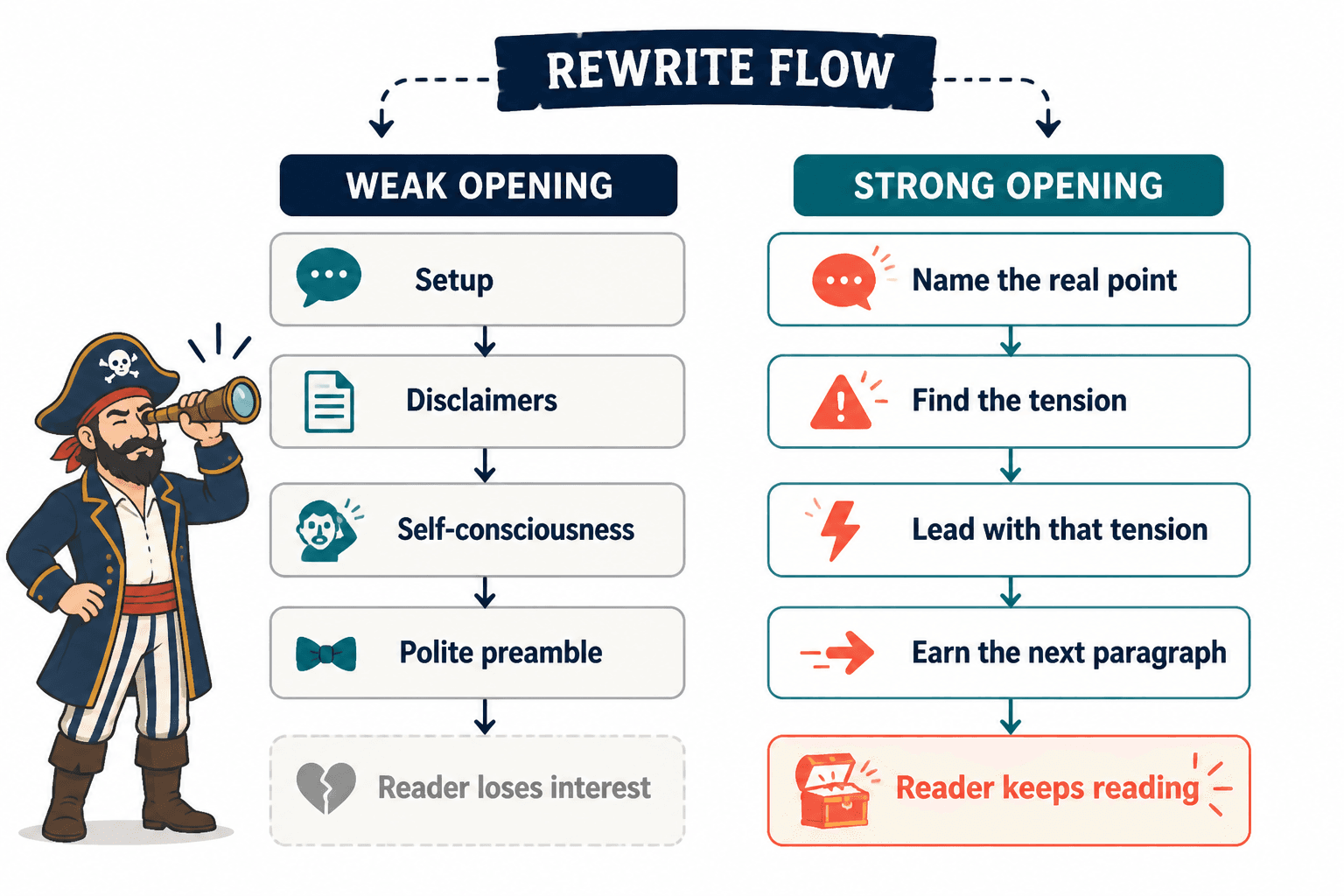
If you keep defaulting to weak intros, use this instead:
- Name the real point — What is the post actually arguing?
- Find the tension — What is wrong, annoying, surprising, or misunderstood here?
- Lead with that tension — Put it in the first line or two.
- Earn the next paragraph — Expand only after the opening has done its job.
Notice what is missing: setup, disclaimers, self-consciousness, and polite preamble.
That stuff feels safer to write because it delays the moment where you actually have to say something. Unfortunately, readers can smell that hesitation from orbit.
Before-and-after rewrites of weak rant openings
Here is where this gets more useful. Let’s fix the kind of openings people actually write.
Rewrite 1: the hesitant opener
Before: I do not usually post things like this, but I felt like I needed to share something that has been on my mind.
After: If your content only sounds “authentic” when it is sad, you do not have a voice. You have a performance style.
Why it works: the rewrite skips the self-introduction and goes straight to the actual issue.
Rewrite 2: the mushy setup
Before: There are a lot of things happening online right now, and I think it is important that we all take a moment to reflect.
After: A lot of online advice is not wrong because it is harsh. It is wrong because it is so generic it cannot help anyone make a real decision.
Why it works: concrete issue, sharper contrast, no fluff.
Rewrite 3: the overly long story lead-in
Before: Earlier this week, I had an interesting conversation with someone in my network, and after thinking about it for a while, I realized it connected to a bigger pattern I have seen.
After: They thought they had a visibility problem. What they actually had was a clarity problem dressed in “more posting” clothes.
Why it works: it cuts to the insight instead of describing the path to the insight.
Rewrite 4: the dramatic but empty hook
Before: This will probably upset some people, but I am going to say it anyway.
After: If your entire Facebook strategy depends on “starting conversations,” but your posts say nothing with teeth, the problem is not reach. It is that nobody has anything real to respond to.
Why it works: the tension is in the point itself, not in a vague promise of backlash.
If you want more help reshaping dull intros and flat delivery, read how to rewrite boring Facebook long-form and rants.
How to choose the right opening for the kind of post you are writing
Not every Facebook long-form post should open the same way. A rant, a story, a teaching post, and a conversational opinion piece have different jobs. You still need strength up front, but the type of strength changes.
| Post type | Best opening style | What it should do |
|---|---|---|
| Rant | Sharp opinion or frustration | Establish the problem fast |
| Story-based post | Moment of tension | Drop readers into the interesting part |
| Teaching post | Clear claim or mistake | Signal the lesson quickly |
| Reflective post | Specific observation | Feel human without drifting |
The bigger point is simple: clearer structure and clearer writing make the piece more useful. That is usually what makes the ending land better too.