
Most Facebook rants do not fail because they are too opinionated. They fail because they are shapeless, repetitive, and weirdly generic for something that is supposed to sound passionate.
You can feel the problem when you read one. It starts with heat, then wanders into three side quests, repeats the same complaint five different ways, and ends with a vague “we need to do better” line that says absolutely nothing. That is not a rant. That is verbal pacing.
If you want to know how to improve Facebook rant structure without sounding generic, the fix is not to become less sharp. It is to become more deliberate. Good long-form Facebook posts and rants have shape. They build tension. They move. They know what they are attacking, why it matters, and where the reader is supposed to land by the end.
Here is how to make your Facebook rants hit harder, read cleaner, and sound like a person with a real point instead of a content machine cosplaying frustration.
To see how this fits into the wider strategy, open the parent guide.
The real problem is not emotion. It is structure.
A lot of people assume a strong rant should feel raw and unfiltered. Some of that is true. Facebook is one of the few places where a post can still sound human, messy in the right way, and conversational without getting punished for not looking polished.
But “unfiltered” is not the same as “badly built.” If your post has no structure, the reader has to do all the work. They have to figure out your point, sort the examples, guess what you are really mad about, and decide why they should care. Most will not bother.
A better Facebook rant feels natural on the surface and intentional underneath. It sounds like you are speaking honestly, but the argument is quietly doing its job.
- It opens with a real tension, not throat-clearing
- It focuses on one core complaint or idea
- It gives the reader specifics, not just vibes
- It escalates instead of circling
- It lands on a clear takeaway, challenge, or perspective
That is the difference between a rant people read, share, and comment on versus one they skim and forget.
What generic Facebook rants usually get wrong
Before fixing the structure, it helps to spot the patterns that make a rant feel painfully interchangeable.
1. They complain about everything at once
If your post attacks fake experts, bad clients, bad marketing, lazy creators, broken platforms, and modern society in one go, congratulations, you have written a fog bank.
Pick one target. One problem. One central frustration. You can branch a little, but there needs to be a spine running through the post.
2. They use broad language instead of concrete examples
Words like “authenticity,” “value,” “integrity,” and “realness” can work, but they often become lazy cover for saying nothing specific.
Generic rant:
Too many people are focused on surface-level success instead of actually serving people.
Sharper version:
Some people spend more time styling screenshots of Stripe notifications than making sure the thing they sold actually helps the buyer.
Now we have a picture. That matters.
3. They repeat the same point with slightly different adjectives
Intensity is not the same as momentum. If every paragraph says, in essence, “this is bad and I hate it,” the post starts feeling flat no matter how emotionally charged it is.
A rant should move through stages. Name the problem. Show the pattern. Explain why it matters. Twist the knife. Offer the deeper point.
4. They end without a payoff
A lot of rants just stop. Or worse, they tack on a limp pitch.
If the post built real tension, the ending should do something with it. It can challenge the reader, sharpen the lesson, draw a line in the sand, or open a strong discussion. It should not wander off like it forgot why it was here.
For more on building stronger Facebook posts in general, this guide on how to write better Facebook long-form and rants is worth keeping nearby.
A simple structure for Facebook rants that actually works
You do not need some tortured 14-step persuasion framework. You need a clean structure that keeps the post from collapsing under its own emotion.
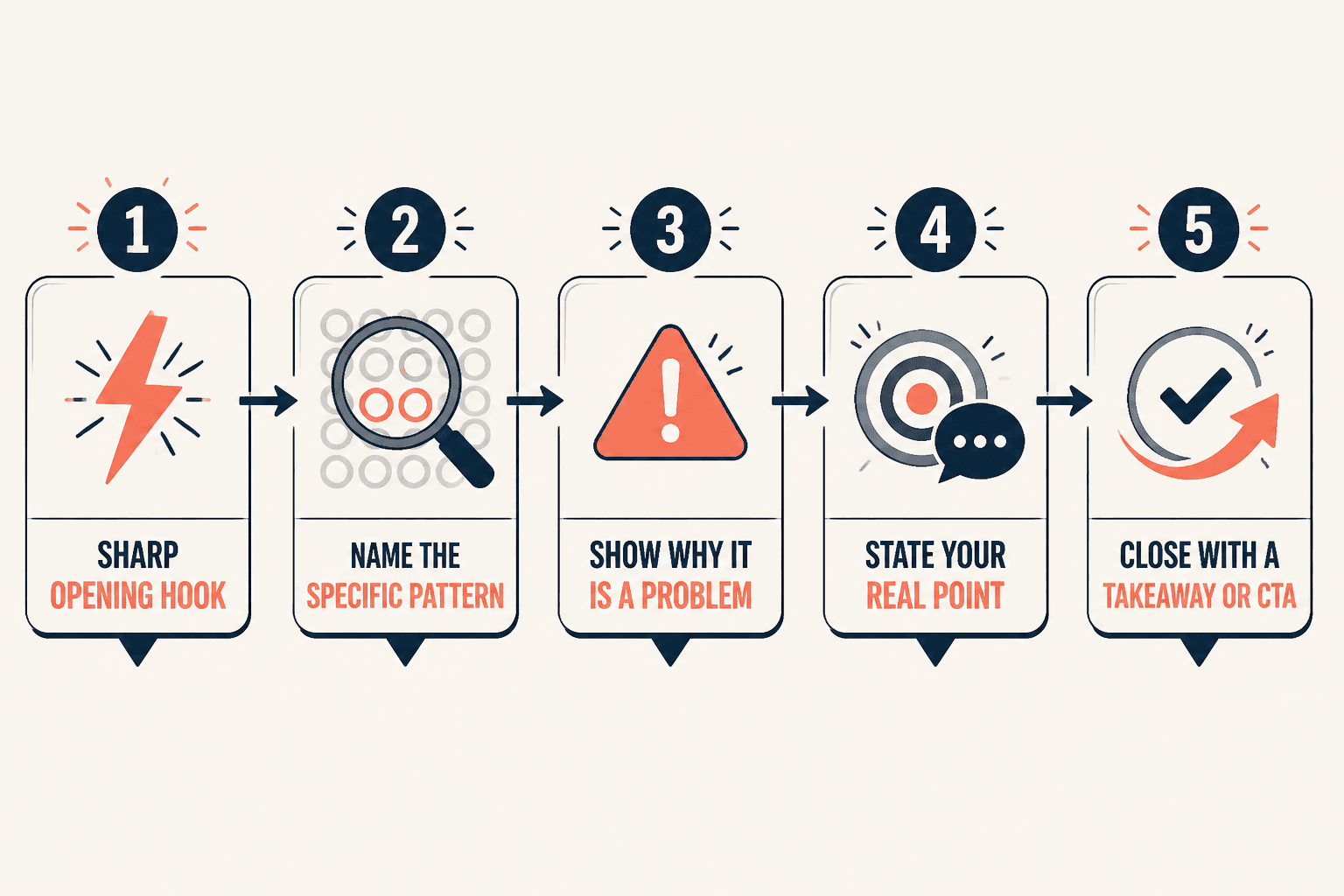
Use this:
- Start with the friction
- Name the specific pattern
- Show why it is a problem
- Add contrast or a sharper truth
- Land with a point, not just a feeling
1. Start with the friction
Do not spend six lines warming up. The first line should carry the tension.
Weak opening:
I have been thinking a lot lately about what is happening in online business.
Better opening:
I am tired of watching people market “authenticity” with copy so rehearsed it sounds focus-grouped by four ghosts and a funnel consultant.
That line has a target. It has texture. It gives the reader a reason to continue.
If your openings are usually too soft, read how to start Facebook long-form and rants without a weak opening. That one fixes a lot of problems upstream.
2. Name the specific pattern
Once the opening creates tension, tell the reader what you are actually pointing at.
This is where many posts drift into abstraction. Do not just say people are “doing it wrong.” Show the pattern.
Example:
It is the same formula every time. Big emotional claim. Fake honesty. A lesson wrapped around a sales pitch. Then a soft CTA pretending not to be a CTA.
Now the rant has shape because the reader can see the behavior being criticized.
3. Show why it is a problem
This is where the rant earns its keep. Do not assume the reader shares your frustration just because you typed it loudly.
Explain why the pattern matters. What does it ruin? What trust does it break? What result does it create? Why should anyone outside your own annoyance care?
For example:
The problem with this style is not that it is cringey. The problem is that it trains people to distrust anything that sounds emotionally open online, including the people who are actually telling the truth.
That is a stronger move than just saying “I hate this trend.” You are giving the frustration a consequence.
4. Add contrast or a sharper truth
This is the part that stops the rant from becoming plain complaining.
Good rants usually pivot. They move from “here is what is broken” to “here is what people are missing.” That contrast gives the post more authority and more staying power.
Example:
You do not need to be more vulnerable on Facebook. You need to be more precise. People do not trust oversharing by default. They trust clarity, honesty, and something that feels like it came from an actual brain.
That is where the post starts becoming useful, not just expressive.
5. Land with a point, not just a feeling
The ending should feel earned. It can be sharp, reflective, challenging, or discussion-friendly. But it should say something definite.
Weak ending:
Anyway, just my thoughts. We all need to do better.
Stronger ending:
If your content only sounds human when it is trying to close a sale, people notice. And they remember.
Short. Clean. Point made.
How to improve Facebook rant structure without sounding generic
Now let us make this practical. If your rants keep sounding interchangeable, these are the fixes that usually matter most.
Use real details, not inflated language
A generic rant lives on abstract words and moral fog. A stronger rant includes details people can picture.
- Name the behavior
- Name the platform habit
- Name the kind of post
- Name the thing people say
- Name the consequence
Instead of saying “people are fake online,” say what they are actually doing.
They write three paragraphs about burnout, then end with a pitch for the system that supposedly helped them escape it by Tuesday.
That is better. It has edges.
Stick to one emotional thread
You can be angry, disappointed, amused, skeptical, or tired. Pick the dominant energy and keep it coherent.
When a post jumps from sarcasm to sincerity to lecture mode to promotion, it starts sounding stitched together. Readers feel that wobble even if they cannot explain it.
This does not mean you have to sound monotone. It means the post should feel emotionally consistent enough that it reads like one person making one case.
Cut the paragraphs that only restate your annoyance
This is where editing matters. Most long-form Facebook posts improve when you remove the middle third that exists purely because the writer was still heated.
Ask this of each paragraph:
- Does this introduce a new layer?
- Does this sharpen the point?
- Does this provide an example or consequence?
- Does this help the ending land better?
If the answer is no, cut it. Your rage does not need a director’s cut.
Earn the strong line
A lot of people want the quotable mic-drop sentence. Fair enough. But those lines work because the post built toward them.
If you open with ten dramatic claims in a row, none of them land. If you build a clear argument and then deliver one sharp sentence, people remember it.
Think less “constant intensity” and more “controlled pressure.”
A before-and-after example
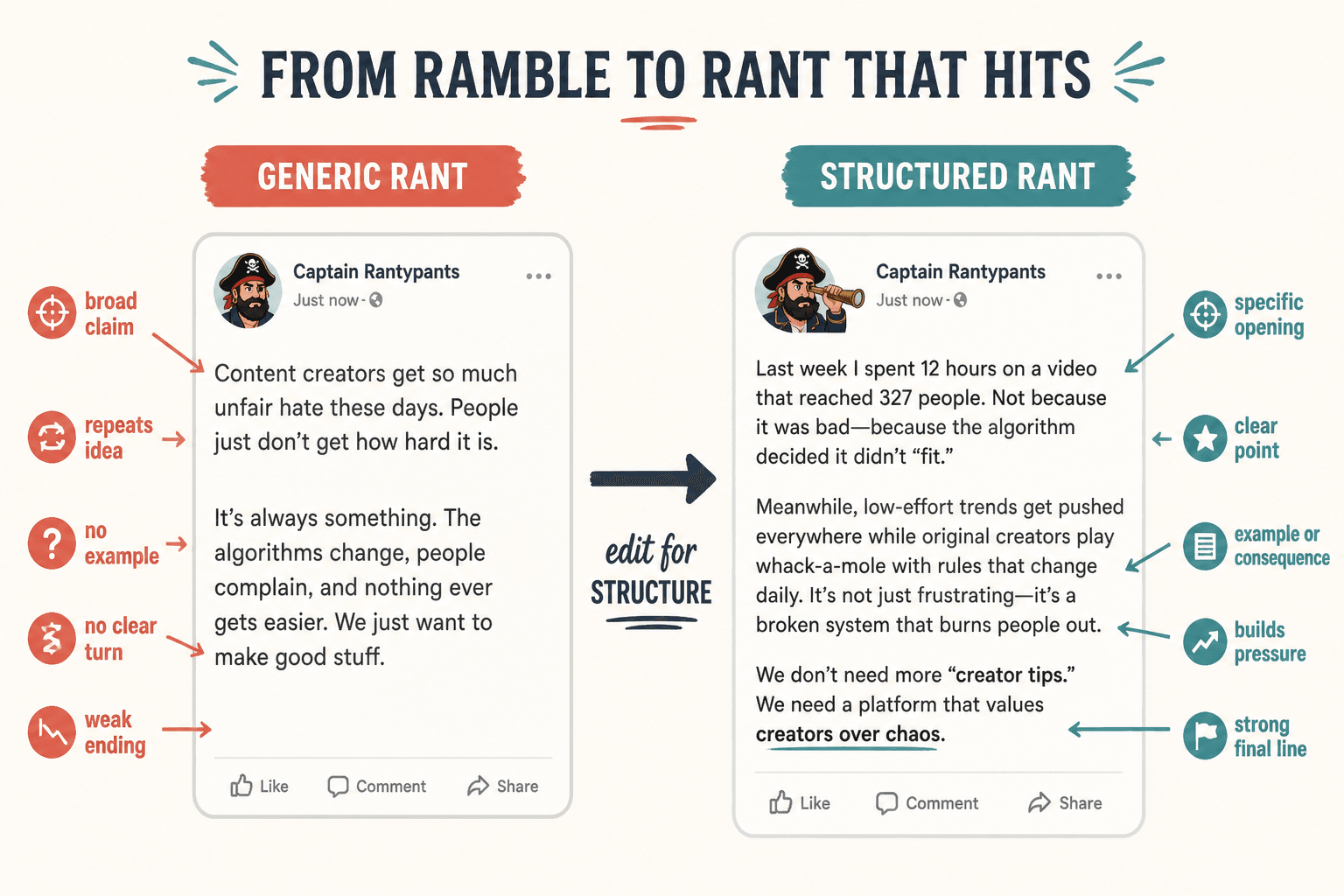
Here is what a generic rant often sounds like:
I am so tired of fake people online. So many people are pretending to care and pretending to be authentic and pretending to help people when really they only care about money. It is exhausting. The online space is full of noise and bad energy and honestly people need to be more real. We need more honesty and less fake marketing. Just saying.
The frustration is clear. The post is not. It uses broad language, says the same thing repeatedly, and gives the reader nothing sticky to grab onto.
Now a tighter version:
I am tired of people using the language of honesty to make obviously rehearsed sales posts feel personal.
It is always the same move.
A confession polished within an inch of its life.
A lesson that somehow proves they are wise.
Then a CTA sliding in with its shoes off so you do not notice it is there.The issue is not that people sell. Sell. Fine.
The issue is pretending the performance is intimacy.That kind of content does not build trust. It teaches readers to doubt anything that sounds emotionally open online.
If your post needs a fake confession to earn attention, the problem is not the algorithm. It is the post.
Same territory. Much stronger structure.
The bigger point is simple: clearer structure and clearer writing make the piece more useful. That is usually what makes the ending land better too.