
Most people do not have a Facebook post length problem. They have a post usefulness problem.
They write a long post when the idea could have fit in three lines. Or they squeeze something nuanced into one punchy sentence and then wonder why nobody cared. That is usually the real issue.
When short Facebook posts beat long ones, it is not because short is magically better. It is because short can feel faster, sharper, more conversational, and a lot easier to respond to. On Facebook especially, that matters. People are not always looking for a polished mini-essay. Often, they are looking for something they can react to, agree with, argue with, or share without needing a snack break first.
So if you keep defaulting to long posts because they feel more substantial, or defaulting to short posts because they feel easier, here is the more useful question: what kind of post gives this idea the best chance of getting read and getting a response?
This article will help you figure that out. We will cover when short Facebook posts work better than long ones, what kinds of ideas fit short form best, what people keep ruining by overexplaining, and how to write short posts that actually do something besides sit there looking efficient.
If you want a broader view of Facebook post strategy first, start with Facebook posts. You can also browse more on social media writing and Facebook writing.
To see how this fits into the wider strategy, open the parent guide.
When short Facebook posts beat long ones
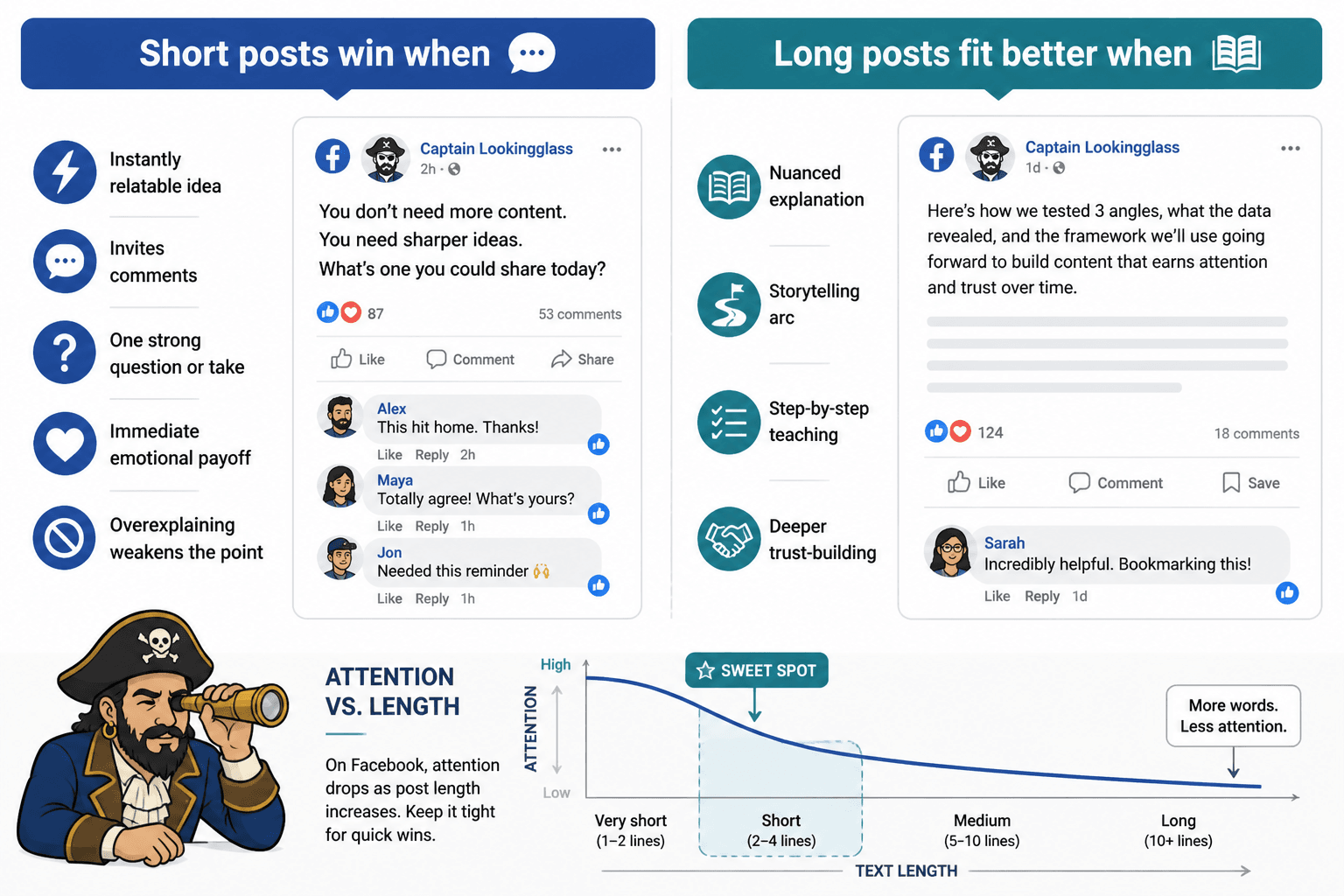
Short Facebook posts usually win when the idea is simple, clear, and emotionally easy to grab.
Not shallow. Simple. There is a difference.
A short post beats a long one when the reader does not need much setup to understand the point. It also wins when the goal is to spark conversation rather than deliver a whole argument. Facebook is still a social platform, not a hostage situation. If people can understand your point quickly and respond quickly, the post often travels better.
- The point is instantly relatable — a frustration, opinion, observation, or small lesson people recognize fast.
- You want comments more than quiet admiration — shorter posts often feel easier to reply to.
- The post works as a strong prompt — one good question or one pointed take can do plenty.
- The emotional payoff is immediate — funny, sharp, honest, surprising, annoying in a useful way.
- The idea loses energy when overexplained — which happens more than people think.
That last one matters. A lot of posts die because the writer keeps talking after the reader already got it. The point lands in line three. The next eleven lines are just it being dragged behind a car.
Why short posts often work so well on Facebook
Facebook is unusually responsive to posts that feel like they belong in a conversation. Not every post needs to sound casual, but it should usually feel readable without ceremony.
Short posts help with that because they lower the effort required to engage. A reader can see the whole thing quickly, decide how they feel, and respond. That friction gap matters more than many creators admit.
They get to the point faster
If your post can be understood at a glance, more people will actually understand it. Revolutionary, apparently.
Short posts remove the warm-up paragraphs. They skip the “here is some context before I say the thing” habit that bloats a lot of content. On Facebook, blunt clarity usually beats careful buildup unless the story itself is the point.
They feel easier to comment on
Long posts can earn thoughtful comments, but they often require more from the reader. A short post feels more open. Less like a speech. More like a door left cracked open for someone to walk through.
If your main goal is discussion, a compact post with one solid opinion can outperform a detailed explanation every time.
They suit repeatable posting better
For creators, coaches, consultants, and personal brands, not every Facebook post needs to be a full event. Short posts let you stay visible, test angles, build familiarity, and keep the conversation moving without turning each post into a Sunday essay assignment.
They preserve punch
Some ideas are stronger before they get overhandled. A good sharp line, a useful observation, a clean takeaway, a pointed contrast — these often lose force when buried in explanation.
Short form keeps the edge intact.
The kinds of Facebook posts that usually work better short
Not every idea belongs in a quick post. But plenty do. Here are the formats that often perform better when you keep them tight.
1. Strong opinions with a clear angle
If you have a clear take, you usually do not need seven paragraphs of throat-clearing before saying it.
Most content does not fail because the creator lacks expertise. It fails because the point arrives wearing three coats and an apology.
That kind of post works because it is clear, arguable, and easy to respond to. Add one line of context if needed. Then stop.
2. Relatable observations
These are the “you have noticed this too, right?” posts. They work best when they are precise and human, not fake-deep.
Example:
The fastest way to make a good idea boring is to explain it like you are trying not to offend anyone who disagrees.
That can spark comments because people instantly recognize the problem.
3. Questions that people can actually answer
Short questions often beat long setup posts because they leave more room for the audience.
Not this:
I have been reflecting recently on how business owners approach productivity, and I would love to hear your thoughts on systems, routines, and the psychological barriers people face around consistency. What do you think?
More like this:
What is one business task you avoid even though it would probably help immediately?
One is a prompt. The other is admin.
4. Small lessons
A useful takeaway does not always need a full story attached.
For example:
If people keep misunderstanding your offer, the problem is probably not their attention span. It is your wording.
That is enough for a short post, especially if you add one practical follow-up sentence.
5. Pattern interrupts
Short posts are great when you want to break someone’s autopilot with a clean contradiction.
Example:
You do not need more content ideas. You need fewer vague ones.
That kind of line makes people pause because it challenges a default assumption without needing a TED Talk attached.
When long Facebook posts still beat short ones
Short is not the winner by default. Long posts still make more sense when the reader needs movement, context, emotional build, or proof.
If your post depends on a story arc, a layered argument, a vulnerable moment with actual substance, or a nuanced explanation, trying to force it into a tiny format can make it feel flat or smug. Some ideas need room to breathe. Others just want attention and pretend to need room. Again, different problem.
- Use longer posts for stories when the sequence matters.
- Use longer posts for rants when the argument needs buildup, examples, and payoff.
- Use longer posts for deeper teaching when people need steps or nuance to apply the idea well.
- Use longer posts for proof when a claim needs examples, context, or credibility support.
If you want more help thinking about ideal length in general, read How Long Should Facebook Posts Be in 2026.
How to tell if your Facebook post should be short or long
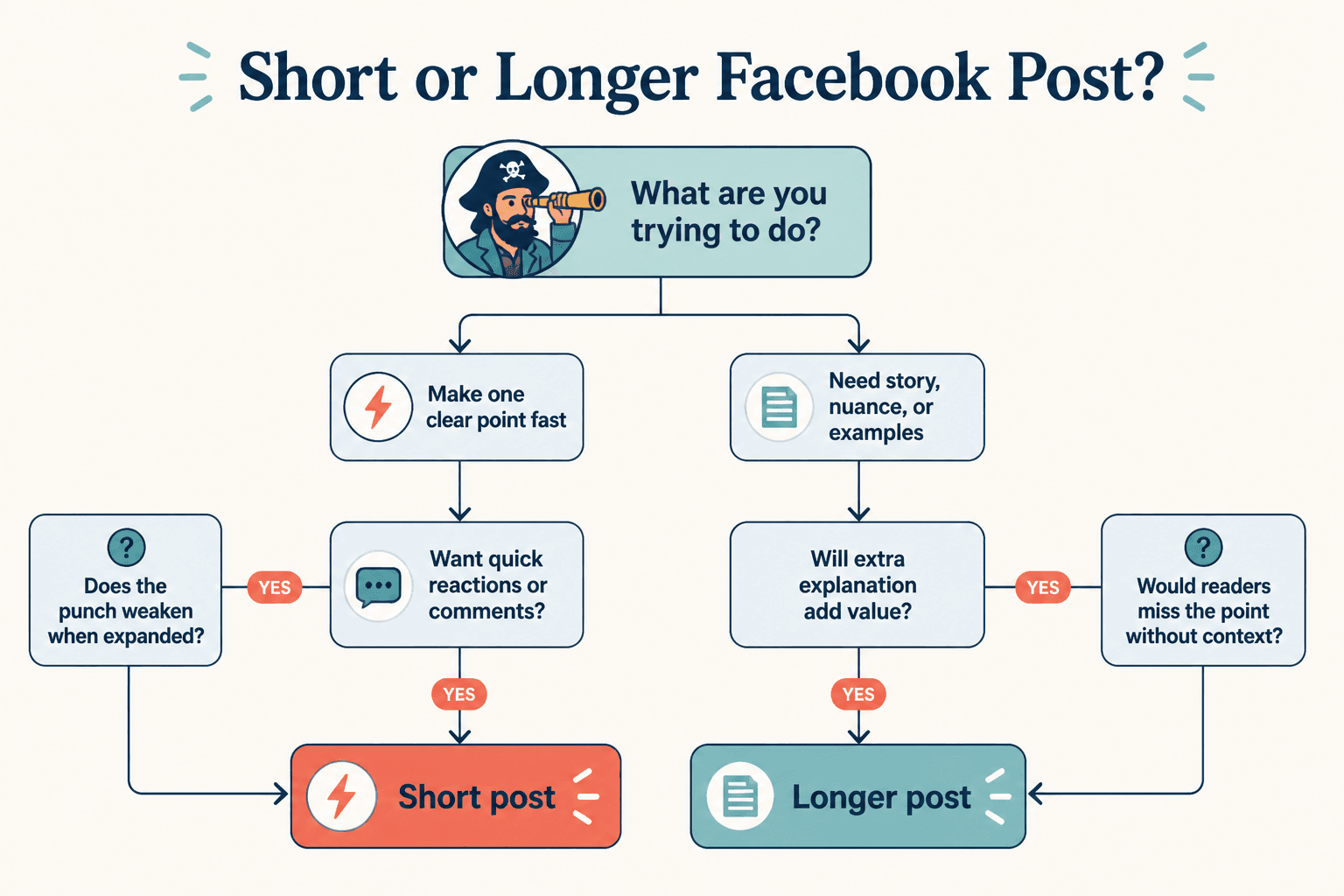
Here is the simplest test: if you cut the post in half, does it get clearer or worse?
If it gets clearer, it probably wanted to be short.
If it gets confusing, emotionally empty, or weirdly abrupt, it probably needs more space.
Use this quick filter before posting:
| Question | If yes | Better fit |
|---|---|---|
| Can the point be understood in one glance? | The main idea lands fast | Short post |
| Do you want quick reactions or comments? | Conversation matters more than depth | Short post |
| Does the post rely on story, nuance, or examples? | Readers need context to care | Longer post |
| Would extra explanation strengthen the point? | The details add value, not fog | Longer post |
| Does the punch weaken when expanded? | The best part is the sharpness | Short post |
What people get wrong about short Facebook posts
Short does not mean lazy. Short does not mean vague. Short definitely does not mean posting a hollow sentence and hoping people mistake it for wisdom.
A lot of weak short posts fail for very predictable reasons.
They are too abstract
“Consistency matters.”
Thanks, fridge magnet.
If a short post is going to work, it needs a real angle. Something specific enough to mean something. Short posts have less room, so every word has to pull harder.
They sound manufactured
Facebook is not kind to stiff, over-polished “thought leadership” voice. If the post sounds like it came from a content machine trained on conference lanyards, people will scroll.
Short posts need voice. Not a clown costume. Just a human tone.
They have no tension
A good short post usually includes one of these:
- contrast
- surprise
- specificity
- emotion
- clarity
- a real opinion
Without that, it is just a sentence floating in public.
They end with needy engagement bait
If the post is short and the last line is “Thoughts?” after saying almost nothing, do not expect miracles.
A better close gives people something specific to react to, even if it is subtle.
Bad:
Being authentic matters. Thoughts?
Better:
Most “authentic” content is still heavily edited to sound effortlessly honest. That is part of why audiences can smell the performance.
The second one does not beg. It gives people something to push against.
A simple formula for writing short Facebook posts that work
You do not need a precious framework for every post, but this one is useful when you are overcomplicating things.
The bigger point is simple: clearer structure and clearer writing make the piece more useful. That is usually what makes the ending land better too.