If you are still asking for one perfect answer to How Long Should Facebook Posts Be in 2026?, here it is: there is no magic character count, and anyone promising one is either oversimplifying or selling tidy nonsense.
Facebook posts do not perform better just because they are short. They also do not become “high value” just because they are long. Length is not the strategy. The job of the post is the strategy. Length just needs to match it.
That is the part people keep botching. They write 40 words when the idea needs context. Or they write 700 words to say something that should have been one sharp sentence and a decent photo. Then they blame reach, the algorithm, their audience, Mercury, whatever helps avoid admitting the post was badly built.
Here is the useful version: in 2026, the best Facebook post length depends on what kind of response you want, how strong the opening is, and whether the post actually gives people a reason to keep reading. If you want comments, story posts and opinion posts often need more room. If you want quick engagement or shareable clarity, shorter can work beautifully. If you want trust, the post needs enough substance to sound like a person with a brain, not a fortune cookie in a blazer.
This article will help you choose the right Facebook post length for the post you are trying to write, not the imaginary post some generic social media blog thinks you should be writing. We will cover what short, medium, and long Facebook posts are good for, when each one falls apart, and how to tell if your post needs trimming or more depth.
For the main guide behind this topic, visit the parent guide.
How long should Facebook posts be in 2026? The practical answer
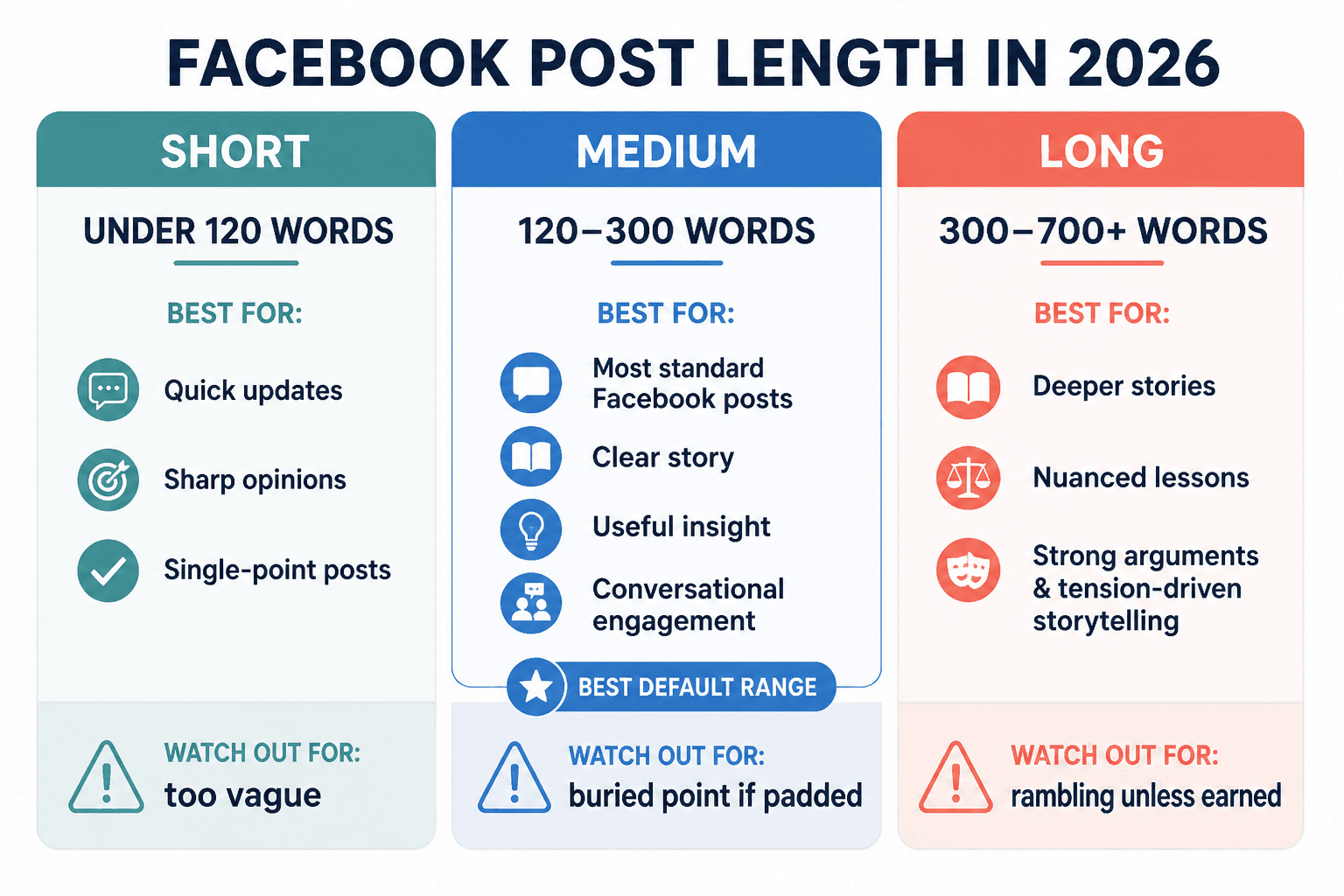
A practical range for Facebook posts in 2026 looks like this:
| Post length | Best use | Risk |
|---|---|---|
| 1–40 words | Quick observation, punchy opinion, simple question, image-led post | Too vague, forgettable, looks lazy |
| 40–120 words | Short conversational posts, concise story setup, easy comment prompts | Can feel undercooked |
| 120–300 words | Most useful range for thoughtful Facebook posts | Can get flabby if the point is weak |
| 300–700 words | Story posts, deeper opinions, mini-rants, nuanced lessons | Rambling, weak pacing, buried point |
| 700+ words | Strong long-form posts with real tension, storytelling, or sharp argument | Most people do not earn this length |
If you want one default recommendation, aim for 120 to 300 words for most Facebook posts. That range gives you enough space to say something real without forcing people to read your memoir before breakfast.
That said, some of the best Facebook posts are much shorter than that, and some of the most memorable are much longer. The difference is not size. It is structure, pace, and whether the post has an actual point.
Why post length matters less than post-job fit
Most Facebook post advice gets weirdly obsessed with character counts, as if readers are out there measuring your copy with a ruler. They are not. They are making a much faster decision:
- Does this look worth my attention?
- Can I understand where this is going?
- Do I care enough to keep reading, react, or comment?
If the answer is yes, people will read longer posts. If the answer is no, they will ignore even your elegant little 23-word masterpiece.
On Facebook especially, people respond well to posts that feel human, conversational, and worth replying to. That means the best length is often the one that gives your idea enough room to breathe without turning into a hostage situation.
Best Facebook post lengths by goal
For quick engagement: keep it short and easy to react to
If your goal is quick likes, simple comments, or lightweight interaction, shorter usually works better. Think:
- A clear opinion
- A relatable observation
- A fast question people can answer without effort
- A strong caption under an image or graphic
Good range: 20 to 100 words.
Example:
The fastest way to make your Facebook posts worse is to write them like you are submitting a school assignment instead of starting a conversation.
That works because it lands quickly. It has a point. It invites agreement, disagreement, and follow-up.
What does not work is writing something short that says almost nothing.
Be yourself. The right people will find you.
That is not concise. That is just empty.
For trust-building: use medium-length posts with some substance
If you are a coach, consultant, freelancer, creator, or founder trying to build trust, medium-length Facebook posts are usually your best bet.
This is where you can explain an idea, challenge a common mistake, or share a useful lesson without sounding like you copied and pasted your LinkedIn leftovers onto Facebook. You have enough room for personality, nuance, and one good example.
Good range: 120 to 300 words.
This range works well because it feels substantial without asking too much from the reader. It is often the sweet spot for posts that build credibility and get decent comments.
If your content tends to be all punchlines and no depth, this is probably the length band that will improve your results fastest.
For stories, strong opinions, and rants: go longer, but earn it
Long Facebook posts can work extremely well when they have tension, pacing, and payoff. This is especially true for:
- Story posts with a clear lesson or emotional shift
- Opinion posts with a strong argument
- Mini-rants that build toward a point
- Posts unpacking a mistake people keep making
Good range: 300 to 700 words, sometimes longer.
But here is the catch: most long posts are bad because the writer is still “getting into it” halfway through paragraph four. The point should not arrive wearing hiking boots.
A good long Facebook post still needs a strong opening, momentum, and a clean ending. It should feel like a guided thought, not a transcription of your internal monologue.
What short Facebook posts do well
Short Facebook posts are underrated when the idea is sharp. They work best when the post is built around one of these:
- A clean opinion with bite
- A relatable micro-moment
- A simple question that people actually want to answer
- A caption supporting a visual
- A quick insight with immediate relevance
Short works when the compression adds power. It fails when the compression removes meaning.
If you want more on that, when short Facebook posts beat long ones is worth reading next.
What long Facebook posts do well
Longer posts usually perform best when they give the reader a reason to stay. That reason might be:
- Story tension
- A controversial or contrarian opinion
- A layered explanation
- Specific examples
- Emotional honesty that does not feel staged
Facebook is still one of the better platforms for conversational long-form posting because people are often in a more discussion-friendly mindset there than on faster, more compressed platforms. But “discussion-friendly” is not the same thing as “please post 1,400 meandering words about your personal growth arc and then ask what everyone thinks.”
Long posts need shape. Usually that means:
- A strong first line
- A clear setup
- Some tension, contrast, or curiosity
- A point that arrives before the reader gets bored
- An ending that invites reaction without begging for it
How to tell if your Facebook post is too short
Your Facebook post is probably too short if:
- The reader cannot tell what you actually mean
- The post sounds clever but not useful
- You make a claim without support
- The question at the end feels disconnected from the rest
- The post gets passive likes but almost no meaningful comments
A lot of creators assume short means better because it is easier to skim. True enough. But if the post has no texture, no specificity, and no real thought, easy to skim just becomes easy to ignore.
How to tell if your Facebook post is too long
Your post is probably too long if:
- The main point could have been said in half the space
- Your strongest line is buried deep in the post
- You repeat the same idea in slightly different words
- The story has detail but no tension
- The ending feels like it wandered in from another draft
This is common with educational posts. People mistake more words for more value. They explain every angle, every caveat, every sub-point, and every side alley until the post collapses under its own good intentions.
Useful content is not the same as exhaustive content. Often, one sharp lesson with one concrete example beats a sprawling post trying to prove how much you know.
A simple way to choose the right Facebook post length
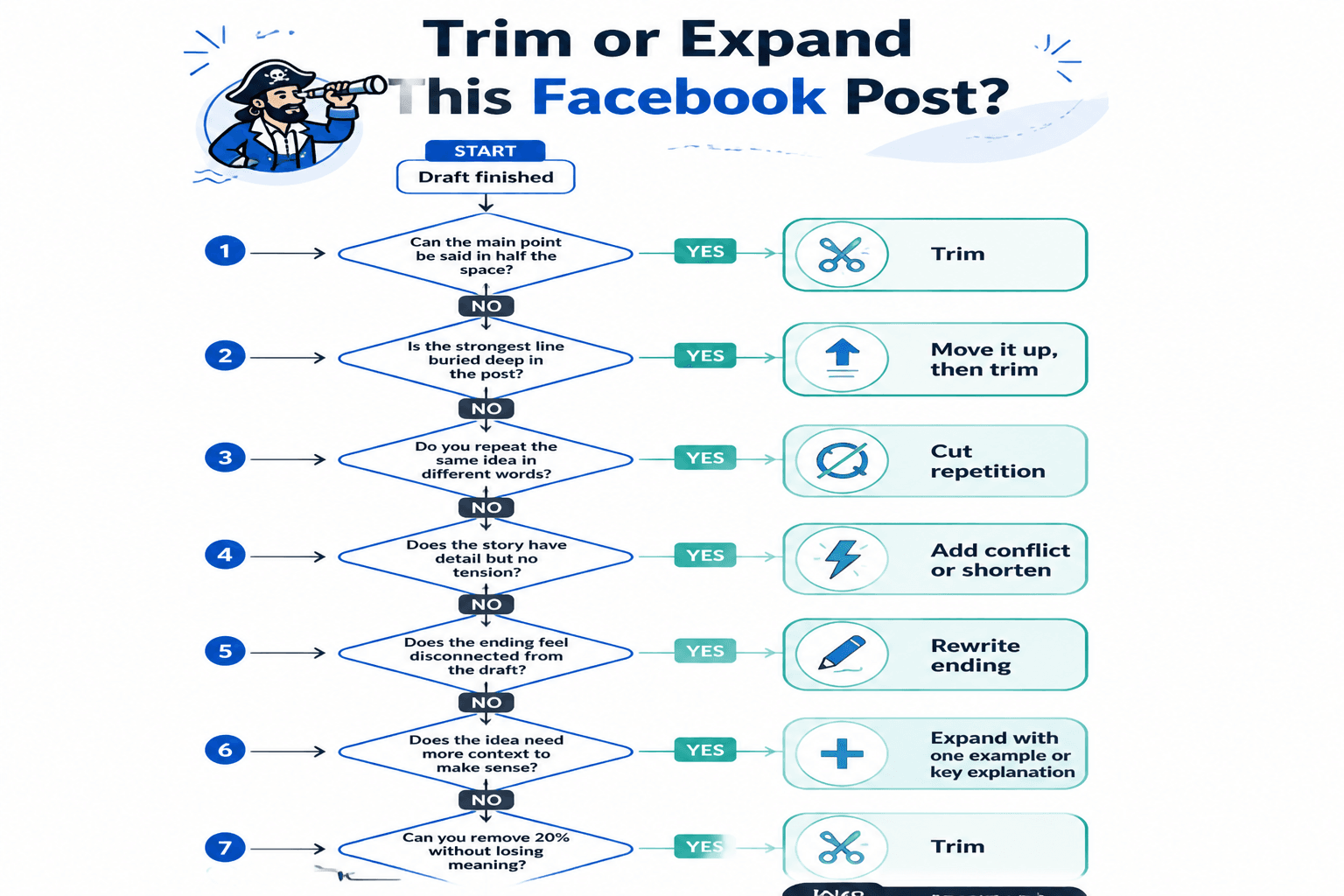
Before writing, ask these four questions:
- What is the job of this post?
Reach, comments, trust, leads, or authority? - Does the idea need context to make sense?
If yes, do not force it into a tiny post. - Is the opening strong enough to support a longer read?
If not, fix the opening before adding more words. - Can I remove 20 percent without losing meaning?
If yes, you probably should.
This is a much better system than trying to memorize some universal rule about character counts.
Recommended Facebook post length by post type
| Post type | Recommended length | What matters most |
|---|---|---|
| Opinion post | 50–200 words | Clarity, angle, strong first line |
| Question post | 15–80 words | Easy response, real relevance |
| Story post | 250–700 words | Tension, pacing, payoff |
| Educational tip post | 120–300 words | Specific lesson, example, usefulness |
| Mini-rant | 180–500 words | Control, argument flow, conclusion |
| Visual caption | 10–100 words | Supports image, does not duplicate it |
| Soft promo post | 80–250 words | Trust, relevance, non-pushy CTA |
The opening often matters more than the length
A weak opening makes any Facebook post feel too long.
That is worth repeating because it explains a lot of performance problems people blame on length. If the first line is generic, slow, or self-important, readers will bounce before they ever get to your good part. Then you assume long posts do not work. No, your setup did not work.
For example:
I have been reflecting lately on some important lessons in business and life.
That opening has all the energy of a waiting room.
Most business advice on Facebook is not too simple. It is too vague to use.
That is better. It creates tension immediately.
If your openings need work, read how to start Facebook posts without a weak opening. It will probably do more for your results than obsessing over another 50 characters.
How creators, coaches, and consultants should think about Facebook post length
If you use Facebook for business, personal branding, community building, or lead generation, your post length should support trust and conversation.
That usually means writing posts that are long enough to sound like you know what you are talking about, but short enough that people still want to respond. For most professionals, that lands in the medium range more often than not.
The bigger point is simple: clearer structure and clearer writing make the piece more useful. That is usually what makes the ending land better too.