
Most creators do not need more email tools. They need fewer moving parts, less duct-tape nonsense, and a setup they will actually keep using after the first burst of productivity wears off.
That is the real problem behind choosing the best email automation tools and CRM tools for creator email sequences. People shop for software like they are building a miniature Silicon Valley stack, then end up with a newsletter, a half-built welcome sequence, a neglected tag system, and a CRM that feels like an expensive digital attic.
If you are a creator, coach, consultant, solo founder, or personal brand, you probably do not need the most powerful tool on earth. You need the right level of automation, enough CRM structure to track real relationships, and a workflow that helps you send better sequences without turning your business into admin cosplay.
This guide will help you choose the best email automation tools and CRM tools for creator email sequences based on what actually matters: automation depth, ease of writing and sending sequences, tagging and segmentation, lead tracking, simplicity, and how much mess the tool adds to your week.
If you are still shaping your sequence strategy, it will also help to read creator email sequences and this broader creator email sequences guide for creators who want better results. Tools matter. The sequence itself still matters more.
For the full path around this topic, head to the parent guide.
What creators actually need from email automation and CRM tools
Before naming tools, let us save you from a very common mistake: buying based on feature quantity.
More features do not automatically mean a better creator email system. Sometimes they just mean a busier dashboard and a stronger urge to procrastinate by “organizing” instead of writing.
For most creators, a good email automation tool should handle five things well:
- Easy sequence building
- Simple segmentation through tags, groups, or custom fields
- Reliable automations for welcome, nurture, launch, and follow-up emails
- Clean signup form and landing page options, if needed
- Useful analytics without drowning you in fake sophistication
A good CRM layer should help you track people who matter, not every human who ever downloaded a free checklist at 2:14 a.m.
That means things like:
- Contact history
- Notes for leads or clients
- Pipeline stages if you sell services or calls
- Audience segmentation based on behavior or interest
- A way to connect email activity with actual business outcomes
If your business is mostly newsletter-driven, you might want an email-first platform with light CRM features. If you run a consulting, coaching, or service business with discovery calls, proposals, and client follow-up, you may want a stronger CRM with decent email automation attached.
That is the fork in the road. Ignore it, and you end up with a tool that is technically impressive and practically annoying.
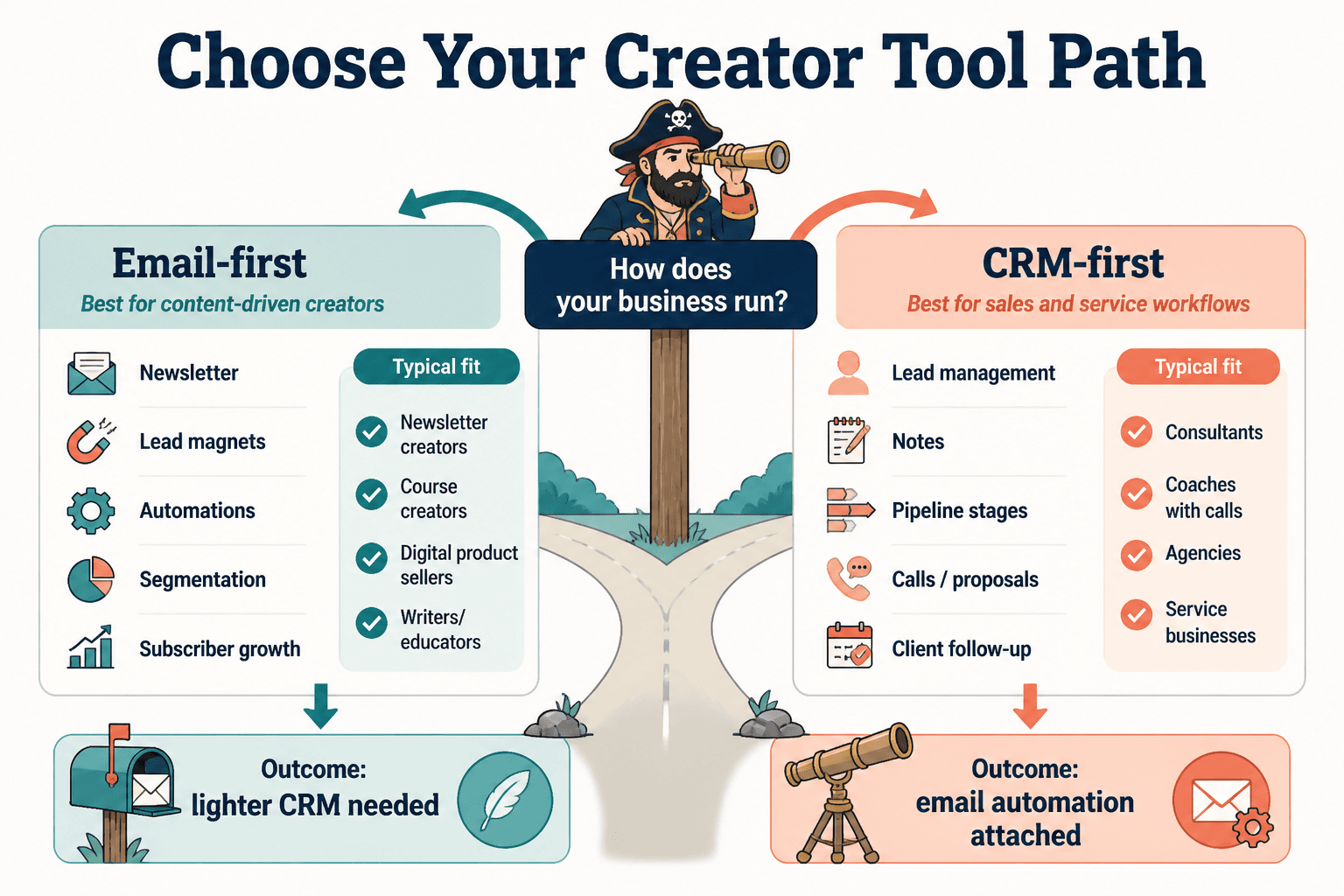
The two main tool paths: email-first or CRM-first
Email-first tools
These are best when your business revolves around content, newsletters, lead magnets, launches, and automated sequences. You care most about writing, segmentation, automations, and subscriber growth.
Typical fit:
- Newsletter creators
- Personal brands
- Course creators
- Digital product sellers
- Writers and educators
- Coaches with fairly simple pipelines
CRM-first tools
These are better when your business depends on lead management, sales conversations, booked calls, deal stages, and longer relationship cycles. Email sequences still matter, but they support a stronger sales process.
Typical fit:
- Consultants
- Service providers
- Agencies
- Coaches with sales calls and pipeline management
- B2B founders with higher-ticket offers
Some tools try to do both. A few do it pretty well. Many do it in the way a hotel room iron can technically make grilled cheese. Possible, yes. Ideal, no.
Best email automation tools for creator email sequences
Here are the strongest email-first options for creators, with a practical take on who each one fits best.
ConvertKit
ConvertKit remains one of the most natural fits for creators because it was built around audience growth, sequences, forms, tagging, and selling simple offers without making everything feel overengineered.
Best for: creators, coaches, educators, and personal brands who want solid automation without needing enterprise-grade complexity.
What it does well:
- Visual automation builder that is not a nightmare to use
- Easy-to-manage email sequences
- Strong tagging and segmentation
- Creator-friendly landing pages and forms
- Commerce features for simple digital sales
Where it falls short:
- Not a deep sales CRM
- Can feel limiting if you need serious pipeline management
- Advanced businesses may outgrow parts of it
If your main job is building trust through content and moving subscribers through welcome, nurture, launch, and follow-up sequences, ConvertKit is often the obvious answer. Not glamorous. Just useful.
MailerLite
MailerLite is the classic “surprisingly solid for the price” option. It works well for creators who want email automation without paying for a giant stack before they have the list or revenue to justify it.
Best for: budget-conscious creators, freelancers, small education brands, and newer businesses setting up straightforward sequences.
What it does well:
- Affordable pricing
- Easy automation setup
- Clean interface
- Landing pages, forms, and basic website tools
- Enough segmentation for many creator businesses
Where it falls short:
- Less sophisticated than heavier platforms
- Not ideal for advanced sales process management
- Some creators may eventually want deeper behavioral logic
MailerLite is especially good when your biggest risk is not missing a feature. It is quitting because the system got too fiddly.
ActiveCampaign
ActiveCampaign is what happens when email automation gets serious. It gives you more power, deeper segmentation, stronger automations, and CRM features that start crossing into real sales-system territory.
Best for: advanced creators, coaches with multiple funnels, consultants, and businesses that want stronger behavior-based automation.
What it does well:
- Advanced automation logic
- Strong tagging, lead scoring, and segmentation
- Built-in CRM capabilities
- Flexible sequences for more complex customer journeys
- Good fit for combining content marketing and sales follow-up
Where it falls short:
- More setup friction
- Easier to overbuild automations you do not need
- Can become expensive as your list grows
This is a great tool when complexity is earned. It is a lousy choice when complexity is just you playing business architect instead of writing emails.
Beehiiv
Beehiiv is more newsletter-media leaning than classic CRM-email hybrid software, but it deserves mention because many creators now build around newsletter growth first and sales second.
Best for: newsletter-first creators, media-style brands, and operators focused on audience growth and monetized newsletters.
What it does well:
- Newsletter publishing and growth features
- Clean writing environment
- Referral and growth mechanics
- Useful for creators building publication-style businesses
Where it falls short:
- Not a true CRM
- Less ideal if your business relies on service sales and pipeline tracking
- Automation may not be the main reason to choose it
If your creator business runs more like a publication, Beehiiv makes sense. If you need serious lead handling, not so much.
Kit alternatives worth considering
A few other tools can make sense depending on your model:
- Flodesk for design-forward brands that want simplicity more than automation depth
- Drip for ecommerce-leaning creators with stronger behavior-based sequence needs
- GetResponse for all-in-one marketers who want webinars and more built-in options
These can work. They are just less universally clean a fit for most content-led creator businesses.
Best CRM tools for creator email sequences
If you sell through conversations, calls, proposals, partnerships, or longer client journeys, your CRM matters a lot more than people in “just post content” circles like to admit.
A creator with a service offer, mastermind, consulting package, or high-ticket coaching sale often needs to know more than who opened Email 3. They need to know who booked, who replied, who went cold, who is qualified, and who needs a human follow-up instead of another “just bumping this up” automation embarrassment.
HubSpot
HubSpot is one of the best-known CRM systems for a reason. It is robust, fairly flexible, and can support email marketing, contact records, deal pipelines, forms, automation, and reporting in one ecosystem.
Best for: consultants, agencies, service providers, and founders who need a real CRM with marketing automation support.
What it does well:
- Strong contact and company records
- Pipeline tracking
- Forms, automation, and email support
- Good sales and marketing alignment
- Scales with a more mature business
Where it falls short:
- Can get expensive fast
- Feature sprawl is real
- Often more tool than a solo creator actually needs
HubSpot is smart if you have a real sales process. It is overkill if you mostly need a welcome sequence and a lead magnet.
ActiveCampaign as a hybrid choice
ActiveCampaign shows up again here because it sits in the middle unusually well. It is not the deepest CRM, but it is often enough CRM for creators and service businesses that want one system instead of several stitched together with hope.
Best for: creators and consultants who want automation-first marketing plus moderate CRM capabilities.
If your pipeline is simple to moderate, and your email strategy matters just as much as your deal tracking, this is often a better fit than going fully HubSpot.
Pipedrive
Pipedrive is a sales CRM first. That can be very useful if your creator business runs on leads, calls, follow-ups, and proposals. It is less useful if your whole business is newsletter-driven education and product sales.
Best for: consultants, B2B creators, service founders, and coaches with an active sales pipeline.
What it does well:
- Clear pipeline management
- Lead and deal tracking
- Sales activity visibility
- Useful for creator businesses with human follow-up at the center
Where it falls short:
- Not the strongest native email automation platform for content-led sequence strategy
- May require integrations or companion tools
- Less appealing for newsletter-centric creators
Close
Close is built for sales teams and follow-up-heavy businesses. For some creators, especially those selling premium services or B2B offers, it can be a strong fit.
Best for: consultants, service sellers, and outbound-friendly businesses that need speed in lead handling.
What it does well:
- Focused sales CRM experience
- Good communication tracking
- Fast lead handling
- Built for action rather than endless configuration
Where it falls short:
- Not ideal as a creator-first newsletter platform
- Can feel sales-heavy for content businesses
- You may still want a stronger standalone email tool
Best Email Automation Tools and CRM Tools for Creator Email Sequences by use case
| Use case | Best fit | Why |
|---|---|---|
| Newsletter-first creator | ConvertKit or Beehiiv | Good for growth, publishing, and straightforward sequences |
| Budget-conscious creator | MailerLite | Simple automation without painful pricing |
| Advanced creator funnels | ActiveCampaign | Stronger segmentation and behavioral automation |
| Consultant with lead pipeline | HubSpot or Pipedrive | Better contact and deal management |
| Coach selling calls and programs | ActiveCampaign or HubSpot | Useful mix of automation and lead tracking |
| B2B creator with service sales | Pipedrive, Close, or HubSpot | CRM matters as much as email |
That table is the simple version. The more honest version is this: your best tool depends less on your niche and more on how your business actually converts.
If people mostly join your list, read your ideas, and buy from emails, choose an email-first platform. If people book calls, move through sales stages, and need personal follow-up, choose a CRM-first or hybrid system.
Revolutionary, I know. But this is where people still get weirdly confused.
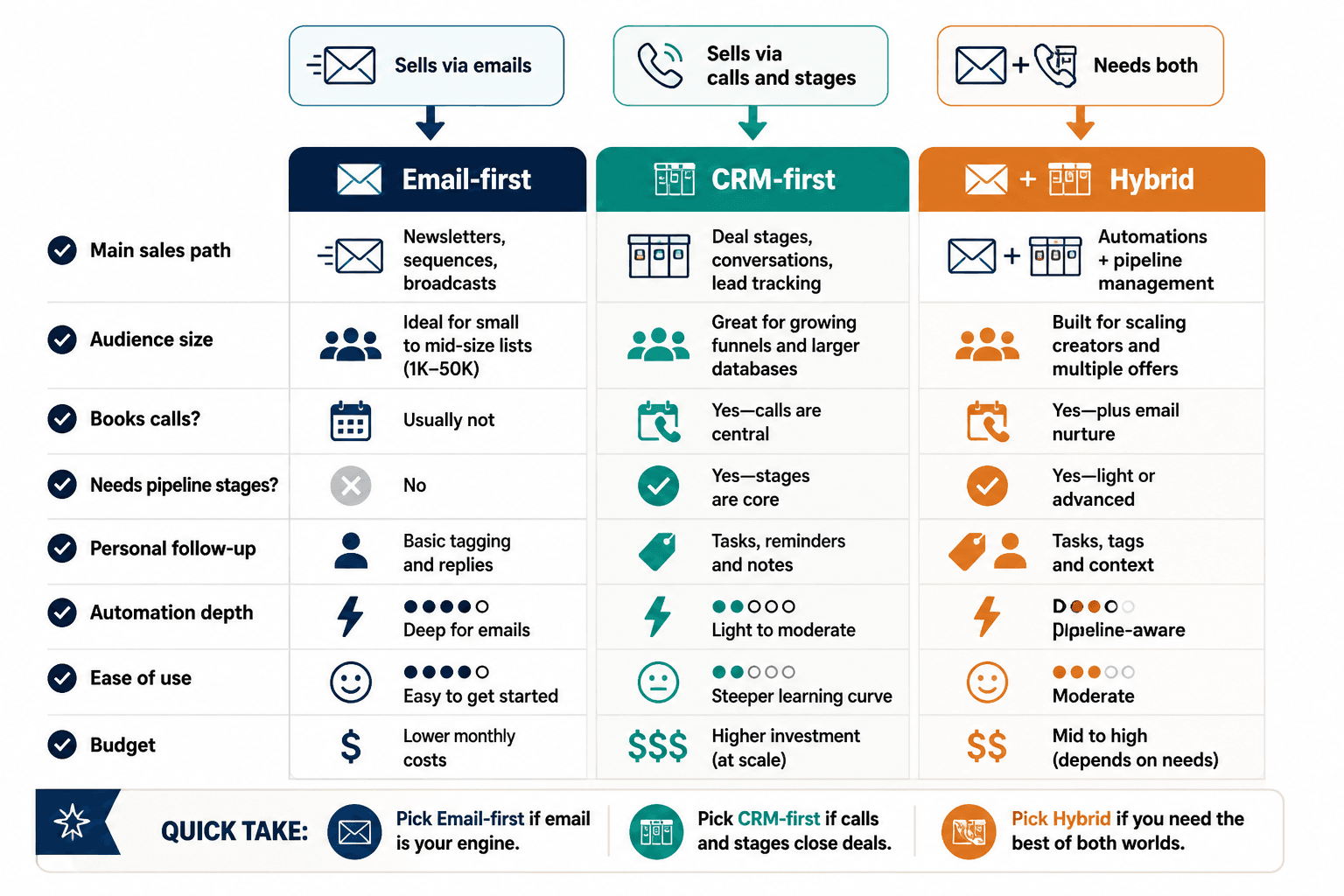
How to choose the right tool without wasting a week “researching”
Here is a cleaner way to decide.
1. Start with your sales model
Ask: do I sell mostly through content and email, or through conversations and pipeline management?
If it is content and email, go email-first. If it is conversation and pipeline, go CRM-first or hybrid.
2. Map your core sequences first
You do not need a perfect automation empire. You need the few sequences that actually support your business.
- Welcome sequence
- Lead magnet follow-up
- Nurture sequence
- Launch or offer sequence
- Inquiry or booking follow-up
- Re-engagement sequence
If the tool makes these hard to build, it is not the right tool for you, no matter how pretty the website is.
3. Decide how much segmentation you will realistically use
A lot of creators buy for the fantasy version of themselves. The version with twelve audience segments, dynamic branches, lead scores, content intent mapping, and a color-coded automation mural.
Meanwhile, actual-you has one newsletter, one freebie, one offer, and a slight headache.
Be honest. If basic tags and a few sequence paths are enough, choose simpler software.
4. Check the writing experience
This gets skipped constantly. If the editor is annoying, clunky, or weirdly technical, you will write less often and hate your setup faster.
The tool should make it easy to draft, revise, preview, and organize sequences. Because, awkward truth, the emails still have to be good.
5. Make sure the CRM layer matches your actual follow-up process
If you take calls, close clients, manage leads, or track partnerships, your system should support:
- Contact notes
- Pipeline stages
- Task reminders
- Email activity visibility
- Simple handoff from automation to personal follow-up
That handoff matters. The best creator email system is not just “automated.” It knows when to stop acting like a robot and let a person step in.
What tools can help with, and what they absolutely cannot fix
Good tools can help you:
- Build sequences faster
- Segment your audience better
- Follow up consistently
- Track leads and subscriber behavior
- Repurpose successful sequence structures
- Reduce admin chaos
They cannot:
- Fix a boring offer
- Make weak positioning compelling
- Invent trust where none exists
- Write emails with actual taste unless you guide them well
- Save a sequence that has no strategy behind it
The bigger point is simple: clearer structure and clearer writing make the piece more useful. That is usually what makes the ending land better too.